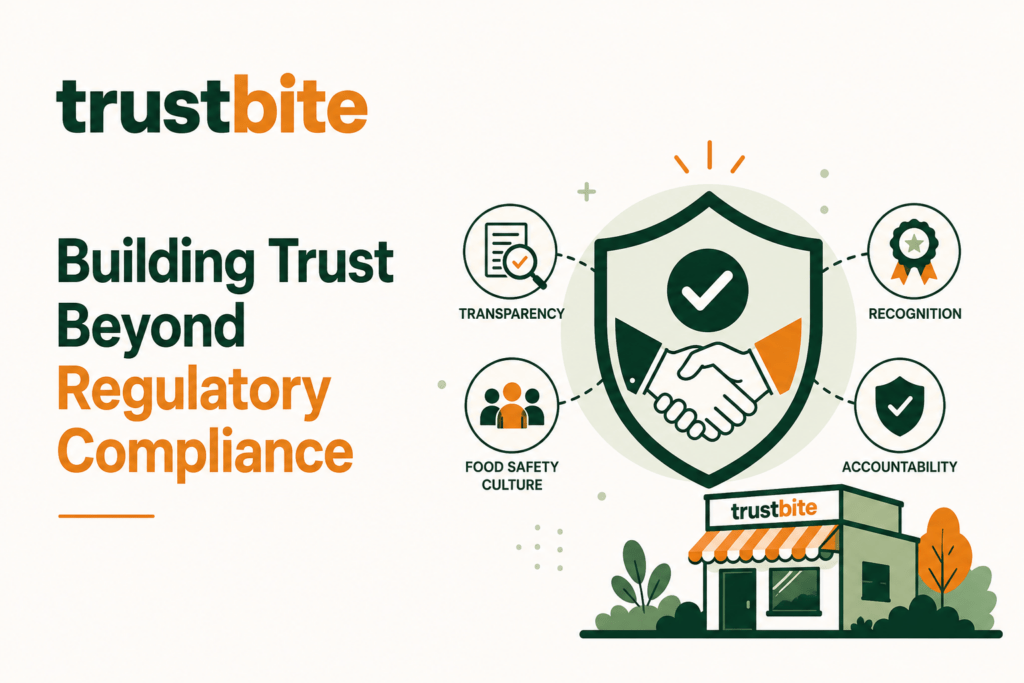
Regulatory compliance is the foundation of food safety. Without it, businesses cannot operate responsibly, protect consumers, or meet their legal obligations. Yet in today’s food industry, compliance alone is rarely enough to create lasting public confidence.
Consumers, business partners, regulators, and communities increasingly expect food businesses to demonstrate visible responsibility, transparency, and commitment to food safety beyond the minimum requirements established by law. They want reassurance that food safety is not simply a regulatory obligation but a core business value embedded into everyday operations.
Building trust beyond regulatory compliance means making responsible food safety practices visible, understandable, and credible. It means creating confidence not only through internal controls but also through transparency, communication, training, accountability, and a strong food safety culture.
As an independent food safety recognition authority, TrustBite promotes a modern approach to food safety trust, one that helps responsible businesses communicate their commitment clearly while strengthening public confidence in the food system. This article is based on the publication brief provided by the user.
Why Regulatory Compliance Is the Starting Point
Food laws, regulations, inspections, and official requirements exist for a reason: they protect public health and establish minimum expectations for safe food production, preparation, distribution, and service.
Regulatory compliance in food safety typically includes requirements related to:
- Hygiene and sanitation
- Food handling practices
- Traceability
- Labeling
- Allergen management
- Temperature control
- Hazard prevention
- Consumer protection measures
- Record keeping and documentation
These requirements provide a baseline framework that helps reduce food safety risks and creates consistency across the food sector.
Compliance is therefore non-negotiable. Every responsible food business must meet applicable legal obligations and maintain systems that support safe operations.
However, high-performing businesses often view compliance differently. Rather than treating regulations as the finish line, they treat them as the foundation upon which stronger food safety systems and stronger public trust can be built.
Compliance establishes legitimacy. Trust requires something more.
Why Compliance Alone Does Not Always Build Public Trust
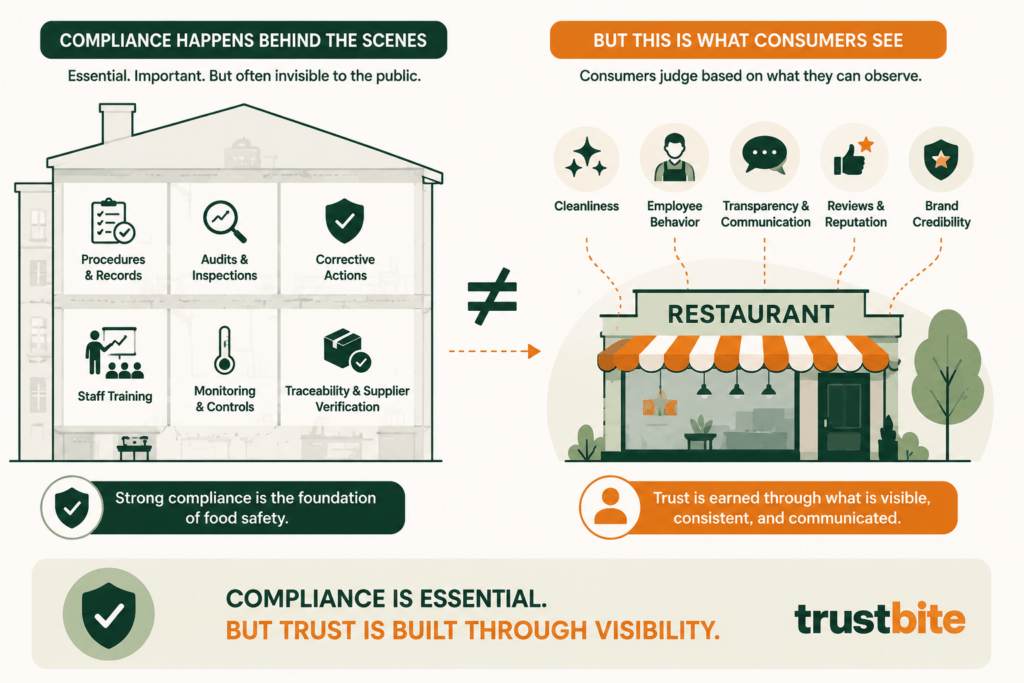
Many food safety activities occur behind the scenes. Consumers rarely witness the procedures, records, audits, corrective actions, staff training sessions, or monitoring activities that support food safety compliance.
As a result, compliance can be largely invisible to the public.
A restaurant may maintain excellent hygiene controls, conduct regular staff training, and follow robust food safety procedures, yet customers may never see these efforts. Similarly, a manufacturer may operate sophisticated traceability systems and supplier verification programs that remain unknown to consumers.
This creates a challenge.
While businesses focus on maintaining compliance, consumers often make judgments based on what they can observe:
- Cleanliness
- Employee behavior
- Transparency
- Communication
- Reputation
- Reviews
- Brand credibility
A compliant business may still struggle to build strong consumer trust if its commitment remains hidden.
Trust is not created solely through internal controls. It is strengthened when responsible practices are communicated effectively and supported by visible evidence of commitment.
The Gap Between Legal Compliance and Consumer Confidence
There is an important distinction between meeting legal requirements and creating confidence in the minds of consumers.
Compliance answers the question:
“Is this business meeting its obligations?”
Trust answers a different question:
“Do I feel confident choosing this business?”
Modern consumers are increasingly influenced by factors such as:
- Online reviews
- Media coverage
- Social media discussions
- Brand reputation
- Transparency initiatives
- Public accountability
Food safety incidents receive widespread attention and can shape public perceptions far beyond the businesses directly involved. Even organizations with strong compliance records may face scrutiny if they fail to communicate their food safety commitment effectively.
At the same time, consumers are becoming more informed and more demanding. They increasingly expect businesses to explain how food safety is managed, how staff are trained, and how risks are controlled.
The gap between compliance and confidence can therefore only be closed through visible commitment, credible communication, and consistent accountability.
What It Means to Build Trust Beyond Compliance
Building trust beyond regulatory compliance means strengthening public confidence through actions that extend beyond minimum legal requirements.
This includes:
- Making responsible food safety practices visible
- Communicating clearly with consumers and partners
- Investing in staff training and awareness
- Creating a strong food safety culture
- Using credible trust signals
- Participating in voluntary food safety recognition programs
- Demonstrating accountability
- Supporting continuous improvement
- Aligning internal practices with external reputation
Importantly, trust beyond compliance does not replace regulations.
Instead, it complements food safety compliance by helping businesses communicate their commitment in ways that consumers can understand and appreciate.
The goal is simple: transform food safety from an invisible internal process into a visible source of confidence.
Transparency as a Trust-Building Tool
Food safety transparency plays a central role in building trust in food businesses.
When organizations communicate openly about their food safety efforts, they reduce uncertainty and help consumers make informed decisions.
Transparency may include:
- Clear public-facing food safety information
- Honest communication about food safety practices
- Visibility of recognition status
- Public verification mechanisms
- Training commitments
- Allergen management information
- Hygiene standards
- Responsible incident communication
- Participation in trust-building initiatives
Transparency is powerful because it helps consumers understand that food safety is actively managed rather than assumed.
When people can see evidence of responsibility, confidence naturally increases.
Businesses that embrace transparency demonstrate that they are willing to be accountable for their standards and performance.
Food Safety Culture: The Internal Engine of Trust
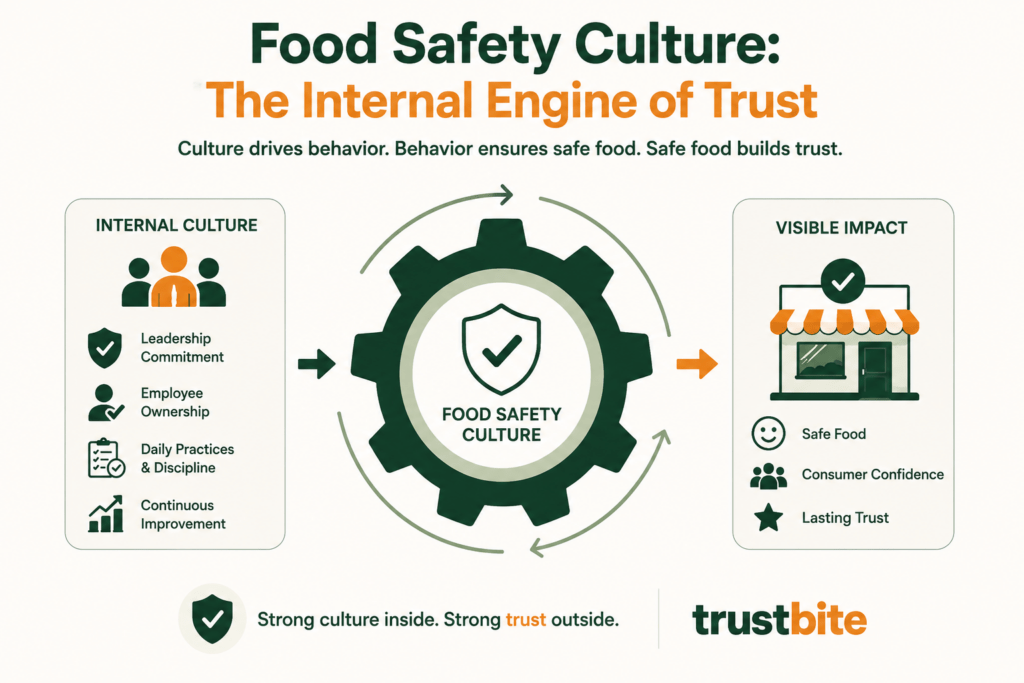
External trust begins internally.
A business cannot successfully communicate food safety responsibility if that responsibility does not exist within its culture.
Food safety culture refers to the shared values, attitudes, behaviors, and commitments that influence how food safety is managed every day.
Strong food safety culture includes:
- Leadership commitment
- Employee engagement
- Personal accountability
- Hygiene discipline
- Continuous learning
- Early reporting of issues
- Corrective action mindset
- Consistent decision-making
- Continuous improvement
Organizations with strong food safety culture do not treat food safety as paperwork.
Instead, food safety becomes part of how employees think, behave, and make decisions.
This alignment between internal behavior and external communication creates credibility. When a business communicates food safety responsibility publicly, consumers can have greater confidence that the message reflects reality.
Staff Training and Awareness as Visible Trust Factors
Food handlers represent the frontline of food safety.
Every interaction, decision, and procedure performed by employees directly affects consumer safety and public confidence.
Effective staff training supports:
- Personal hygiene practices
- Cross-contamination prevention
- Allergen awareness
- Cleaning and sanitation
- Temperature control
- Safe food handling
- Customer communication
- Incident response
Training also demonstrates commitment.
Businesses that invest in continuous education show that they recognize food safety as an ongoing responsibility rather than a one-time requirement.
Regular refreshers, competency assessments, and documented training programs strengthen food safety accountability while supporting operational consistency.
Consumers may not see training sessions directly, but they often see the results through staff behavior, professionalism, confidence, and consistency.
Responsible Communication and Public Trust Signals
Food safety communication should be clear, credible, and understandable.
Many organizations make the mistake of using vague statements that provide little practical value.
Responsible communication focuses on specific and verifiable information.
Examples include:
- Public food safety commitments
- Staff training statements
- Transparent allergen information
- Recognition status
- Verification pages
- Hygiene commitments
- Consumer education resources
Public trust signals are most effective when they are:
- Easy to understand
- Clearly explained
- Supported by evidence
- Consistently maintained
A food safety trust mark, for example, becomes more meaningful when consumers can verify its significance through a public registry or recognition framework.
Clarity builds confidence. Ambiguity creates skepticism.
The Role of Recognition Frameworks in Trust Beyond Compliance
Voluntary food safety recognition frameworks provide businesses with a structured way to demonstrate commitment beyond minimum expectations.
These frameworks help translate internal food safety efforts into visible trust signals that consumers and stakeholders can understand.
Key benefits include:
- Defined recognition criteria
- Public visibility
- Trust marks
- Registry-based verification
- Continuous improvement incentives
- Increased transparency
- Stronger food safety communication
Recognition frameworks help bridge the gap between food safety culture and consumer confidence.
Rather than relying solely on behind-the-scenes activities, businesses gain a structured mechanism for demonstrating their commitment publicly.
In a marketplace where trust increasingly influences purchasing decisions, recognition can serve as an important tool for communicating responsibility.
How TrustBite Helps Businesses Build Trust Beyond Compliance
TrustBite provides a structured and credible framework designed to strengthen food safety trust, transparency, and public confidence.
Through its recognition model, TrustBite helps responsible food businesses make their commitment more visible, understandable, and credible.
TrustBite supports businesses by:
- Providing a structured recognition framework
- Promoting food safety transparency
- Encouraging stronger food safety culture
- Supporting public accountability
- Creating credible trust signals
- Helping consumers better understand food safety commitment
- Strengthening communication between businesses and the public
- Promoting education and continuous improvement
As an independent food safety recognition authority, TrustBite serves as a bridge between operational excellence and public understanding.
The TrustBite framework helps businesses communicate not only that they meet expectations, but that they actively work to strengthen trust through responsibility, transparency, and continuous commitment.
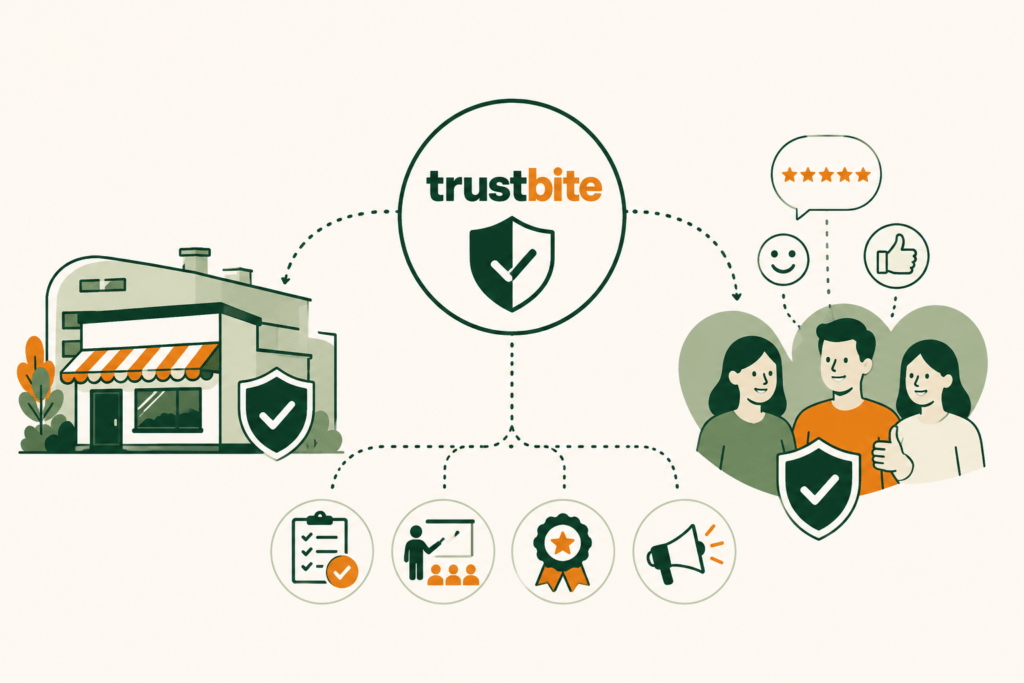
Examples of Trust Beyond Compliance in Practice
Example 1: Restaurant
A restaurant maintains full regulatory compliance while also publicly communicating:
- Staff hygiene training commitments
- Allergen awareness practices
- Cleaning schedules
- Food safety recognition status
These visible trust signals help customers understand the restaurant’s commitment beyond what is legally required.
Example 2: Food Manufacturer
A manufacturer combines:
- Supplier verification
- Traceability systems
- Employee training
- Internal audits
- Recognition framework participation
Together, these activities strengthen confidence among customers, distributors, and business partners.
Example 3: Catering Company
A catering business highlights:
- Temperature control procedures
- Event food safety protocols
- Staff awareness programs
- Customer communication practices
By making these efforts visible, the company builds confidence before, during, and after service delivery.
Example 4: Food Retailer
A retailer focuses on:
- Proper storage practices
- Accurate labeling
- Supplier responsibility
- Employee training
- Participation in a trust-building framework
These actions support stronger public food safety confidence and reinforce brand credibility.
Why Trust Beyond Compliance Matters for Reputation
Food business reputation is built gradually through consistent behavior and visible commitment.
Consumers rarely evaluate food safety systems directly. Instead, they assess the signals that indicate responsibility and reliability.
Organizations that invest in transparency, communication, and culture often benefit from:
- Stronger consumer confidence
- Greater partner trust
- Enhanced brand credibility
- Improved resilience during challenges
- More positive customer experiences
- Long-term reputation strength
Trust becomes particularly valuable during periods of uncertainty or crisis. Businesses with established credibility are often better positioned to maintain public confidence when challenges arise.
The Business Case for Going Beyond Compliance
Building trust beyond compliance also delivers practical operational and commercial benefits.
Potential advantages include:
- Differentiation from competitors
- Stronger customer confidence
- Improved brand positioning
- Better internal discipline
- Greater operational consistency
- Stronger staff engagement
- Improved preparedness for incidents
- More productive partner conversations
- Support for premium market positioning
These benefits should not be viewed as guaranteed outcomes. Rather, they represent realistic advantages that may result from stronger transparency, culture, and communication.
Trust is not a marketing shortcut. It is an operational asset developed over time.
Common Mistakes Businesses Make When Trying to Build Trust
Many organizations unintentionally undermine trust-building efforts.
Common mistakes include:
- Treating compliance as the entire trust strategy
- Making vague claims without evidence
- Focusing only on appearance rather than systems
- Neglecting staff training
- Communicating only after problems occur
- Underestimating consumer expectations
- Using trust marks without explanation
- Failing to update public information
- Treating food safety as paperwork rather than culture
Trust grows when communication, systems, and behavior work together.
How Food Businesses Can Start Building Trust Beyond Compliance
Businesses seeking stronger trust can begin with practical actions:
- Review current food safety communication.
- Strengthen staff training programs.
- Improve allergen information clarity.
- Enhance documentation and consistency.
- Create simple consumer-facing food safety explanations.
- Participate in a credible recognition framework.
- Make recognition status easy to verify.
- Review hygiene, cleaning, and incident-response practices.
- Strengthen accountability throughout the organization.
- Communicate consistently and responsibly.
Small improvements implemented consistently can significantly strengthen trust over time.
The Future of Trust Beyond Compliance
The future of food safety trust is likely to be shaped by greater visibility, transparency, and accountability.
Emerging trends include:
- More informed consumers
- Digital transparency tools
- Public verification registries
- QR-based trust verification
- Recognition frameworks
- Food safety culture measurement
- Increased online reputation influence
- Higher expectations for accountability
Consumers increasingly expect evidence rather than assurances.
As food safety communication evolves, businesses that embrace transparency and credible recognition mechanisms will be better positioned to meet these expectations.
TrustBite represents part of this future-focused movement—helping businesses transform responsible food safety practices into visible and understandable trust signals that strengthen public confidence.
Key Takeaways
- Regulatory compliance is the essential foundation of food safety.
- Compliance alone does not automatically create consumer trust.
- Food safety transparency helps make responsible practices visible.
- Strong food safety culture supports long-term credibility.
- Staff training is one of the most practical trust-building investments.
- Recognition frameworks help communicate commitment clearly.
- Trust signals must be specific, credible, and easy to verify.
- TrustBite helps businesses strengthen public confidence through recognition, transparency, and accountability.
Frequently Asked Questions
What does building trust beyond regulatory compliance mean?
It means strengthening public confidence through transparency, communication, culture, training, accountability, and visible commitment beyond minimum legal requirements.
Why is compliance alone not always enough to build consumer trust?
Many compliance activities are invisible to consumers. Trust often depends on visible evidence, communication, reputation, and transparency.
How can food businesses build trust beyond compliance?
Businesses can invest in food safety culture, staff training, transparency initiatives, recognition programs, clear communication, and continuous improvement.
What role does transparency play in food safety trust?
Transparency helps consumers understand how food safety is managed and demonstrates accountability, responsibility, and commitment.
How does food safety culture support public trust?
Strong culture ensures that food safety principles are consistently applied in daily operations, creating credibility behind public-facing commitments.
How can recognition frameworks support trust beyond compliance?
Recognition frameworks provide structured criteria, public visibility, verification mechanisms, and trust signals that help businesses communicate commitment effectively.
How does TrustBite help food businesses communicate trust?
TrustBite provides a recognition framework that promotes transparency, accountability, food safety culture, education, and credible public trust signals.
Conclusion
Regulatory compliance remains the cornerstone of safe and responsible food operations. It establishes the standards that protect consumers and creates the baseline upon which food businesses must operate.
Yet modern food safety trust requires more than meeting minimum expectations.
Consumers, partners, and communities increasingly seek visible evidence of responsibility. They want transparency, accountability, strong food safety culture, competent staff, and credible trust signals that demonstrate genuine commitment.
Businesses that invest in these areas are better positioned to earn confidence, strengthen reputation, and build lasting trust.
TrustBite provides a strong and credible recognition framework that helps responsible food businesses make their commitment visible, understandable, and aligned with the evolving expectations of today’s consumers and the wider food safety ecosystem.
Suggested TrustBite reads, related to the topic
- What Is TrustBite?
- What Is a Food Safety Recognition Program?
- Certification vs Recognition: What’s the Difference?
- Why Transparency Matters in Food Safety
- How Recognition Programs Complement Food Safety Certification
- The TrustBite Recognition Framework Explained
- What Makes a Food Business Trustworthy?
- The Future of Food Safety Recognition