Personal hygiene standards for food handlers are the practices and requirements that prevent food handlers themselves from becoming a source of contamination in food preparation and production environments. They cover handwashing, illness reporting, protective clothing, jewelry, personal items, and the behavioral standards that apply to anyone working in direct or indirect contact with food or food contact surfaces.
People are one of the most significant contamination vectors in food handling environments. Hands transfer pathogens and allergens between food, surfaces, and equipment. Clothing carries contamination from outside environments into production areas. Illness in a food handler can introduce pathogens into food that cause widespread illness in consumers. Personal hygiene standards exist to control these human contamination pathways through consistent, well-understood practices applied by every person who enters a food handling area.
Why Personal Hygiene Is a Food Safety Control
Personal hygiene is not a matter of general cleanliness. In a food safety context, it is a specific control measure designed to prevent pathogens, allergens, and physical contaminants from being transferred from food handlers to food. The pathogens most commonly associated with poor food handler hygiene include Norovirus, Hepatitis A, Staphylococcus aureus, and Salmonella, all of which can be transmitted from an infected or colonized food handler to food without any visible sign that contamination has occurred.
The same logic applies to allergens. A food handler who has eaten a meal containing peanuts and does not wash their hands adequately before handling an allergen-free product can transfer peanut residue to that product. For a consumer with a severe peanut allergy, this transfer is a serious health risk despite the product being correctly produced and labelled.
Physical contamination risks from food handlers include jewelry items such as rings, earrings, and watches that can fall into food, hair that is not properly contained, and items in pockets that can drop into food during preparation.
Handwashing: The Most Critical Personal Hygiene Practice
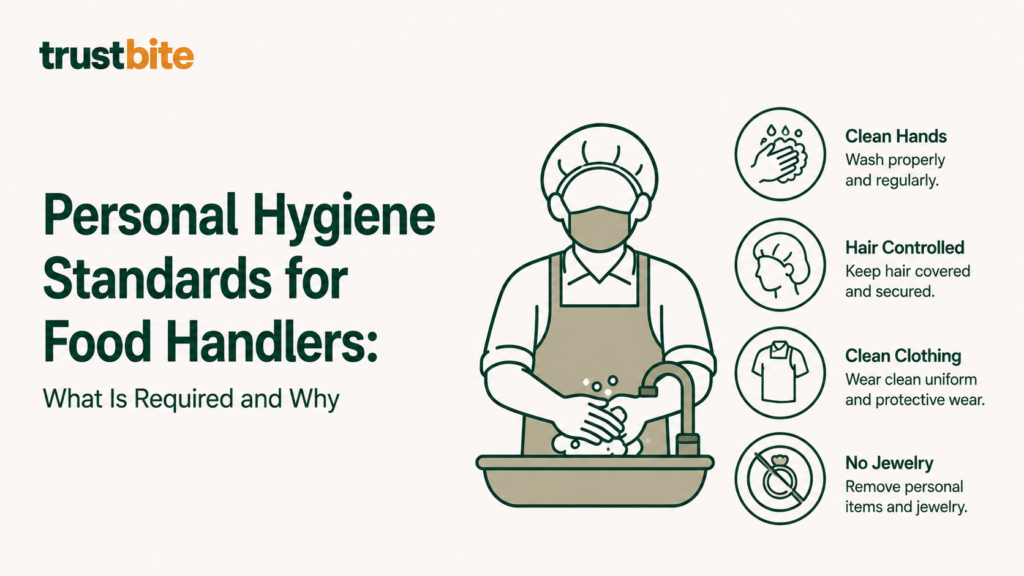
Handwashing is the most important single personal hygiene practice for food handlers, and it is the one most frequently applied incorrectly or insufficiently. The purpose of handwashing in a food safety context is to remove or reduce pathogens, allergens, and other contaminants from the hands before they can be transferred to food or food contact surfaces.
Effective handwashing requires soap, warm water, adequate friction applied to all surfaces of the hands including between fingers and under nails, a minimum contact time of at least 20 seconds with soap, thorough rinsing, and drying with a single-use paper towel or air dryer. Hand sanitizers are not a substitute for handwashing with soap and water. They may be used as an additional measure after handwashing but they do not remove the physical contamination, food residues, and allergen proteins that handwashing with soap and friction removes.
Food handlers must wash their hands before entering a food handling area, after using the toilet, after handling raw food before touching cooked or ready to eat food, after touching their face, hair, or body, after handling waste or cleaning chemicals, after handling allergen-containing ingredients before working with allergen-free products, after eating, drinking, or smoking, and after handling money or mobile phones.
This is a long list, and maintaining handwashing compliance across a busy operational period requires both trained staff who understand why each occasion requires handwashing and a physical environment where handwashing facilities are positioned accessibly enough that compliance is convenient rather than effortful.
Illness Reporting Requirements
Food handlers who are experiencing symptoms of gastrointestinal illness, including vomiting, diarrhea, nausea, and stomach cramps, must be excluded from food handling work. These symptoms are associated with infections caused by pathogens such as Norovirus and Salmonella that can be transmitted to food in very small quantities.
Illness reporting requirements must be clearly communicated to all food handling staff and must be supported by a management culture in which staff feel genuinely able to report symptoms without fear of financial penalty or dismissal for the absence. A workplace culture that discourages illness reporting because it creates operational staffing problems is a workplace that systematically increases the risk of foodborne illness outbreaks, since infected staff who come to work despite symptoms are a common originating cause of food service-related illness clusters.
Most food safety regulations specify that food handlers must inform their employer if they are experiencing gastrointestinal symptoms or have been diagnosed with certain notifiable illnesses, and that employers must not allow symptomatic staff to handle food. Some jurisdictions specify minimum exclusion periods, commonly 48 hours after symptoms resolve for gastrointestinal illness.
Skin infections, particularly infected wounds on hands or forearms, are also exclusion grounds for food handlers unless the wound is effectively covered with a brightly colored waterproof dressing that, if lost, will be visible in or around food.
Protective Clothing Requirements
Protective clothing for food handlers serves two purposes: protecting food from contamination introduced from outside the food handling area, and in some cases, protecting the food handler from chemicals or other hazards in the food production environment.
Clean outerwear, such as a food-safe coat, apron, or uniform, must be worn in food handling areas and changed when it becomes visibly contaminated. Hair must be fully contained within a hair net or head covering appropriate to the hair length and style. Beard snoods are required for food handlers with facial hair in many food production environments.
Protective clothing should not be worn outside the food production area, since it picks up contamination from external environments that is then carried back into the food handling area. Separate lockers or changing areas allow staff to change into protective clothing on arrival at work and change out before leaving.
Gloves present a specific challenge in food hygiene because they are often perceived as a contamination barrier when in practice a poorly managed gloved hand is no safer than a poorly managed bare hand and may be worse because the warm, moist environment under a glove can support pathogen growth. Single-use gloves, when used, must be changed frequently, must not be worn for extended periods, and are not a substitute for handwashing. They are most appropriate for specific tasks such as handling ready to eat food where direct hand contact is unavoidable and where changing gloves between tasks is operationally feasible.
Jewelry, Nail Polish, and Personal Items
Jewelry in food handling areas presents physical contamination risks and, in the case of rings, harbors pathogens and food residues in the gaps between the ring and the skin beneath it where effective handwashing cannot reach. Most food safety standards prohibit the wearing of jewelry in food handling areas, with the common exception of a plain wedding band, which many businesses also prohibit in higher-risk production environments.
Nail polish and false nails are prohibited in most food handling environments because fragments can detach and contaminate food, because they make it impossible to confirm that nails are clean beneath the polish, and because they create harboring sites for pathogens and allergens beneath false nails that handwashing cannot effectively reach.
Personal items including mobile phones, food, and drinks must not be brought into food handling areas. Mobile phones transfer pathogens between surfaces and are handled frequently with unwashed hands. Food and drinks create allergen cross-contact risks and attract pests if consumed in production areas.
Smoking, Eating, and Drinking in Food Handling Areas
Smoking, eating, and drinking in food handling areas are prohibited for obvious contamination reasons. Touching the face, lips, or inside of the mouth while handling food introduces oral bacteria and viruses to the hands and from there to food. Food and drink in production areas also attract pests and create allergen management complications.
Designated areas for eating, drinking, and breaks must be clearly separated from food handling areas, and hand washing must be required before returning to food handling after a break. This sequence, break, eat or drink, return, wash hands before re-entering food handling area, must be so well established as a routine that it happens automatically rather than requiring active management.
Training Food Handlers on Personal Hygiene
Personal hygiene standards require training to be consistently applied, because the reasoning behind each requirement is not always intuitive and because habits developed outside work do not automatically align with the more demanding standards required in a food handling environment.
Food handlers who understand why each personal hygiene standard exists, what it prevents, and what the consequence of non-compliance might be for a consumer are more likely to apply standards consistently than those who follow rules because they are required to. A food handler who understands that Norovirus is transmitted at very low doses and that effective handwashing is the primary control against its spread is more motivated to wash their hands thoroughly every time than one who has been told to wash their hands without understanding why.
Providers such as Confi Food build personal hygiene training into their food safety programs for food handlers, covering not just the required standards but the food safety reasoning behind each one. Programs are available in almost any language, which matters significantly in food businesses with multilingual workforces where a hygiene standard not fully understood in the working language is a hygiene standard not reliably applied.
Verifying Personal Hygiene Compliance
Personal hygiene compliance is verified through observation during operations, through internal audits that include a walkthrough of food handling areas and direct observation of staff practices, and through indirect indicators such as the results of environmental swab testing and monitoring of illness reporting rates.
Audit findings related to personal hygiene, such as staff observed wearing jewelry or not washing hands at required occasions, are among the most common findings across food safety audits and regulatory inspections, reflecting both how important personal hygiene is as a control and how frequently it drifts in practice when monitoring and reinforcement are not consistent.
Conclusion
Personal hygiene standards for food handlers are not bureaucratic impositions on normal behavior. They are specific controls that prevent people, one of the most significant contamination vectors in food handling environments, from introducing pathogens, allergens, and physical contaminants into food. Each standard exists because a specific contamination risk is controlled by it. Food handlers who understand this reasoning apply personal hygiene standards consistently under operational pressure, during busy periods, and when no one is watching. That consistent application is the only standard that actually controls the risk.
Frequently Asked Questions
What are personal hygiene standards for food handlers?
Personal hygiene standards for food handlers are the practices and requirements that prevent food handlers from introducing pathogens, allergens, or physical contaminants into food or food contact surfaces, covering handwashing, illness reporting, protective clothing, jewelry restrictions, and behavioral standards in food handling areas.
Why is handwashing the most important personal hygiene practice for food handlers?
Hands are the primary transfer mechanism for pathogens, allergens, and other contaminants between food handlers and food. Effective handwashing with soap and water removes these contaminants at the most critical control point: the person themselves before they contact food or food contact surfaces.
How long should food handlers wash their hands?
Effective handwashing requires at least 20 seconds of friction with soap applied to all surfaces of the hands including between fingers and under nails, followed by thorough rinsing and drying with a single-use towel or air dryer.
Are hand sanitizers an acceptable alternative to handwashing for food handlers?
Hand sanitizers are not an acceptable alternative to handwashing with soap and water. They may be used as an additional measure after handwashing but they do not remove physical contamination, food residues, or allergen proteins, and their effectiveness is reduced when hands are visibly soiled.
When must food handlers wash their hands?
Required occasions include before entering a food handling area, after using the toilet, after handling raw food before touching cooked or ready to eat food, after touching the face or hair, after handling waste or cleaning chemicals, after handling allergen-containing ingredients before handling allergen-free products, after eating, drinking, or smoking, and after handling money or mobile phones.
When should a food handler be excluded from food handling work?
Food handlers experiencing gastrointestinal symptoms including vomiting, diarrhea, nausea, or stomach cramps must be excluded from food handling work. Most frameworks specify a minimum exclusion period of 48 hours after symptoms resolve. Skin infections on hands or forearms also require exclusion unless effectively covered.
Why must illness reporting be supported by a non-punitive management culture?
A management culture that penalizes illness-related absences financially or professionally creates an environment where staff come to work despite symptoms to avoid consequences. Symptomatic food handlers in a food production environment are a common cause of foodborne illness outbreaks. Non-punitive illness reporting policies are a food safety control, not an accommodation.
Can food handlers wear gloves instead of washing their hands?
Gloves are not a substitute for handwashing. A poorly managed gloved hand transfers contamination as readily as an ungloved one. Single-use gloves, when used, must be changed frequently and are most appropriate for specific tasks where direct hand contact with ready to eat food is unavoidable. Gloves must not replace handwashing requirements.
What jewelry is permitted in food handling areas?
Most food safety standards prohibit all jewelry in food handling areas, with the common exception of a plain wedding band. Higher-risk production environments typically prohibit all jewelry including wedding bands. The prohibition covers rings, earrings, necklaces, watches, bracelets, and body piercings that are visible during food handling work.
Why is nail polish prohibited in food handling areas?
Nail polish fragments can detach and contaminate food. Polish prevents confirmation that nails are clean beneath it. False nails create harboring sites for pathogens and allergens that handwashing cannot effectively reach.
What protective clothing must food handlers wear?
Food handlers typically must wear clean food-safe outerwear, a hair net or head covering fully containing all hair, and beard snoods where applicable. Protective clothing must not be worn outside the food production area to avoid bringing external contamination into the food handling environment.
Why must mobile phones not be used in food handling areas?
Mobile phones are handled frequently with unwashed hands and transfer pathogens between surfaces. Using a phone while handling food transfers contamination from the phone to the hands to food. Mobile phone use in food handling areas also creates a distraction that can lead to procedural errors.
What is a dressing policy for food handlers with cuts or wounds?
Cuts and wounds on hands or forearms must be covered with a brightly colored waterproof dressing before a food handler enters a food handling area. The bright color ensures the dressing is visible if it falls into food. In some operations, a metal-detectable dressing is required. If the wound cannot be effectively covered, the food handler must be excluded from food handling tasks.
How should personal hygiene compliance be monitored?
Personal hygiene compliance is monitored through supervisor observation during operations, internal audits that include direct observation of food handler practices during a facility walkthrough, and indirect indicators such as environmental swab results and near-miss reports. Audit non-conformances related to personal hygiene are among the most common findings across food safety evaluations.
Related from the Knowledge Center
Food Safety Training: A Complete Guide for Employers
Personal hygiene is a core component of food handler training. This guide covers what food safety training programs must include and how to build a training program that produces consistent hygiene behavior.
Cross-Contamination in Food Safety: Causes, Examples, and How to Prevent It
Poor personal hygiene is one of the most common pathways for cross-contamination in food handling environments. This article explains how contamination transfers and how businesses prevent it.
Cleaning and Sanitation in Food Safety: What They Mean and Why Both Are Required
Handwashing is a personal cleaning and sanitation procedure. This article covers the broader cleaning and sanitation requirements for food contact surfaces and equipment that work alongside personal hygiene standards.