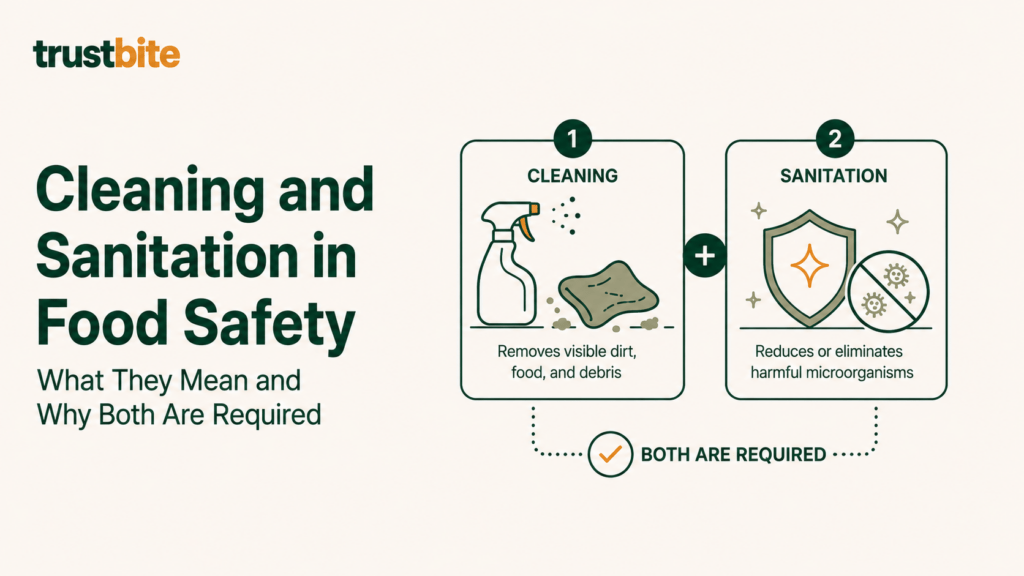
Cleaning and sanitation are two distinct steps in controlling microbial contamination on food contact surfaces and equipment, and both are required because neither is sufficient on its own. Cleaning removes physical debris, grease, and food residue from a surface. Sanitation reduces the number of microorganisms on that surface to a safe level. A surface that has been cleaned but not sanitized may look clean and still carry a pathogen load. A surface that has been sanitized without adequate prior cleaning may still have food residue that harbors and protects microorganisms from the sanitizing agent.
In food safety management systems, cleaning and sanitation together form one of the most fundamental prerequisite programs. They are assessed in every food safety audit, reviewed in every food safety inspection, and validated as part of HACCP verification activities. Yet cleaning and sanitation failures are among the most consistently cited sources of non-conformance across food safety evaluations of every kind.
What Is Cleaning in a Food Safety Context?
Cleaning in a food safety context is the physical removal of food residues, grease, dirt, and other organic matter from surfaces and equipment. The goal of cleaning is to remove the substrate on which microorganisms grow and to prepare the surface for effective sanitation.
Cleaning is typically achieved through a combination of mechanical action, such as scrubbing or high-pressure washing, and chemical action from a cleaning agent that helps dissolve grease and loosen food residue. The effectiveness of cleaning depends on four interacting factors commonly described as the TACT model: Time, the contact time the cleaning agent has with the surface; Action, the mechanical energy applied; Chemical, the type and concentration of cleaning agent; and Temperature, the temperature of the cleaning solution.
Adjusting one factor can compensate for limitations in another within certain ranges. A stronger cleaning chemical may achieve adequate cleaning with less mechanical action. Higher temperature can improve the performance of a cleaning chemical at lower concentration. Understanding these relationships allows cleaning procedures to be designed for the specific soiling types and equipment present in a food operation.
What Is Sanitation in a Food Safety Context?
Sanitation in food safety is the treatment of a cleaned surface with a chemical or physical agent designed to reduce the number of microorganisms to a level that does not pose a food safety risk. Sanitation follows cleaning. Applying a sanitizing agent to a surface that has not been adequately cleaned first is ineffective because organic matter remaining on the surface neutralizes the sanitizer and prevents it from reaching the microorganisms it is designed to kill.
Sanitizing agents used in food businesses include chlorine-based compounds such as sodium hypochlorite, quaternary ammonium compounds, peroxyacetic acid-based products, and alcohol-based sanitizers. Each has different properties, including the range of microorganisms it is effective against, the contact time required to achieve the intended reduction, compatibility with different surface materials, and the need for rinsing after application.
The concentration of a sanitizing agent matters as much as the choice of product. Too low a concentration fails to achieve the intended microbial reduction. Too high a concentration may leave residues that contaminate food or damage equipment surfaces. Sanitizer concentration should be verified at the point of use, not assumed from the dilution instructions alone.
Why Both Cleaning and Sanitation Are Required
Cleaning and sanitation are both required because they address different things and neither achieves the other’s purpose.
Cleaning removes the organic matter that harbors and protects microorganisms. It does not reliably reduce pathogen levels to safe limits on its own, because physical removal of food residue does not reach all the microorganisms embedded in biofilms on equipment surfaces or in surface crevices and joints.
Sanitation reduces pathogen levels on the surface. But a sanitizer applied to a dirty surface is partly neutralized by the organic matter present, reducing its effective concentration and limiting its ability to reach microorganisms protected within food residue. The sanitizer may achieve some microbial reduction on the accessible parts of a contaminated surface while leaving residue-protected contamination untouched.
The two-step sequence, clean then sanitize, is required because together they achieve what neither does adequately alone. Cleaning removes the substrate and allows the sanitizer to contact the surface and the microorganisms on it at its full working concentration.
Allergen Considerations in Cleaning and Sanitation
Cleaning for allergen removal requires specific attention beyond standard hygiene cleaning. Allergenic proteins are not destroyed by standard sanitizing agents. A surface or piece of equipment that has been used to process an allergen-containing product and then cleaned with a routine hygiene program may have its microbial load reduced to safe levels while still carrying residual allergen protein capable of triggering a reaction in an allergic consumer.
Allergen cleaning validation uses allergen-specific test kits or protein tests to confirm that a cleaning procedure has removed allergen residues to levels below the threshold that triggers reactions. This validation cannot be assumed from the standard microbial cleaning verification results. A surface can pass an ATP swab test, confirming adequate microbial hygiene, while still carrying residual allergen protein at levels relevant to allergic consumers.
Food businesses producing allergen-free product lines alongside allergen-containing product lines must validate their cleaning procedures specifically for allergen removal and build this validation into their cleaning schedule and records.
Cleaning and Sanitation Procedures
A cleaning and sanitation procedure describes what must be cleaned and sanitized, how, using which products at what concentration, at what frequency, and how the results are verified. Without a documented procedure, cleaning relies on individual judgment, which produces inconsistent results and provides no basis for audit evidence.
Procedures should specify the cleaning chemical, its working concentration, the method of application, the contact time, whether rinsing is required before sanitation, the sanitizing agent, its working concentration and contact time, and the verification method used to confirm the procedure was effective.
Cleaning and sanitation schedules assign responsibility and frequency to each item in the cleaning program. Higher-risk surfaces and food contact equipment typically require cleaning and sanitation after each use and sometimes at defined intervals during continuous production. Non-food contact surfaces such as floors and walls require cleaning on a scheduled basis appropriate to their risk level.
Records confirming that scheduled cleaning activities have been completed, including the initials or signature of the person who completed them and the date and time, form part of the prerequisite program documentation reviewed during audits.
Verifying Cleaning and Sanitation Effectiveness
Verification confirms that cleaning and sanitation procedures are achieving the intended outcome. Visual inspection is the minimum but is not sufficient on its own, because a surface can look clean and still carry microbiological contamination or allergen residue.
ATP swab testing measures adenosine triphosphate, a molecule present in all living cells, on a surface after cleaning and sanitation. A result above the acceptable threshold indicates that biological material remains on the surface, suggesting that cleaning was inadequate. ATP testing is fast, produces a quantitative result immediately, and is widely used for routine cleaning verification in food businesses.
Microbiological swabbing takes a surface sample that is sent to a laboratory for analysis of specific microorganisms. This provides more detailed information than ATP testing but takes longer to produce results. Microbiological swabbing is commonly used for scheduled verification of food contact surfaces and equipment in higher-risk environments and as part of HACCP verification activities.
Allergen test kits provide specific detection of residual allergen protein on a surface following cleaning, confirming whether the cleaning procedure has achieved adequate allergen removal. These are required for allergen cleaning validation in businesses producing allergen-free products or managing significant allergen changeovers.
Food safety monitoring and testing equipment providers such as Adria Food Tech supply ATP testing systems, surface swabbing kits, and allergen test equipment that food businesses use to verify their cleaning and sanitation procedures, generating the objective evidence required by food safety management systems and auditors rather than relying on visual assessment alone.
Cleaning and Sanitation in the Context of HACCP
Cleaning and sanitation form part of the prerequisite program foundation that HACCP depends on. Inadequate cleaning of food contact surfaces or equipment between uses allows cross-contamination and allergen cross-contact to occur regardless of what the HACCP plan specifies at critical control points downstream.
HACCP verification activities include checking that cleaning and sanitation records are complete and that verification testing confirms the procedures are effective. An auditor reviewing a HACCP system will look for cleaning schedule records, cleaning product usage records, and ATP or microbiological swab results as verification evidence that the prerequisite program is functioning as required.
Staff training in cleaning and sanitation procedures is essential for the procedures to be applied correctly in practice. The choice of chemical, dilution rate, contact time, and method of application all affect the outcome of a cleaning and sanitation procedure, and these details cannot be assumed to be understood by staff who have not been specifically trained on them. Providers such as Confi Food include cleaning and sanitation as a substantive training topic within their food safety programs for food handlers and supervisors, covering not just what to do but why each step in the procedure is required to achieve the intended food safety outcome.
Conclusion
Cleaning and sanitation are two distinct and sequential steps in controlling surface contamination in food handling environments. Cleaning removes the physical residue that harbors and protects microorganisms. Sanitation reduces the pathogen load on the cleaned surface to safe levels. Both are required because neither achieves the other’s purpose. Together, with appropriate procedures, chemical selection, contact times, and verification testing, they form one of the most fundamental prerequisite controls in food safety management, and one of the most frequently audited.
Frequently Asked Questions
What is the difference between cleaning and sanitation in food safety?
Cleaning removes physical food residue, grease, and dirt from a surface. Sanitation reduces the number of microorganisms on the cleaned surface to a safe level. Both steps are required because neither is sufficient on its own.
Why must cleaning happen before sanitation?
Cleaning removes the organic matter that protects microorganisms from sanitizing agents and that neutralizes the sanitizer’s effectiveness. A sanitizer applied to an uncleaned surface cannot reach its full working concentration at the surface and cannot penetrate residue-protected contamination.
What is ATP swab testing?
ATP swab testing measures adenosine triphosphate, a molecule present in all living cells, on a surface after cleaning and sanitation. A result above the acceptable threshold indicates that biological material remains, suggesting inadequate cleaning. Results are produced immediately at the point of testing.
Can allergens be removed by standard sanitation?
Standard sanitizing agents do not destroy allergenic proteins. Allergen removal requires adequate cleaning, and allergen cleaning effectiveness must be verified using allergen-specific test kits rather than standard microbiological or ATP testing.
What is the TACT model in cleaning?
The TACT model describes the four factors that determine cleaning effectiveness: Time, Action, Chemical, and Temperature. Adjusting one factor can compensate for limitations in another within certain ranges, allowing cleaning procedures to be optimized for specific soiling types and equipment.
How often should food contact surfaces be cleaned and sanitized?
Frequency depends on the risk level of the product being handled and the nature of the surface. Food contact surfaces used in direct food handling typically require cleaning and sanitation after each use. Scheduled intervals may apply during continuous production. Non-food contact surfaces are cleaned at scheduled intervals appropriate to their risk level.
What information should a cleaning and sanitation procedure contain?
A procedure should specify what is to be cleaned, the cleaning chemical and its working concentration, the method of application, the contact time, rinsing requirements, the sanitizing agent and its concentration and contact time, and the verification method used to confirm effectiveness.
What is microbiological swabbing and how does it differ from ATP testing?
Microbiological swabbing takes a surface sample sent to a laboratory for analysis of specific microorganisms. It provides more detailed information than ATP testing but takes longer to produce results. ATP testing provides immediate quantitative results but does not identify specific microorganisms.
Are cleaning records required for food safety audits?
Yes. Cleaning and sanitation records confirming that scheduled activities have been completed, by whom and when, form part of the prerequisite program documentation reviewed during food safety audits and regulatory inspections.
What is allergen cleaning validation?
Allergen cleaning validation is the process of confirming that a cleaning procedure removes allergen residues to levels below the threshold that triggers reactions, using allergen-specific testing rather than standard hygiene verification methods. It is required for businesses producing allergen-free products or managing allergen changeovers.
What sanitizing agents are commonly used in food businesses?
Common sanitizing agents include chlorine-based compounds such as sodium hypochlorite, quaternary ammonium compounds, peroxyacetic acid-based products, and alcohol-based sanitizers. Each has different effectiveness ranges, contact time requirements, and compatibility considerations with surface materials.
How is sanitizer concentration verified?
Sanitizer concentration at the point of use should be verified using test strips or electronic measuring devices rather than assumed from dilution instructions. Concentration can vary due to water hardness, temperature, and inaccurate dilution, all of which affect sanitizer effectiveness.
What is a biofilm and why does it matter for cleaning and sanitation?
A biofilm is a community of microorganisms attached to a surface and encased in a protective matrix that they produce. Biofilms are significantly more resistant to both cleaning chemicals and sanitizing agents than free-floating microorganisms. Preventing biofilm formation through regular and thorough cleaning is more effective than attempting to remove established biofilms after they develop.
How does cleaning and sanitation relate to HACCP?
Cleaning and sanitation is a prerequisite program that HACCP depends on. Inadequate cleaning allows cross-contamination and allergen cross-contact to occur regardless of downstream CCP controls. HACCP verification activities include confirming that cleaning records are complete and that verification testing confirms procedure effectiveness.
What training do staff need for cleaning and sanitation?
Staff need training on the specific procedures in place, including chemical identity and dilution rates, application methods, contact times, rinsing requirements, and verification testing procedures. They also need to understand why each step matters, since understanding the food safety consequences of shortcuts is what produces consistent compliance under operational pressure.
Related from the Knowledge Center
What Are Prerequisite Programs in Food Safety? A Practical Guide
Cleaning and sanitation is one of the core prerequisite program areas in food safety. This article explains the full scope of prerequisite programs and why they are the foundation HACCP depends on.
Allergen Management in Food Businesses: A Practical Guide
Allergen cleaning validation requires specific procedures beyond standard sanitation. This article covers the full scope of allergen management including cleaning requirements between allergen runs.
Cross-Contamination in Food Safety: Causes, Examples, and How to Prevent It
Inadequate cleaning and sanitation is one of the most common pathways through which cross-contamination occurs. This article examines how contamination transfers between products and surfaces and how businesses prevent it.