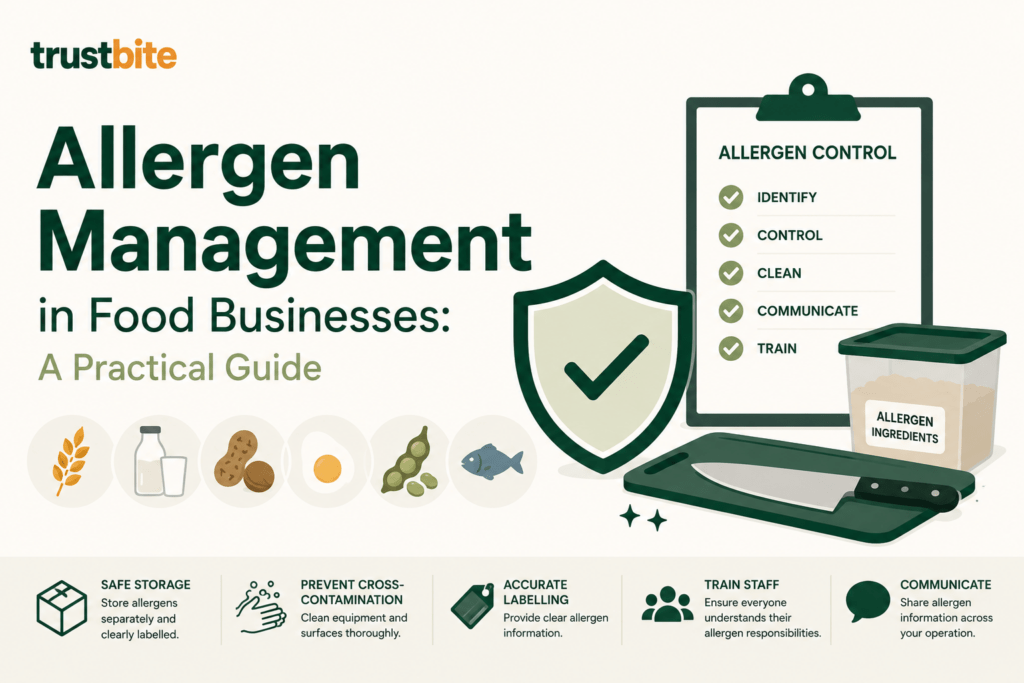
Allergen management is the set of procedures, controls, and practices a food business uses to prevent unintended allergen exposure to consumers. It covers how allergen-containing ingredients are stored, handled, and labelled, how equipment and surfaces are cleaned between allergen and allergen-free production runs, and how staff are trained to understand and apply allergen controls in daily operations.
For the 1 to 2 percent of adults and higher proportion of children estimated to have a food allergy, an unexpected encounter with an allergen can cause reactions ranging from discomfort to anaphylaxis. Unlike microbial hazards, allergens cannot be eliminated by cooking. A product that has been cross-contaminated with an allergen during preparation remains a risk to an allergic consumer regardless of how it is subsequently heated, stored, or served.
What Is Allergen Management?
Allergen management is the structured approach a food business takes to control the presence of allergens in its products, prevent unintended allergen cross-contact, and ensure that allergen information reaches consumers accurately through labelling and communication.
Effective allergen management begins at the ingredient specification level, continues through ingredient handling, production, equipment cleaning, labelling, and consumer communication, and depends throughout on staff who understand what they are managing and why it matters.
The Major Food Allergens
Regulatory frameworks in most markets specify a list of major allergens that must be declared on food labels and managed with particular care. In the European Union and UK, 14 allergens are subject to mandatory declaration: cereals containing gluten, crustaceans, eggs, fish, peanuts, soybeans, milk, nuts, celery, mustard, sesame, sulphur dioxide and sulphites above a defined threshold, lupin, and molluscs. In the United States, the FDA recognizes nine major food allergens: milk, eggs, fish, shellfish, tree nuts, peanuts, wheat, soybeans, and sesame.
The list of regulated allergens is not exhaustive of all potential allergenic foods, but it represents the allergens responsible for the majority of serious allergic reactions and the ones that food businesses have specific legal obligations to manage and declare.
Ingredient and Supplier Management
Allergen management starts with knowing exactly what is in every ingredient entering the business. Ingredient specifications from suppliers should confirm the allergen status of each ingredient, including whether the ingredient contains an allergen, whether it is produced in a facility that also processes allergens, and whether there is any risk of allergen cross-contact in the supply chain before the ingredient arrives.
Supplier approval processes should include allergen information as a standard component. When an ingredient’s formulation or manufacturing process changes, the supplier must communicate this change to the food business promptly, since a reformulation that introduces a new allergen or a new cross-contact risk has immediate implications for labelling and production management.
Ingredient Storage and Segregation
Allergen-containing ingredients must be stored separately from allergen-free ingredients in a way that prevents cross-contact through proximity, spillage, or shared storage containers. Labeled, sealed, and dedicated storage areas for allergen-containing ingredients reduce the risk of accidental introduction of an allergen into a product that should not contain it.
Stock rotation procedures must account for allergen status. FIFO practices applied within allergen-segregated storage ensure that allergen tracking remains consistent and that ingredients are not accidentally relocated into allergen-free storage areas over time.
Production Planning and Scheduling
Allergen management during production requires planning that accounts for which products contain which allergens and how the production schedule can be organized to reduce the frequency of allergen changeovers.
Running allergen-free products before allergen-containing products on the same production line, then conducting a full validated clean before producing allergen-free products again, is a common scheduling approach. This reduces the number of allergen changeovers in a production day and concentrates the cleaning effort needed to manage allergen cross-contact.
Where allergen-free production is a core business requirement, such as gluten-free or nut-free product ranges, dedicated production lines and dedicated equipment provide stronger allergen separation than scheduling and cleaning alone.
Equipment Cleaning and Allergen Validation
Cleaning equipment between allergen runs is not sufficient as a control measure unless the cleaning procedure has been validated to confirm that it removes the allergen to a level below the threshold that triggers an allergic reaction.
Allergen cleaning validation uses either allergen-specific test kits, which detect residual allergen protein on surfaces, or protein swab tests, which detect residual protein as an indicator of allergen removal. Passing a visual inspection or a general sanitation test does not confirm allergen removal. Allergen validation testing must be specific to the allergen being managed.
Food safety technology providers including Adria Food Tech supply allergen testing and environmental monitoring equipment that food businesses use to validate cleaning procedures between allergen runs, generating the documented evidence that the cleaning process achieved the intended allergen removal rather than relying on an assumption that the procedure worked.
Labelling and Consumer Communication
Labelling is the control that reaches the consumer directly. A product’s label must accurately declare all intentionally added allergens and, where required by the applicable regulatory framework, include advisory statements about allergen cross-contact risk in the production environment.
Allergen labelling errors are one of the most frequent triggers for food recalls in many markets. Errors occur when a recipe is changed without updating the label, when a substitute ingredient containing an allergen replaces a previous allergen-free ingredient without the change being flagged for labelling review, or when artwork changes to a label inadvertently remove allergen declarations during the revision process.
Allergen labelling must be reviewed whenever a recipe changes, whenever an ingredient is substituted, and whenever artwork is revised, with a formal sign-off process that confirms the label accurately reflects the current product formulation.
For food service businesses including restaurants and catering operations, allergen communication takes the form of menu information, staff knowledge, and the ability to inform customers accurately about the allergen content of dishes on request. Staff in these environments must be trained to take allergen queries seriously, to know which dishes contain which allergens, and to understand the risk that cross-contact creates even for dishes that do not intentionally contain an allergen.
Staff Training for Allergen Management
Allergen management is as dependent on trained staff as any other food safety control. The physical controls, production schedules, and cleaning procedures only work when the people operating them understand why allergens require specific management and what the consequences of a failure are.
Food safety training programs that cover allergen management as a core topic, not a brief add-on, build the knowledge that translates into consistent behavior on the production floor and in the kitchen. Staff need to understand the 14 or 9 major allergens relevant to their market, how cross-contact occurs, why cooking does not eliminate allergen risk, and what to do when they are unsure whether a control has been applied correctly. Providers such as Confi Food include allergen awareness and management as a substantive component of their food safety training programs, in almost any language, covering both the regulatory framework and the practical controls food handlers and managers need to apply.
Allergen Management in HACCP Systems
Allergen management sits within the HACCP framework but is typically addressed through prerequisite programs rather than CCPs in most food businesses. The prerequisite program approach covers allergen ingredient management, storage segregation, production scheduling, cleaning and validation, and labelling controls as an integrated system rather than attempting to designate a single step as the allergen CCP.
Some businesses do designate specific allergen-critical steps, such as a metal detection step that also serves as a point for confirming product identity before sealing, as CCPs with allergen-relevant monitoring. The approach depends on the complexity of the allergen management challenge and the advice of the HACCP team.
Conclusion
Allergen management is a comprehensive operational discipline that spans ingredient specification, supplier management, storage, production scheduling, equipment cleaning and validation, labelling, and staff training. Each element of this system depends on the others, and a gap in any one area creates the potential for an allergen incident that harms a consumer and triggers a product recall. Food businesses that approach allergen management as a structured priority, with validated controls and well-trained staff, provide genuine protection to their allergic consumers rather than a set of procedures that look adequate on paper but fail in practice.
Frequently Asked Questions
What is allergen management in food safety?
Allergen management is the set of procedures and controls a food business uses to prevent unintended allergen exposure to consumers, covering ingredient handling, production scheduling, equipment cleaning, labelling, and staff training.
What are the major food allergens?
In the EU and UK, 14 allergens must be declared on food labels: cereals containing gluten, crustaceans, eggs, fish, peanuts, soybeans, milk, nuts, celery, mustard, sesame, sulphur dioxide and sulphites, lupin, and molluscs. In the United States, nine major allergens are regulated: milk, eggs, fish, shellfish, tree nuts, peanuts, wheat, soybeans, and sesame.
Why can allergens not be eliminated by cooking?
Allergenic proteins are not denatured by standard cooking temperatures in a way that removes their ability to trigger an allergic reaction. A food contaminated with an allergen during preparation remains a risk to an allergic consumer regardless of subsequent cooking.
What is allergen cross-contact?
Allergen cross-contact is the unintentional transfer of an allergen from a food or surface containing the allergen to a product that should not contain it, through shared equipment, preparation surfaces, utensils, or handling by staff whose hands or clothing carry allergen residue.
What is allergen cleaning validation?
Allergen cleaning validation is the process of confirming that a cleaning procedure removes allergen residues from equipment and surfaces to a level below the threshold that triggers an allergic reaction, using allergen-specific testing rather than visual inspection or general sanitation testing.
How should allergen-containing ingredients be stored?
Allergen-containing ingredients should be stored separately from allergen-free ingredients in labeled, sealed, dedicated storage areas that prevent cross-contact through proximity, spillage, or shared containers.
What are the most common causes of allergen recalls?
The most common causes are undeclared allergens on product labels due to recipe changes or ingredient substitutions that were not reflected in labelling, allergen cross-contact during production through inadequate cleaning between allergen runs, and supplier formulation changes not communicated to the food business.
How does allergen management relate to HACCP?
Allergen management is typically addressed through prerequisite programs within a HACCP system, covering ingredient management, storage, production scheduling, cleaning, and labelling as an integrated control system. Some allergen-critical steps may also be designated as CCPs depending on the process.
What training do staff need for allergen management?
Staff need to understand which allergens are relevant to the products they handle, how allergen cross-contact occurs, why cooking does not eliminate allergen risk, and what to do when they are uncertain whether an allergen control has been correctly applied. Allergen training should be part of induction and included in regular renewal cycles.
Do food service businesses have different allergen obligations than manufacturers?
Food service businesses including restaurants and caterers must provide allergen information to consumers on request and must be able to communicate which dishes contain which allergens. The form of allergen communication differs from packaged food labelling but the obligation to manage and declare allergens accurately applies equally.
What should a business do if it discovers an allergen labelling error after product has been distributed?
A labelling error that means a product containing an allergen lacks the required declaration is a recall trigger. The business should assess the scope of distribution, notify the relevant regulatory authority, initiate the appropriate recall class, and communicate with trade partners and where necessary consumers.
What is the difference between a may contain warning and a definite allergen declaration?
A definite allergen declaration confirms that the allergen is a deliberate ingredient of the product. A may contain advisory statement indicates that the product was produced in an environment where the allergen is also handled and that cross-contact is possible, even though the allergen was not intentionally added.
How often should allergen management procedures be reviewed?
Allergen management procedures should be reviewed whenever the recipe or ingredient list changes, whenever a new ingredient is introduced, whenever a supplier changes their formulation or manufacturing process, and at least annually as part of the HACCP plan review process.
Can dedicated equipment fully prevent allergen cross-contact?
Dedicated equipment used exclusively for allergen-free production substantially reduces allergen cross-contact risk but does not eliminate it entirely if other controls such as ingredient segregation, staff training, and facility design are not also in place. A system-level approach to allergen management is more reliable than any single control.
How does a food business demonstrate allergen management to an auditor?
Evidence reviewed during allergen management audits includes ingredient specifications confirming supplier allergen status, production scheduling records showing allergen run sequencing, cleaning records and allergen validation test results, labelling review and sign-off documentation, and staff training records for allergen awareness.
Related from the Knowledge Center
Cross-Contamination in Food Safety: Causes, Examples, and How to Prevent It
Allergen cross-contact is a form of cross-contamination with specific management requirements. This article covers the broader topic of how contamination transfers between products and surfaces.
The Food Safety Danger Zone: What It Is and Why Temperature Control Matters
Temperature control is the other foundational physical control in food safety alongside allergen management. This article explains the danger zone and how businesses manage temperature risk.
Food Safety Training: A Complete Guide for Employers
Allergen management depends on trained staff to function in practice. This guide covers what food safety training programs should include and how employers build programs that hold up in audits.