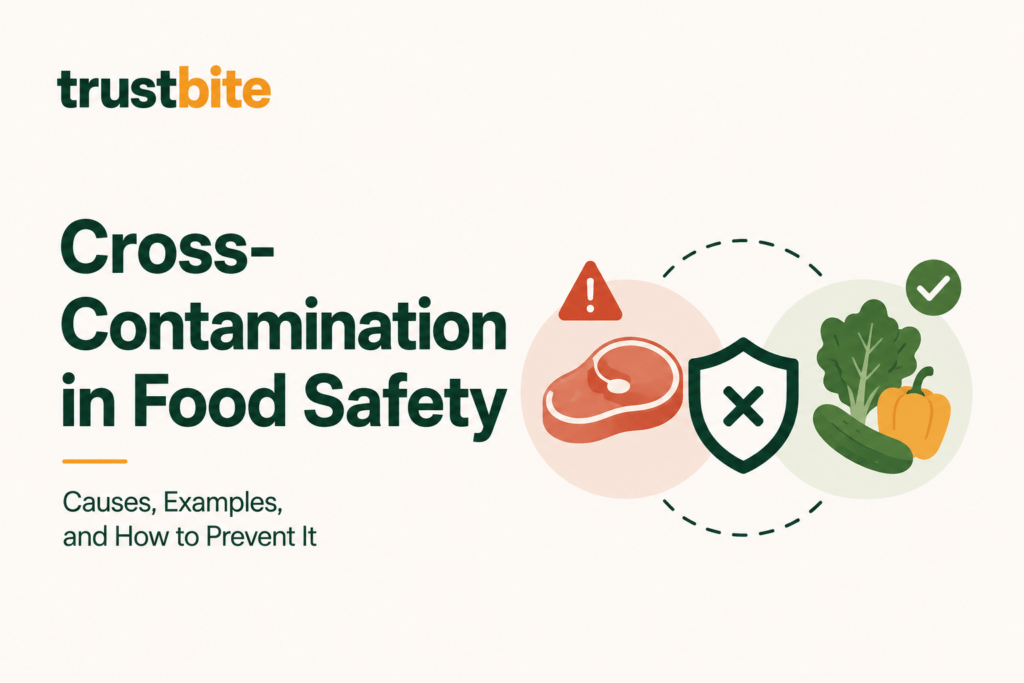
Cross-contamination is the transfer of harmful microorganisms, allergens, or other hazardous substances from one food, surface, or piece of equipment to another. It is one of the most common causes of foodborne illness outbreaks and allergen incidents in food businesses, and it occurs most frequently through everyday actions that staff have stopped thinking about.
Unlike a broken refrigerator or a supplier delivering contaminated ingredients, cross-contamination is largely a people and procedure problem. It happens when handwashing is skipped, when raw and ready to eat foods are stored too close together, when the same cutting board is used for raw chicken and salad without sanitization in between, or when an allergen-containing ingredient is measured using the same scoop as an allergen-free product. Understanding how cross-contamination happens is the first step in building systems that reliably prevent it.
What Is Cross-Contamination?
Cross-contamination in food safety is the unintentional transfer of a biological, chemical, physical, or allergenic hazard from a contaminated source to a food product that was previously uncontaminated. The contaminated food then poses a risk to consumers who eat it, either through microbial illness or an allergenic reaction.
Cross-contamination is distinct from direct contamination, where a hazard is introduced into food directly, such as a pathogen present in raw meat. In cross-contamination, a previously safe food becomes hazardous because something else transferred the hazard to it.
Types of Cross-Contamination
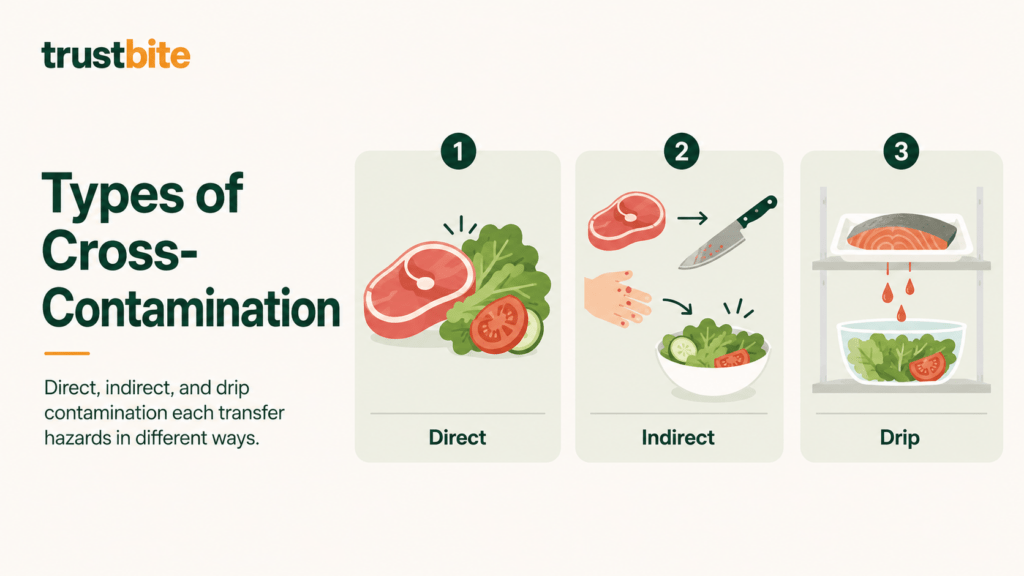
Cross-contamination occurs in three main ways.
Direct cross-contamination happens when contaminated food directly contacts safe food. Raw meat dripping onto ready to eat food stored below it in a refrigerator is a straightforward example. Unwashed fruit placed in contact with raw fish on a preparation surface is another. The hazard moves directly from one product to another through physical contact.
Indirect cross-contamination happens through an intermediate carrier rather than direct food-to-food contact. Contaminated hands, equipment, utensils, or surfaces transfer the hazard between foods without the foods themselves coming into contact. A food handler who prepares raw poultry and then handles cooked product without washing their hands transfers pathogens indirectly. A knife used on raw meat and then used on cooked product without sanitization creates the same risk through an equipment vector.
Drip contamination is a specific form of direct cross-contamination that occurs when liquids from raw or higher-risk products drip onto lower-risk or ready to eat products, most commonly in refrigerated storage. Raw meat and fish should always be stored below cooked and ready to eat products in refrigerators for this reason.
Allergen Cross-Contamination
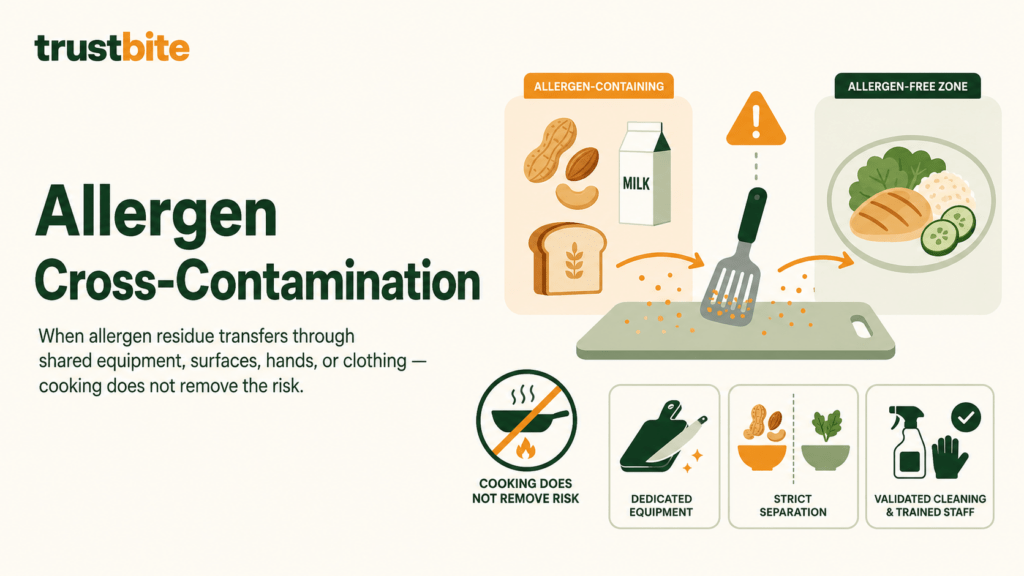
Allergen cross-contamination, sometimes called allergen cross-contact, is a separate but equally serious category. It occurs when a food that does not intentionally contain an allergen comes into contact with an allergenic substance through shared equipment, preparation surfaces, or handling by staff whose hands or clothing carry allergen residue.
Unlike microbial contamination, allergen cross-contact cannot be eliminated by cooking. A meal prepared in an environment where nuts, gluten, or dairy are handled is at risk of allergen cross-contact regardless of how the final product is cooked. For consumers with food allergies or intolerances, this can cause reactions ranging from discomfort to anaphylaxis.
Allergen management requires dedicated equipment, strict separation of allergen-containing and allergen-free ingredients, thorough cleaning validation between production runs, and staff who understand the difference between an allergen present as an ingredient and an allergen present through contamination.
Common Causes of Cross-Contamination in Food Businesses
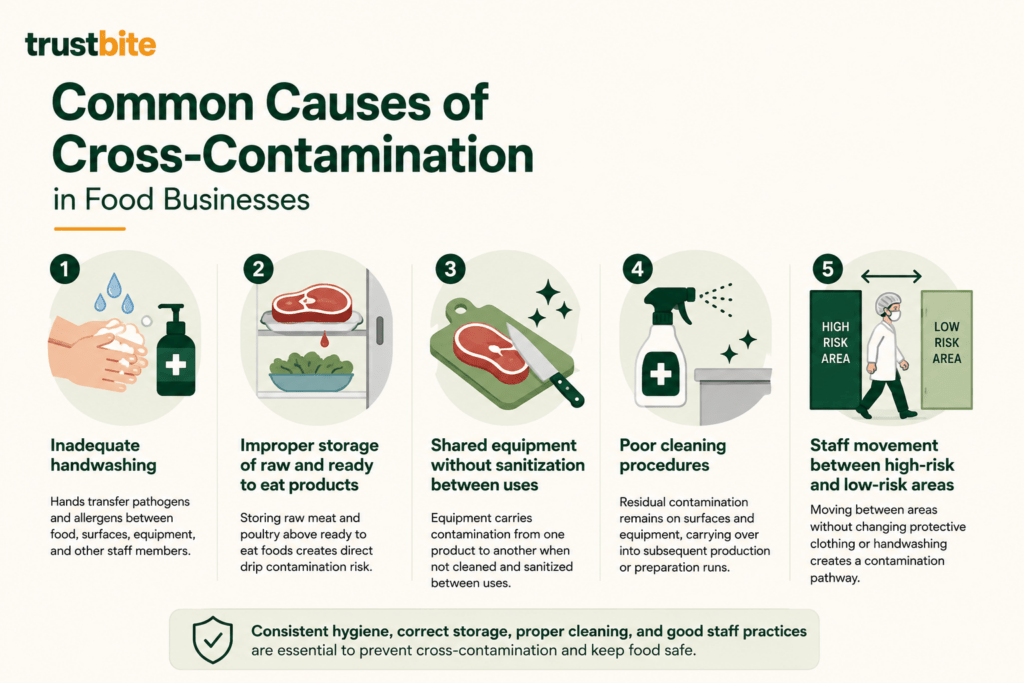
Several causes come up repeatedly across different types of food business when cross-contamination incidents are investigated.
Inadequate handwashing is the most common single factor. Hands transfer pathogens and allergens between food, surfaces, equipment, and other staff members. Handwashing at the correct frequency, with the correct technique, using soap and warm water, and for an adequate duration is a basic control that is frequently poorly applied in practice.
Improper storage of raw and ready to eat products, particularly in refrigerated environments where raw meat and poultry are stored above ready to eat foods, creates direct drip contamination risk.
Shared equipment without sanitization between uses allows equipment to carry contamination from one product to another. This includes cutting boards, knives, slicers, mixing bowls, and any other utensil or piece of equipment that contacts multiple products.
Poor cleaning procedures allow residual contamination to remain on surfaces and equipment, carrying over into subsequent production or preparation runs. A surface that looks clean can still carry pathogen or allergen residue if it was cleaned without the right product, at the wrong concentration, or without adequate contact time.
Staff movement between high-risk and low-risk areas without changing protective clothing or handwashing creates a contamination pathway through the building itself.
How Food Businesses Prevent Cross-Contamination
Preventing cross-contamination in a food business requires both physical controls and behavioral controls, and both must be maintained consistently.
Physical separation of raw and ready to eat products, including dedicated storage areas, color-coded equipment, and defined workflow patterns that prevent raw and cooked products from occupying the same space at the same time, is the foundational structural control.
Cleaning and sanitation procedures must be designed to actually remove the hazards they are targeting. Surface ATP swab testing confirms whether cleaning has produced microbiologically clean surfaces rather than just visually clean ones. Equipment such as Adria Food Tech‘s food safety monitoring and detection solutions provides the objective verification evidence that sanitation is performing as required rather than being assumed from visual inspection alone.
Allergen management procedures require explicit protocols covering ingredient segregation, equipment cleaning and validation between allergen runs, and labelling controls.
Handwashing facilities must be accessible, adequately supplied, and positioned so that staff can wash hands at the required frequency without friction. If washing hands requires walking to a distant sink, it will happen less often.
Staff training is the control that makes all other controls actually work. Physical systems and procedures are only effective when the people operating them understand why cross-contamination matters, what it causes, and what their specific responsibilities are in preventing it. Providers such as Confi Food deliver structured food safety training that covers cross-contamination prevention as a core topic, building the knowledge and practical understanding that turns procedures into consistent behavior.
Cross-Contamination and HACCP
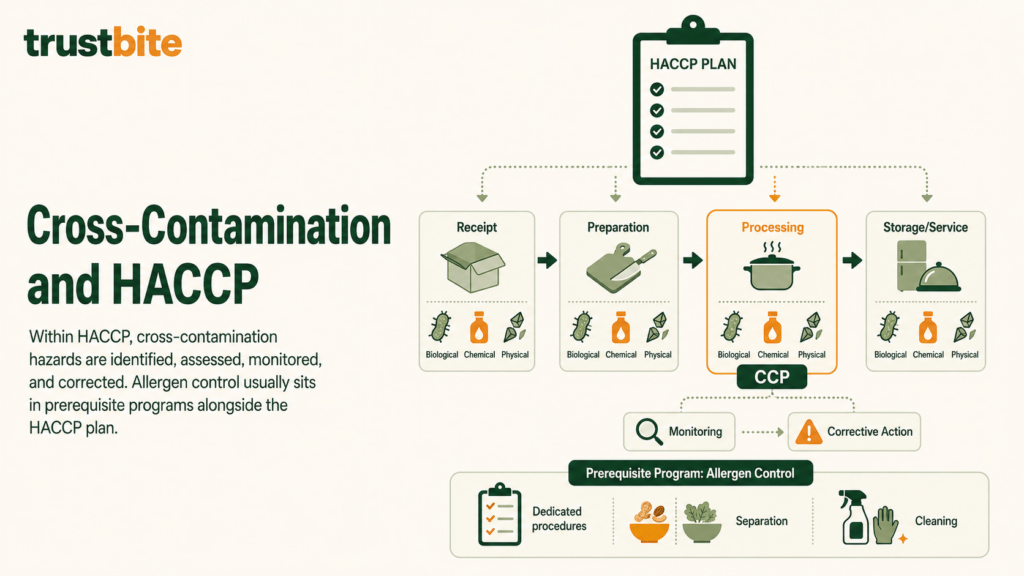
Cross-contamination is addressed within a HACCP system as part of the hazard analysis. Biological, chemical, and physical cross-contamination hazards are identified at each process step and assessed for likelihood and severity. Where cross-contamination is identified as a significant hazard at a specific step, that step may become a critical control point, with a defined monitoring procedure and corrective action.
Allergen management is typically addressed through prerequisite programs rather than CCPs in most HACCP frameworks, with dedicated allergen control procedures that sit alongside the HACCP plan.
Conclusion
Cross-contamination is one of the most preventable causes of foodborne illness and allergen incidents in food businesses, and one of the most consistently present across food safety failures. The controls that prevent it are well established: physical separation of raw and ready to eat products, correct cleaning and sanitation procedures, allergen management protocols, and well-trained staff who understand the consequences of the shortcuts they might otherwise take. The challenge in every food business is not knowing what to do but maintaining the discipline to do it consistently across every shift, every day.
Frequently Asked Questions
What is cross-contamination in food safety?
Cross-contamination is the unintentional transfer of a biological, chemical, physical, or allergenic hazard from a contaminated source to a previously uncontaminated food product, creating a food safety risk for the consumer.
What are the three types of cross-contamination?
The three main types are direct cross-contamination, where contaminated food directly contacts safe food; indirect cross-contamination, where the hazard is transferred through an intermediate such as hands, equipment, or surfaces; and drip contamination, where liquids from raw or higher-risk products drip onto lower-risk products.
What is the difference between cross-contamination and allergen cross-contact?
Cross-contamination typically refers to the transfer of microbial, chemical, or physical hazards. Allergen cross-contact is the transfer of an allergen from one food to another through shared equipment, surfaces, or handling. Both are forms of cross-contamination, but allergen cross-contact requires different management approaches since it cannot be eliminated by cooking.
What are the most common causes of cross-contamination in food businesses?
The most common causes are inadequate handwashing, improper storage of raw and ready to eat products, shared equipment used between products without sanitization, poor cleaning procedures, and staff movement between high-risk and low-risk areas without appropriate hygiene measures.
How can cross-contamination be prevented?
Prevention requires physical separation of raw and ready to eat products, correct cleaning and sanitation validated through objective testing, allergen management protocols, accessible handwashing facilities, and well-trained staff who understand the risks and their responsibilities.
Why is handwashing so important for preventing cross-contamination?
Hands transfer pathogens and allergens between food, surfaces, equipment, and other people. Inadequate handwashing is the most common single contributor to cross-contamination incidents in food handling environments.
What is drip contamination?
Drip contamination occurs when liquid from a raw or higher-risk product drips onto a lower-risk or ready to eat product below it, most commonly in refrigerated storage. Raw meat and fish should always be stored below cooked and ready to eat products to prevent this.
How does cross-contamination relate to HACCP?
Cross-contamination hazards are identified and assessed during the hazard analysis stage of HACCP. Where cross-contamination is a significant hazard at a specific process step, that step may be designated a critical control point with defined monitoring procedures and corrective actions.
Can allergen cross-contamination be prevented by cooking?
No. Allergens are not destroyed by heat. A food contaminated with an allergen through cross-contact during preparation remains an allergen risk regardless of how it is subsequently cooked.
What is ATP swab testing and how does it help prevent cross-contamination?
ATP swab testing is a method for verifying that cleaning has removed biological contamination from surfaces by detecting adenosine triphosphate, a molecule present in living cells. A result above the acceptable threshold indicates that surface cleaning was insufficient and that cross-contamination risk remains.
What color-coded equipment systems are used to prevent cross-contamination?
Color-coded cutting boards, knives, and other utensils are assigned to specific food categories or allergen handling zones to prevent equipment from being used across incompatible product types. Common systems assign red to raw meat, blue to raw fish, yellow to raw poultry, green to salads and fruit, and white to dairy and bakery products.
How often should food businesses test for cross-contamination risks?
Environmental testing through ATP swabs and microbiological swabs should be scheduled as part of the verification program, with frequency based on the risk level of the production environment. High-risk ready to eat environments typically require more frequent testing than lower-risk environments.
Does staff training help prevent cross-contamination?
Yes. Most cross-contamination incidents involve a human action or inaction, whether a skipped handwash, a shortcut in cleaning, or incorrect storage. Trained staff who understand why controls exist and what cross-contamination causes are more likely to apply procedures consistently than staff who follow rules without understanding the reasoning.
What should a business do if cross-contamination is discovered?
The affected product should be isolated and assessed. If it cannot be shown to be safe, it should be disposed of. The source of the contamination should be identified and the contributing gap in procedure should be addressed. The incident and its resolution should be documented.
Related from the Knowledge Center
Why Food Safety Systems Fail: Common Causes and Practical Prevention
Cross-contamination is one component of a broader pattern of system failures. This article examines the full range of causes behind food safety system breakdowns.
What Is HACCP? A Beginner’s Guide to Food Safety and Risk Prevention
HACCP is the system most food businesses use to identify and control cross-contamination as part of a structured hazard analysis.
Food Safety Training: A Complete Guide for Employers
Because cross-contamination is largely a behavioral failure, staff training is one of the most effective controls a food business can invest in.