Why Food Safety Systems Fail
Food safety systems are created to control risk. They define how food should be received, stored, prepared, cooked, cooled, packaged, delivered, served, and documented. They also set expectations for hygiene, cleaning, allergen control, temperature control, traceability, and corrective action.
Yet businesses with written procedures, HACCP plans, checklists, and training records can still experience food safety failures. This does not always mean the system was badly designed. In many cases, the system fails because daily operations slowly move away from the written rules.
A procedure may say that chilled food must be kept under control, but if the refrigerator is overloaded, temperatures are not checked, staff are too busy to react, or no one knows what to do when a limit is exceeded, the system becomes weak. The same applies to cleaning, hand hygiene, allergen control, stock rotation, or cross contamination. A single mistake may not create an immediate problem, but repeated small mistakes can build into a serious operational failure.
This is why food safety is not only about documents. A strong system depends on trained people, active supervision, accurate records, clear communication, and a workplace culture where food safety is treated as part of normal work, not as an audit requirement.
Poor Training
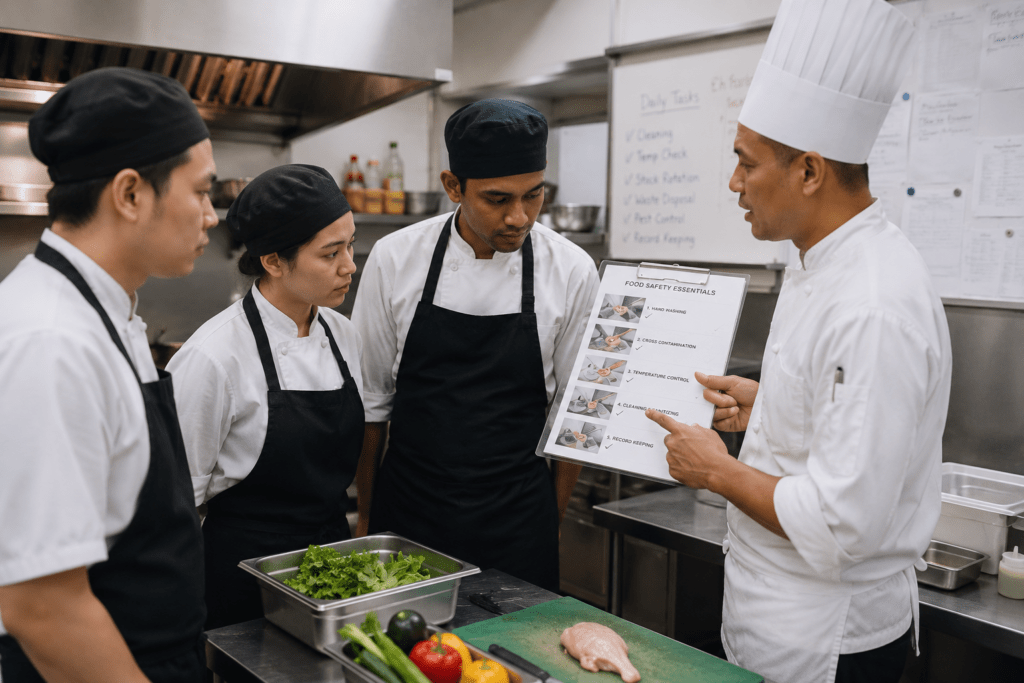
Poor training is one of the most common reasons food safety systems fail. Many businesses train employees when they start work, then assume the risk is controlled. In reality, food safety knowledge needs to be repeated, refreshed, and connected to the actual tasks employees perform every day.
A food handler may understand that poor food hygiene is a risk, but still forget to wash hands between handling raw ingredients and ready-to-eat food during a busy shift. A hotel breakfast worker may know that buffet food must be controlled, but may not understand when food should be replaced, when utensils should be changed, or how allergen information should be communicated to guests. A vending operator may know that machines should be cleaned, but may not understand which surfaces require special attention or how product residue can build up over time.
Training fails when it is too general. Employees do not only need to hear what the rules are. They need to understand how those rules apply in their work area, during pressure, and when something goes wrong.
Good employee training explains the reason behind the task. Staff should understand why handwashing matters, why raw and ready-to-eat foods must be separated, why temperature limits exist, and why records must reflect real conditions. When people understand the reason, they are more likely to make the right decision when a supervisor is not present.
Employee Turnover
Employee turnover creates one of the biggest consistency problems in food safety. Restaurants, hotels, catering operations, delivery services, vending companies, and food factories often rely on seasonal workers, temporary workers, part-time staff, or employees with limited experience.
When trained employees leave, knowledge leaves with them. New workers may not know where cleaning tools are kept, how allergens are controlled, how temperatures are recorded, or what to do when something is outside the required limit. Temporary workers may follow what they see others doing, even if those habits are not correct.
This is how food safety mistakes become routine. A shortcut used by one experienced employee can quickly become the unofficial method taught to new staff.
High turnover also puts pressure on supervisors. They may have to train new employees while managing service, production, deliveries, or customer demands. If onboarding is rushed, the business may end up with workers performing food safety tasks they do not fully understand.
Food businesses need simple onboarding, clear task instructions, and easy access to procedures. New employees should not have to rely on memory, guesswork, or informal explanations from busy colleagues.
Lack of Monitoring
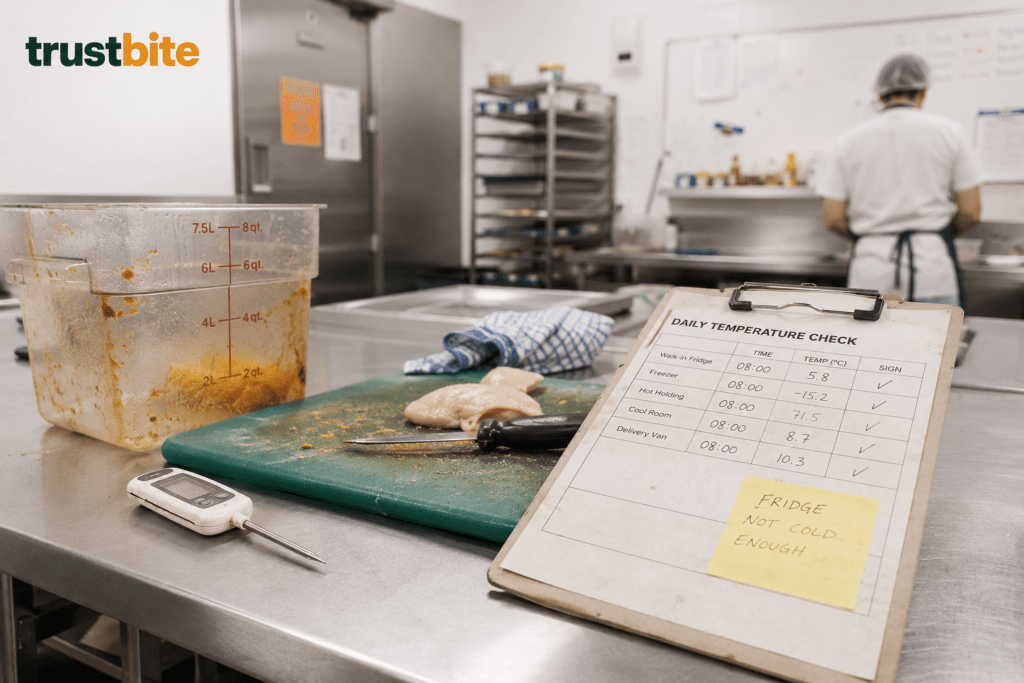
A food safety system only works if important controls are monitored. Temperatures must be checked. Cleaning must be verified. Critical control points must be reviewed. Corrective actions must be recorded and followed up.
When monitoring is weak, problems can continue without being noticed.
In a restaurant, chilled ingredients may be stored in a refrigerator that is not holding the correct temperature. In a hotel, buffet food may remain on display too long without proper checks. In a food factory, a metal detector, sieve, cooking step, cooling process, or packaging control may not be checked at the required frequency. In a delivery operation, chilled food may be transported without reliable temperature confirmation.
Monitoring failures often happen for practical reasons. A thermometer may be missing or damaged. A checklist may be completed at the end of the shift from memory. A manager may assume that a refrigerator is safe because it feels cold. A worker may skip a check because the line is busy.
Monitoring should be realistic, simple, and connected to action. Recording a temperature is not enough if no one knows what to do when the result is unacceptable. A food safety system fails when monitoring becomes a habit of writing numbers instead of controlling risk.
Documentation Failures
Food safety documentation is often treated as paperwork, but it has a practical purpose. Records help prove that controls were followed, identify repeated problems, support investigations, and show whether corrective actions were completed.
Documentation failures hide the real condition of the operation. A signed cleaning checklist does not prove that cleaning was effective if no one verified the result. A temperature log does not protect the business if the values are copied from previous days. A HACCP plan does not control risk if corrective actions are vague, missing, or not followed.
Common documentation failures include incomplete records, forms filled in before tasks are completed, missing signatures, outdated procedures, unclear corrective actions, and records that are collected but never reviewed.
This creates a false sense of control. The business appears compliant on paper, while daily practice may be drifting away from the system.
Good documentation should be accurate, practical, and useful. It should help managers understand what is happening in the operation. If records are only created for audits, they are unlikely to support real food safety compliance.
Poor Management Involvement
Food safety systems fail when management treats food safety as a side responsibility. Employees quickly notice what leaders truly prioritize. If speed, output, and cost are always discussed, while hygiene, cleaning, training, and corrective action are ignored, staff will naturally adjust their behavior.
Management involvement does not mean managers must perform every food safety task themselves. It means they must set expectations, provide resources, check performance, correct unsafe habits, and support employees when food safety decisions affect operations.
A restaurant manager should support a cook who rejects a delivery because the temperature is not acceptable. A factory supervisor should stop production when a critical control issue appears. A hotel manager should allow enough time for proper cleaning between service periods. A vending business owner should ensure that operators have the right tools, instructions, and replacement parts to maintain machines correctly.
When management is not involved, food safety becomes something employees do only when they have time. That is when systems start to fail.
Time Pressure
Food businesses often operate under pressure. Orders must be prepared quickly. Guests are waiting. Production targets must be met. Deliveries are delayed. Employees call in sick. Equipment breaks down. These are normal operational realities, not unusual events.
Time pressure increases the chance of food safety mistakes. A cook may skip handwashing between tasks. A warehouse worker may leave chilled ingredients outside cold storage for too long. A cleaner may rush through contact surfaces. A delivery driver may combine incompatible products to save time. A vending operator may restock a machine without properly cleaning the dispensing area.
Food safety risks often appear in the gap between the correct procedure and the fastest shortcut.
A realistic food safety system must work under normal pressure. Procedures should be clear enough to follow during busy periods, not only during quiet moments. Staff should know which steps must never be skipped. Managers should identify the points where pressure regularly causes mistakes and build controls around them.
A system that only works in perfect conditions is not a reliable system.
Cross Contamination
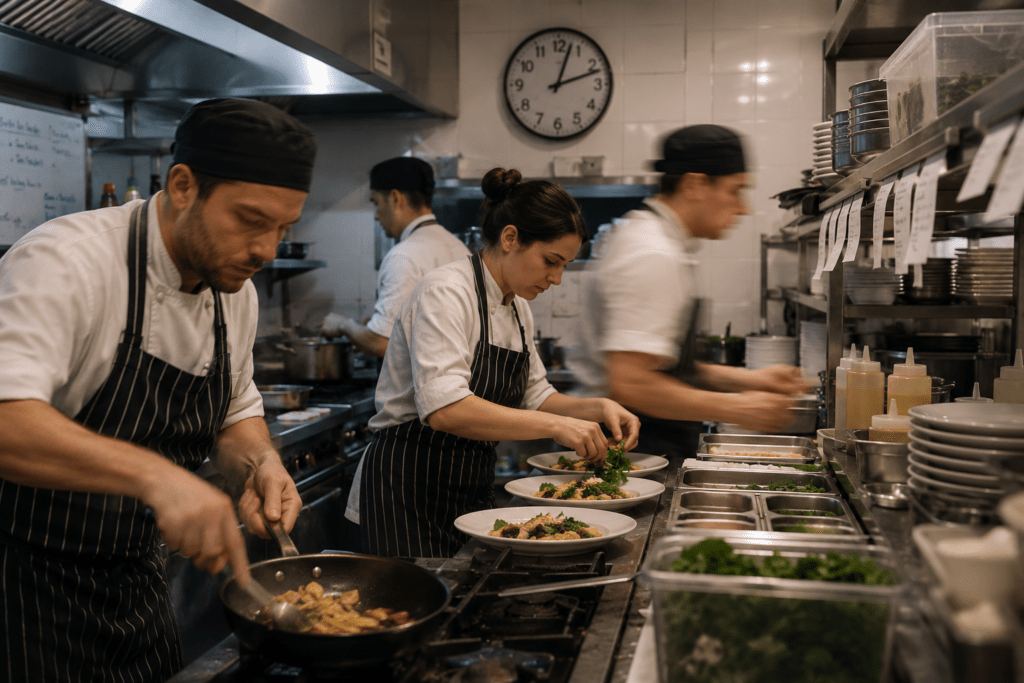
Cross contamination remains one of the most common causes of food safety failures. It occurs when harmful bacteria, allergens, chemicals, or foreign materials move from one food, surface, tool, person, or area to another.
In restaurants, cross contamination may happen when raw meat juices come into contact with ready-to-eat foods. In hotels, shared buffet utensils may transfer allergens between dishes. In food factories, poor cleaning between production runs may allow residue from one product to contaminate the next. In delivery operations, raw and ready-to-eat foods may be transported together without proper separation. In vending systems, residue can build up on contact surfaces if cleaning is not performed correctly.
Cross contamination is often a system failure, not simply an employee mistake. If work areas are poorly organized, tools are not separated, allergens are not clearly labelled, or cleaning equipment is shared between zones, mistakes become more likely.
Prevention requires practical controls. These may include separation of raw and ready-to-eat areas, clear allergen procedures, suitable cleaning methods, colour-coded equipment where appropriate, staff training, and regular checks by supervisors.
Temperature Abuse
Temperature abuse happens when food is stored, cooked, cooled, transported, displayed, or served outside safe temperature conditions. It is a common food safety risk because it can happen quietly. Food may look normal, smell normal, and still be unsafe.
Restaurants may experience temperature abuse when cooked food cools too slowly or chilled ingredients are left out during preparation. Hotels may face problems during buffet service, especially when food remains on display for long periods. Food factories may struggle with temperature control during storage, processing, packing, or loading. Delivery operations may face delays, poor insulation, or unsuitable vehicle conditions. Vending systems may be affected by machine faults, poor stock rotation, or delayed maintenance.
Temperature control depends on equipment, monitoring, staff response, and management follow-up. It is not enough to record temperatures if unacceptable results are ignored. It is not enough to cook food correctly if it is later held or cooled incorrectly.
Temperature abuse becomes a serious problem when no one notices it, or when employees notice it but do not know what action to take.
Communication Failures
Food safety depends on communication between shifts, departments, suppliers, managers, and employees. When communication breaks down, important information does not reach the people who need it.
A morning shift may notice a refrigerator problem but fail to inform the evening team. A supplier may change an ingredient, but allergen information may not reach front-of-house staff. A factory quality team may update a procedure, while production employees continue using the old version. A delivery team may experience a delay, but the receiving customer may not be told that temperature control could be affected.
Many food safety failures are linked to these small communication gaps.
Verbal instructions are useful, but they are not enough for critical information. People forget details. Messages change as they pass from one person to another. New and temporary employees may not receive the message at all.
Food businesses need clear communication methods for shift handovers, allergen updates, maintenance problems, cleaning issues, rejected deliveries, corrective actions, and changes in procedures.
Weak Food Safety Culture
Food safety culture is the way people behave when no one is watching. It is shaped by leadership, training, expectations, supervision, accountability, and daily habits.
A weak food safety culture does not always look obvious. It may appear as small repeated behaviours. Staff may ignore handwashing because others do the same. Managers may accept incomplete records because the audit is not soon. Workers may avoid reporting problems because they fear blame. Cleaning may be rushed because it is seen as less important than production or service.
Over time, unsafe habits become normal.
A strong food safety culture is not built by slogans or posters alone. It is built when managers respond to problems properly, employees are trained for real tasks, procedures are easy to follow, and food safety is treated as part of daily work.
The goal is not to create fear. The goal is to create consistency.
How Small Mistakes Become Larger Failures
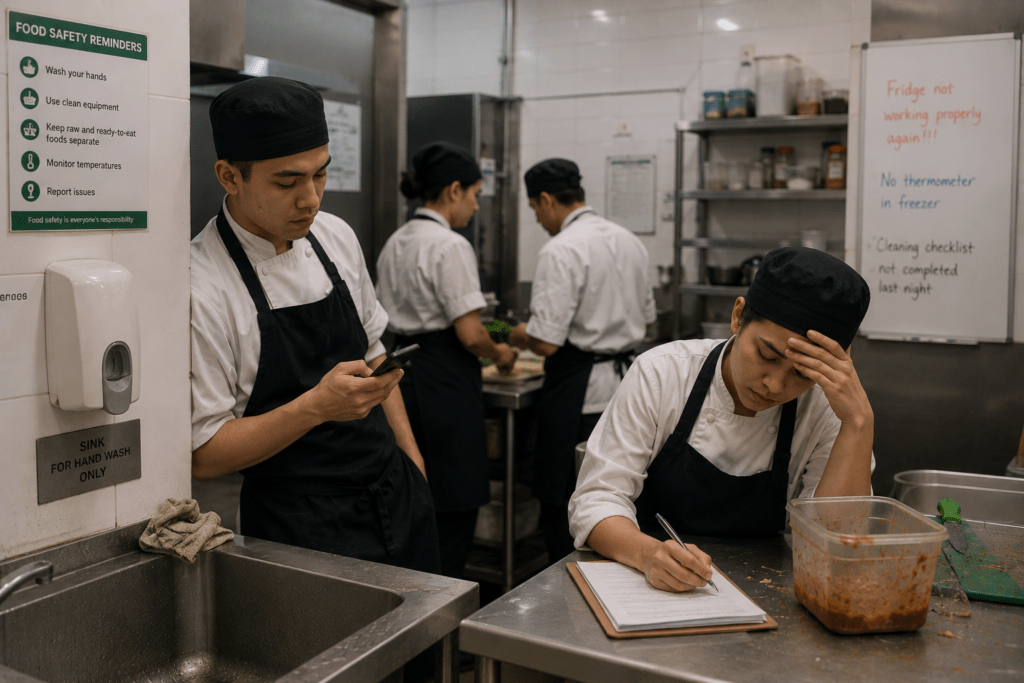
Most food safety failures do not begin with one major event. They usually develop through a chain of smaller weaknesses.
A new employee receives rushed training. A supervisor is too busy to check their work. A cleaning record is signed without verification. A refrigerator temperature is slightly high, but no one investigates. A delivery arrives late and is accepted without checking. A shift handover is missed. A customer complaint is treated as an isolated issue.
Each event may seem minor. Together, they show a system that is losing control.
This is why businesses should look for patterns, not only incidents. Repeated missing records, frequent temperature deviations, recurring cleaning problems, unclear corrective actions, and regular staff confusion are warning signs. They show that the system may not be working as intended.
Food safety systems fail when small problems are allowed to become normal.
Practical Examples Across Food Operations
In restaurants, food safety failures often involve poor hand hygiene, rushed preparation, cross contamination between raw and cooked foods, incorrect cooling, weak allergen communication, or cleaning that is completed too quickly during busy service.
In hotels, risks often appear during breakfast service, buffets, banquets, and large events. Food may remain on display too long. Serving utensils may be mixed between dishes. Temporary staff may not understand allergen procedures. Communication between kitchen, service, and management may be unclear.
In food factories, HACCP failures may involve weak monitoring of critical control points, poor sanitation between production runs, incorrect labelling, foreign body control issues, incomplete traceability, or records that are not reviewed properly. The more complex the operation, the more important it becomes to keep procedures clear and controls verified.
In delivery operations, food safety risks include poor temperature control, damaged packaging, mixed loads, delays, unclear responsibility, and lack of communication between the business, driver, and customer.
In vending systems, food safety depends on product suitability, stock rotation, cleaning, pest prevention, machine maintenance, and temperature control where chilled products are involved. A vending machine may seem simple, but it still requires a controlled food safety process.
Different operations have different risks, but the pattern is the same. Failures happen when daily work drifts away from the system.
How Continuous Education and Digital SOP Access Reduce Operational Risk
Food safety systems work better when employees can access clear instructions at the moment they need them.
Continuous education helps keep food safety knowledge active after initial training. It supports new employees, refreshes experienced staff, and helps businesses respond when procedures change. This is especially important in workplaces with employee turnover, multiple shifts, seasonal workers, or language barriers.
Digital SOP access can reduce confusion by making procedures available directly at the point of work. Employees can quickly check how to clean a machine, how to handle an allergen request, what to do when a temperature is outside the limit, or how to complete a specific food safety task. This reduces reliance on memory and informal instructions.
Workforce consistency platforms such as Confi Food can support this approach by helping food businesses organize training, SOP access, task guidance, and operational reminders in one place. The value is not only in storing documents digitally. The real value is making the correct instruction easy to find, easy to understand, and available during daily work.
This can help restaurants standardize procedures across shifts, hotels train rotating staff, factories support production teams, delivery operations follow handling rules, and vending operators complete cleaning and maintenance tasks more consistently.
Digital tools do not replace management responsibility, supervision, or professional judgement. They support the system by making consistency easier.
Conclusion
Food safety systems fail when written procedures do not match daily behaviour. Poor training, employee turnover, weak monitoring, documentation failures, limited management involvement, time pressure, cross contamination, temperature abuse, communication gaps, and weak food safety culture all reduce control.
These problems do not need to be dramatic to matter. Small mistakes, repeated often enough, can become larger operational failures.
Prevention depends on consistency. Food businesses need practical training, clear responsibilities, realistic procedures, active supervision, accurate records, and a culture where employees report problems before they grow. Food safety compliance is not only about passing audits. It is about maintaining control of everyday operations.
A strong food safety system is not the one that looks best in a folder. It is the one people understand, use, check, and improve every day.
FAQ
Why do food safety systems fail?
Food safety systems fail when written procedures are not followed consistently in daily operations. Common causes include poor training, employee turnover, lack of monitoring, inaccurate documentation, weak communication, time pressure, and poor food safety culture.
What are the most common food safety failures?
Common food safety failures include poor hand hygiene, cross contamination, temperature abuse, weak allergen control, incomplete cleaning, missing records, poor employee training, and unclear communication between staff.
Can a business have HACCP and still experience food safety failures?
Yes. HACCP is an important food safety tool, but it only works when it is properly implemented, monitored, reviewed, and understood by employees. HACCP failures can happen when critical limits are not checked, corrective actions are not taken, or staff do not understand their responsibilities.
How does employee turnover affect food safety?
Employee turnover affects food safety because it reduces consistency. New or temporary workers may not understand cleaning procedures, allergen controls, monitoring tasks, or corrective actions. Without structured onboarding and clear instructions, mistakes become more likely.
How can restaurants reduce food safety risks?
Restaurants can reduce food safety risks by training employees regularly, preventing cross contamination, monitoring temperatures, keeping accurate records, maintaining cleaning routines, improving allergen communication, and making sure managers correct unsafe practices quickly.
How can hotels prevent food safety failures during buffet service?
Hotels can reduce buffet-related risks by monitoring holding temperatures, replacing food at appropriate times, separating allergens, changing utensils when needed, supervising service areas, and training staff to identify and report problems quickly.
What causes HACCP failures in food manufacturing?
HACCP failures in food manufacturing often happen because monitoring is incomplete, critical limits are not followed, sanitation is weak, labelling controls fail, traceability records are incomplete, or corrective actions are not properly documented and reviewed.
How can digital SOPs improve food safety?
Digital SOPs improve food safety by giving employees quick access to clear instructions at the point of work. This helps reduce confusion, supports new staff, improves consistency across shifts, and makes it easier to follow correct procedures during daily operations.