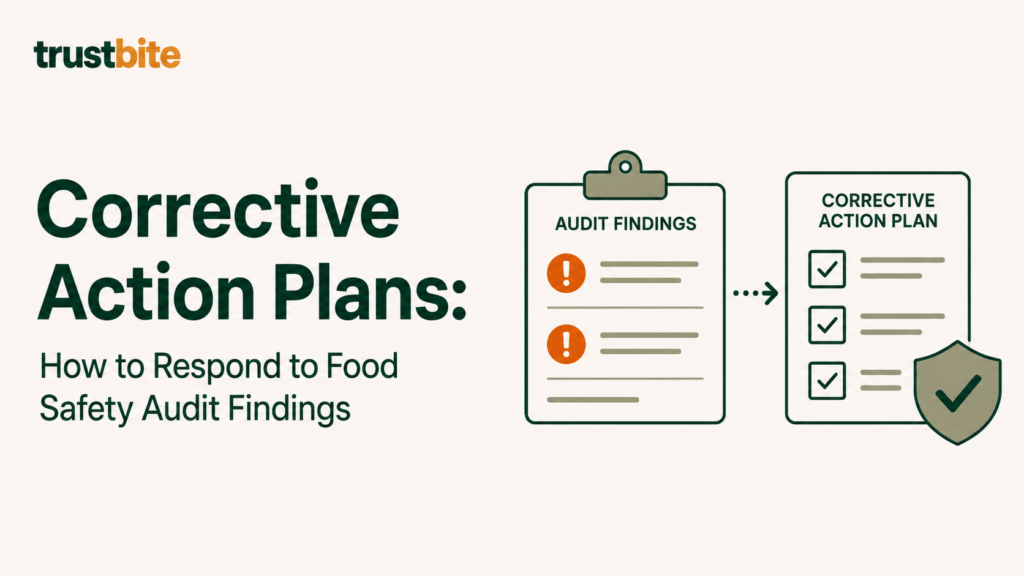
A corrective action plan is a documented response to non-conformances identified during a food safety audit or regulatory inspection. It specifies what will be done to address each finding, who is responsible for doing it, and by when it will be completed. Submitting a credible corrective action plan is typically required before a certification outcome is confirmed or a regulatory finding is closed, and how a business responds to audit findings tells auditors as much about its food safety management capability as the findings themselves.
The quality of a corrective action plan is consistently underestimated by food businesses. A plan that addresses the symptom of a finding rather than its root cause, or that commits to actions without the follow-up evidence to confirm they were completed, is one of the most reliable ways to generate additional audit findings at the next evaluation.
What Is a Corrective Action Plan?
A corrective action plan is a formal document submitted in response to one or more non-conformances found during a food safety audit. It records the nature of each non-conformance, the immediate action taken to correct the specific situation that caused the finding, the root cause of the non-conformance, the systematic corrective action that will prevent recurrence, the evidence that will demonstrate completion, the person responsible, and the deadline for completion.
A corrective action plan is different from an immediate corrective action. An immediate corrective action is the response taken at the time of a CCP monitoring breach: a product is isolated, a process is stopped, or an equipment fault is addressed. A corrective action plan is the structured, documented response to an audit finding that addresses both the immediate situation and the underlying cause.
The Difference Between Correction and Corrective Action
Understanding the distinction between correction and corrective action is the most important concept in effective corrective action plan development.
A correction addresses the specific instance of the problem identified by the auditor. If an auditor finds that a refrigerator is operating at 8°C rather than the required maximum of 5°C, the correction is to reduce the refrigerator temperature to within its critical limit. This addresses the immediate finding but does not explain why the refrigerator drifted above temperature or prevent the same thing from happening again.
A corrective action addresses the root cause of the problem, the underlying reason why the finding occurred, in a way that prevents recurrence. The same refrigerator finding might have a root cause of inadequate equipment maintenance, a monitoring frequency that did not detect the drift quickly enough, or a critical limit set without adequate regard for the refrigerator’s actual performance range. The corrective action addresses whichever root cause investigation identifies as the actual driver of the finding.
An auditor reviewing a corrective action plan evaluates whether the actions proposed address root causes rather than only the symptoms. A plan that responds to every finding with “staff retrained” or “procedure updated” without evidence of root cause analysis is a plan that will generate the same findings at the next audit.
Root Cause Analysis in Corrective Action Planning
Root cause analysis is the structured process of identifying the underlying reason why a non-conformance occurred. In a corrective action plan, root cause analysis answers the question: why did this happen, and what systemic condition allowed it to occur?
Several root cause analysis methods are used in food safety contexts. The 5 Whys technique involves repeatedly asking “why” about each successive answer until the underlying cause is reached. Starting with “the refrigerator was above temperature” and asking why five times might reveal that the monitoring frequency was too low to detect a gradual drift, which occurred because the equipment calibration had not been checked in six months, which occurred because there was no scheduled calibration procedure in the food safety management system. The corrective action at that root cause level is implementing a calibration schedule, not retraining a technician.
Fishbone diagrams, also called Ishikawa or cause-and-effect diagrams, systematically explore possible causes across categories including people, procedures, equipment, environment, materials, and measurement. They are useful for complex findings with multiple potential contributing factors.
The depth of root cause analysis required should be proportionate to the severity of the finding. A minor documentation gap may have a straightforward root cause that is quickly identified. A major non-conformance involving a CCP monitoring failure warrants a more thorough investigation before a corrective action plan is submitted.
What a Corrective Action Plan Must Include
A credible corrective action plan must include the following components for each non-conformance addressed.
The non-conformance statement records the finding as identified by the auditor, typically in the auditor’s own words from the audit report. This anchors the corrective action plan to the specific finding.
The immediate correction records what was done right away to address the specific instance identified by the auditor. This confirms that the immediate food safety risk has been managed.
The root cause statement records the finding of the root cause analysis, explaining why the non-conformance occurred and what systemic condition allowed it to persist.
The corrective action records the specific steps that will be taken to address the root cause and prevent recurrence. Actions should be specific, practical, and proportionate to the root cause identified.
The implementation evidence describes the objective evidence that will confirm the corrective action has been completed, such as updated procedure documents with a new version date, training records showing the relevant employees received the updated training, calibration certificates, or monitoring records from the period following the corrective action showing the situation has improved.
The responsible person is the named individual who is accountable for ensuring the corrective action is completed within the defined timeframe.
The completion date is the committed deadline for all corrective actions related to the finding. Deadlines should be realistic given the nature of the actions required but should not be so distant that they suggest the finding is not being treated seriously.
Timelines for Corrective Action Plans
Most certification schemes specify the timeframe within which a corrective action plan must be submitted and within which corrective actions must be completed. Timelines vary by the severity of the finding.
Critical non-conformances typically require immediate action, with evidence of correction provided within days. Certification may be withheld until the certification body is satisfied that a critical finding has been effectively addressed.
Major non-conformances typically require a corrective action plan submitted within a defined period, commonly 28 days, with corrective actions completed within a further defined period. Failure to submit a credible corrective action plan within the required timeframe can result in certification being withheld or suspended.
Minor non-conformances are typically addressed within a longer timeframe, often at the next scheduled audit, provided a corrective action plan is submitted and the business can demonstrate that the finding has been acknowledged and addressed.
Consulting support for corrective action planning, including root cause analysis facilitation, documentation updates, and system improvements required to address certification findings, is part of the food safety management system support that providers such as Confi Food offer to food businesses preparing corrective action responses and rebuilding food safety system elements following significant audit findings.
Verifying That Corrective Actions Have Been Completed
Submitting a corrective action plan is the commitment. Evidence of completion is the confirmation. A corrective action plan that records all the right intentions without follow-up evidence of completion is not a closed finding. It is a pending one.
Objective evidence of completion typically takes the form of updated documents with version control showing the revision date, training records showing the relevant employees completed updated training after the corrective action was implemented, calibration records confirming that equipment has been calibrated or replaced, monitoring records from the period following the corrective action demonstrating improved compliance, or photographs of physical changes to the facility or equipment.
Auditors at the next evaluation will review whether the corrective actions committed in the previous plan have actually been implemented and whether they have produced the improvement they were designed to deliver. A pattern of corrective action plans that are submitted but not followed through, or that address findings without producing sustained improvement, is a significant indicator of food safety management system weakness.
Where monitoring equipment plays a role in the corrective action, such as when a finding relates to inadequate temperature monitoring at a CCP and the corrective action involves upgrading to automated continuous monitoring, equipment providers such as Adria Food Tech supply the monitoring and detection systems that form the objective technical element of such corrective actions, generating the continuous audit-ready records that demonstrate the upgraded control is functioning as intended.
Common Mistakes in Corrective Action Plans
Several patterns appear consistently in corrective action plans that fail to satisfy auditors and result in repeated findings.
Addressing the symptom rather than the root cause produces corrective actions that are implemented and completed but do not prevent the finding from recurring. Retraining staff for a CCP monitoring failure that was actually caused by inadequate monitoring frequency does not address the root cause.
Vague corrective actions that do not specify what will change, who will change it, and how completion will be confirmed provide no basis for an auditor to assess whether the plan will be effective. “Procedures will be reviewed and updated” is not a corrective action. “Procedure TB-CCP-003 will be revised to increase monitoring frequency from every 60 minutes to every 30 minutes, with the revised procedure implemented from [date], and all relevant staff trained on the change by [date], with training records retained in the training management system” is a corrective action.
Unrealistic deadlines that cannot be met result in overdue corrective actions at the next audit, which are often treated as more serious than the original finding because they indicate that the business did not take the commitment seriously.
Missing implementation evidence means corrective actions cannot be confirmed as complete, leaving the finding open regardless of whether the work was actually done.
Conclusion
A corrective action plan is both a compliance requirement and a demonstration of food safety management capability. Businesses that respond to audit findings with genuine root cause analysis, specific and realistic corrective actions, and objective evidence of completion demonstrate food safety management competence that auditors recognize and certification bodies reward with confidence in the overall system. Businesses that treat corrective action plans as paperwork to be produced quickly and forgotten produce recurring findings that erode certification confidence and eventually become significant compliance risks.
Frequently Asked Questions
What is a corrective action plan in food safety?
A corrective action plan is a formal document submitted in response to non-conformances found during a food safety audit or regulatory inspection, specifying the immediate correction, the root cause of the finding, the corrective action to prevent recurrence, the evidence of completion, the responsible person, and the deadline.
What is the difference between a correction and a corrective action?
A correction addresses the specific instance of the problem identified by the auditor. A corrective action addresses the root cause of the problem in a way that prevents recurrence. Both are required in a complete corrective action plan.
What is root cause analysis?
Root cause analysis is the structured process of identifying the underlying reason why a non-conformance occurred. Common methods include the 5 Whys technique and fishbone diagrams. The root cause is the systemic condition that allowed the finding to occur, not the immediate symptom.
How quickly must a corrective action plan be submitted after an audit?
Submission timelines vary by certification scheme and finding severity. Critical non-conformances typically require immediate action with evidence within days. Major non-conformances typically require a plan within 28 days. Minor non-conformances may be addressed over a longer period. Specific timeframes should be confirmed with the certification body.
What evidence is required to confirm a corrective action is complete?
Objective evidence of completion includes updated documents with version control, training records showing relevant staff completed updated training, calibration records, monitoring records from the period following the corrective action, or photographs of physical changes. The evidence must demonstrate that the action was implemented, not just planned.
What happens if a corrective action plan is not submitted within the required timeframe?
Failure to submit a corrective action plan within the required timeframe can result in certification being withheld or suspended. The certification body cannot close an audit finding without receiving and approving the corrective action plan and its supporting evidence.
What makes a corrective action plan credible to an auditor?
A credible plan demonstrates genuine root cause analysis rather than superficial responses, proposes specific and practical corrective actions proportionate to the root cause, commits to realistic deadlines, and identifies objective evidence that will confirm completion.
What is the most common mistake in corrective action planning?
The most common mistake is addressing the symptom rather than the root cause, producing corrective actions that are completed but do not prevent the finding from recurring. The second most common mistake is vague corrective actions that do not specify what will change, who is responsible, and how completion will be confirmed.
Can corrective action plans be rejected by a certification body?
Yes. A certification body can reject a corrective action plan that does not adequately address the root cause of the finding, that proposes vague or insufficient corrective actions, or that does not provide credible evidence of completion. A rejected plan requires resubmission with additional detail or different proposed actions.
What is the relationship between corrective action plans and HACCP?
HACCP requires pre-defined corrective actions for each CCP, specifying the response to a monitoring result showing a critical limit has been breached. These are distinct from the corrective action plans submitted in response to audit findings, though the same analytical discipline of identifying and addressing root causes applies to both.
Should corrective action plans cover all non-conformances from an audit?
Yes. Every non-conformance identified in the audit report requires a documented corrective action response. Plans may address minor findings collectively where they share a common root cause, but each finding must be acknowledged and its corrective action documented.
What role does staff training play in corrective action plans?
Training is often a component of corrective action for findings related to staff knowledge or practice gaps. However, training should only be included as a corrective action where the root cause analysis confirms that a knowledge or skills gap was the actual cause of the finding. Including retraining as a corrective action for every finding regardless of root cause is a pattern auditors recognize as inadequate root cause analysis.
How are corrective action plans reviewed at the next audit?
At the next audit, the auditor reviews the corrective actions committed in the previous plan and assesses whether they have been implemented, whether the implementation evidence is objective and complete, and whether the corrective actions have produced the improvement they were designed to deliver. Repeated findings in the same area indicate that previous corrective actions were not effective.
Can a business dispute an audit finding in a corrective action plan?
A business that believes an audit finding is incorrect can raise this with the certification body through the appropriate appeals or dispute process. The corrective action plan itself should address the finding as recorded unless a formal dispute has been lodged. Addressing a disputed finding under protest while the dispute is resolved prevents the finding from becoming a compliance risk if the dispute is not upheld.
Related from the Knowledge Center
What Is a Food Safety Audit? Types, Process, and What to Expect
Explains how food safety audits work, how findings are categorized by severity, and what the audit process looks like from opening meeting to closing.
Internal vs External Food Safety Audits: Key Differences and How Each Works
Internal audits generate findings that should also be addressed through a corrective action process. This article explains how internal and external audits work together in a food safety management system.
What Happens During a Food Safety Inspection? A Practical Walkthrough
Regulatory inspections also generate findings that require formal corrective action responses. This article explains what inspectors assess and how inspection outcomes are determined.