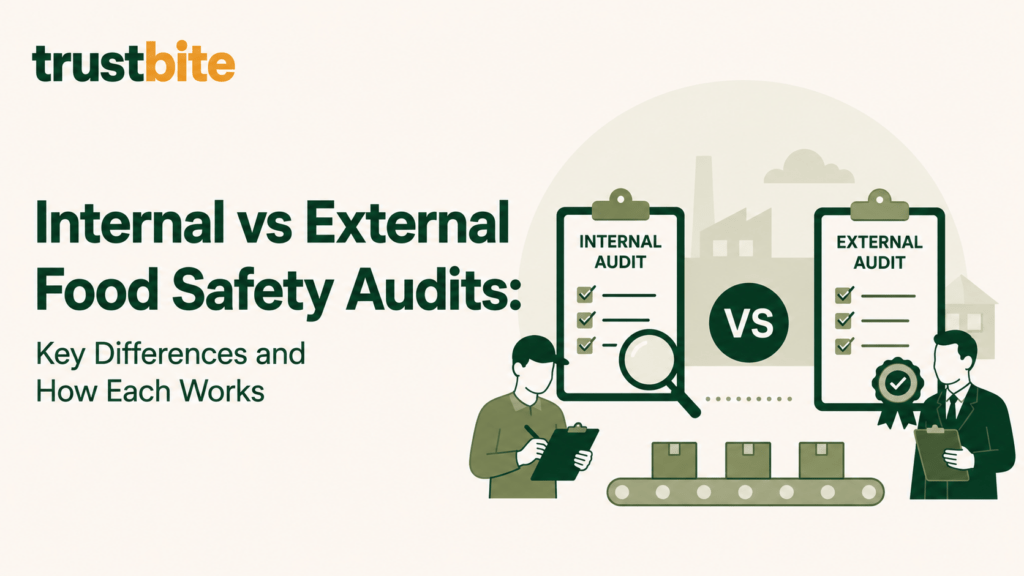
An internal food safety audit is conducted by personnel within the business to assess its own food safety system. An external food safety audit is conducted by an independent party, such as a certification body or a customer, to verify the system against a defined standard or requirement. Both types of audit serve essential functions, and a food business that relies on external audits alone is missing the layer of continuous self-assessment that keeps systems aligned with current practice.
Understanding the difference between internal and external food safety audits, what each one looks for, and how they work together helps food businesses use both more effectively and prepare more reliably for the external evaluations that determine certification and regulatory standing.
What Is an Internal Food Safety Audit?
An internal food safety audit is a systematic review of a food business’s food safety management system conducted by trained personnel within the organization. The purpose is to verify that the food safety system is functioning as documented, identify gaps or inconsistencies before they are found by an external auditor, and generate information that management can use to improve the system.
Internal audits are planned, scheduled, and documented. They are not informal walkthroughs or supervisory spot checks. An internal food safety audit follows a defined scope, uses a checklist or audit protocol based on the relevant standard or procedure, and produces a written report with findings and recommended corrective actions.
Internal audits are conducted by staff who have been trained in audit techniques and who are independent of the activities being audited. A production worker cannot credibly audit their own production area. A quality manager can audit the production area. In smaller businesses where genuine independence is harder to achieve, the audit process still benefits from following a structured protocol rather than relying on informal review.
What Is an External Food Safety Audit?
An external food safety audit is conducted by a party outside the organization. External food safety audits fall into two main categories based on who conducts them and why.
Second party audits are conducted by a customer, buyer, or retailer auditing a supplier. The purpose is to confirm that the supplier’s food safety system meets the buyer’s requirements, which may go beyond baseline regulatory requirements. A major retailer auditing a manufacturer supplying own-brand products is a common example. Second party audits are driven by commercial relationships and buyer standards rather than by certification requirements.
Third party audits are conducted by an independent certification body that has no commercial relationship with the business being audited. Third party audits are what lead to formal food safety certifications such as BRCGS, ISO 22000, SQF, IFS, or FSSC 22000. Because the auditor is independent of both the business and any buyer relationship, third party audit outcomes carry the greatest external credibility.
Regulatory inspections are a related category conducted by government food safety authorities. These differ from certification audits in that they assess compliance with food safety law rather than voluntary standards, and non-compliance carries legal consequences rather than the loss of a voluntary certification.
Key Differences Between Internal and External Food Safety Audits
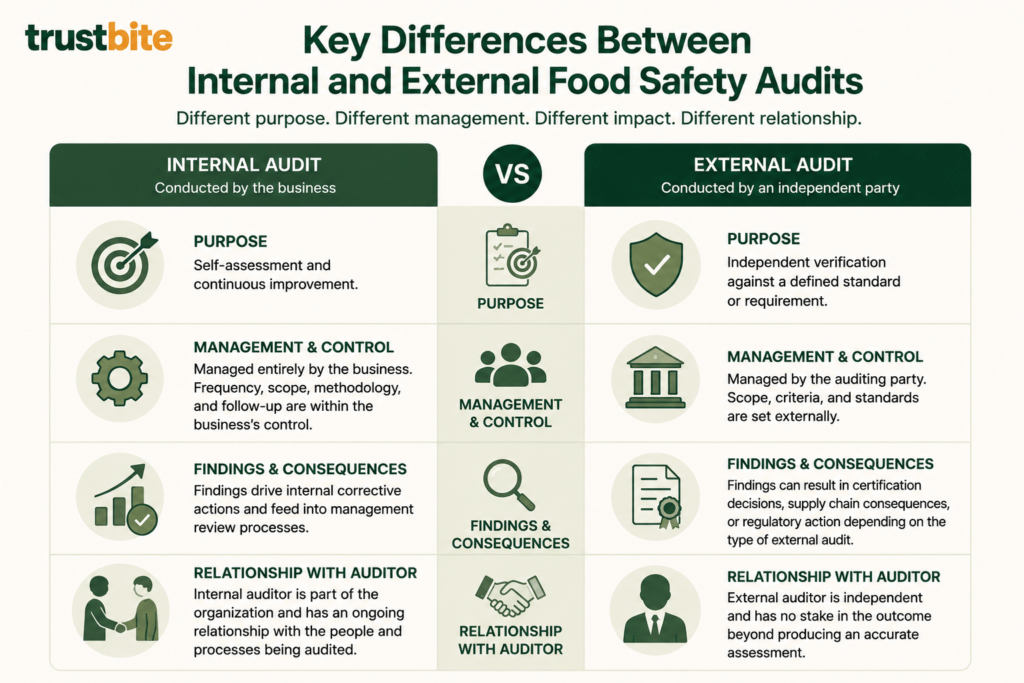
The purpose of an internal food safety audit is self-assessment and continuous improvement. The purpose of an external food safety audit is independent verification against a defined standard or requirement. These different purposes produce different audit approaches, different documentation requirements, and different consequences for findings.
Internal audits are managed entirely by the business. The frequency, scope, methodology, and follow-up process are within the business’s control. Findings from an internal audit drive internal corrective actions and feed into management review processes.
External audits are managed by the auditing party. The scope, criteria, and standards are set externally. Findings can result in certification decisions, supply chain consequences, or regulatory action depending on the type of external audit.
The relationship between auditor and organization also differs significantly. An internal auditor is part of the organization and has an ongoing relationship with the people and processes being audited. An external auditor is independent and has no stake in the outcome beyond producing an accurate assessment.
How Internal Audits Prepare Businesses for External Audits
Well-run internal food safety audits substantially improve performance in external audits by identifying and resolving gaps before an external auditor finds them. A business that has audited its own documentation, walked through its own facility with the critical eye of an external auditor, and addressed the findings has fewer surprises when the certification or regulatory audit takes place.
Internal audits also build organizational familiarity with the audit process. Staff who have been through internal audits know what questions to expect, are practiced at explaining their responsibilities, and are less likely to be caught off-guard by an external auditor’s interview questions.
Many food safety certification schemes explicitly require internal audits as part of the certified system. BRCGS and ISO 22000 both include internal audit requirements, meaning that the absence of a functioning internal audit program is itself a finding in an external audit.
Monitoring equipment that generates continuous, time-stamped records provides the kind of objective evidence an internal audit team can review in the same way an external auditor would. Equipment providers such as Adria Food Tech supply temperature monitoring, ATP testing equipment, and detection systems whose data trails serve both as verification evidence in internal audits and as the records an external auditor will examine during a certification or regulatory audit.
How Often Should Internal Food Safety Audits Be Conducted?
Internal food safety audit frequency should be risk-based, meaning that higher-risk areas of the operation are audited more frequently than lower-risk areas. A reasonable baseline for most food businesses is a full internal audit of the food safety management system at least once per year, with targeted internal audits of higher-risk processes or areas conducted more frequently, commonly quarterly.
Most food safety professionals also recommend scheduling an internal audit close to but not immediately before a planned external audit. This gives the business enough time to address findings identified internally before the external auditor arrives, without the internal audit being so far in advance that operational drift has occurred between the two.
What an Internal Food Safety Audit Covers
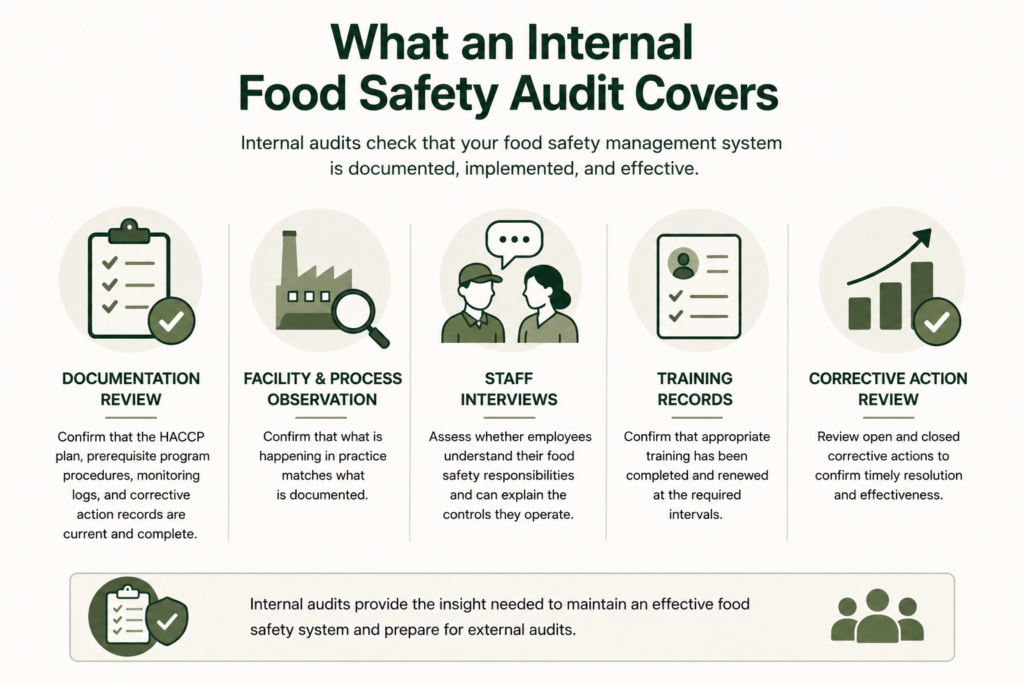
The scope of an internal food safety audit should mirror the scope of the external audit the business is preparing for, or in the absence of a planned external audit, should cover the full food safety management system.
Core areas typically covered include documentation review confirming that the HACCP plan, prerequisite program procedures, monitoring logs, and corrective action records are current and complete. Facility and process observation confirms that what is happening in practice matches what is documented. Staff interviews assess whether employees understand their food safety responsibilities and can explain the controls they operate. Training records confirm that appropriate training has been completed and renewed at the required intervals.
Consulting support for internal audit programs, including documentation review, gap analysis against specific certification standards, and mock audit exercises, is available from food safety management system specialists. Providers such as Confi Food work with food businesses to assess food safety management system readiness, identify gaps ahead of external audits, and build the internal audit capability that makes ongoing system maintenance more reliable.
Recording and Following Up Internal Audit Findings
Every internal food safety audit should produce a written report that documents the scope of the audit, the findings, their categorization by severity, and the corrective actions required. Corrective action owners and completion deadlines should be assigned for every finding.
Follow-up activity confirms that corrective actions have been completed and that the underlying gap has been resolved rather than merely addressed on paper. A finding that has a documented corrective action but no follow-up verification is only half resolved.
Internal audit records serve as evidence during external audits that the business is actively managing its food safety system between formal certification events.
Conclusion
Internal and external food safety audits serve different but complementary functions. External audits provide independent verification against defined standards and produce certification or compliance outcomes with commercial and regulatory significance. Internal audits provide ongoing self-assessment, identify gaps before they surface during external evaluations, and build the organizational discipline that keeps a food safety system aligned with current practice over time. Businesses that invest in well-run internal food safety audits consistently perform better in external audits and maintain more reliable food safety systems in the periods between them.
Frequently Asked Questions
What is an internal food safety audit?
An internal food safety audit is a systematic review of a food business’s food safety management system conducted by trained personnel within the organization, designed to verify that the system is functioning as documented and to identify gaps before an external audit.
What is an external food safety audit?
An external food safety audit is conducted by a party outside the organization, either a customer auditing a supplier, an independent certification body conducting a third-party audit, or a government authority conducting a regulatory inspection.
What is the difference between a second party and a third party food safety audit?
A second party audit is conducted by a customer or buyer auditing a supplier against their own requirements. A third party audit is conducted by an independent certification body against a defined standard such as BRCGS or ISO 22000, with no commercial relationship between the auditor and the business being audited.
How often should a food business conduct internal food safety audits?
A full internal audit of the food safety management system at least once per year is a reasonable baseline for most food businesses. Higher-risk areas should be audited more frequently, commonly on a quarterly basis.
Do certification schemes require internal food safety audits?
Yes. Most major food safety certification schemes including BRCGS and ISO 22000 require that the certified organization conducts internal audits as part of its food safety management system. The absence of a functioning internal audit program is a non-conformance in an external audit.
Can a business audit its own food safety system?
Yes. Internal food safety audits are conducted by the business’s own staff, provided the auditor is trained in audit techniques and is independent of the area being audited. In smaller businesses, a structured audit protocol helps maintain rigor when full independence is harder to achieve.
How does an internal food safety audit prepare a business for external certification?
A well-run internal audit identifies and resolves gaps before an external auditor finds them. It also builds staff familiarity with the audit process, so employees are better prepared to answer auditor questions and explain their responsibilities during the external evaluation.
What should an internal food safety audit report contain?
The report should document the audit scope, findings and their severity categorization, required corrective actions with assigned owners and completion deadlines, and any positive observations. Follow-up verification that corrective actions have been completed should be recorded as a separate activity.
What is a mock audit?
A mock audit is an internal or consultant-led simulation of an external food safety audit, designed to assess readiness and identify gaps under conditions that mirror what an external auditor would do. Mock audits are commonly conducted in the period before a certification audit.
Who can conduct a food safety audit on behalf of a customer?
Second party audits may be conducted by the customer’s own food safety personnel, an internal audit team, or an external audit service engaged by the customer to conduct supplier audits on their behalf.
What records from internal audits are reviewed during external audits?
External auditors typically review internal audit reports, the corrective actions taken in response to internal audit findings, and follow-up records confirming those corrective actions were completed. A history of internal audits with resolved findings is a positive indicator of a well-managed food safety system.
How does an unannounced external audit differ from a scheduled one?
A scheduled audit gives the business advance notice and time to prepare. An unannounced audit is designed to assess how the food safety system performs under normal unprepared operating conditions. Many certification schemes now use a mix of both to get a more accurate picture of system consistency.
Can a food business fail an external audit due to internal audit deficiencies?
Yes. If a certification scheme requires a functioning internal audit program and the external auditor finds that internal audits are not being conducted, documented, or followed up properly, this is a non-conformance that can affect the certification outcome.
What is the role of a food safety consultant in the audit process?
Food safety consultants can conduct gap analyses against certification standards, develop internal audit programs, run mock audits, review and update HACCP documentation, and coach businesses through the preparation process for external certification audits.
Related from the Knowledge Center
What Is a Food Safety Audit? Types, Process, and What to Expect
The foundational overview of food safety audits covering types, the audit process from opening meeting to closing, and how findings are categorized.
The 12 Steps of HACCP: A Practical Guide to Implementation
The HACCP plan and its associated records form the core of what both internal and external auditors review. This article explains how a HACCP system is built from the ground up.
Why Food Safety Systems Fail: Common Causes and Practical Prevention
Many of the gaps internal audits are designed to catch are the same gaps that lead to food safety system failures. This article explores the patterns in depth.