Every food business eventually faces the same question from a regulator, a buyer, or a certification body. Can you prove your food safety system works? A food safety audit is how that proof gets tested.
For many food businesses, the words food safety audit bring a mix of routine and anxiety. Restaurants prepare for health inspections. Manufacturers schedule certification audits months in advance. Suppliers respond to customer audit requests as a condition of doing business. Despite how common a food safety audit is, many people inside the food industry have only a partial understanding of what it actually verifies, who performs it, and what happens when something goes wrong during one.
This guide explains what a food safety audit is, the different types of food safety audits used across the food industry, what the process typically looks like from start to finish, and how businesses prepare for them.
What Is a Food Safety Audit?
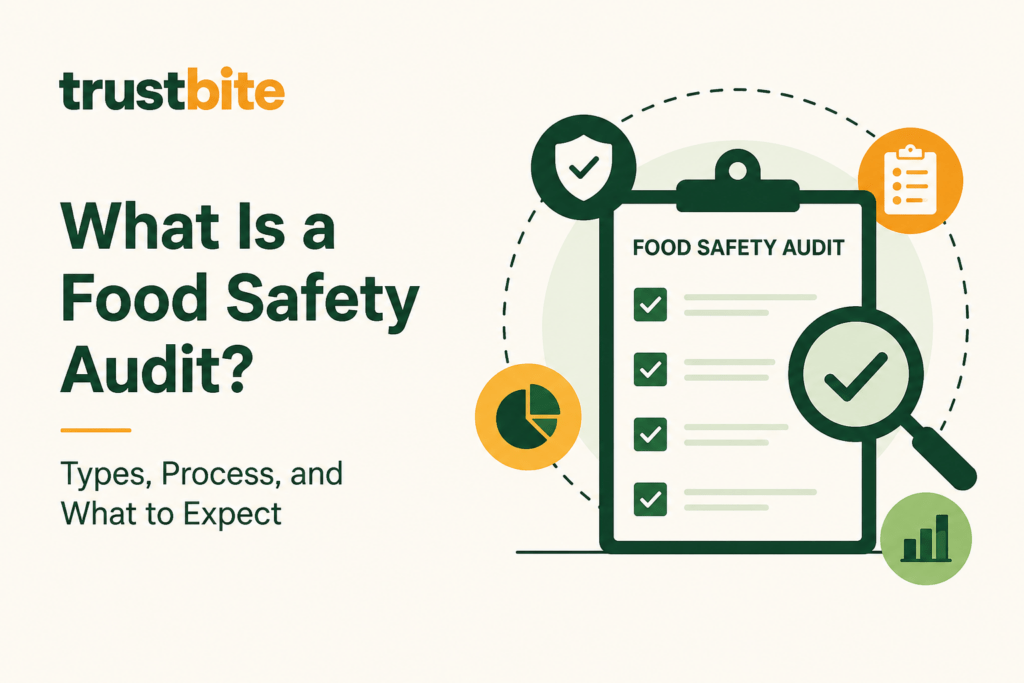
A food safety audit is a structured evaluation of a business’s food safety practices, documentation, and operational controls against a defined set of requirements. Those requirements might come from a government regulation, an industry certification scheme such as HACCP, ISO 22000, BRCGS, or SQF, or a private standard set by a customer or buyer.
The purpose of a food safety audit is to verify, with evidence, that a food safety system is being followed in practice and not just described on paper. Auditors examine records, observe operations, interview staff, and inspect facilities to determine whether food safety controls are functioning as intended.
Monitoring activities such as temperature checks or cleaning logs happen continuously as part of daily operations. A food safety audit is a separate, point-in-time assessment, usually performed by someone outside the immediate operational team, that tests whether those daily activities are consistent, documented, and effective.
Why Food Safety Audits Matter
Food safety audits exist because self-reporting alone is rarely treated as sufficient evidence of food safety performance. A business can claim to follow HACCP principles, but a food safety audit confirms whether critical control points are actually being monitored, whether corrective actions are documented, and whether staff understand their responsibilities.
For regulators, food safety audits and inspections are a tool for protecting public health. For certification bodies, an audit determines whether a business meets the requirements needed to hold a certificate. For buyers and retailers, a supplier audit provides assurance that food safety practices meet expectations before products reach shelves or menus.
Audits also serve an internal purpose. A well-run food safety audit, even an unannounced one, often reveals operational gaps that day-to-day staff have stopped noticing. Repetition can make people blind to small inconsistencies, and an outside reviewer asking direct questions tends to surface those gaps quickly.
Types of Food Safety Audits
Not all food safety audits serve the same purpose or carry the same weight. Understanding the different types helps explain why a business might be audited several times a year by several different parties.
Internal audits are conducted by a business’s own staff, often a quality or food safety manager, to check compliance with internal procedures before an external food safety audit takes place. Internal audits are typically less formal but serve as an early warning system for gaps that would otherwise surface during a certification or regulatory audit.
Second party audits are performed by a customer or business partner, most commonly a retailer or distributor auditing one of its suppliers. These audits confirm that a supplier meets the specific requirements set out in a supply agreement, which may go beyond baseline regulatory requirements.
Third party audits are conducted by an independent certification body that has no commercial relationship with the business being audited. These are the food safety audits that lead to formal certifications such as ISO 22000, BRCGS, IFS, SQF, or FSSC 22000. Because the auditor is independent, third party audits are generally viewed as more objective than internal or second party audits.
Regulatory audits and inspections are carried out by government food safety authorities to confirm compliance with food safety law. These are mandatory rather than voluntary, and the consequences of failure can include fines, closure orders, or product recalls.
A food safety audit can also be classified by whether it is announced or unannounced. Scheduled audits give a business time to prepare. Unannounced audits are designed to assess how the food safety system performs under normal, unprepared conditions. Many certification schemes now use a mix of both to get a more accurate picture of day to day compliance.
What Happens During a Food Safety Audit
While the specifics vary by audit type and standard, most food safety audits follow a similar structure.
The process usually begins with an opening meeting, where the auditor explains the scope of the food safety audit, the standard being assessed, and the schedule for the day. This is also when the business can flag any relevant context, such as recent renovations or process changes.
Next comes documentation review. The auditor examines records such as HACCP plans, monitoring logs, corrective action reports, supplier approvals, cleaning schedules, pest control records, and staff training documentation. Documentation review establishes whether the required systems exist on paper before the auditor checks whether they are followed in practice.
The facility walkthrough is where the auditor observes actual operations, including how food is stored, how temperatures are controlled, how staff handle raw and cooked products, how cleaning is carried out, and whether critical control points are being monitored as described in the documentation.
Many food safety audits include staff interviews, where employees are asked questions about their responsibilities, such as what they would do if a refrigerator temperature exceeded a critical limit. These interviews test whether food safety knowledge has been absorbed by the people actually doing the work, not just documented by management.
The audit typically concludes with a closing meeting, where the auditor summarizes findings, including any non-conformances identified, and outlines the next steps, including timelines for corrective action where needed.
What Auditors Typically Look For
Auditors generally assess three things at once during a food safety audit. They check whether a system exists, whether it is being followed, and whether it is effective at controlling the hazards it is designed to control.
This means an auditor checks more than whether a cleaning schedule exists on paper. The auditor verifies the cleaning schedule is actually being completed, signed, and verified, and that the cleaning itself is achieving the intended hygiene outcome. A business can have excellent documentation and still fail a food safety audit if the physical evidence on the ground does not match what the paperwork describes.
Verification evidence often comes from equipment rather than manual checks alone. ATP swab testing confirms whether a surface is genuinely clean after sanitation, cold chain monitoring sensors generate a continuous temperature record auditors can review directly, and foreign body detection systems provide automated proof that a control point is functioning rather than relying on a single visual check. Food safety systems integrators such as Adria Food Tech supply this kind of monitoring and detection equipment, which gives auditors objective, time-stamped evidence instead of a verbal account of what usually happens.
Common Reasons Businesses Fail Audits
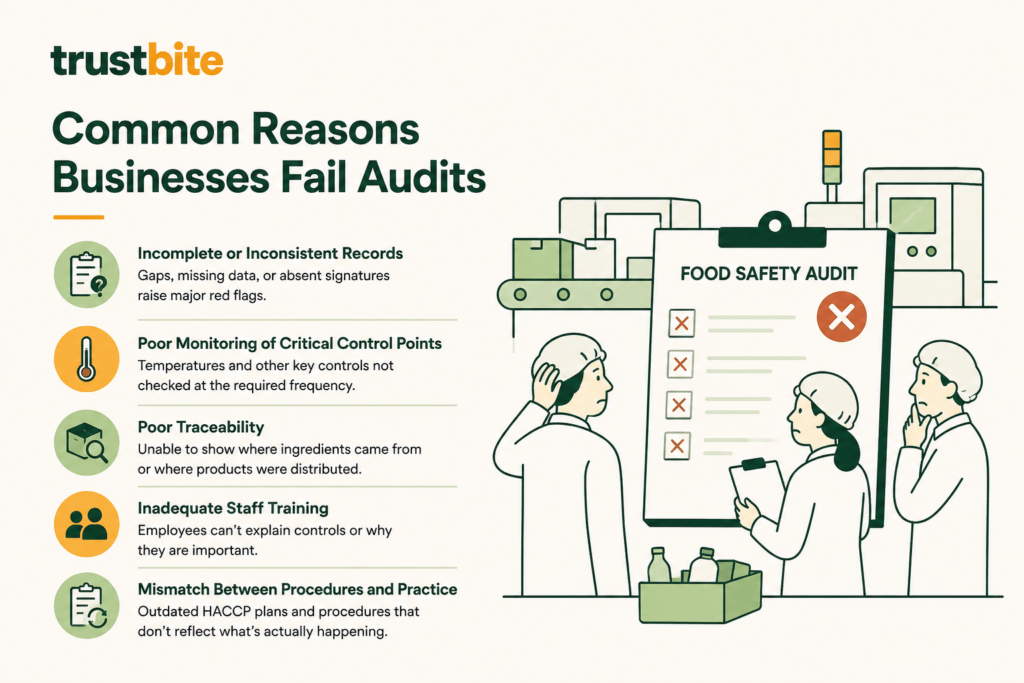
Certain issues come up repeatedly across food safety audits, regardless of industry or standard. Incomplete or inconsistent records are one of the most frequent findings, particularly monitoring logs with gaps or missing signatures. Critical control points that are not properly monitored, such as cooking or cooling temperatures that are not checked at the required frequency, are another common gap.
Poor traceability is a recurring issue, especially when a business cannot quickly demonstrate where a specific batch of raw material came from or where a finished product was distributed. Inadequate staff training is also frequently cited, often surfacing during interviews when employees can confirm a control is required but cannot explain why it matters.
Many food safety audit failures come down to a mismatch between documented procedures and actual practice. A HACCP plan that was written once and never updated to reflect process changes is a common source of non-conformances.
How Audit Findings Are Categorized
Most food safety audit standards classify findings by severity. Critical non-conformances represent an immediate risk to food safety, such as evidence of contamination or a complete failure to control a critical point, and usually require immediate corrective action. Major non-conformances indicate a significant gap in the system that could lead to a food safety failure if left unaddressed, such as a missing verification step. Minor non-conformances are smaller deviations, such as incomplete documentation, that should be corrected but do not represent an immediate hazard.
The number and severity of non-conformances generally determines whether a business passes the food safety audit outright, passes with a corrective action plan, or fails and must undergo a follow up audit.
Audits vs Ongoing System Performance
A food safety audit captures a single point in time. A business can pass a certification audit and still experience operational gaps in the weeks or months that follow, particularly if staff turnover, seasonal pressure, or process changes are not matched by updated training and monitoring.
This is one reason food safety performance is increasingly evaluated through more than certification alone. Frameworks that consider how training, documentation, and monitoring function continuously, rather than only on the day an auditor visits, offer a more complete picture of how a food safety system actually performs. TrustBite’s distinction between certification and recognition explores this gap in more detail.
Preparing for a Food Safety Audit
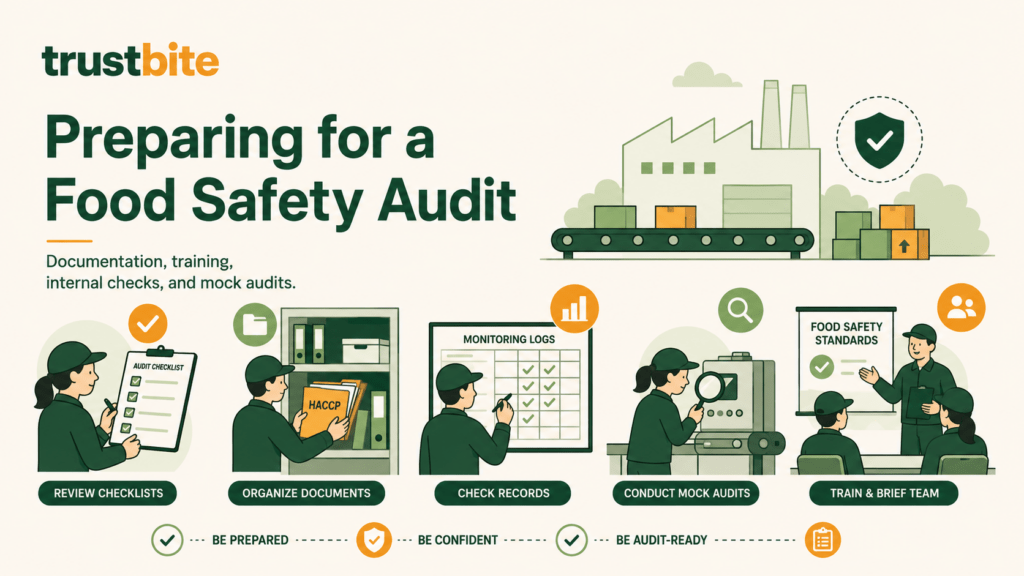
Preparation tends to make the difference between a food safety audit that confirms a strong system and one that surfaces a long list of corrective actions. Businesses that prepare well typically conduct an internal audit beforehand, review and update documentation to reflect current practice, confirm that all monitoring records are complete and signed, and refresh staff training so employees can confidently answer interview questions.
Many businesses bring in outside support for this preparation, particularly smaller operations without a dedicated food safety manager. Food safety consultants review documentation gaps, help build or update HACCP plans, and run mock audits to identify weak points before the real one happens. Providers such as Confi Food offer this kind of food safety management system consulting alongside structured workforce training, which helps close the gap between what a HACCP plan says on paper and what staff are actually doing on the floor.
How Often Should Food Safety Audits Happen
Audit frequency depends on the type of food safety audit, the certification scheme, and the risk profile of the business. Regulatory inspections are typically scheduled by the relevant authority based on the type of food business and its compliance history, often ranging from every few months to once every year or two. Third party certification audits are commonly conducted annually to maintain certification, with surveillance audits sometimes scheduled more frequently for higher risk operations. Second party audits from customers vary widely depending on the buyer’s own requirements.
Internal audits are the one category fully within a business’s control. Many food safety professionals recommend conducting them quarterly or before any external food safety audit, whichever comes first.
Conclusion
A food safety audit tests whether a system that exists on paper also exists in practice. Understanding the different types of audits, what auditors look for, and how findings are categorized helps businesses approach the process with less uncertainty and better preparation.
Passing a food safety audit is an important milestone, but it represents a single point in time rather than an ongoing guarantee. Businesses that treat audit preparation as a continuous discipline, supported by accurate documentation, consistent monitoring, and well trained staff, tend to perform more reliably both during scheduled audits and in the operational gaps between them.
Frequently Asked Questions
What is a food safety audit?
A food safety audit is a structured review of a business’s food safety practices, records, and facilities against a defined standard or regulation, used to confirm whether food safety controls are being followed effectively.
What is the difference between a food safety audit and a food safety inspection?
An inspection is typically conducted by a government regulatory authority to confirm compliance with food safety law. A food safety audit may be conducted by an internal team, a customer, or a third party certification body against a specific standard, which can be broader or more detailed than baseline regulatory requirements.
What are the main types of food safety audits?
The main types are internal audits, second party audits conducted by customers or partners, third party audits conducted by independent certification bodies, and regulatory audits or inspections conducted by government authorities.
What happens if a business fails a food safety audit?
A failed audit usually requires the business to submit a corrective action plan addressing the non-conformances found. Depending on the severity of the findings, a follow up audit may be required before certification is granted or maintained.
What is a non-conformance in a food safety audit?
A non-conformance is a finding where a business does not meet a specific requirement of the standard being audited. Non-conformances are typically categorized as critical, major, or minor based on their potential impact on food safety.
How long does a food safety audit take?
The length of a food safety audit depends on the size of the facility, the complexity of operations, and the standard being assessed. Audits can range from a few hours for a small operation to several days for a large manufacturing facility.
Who can perform a food safety audit?
Internal audits are performed by trained staff within the business. Second party audits are performed by customers or their representatives. Third party audits are performed by accredited certification bodies. Regulatory inspections are performed by government food safety authorities.
How often should a business be audited?
Frequency depends on the audit type and the certification scheme involved. Regulatory inspections and third party certification audits are often annual or set by the relevant authority. Internal audits are commonly recommended on a quarterly basis.
Does passing a food safety audit mean a system is fully effective?
An audit reflects performance at a single point in time. A business can pass a food safety audit and still experience gaps in the weeks or months that follow if monitoring, training, and documentation are not maintained consistently.
What documents are usually reviewed during a food safety audit?
Common documents include the HACCP plan, monitoring logs, corrective action records, supplier approval records, cleaning and sanitation schedules, pest control records, and staff training documentation.
What is an unannounced audit?
An unannounced audit is conducted without advance notice to the business, designed to assess how the food safety system performs under normal day to day conditions rather than after deliberate preparation.
How can a business prepare for a food safety audit?
Preparation typically includes conducting an internal audit, updating documentation to reflect current practice, verifying that monitoring records are complete, and refreshing staff training so employees understand their responsibilities and can answer questions confidently.
What is the difference between certification and a food safety audit?
An audit is the evaluation process. Certification is the outcome awarded when a business successfully passes a food safety audit against a recognized standard, typically valid for a set period before a renewal audit is required.
Can small food businesses get audited?
Yes. Food safety audit requirements apply across business sizes, though the scope and frequency may differ. Small businesses are commonly subject to regulatory inspections and may pursue voluntary certification audits depending on customer requirements or business goals.
Where can a food business get help preparing for an audit?
Food safety consultants can review documentation, identify gaps ahead of time, and help build or update a HACCP plan. Confi Food provides food safety management system consulting alongside structured training designed to help businesses prepare for certification and regulatory audits.
How does monitoring equipment support audit readiness?
Equipment such as ATP swab testers, cold chain temperature sensors, and foreign body detection systems generates the time stamped, objective records auditors look for during documentation review and facility walkthroughs, reducing reliance on manual checks alone.
Related from the Knowledge Center
What Is HACCP? A Beginner’s Guide to Food Safety and Risk Prevention
Most audits exist to verify that a HACCP system is being followed in practice. This guide explains the foundation an auditor is actually checking against.
Why Food Safety Systems Fail: Common Causes and Practical Prevention
Audits are designed to catch the same gaps that lead to system failures. This article breaks down the patterns behind those failures in more depth.
How TrustBite Evaluates Food Businesses
A look at how TrustBite’s own evaluation approach differs from a standard certification audit, and what that means for ongoing system performance.