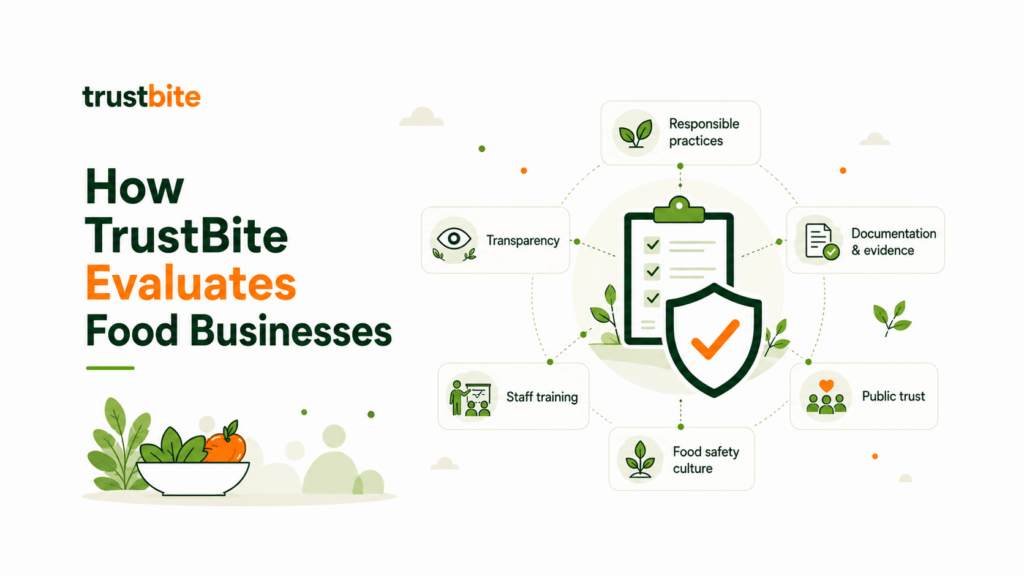
Food safety trust is built through more than a single document, inspection result, or claim displayed on a wall. In today’s food sector, consumers, business partners, employees, and local communities increasingly expect food businesses to show visible commitment to responsible practices, transparency, staff awareness, and continuous improvement.
A food business may have internal procedures, training records, cleaning schedules, allergen controls, supplier documents, and management systems in place. However, the public often cannot always see or understand those efforts. This creates a gap between what a business does internally and what customers are able to recognize externally.
TrustBite exists to help bridge that gap.
TrustBite is an independent food safety recognition authority focused on strengthening public trust in food businesses through voluntary recognition, transparency, professional credibility, education, and responsible food safety practices. TrustBite recognition helps food businesses communicate responsibility, transparency, and commitment to food safety culture in a clear and honest way.
This article explains how TrustBite evaluates food businesses, what TrustBite evaluation is designed to communicate, and why clear evaluation principles are essential for maintaining credibility.
Why Food Business Evaluation Matters
Food businesses operate in an environment where trust can be built slowly but damaged quickly. A single food safety incident, unclear communication, poor hygiene perception, or lack of visible control can affect customer confidence, brand reputation, and commercial relationships.
Modern food safety is no longer only about having procedures in place. It is also about demonstrating that those procedures are understood, implemented, supported by management, and communicated responsibly.
Food business evaluation matters because it helps identify whether a business shows visible commitment to responsible food safety practices. This does not mean creating a false impression that any business can be completely risk-free. Food safety risk can never be reduced to zero. Instead, responsible evaluation focuses on whether the business has taken meaningful steps to manage risk, support staff awareness, document key controls, and communicate honestly.
Consumers increasingly want to know whether a food business takes hygiene, allergens, temperature control, traceability, and staff training seriously. Business partners may want reassurance that a supplier or hospitality operator has structured practices in place. Managers want to protect their reputation and create a culture where food safety is not treated as an occasional paperwork exercise.
This is where a food safety recognition framework can play a useful role. It gives businesses a structured way to show commitment, while giving the public a clearer explanation of what recognition means.
What TrustBite Evaluation Is
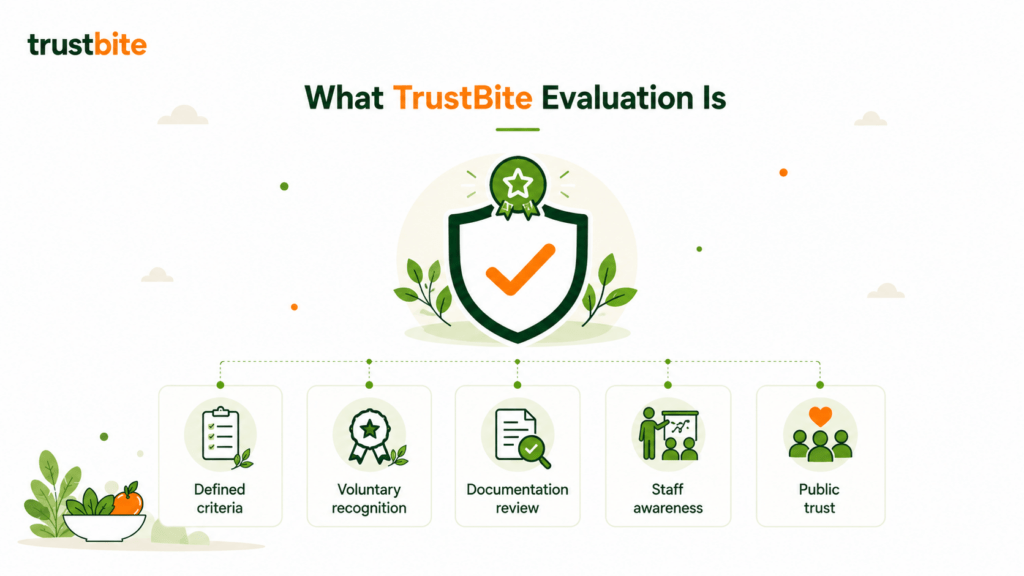
TrustBite evaluation is part of a voluntary recognition process. It is designed to assess how a food business demonstrates responsibility, transparency, and commitment to food safety culture.
TrustBite evaluation may include:
- A recognition-based evaluation
- A review of defined trust and responsibility criteria
- An assessment of visible commitment to responsible food safety practices
- A framework for transparency and public accountability
- A review of relevant food safety documentation, training, and operational practices
- A way to support clearer communication between food businesses and the public
TrustBite evaluation is designed to help businesses communicate food safety responsibility in a structured, transparent, and credible way.
Recognition should be presented carefully and honestly. It should not create unrealistic expectations, exaggerate what has been reviewed, or suggest that food safety risk can ever be completely eliminated.
Suggested TrustBite reads on this topic:
- What Is TrustBite?
- What Is a Food Safety Recognition Program?
- What Does Recognition Communicate?
- The TrustBite Recognition Framework Explained
The Core Principles Behind TrustBite Evaluation
TrustBite evaluation is based on principles that support responsible recognition and clear public communication.
The core principles include:
- Transparency
- Responsibility
- Evidence-based review
- Food safety culture
- Staff awareness
- Consumer trust
- Clear public communication
- Continuous improvement
- Honest representation of recognition status
Transparency means that a food business should be willing to communicate its recognition status clearly and responsibly.
Responsibility means that recognition should reflect a business’s willingness to take food safety seriously, maintain appropriate practices, and support improvement over time.
Evidence-based review means that responsible food safety recognition should not rely only on marketing claims. It should be supported by relevant evidence such as training records, procedures, logs, checklists, corrective actions, or other documentation appropriate to the business type.
Food safety culture means that the business treats food safety as a living responsibility, not only as paperwork. TrustBite evaluation may consider whether management supports practical implementation, staff awareness, accountability, and improvement.
Staff awareness is central because food handlers are often the frontline of food safety. Their understanding of hygiene, allergens, cleaning, storage, and safe handling directly affects daily risk control.
Consumer trust is supported when recognition helps the public better understand that a business is participating in a voluntary trust-building framework.
Clear public communication ensures that recognition marks, registry listings, website claims, and customer-facing statements are accurate and not exaggerated.
Continuous improvement encourages businesses to identify gaps, strengthen practices, and improve over time.
What TrustBite Looks For in Food Businesses
TrustBite evaluation may review several areas depending on the type of food business, the recognition category, and the current TrustBite recognition model.
TrustBite may look for evidence of:
- Documented food safety procedures
- Hygiene and sanitation practices
- Staff food safety training
- Management commitment
- Allergen awareness
- Cleaning and disinfection routines
- Temperature control awareness
- Traceability awareness
- Incident response readiness
- Supplier and product responsibility
- Communication with customers
- Transparency practices
- Willingness to improve
The goal is not to apply a one-size-fits-all checklist without context. The goal is to evaluate whether the business demonstrates responsible practices appropriate to its operations.
A restaurant, café, bakery, food manufacturer, packaging facility, catering company, or food retailer may not require identical evaluation criteria. The exact focus may depend on the business model, food safety risks, customer interaction, product type, and operational complexity.
Documentation and Evidence Review
Responsible recognition should be based on evidence, not only on claims. A business that says it values food safety should be able to support that statement with appropriate records, procedures, and examples of implementation.
TrustBite evaluation may review evidence such as:
- Training records
- Cleaning logs
- Temperature records
- Standard operating procedures
- HACCP-related documents
- Allergen control procedures
- Internal checklists
- Corrective action records
- Supplier documentation
- Photos or digital records where appropriate
- Proof of participation in training or support programs
Food safety documentation can show that a business has structured controls in place. However, documentation alone is not enough if it is not supported by practical commitment.
A cleaning log has limited value if cleaning is not actually performed. A training record has limited value if staff do not understand basic hygiene. A procedure has limited value if management does not support its implementation.
For this reason, TrustBite evaluation should consider both documented evidence and the broader context of responsibility, awareness, and management commitment.
Staff Training and Food Safety Awareness
Food handlers are the frontline of food safety. They receive ingredients, prepare meals, clean surfaces, handle allergens, manage storage, serve customers, pack products, and respond to daily operational risks.
Because of this, staff food safety training is central to consumer trust in food businesses.
Effective staff training helps employees understand:
- Why hygiene matters
- How contamination can occur
- How allergens must be controlled
- Why temperature control is important
- How to follow cleaning and sanitation procedures
- What to do when something goes wrong
- Why their daily behavior affects customer safety and business reputation
Training should be practical, understandable, and relevant to the employee’s role. A food handler in a café does not need the same depth of technical knowledge as a food safety manager in a manufacturing facility, but both need training that matches their responsibilities.
Training records also support transparency. They help demonstrate that the business does not rely only on verbal instruction or assumptions. They show that food safety awareness is being addressed in a structured way.
TrustBite evaluation may consider whether a business provides staff training, keeps records of participation, supports ongoing awareness, and treats training as part of food safety culture rather than a one-time formality.
Food Safety Culture and Management Commitment
Food safety culture refers to the shared values, behaviors, expectations, and practices that influence how people in a business handle food safety every day.
A business with a strong food safety culture does not treat food safety as paperwork completed only when someone asks for it. Instead, management actively supports safe practices, staff understand expectations, problems are reported and corrected, and improvement is encouraged.
TrustBite evaluation may consider whether management demonstrates:
- Leadership involvement
- Consistent internal expectations
- Openness to improvement
- Corrective action mindset
- Internal communication
- Accountability
- Practical implementation of procedures
Management commitment is essential because employees usually follow the priorities that leadership reinforces.
If managers ignore hygiene shortcuts, staff will notice. If managers take allergen communication seriously, staff are more likely to do the same. If managers respond constructively to problems, employees are more likely to report them before they become serious.
Recognition should therefore consider not only whether documents exist, but whether the business appears to treat food safety as an active responsibility.
Transparency and Public Communication
One of TrustBite’s core goals is to help responsible food businesses communicate trust honestly.
Public trust signals can include:
- Recognition marks
- Public registry listings
- Verification pages
- Educational explanations
- Clear recognition statements
- Customer-facing communication about responsible food safety practices
These tools can help customers understand that a business has participated in a voluntary recognition program and has been evaluated against defined responsibility criteria.
Public communication must be clear and accurate. A business should not exaggerate its recognition status, suggest that food safety risk is zero, or create unrealistic expectations.
Honest communication protects:
- Consumers
- Food businesses
- Regulators
- Food safety professionals
- TrustBite’s credibility
- The wider food safety ecosystem
A responsible food safety trust mark should help people understand commitment, not confuse them.
The TrustBite Evaluation Process
The TrustBite evaluation process may vary depending on the business type, recognition category, and TrustBite’s current recognition model.
A general process may include:
- Step 1: The business expresses interest or applies for recognition
- Step 2: TrustBite reviews the business type and relevant recognition category
- Step 3: The business provides relevant information or evidence
- Step 4: Evaluation is performed against defined recognition criteria
- Step 5: Gaps or improvement areas may be identified
- Step 6: A recognition decision is made
- Step 7: Recognized businesses may be listed publicly or allowed to communicate recognition status
- Step 8: Recognition may require renewal, updates, or ongoing transparency
This process is designed to support structured recognition and responsible improvement.
If gaps are identified, the goal may be to encourage better documentation, stronger staff awareness, clearer communication, improved procedures, or stronger internal food safety culture.
Different Business Types May Require Different Evaluation Criteria
Food businesses vary significantly. A small café, bakery, restaurant, catering company, food manufacturer, packaging facility, and retail store face different operational risks.
Restaurants and cafés may focus heavily on:
- Hygiene
- Allergen communication
- Staff training
- Cleaning routines
- Storage practices
- Daily controls
- Customer communication
Food manufacturers may require stronger focus on:
- Documentation
- Production procedures
- Supplier approval
- Traceability
- Batch control
- Allergen management
- Corrective action records
- Internal monitoring systems
Catering businesses may require strong controls for:
- Transport
- Time and temperature control
- Event-service planning
- Cross-contamination prevention
- Temporary service conditions
- Readiness for changing environments
Retail businesses may focus on:
- Product handling
- Storage
- Labeling
- Date control
- Consumer communication
- Supplier responsibility
- Cleanliness of display and storage areas
Food packaging facilities may require attention to:
- Contamination prevention
- Hygiene zoning
- Material handling
- Staff practices
- Product protection
- Cleaning routines
Because of these differences, TrustBite evaluation should be appropriate to the business model and recognition category. A credible recognition framework must be structured enough to be consistent but flexible enough to reflect real operational differences.
How TrustBite Supports Improvement
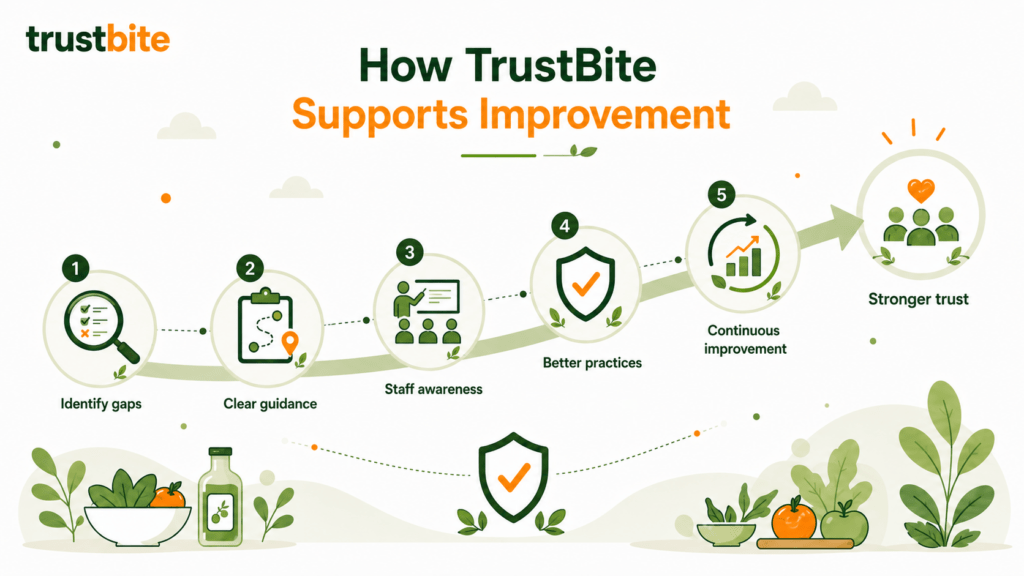
TrustBite recognition can encourage better practices, stronger documentation, staff awareness, and public accountability.
Food businesses remain responsible for maintaining safe and responsible operations. TrustBite recognition can support that responsibility by encouraging businesses to organize their evidence, communicate transparently, invest in training, strengthen food safety culture, and present their commitment responsibly.
TrustBite can support improvement by encouraging:
- Better food safety documentation
- More consistent staff training
- Stronger hygiene routines
- Clearer allergen communication
- Better internal accountability
- Improved corrective action practices
- More transparent customer communication
- Continuous improvement over time
Recognition can motivate businesses to make food safety efforts more visible and understandable. It can also help responsible operators stand apart by showing that they take food safety communication seriously.
How TrustBite Evaluation Differs from Food Safety Audits
Food safety audits and recognition evaluations can both support trust, but they serve different communication purposes.
| Area | TrustBite Recognition Evaluation | Food Safety Audit |
|---|---|---|
| Purpose | Evaluates and communicates visible commitment, transparency, and responsible food safety practices. | Reviews food safety systems, procedures, records, and implementation against defined expectations or requirements. |
| Main focus | Responsibility, transparency, staff awareness, documentation, food safety culture, and public communication. | System conformity, operational controls, documentation, implementation, and corrective actions. |
| Evidence reviewed | May include procedures, training records, logs, transparency practices, and responsibility criteria. | May include documented systems, monitoring records, procedures, facility conditions, process controls, and corrective actions. |
| Outcome | Recognition status, public listing, or permission to communicate recognition where applicable. | Audit findings, reports, corrective actions, and other outcomes depending on audit type. |
| Public communication | Designed to help businesses communicate commitment and transparency clearly. | Communication depends on audit type, business context, customer requirements, and applicable rules. |
| Limitations | Does not eliminate food safety risk or remove the need for responsible management. | Does not eliminate food safety risk or remove the business’s responsibility for ongoing control. |
| Best use | Building consumer trust, transparency, and visible commitment to responsible practices. | Reviewing food safety systems, identifying gaps, and verifying implementation. |
TrustBite recognition evaluates and communicates commitment, transparency, and responsible food safety practices. Food safety audits usually focus more deeply on system review, operational controls, and implementation. Both can be useful when their purpose is communicated accurately.
What Recognition Communicates to Consumers
TrustBite recognition can communicate that a business:
- Is willing to be evaluated
- Values transparency
- Supports food safety culture
- Is committed to responsible practices
- Participates in a voluntary trust-building framework
- Takes staff awareness seriously
- Understands the importance of public confidence
- Wants to make its food safety efforts more visible
This can help consumers better understand that the business is not relying only on claims. It has chosen to participate in a structured recognition process designed around responsibility and transparency.
Recognition should still be understood realistically. It communicates commitment and participation in a responsible framework. It does not communicate that risk is zero, that incidents are impossible, or that the business no longer needs ongoing management attention.
Responsible recognition is most valuable when consumers understand both its meaning and its limits.
Common Misunderstandings About TrustBite Evaluation
Misunderstandings can weaken public trust if recognition is not explained clearly. TrustBite evaluation should therefore be communicated in a way that is simple, transparent, and realistic.
Common misunderstandings include:
- Recognition guarantees that no food safety incident will ever happen.
- Evaluation is only about paperwork.
- Recognition is only marketing.
- Only large companies can be evaluated.
- A recognized business no longer needs continuous improvement.
- Recognition means every risk has been eliminated.
TrustBite recognition should never be presented as a promise of zero risk. No responsible food safety program should make that claim. Food safety risk can be reduced and managed, but never completely eliminated.
Evaluation is also not only about paperwork. Documentation is important, but credible recognition should also consider practical commitment, staff awareness, management responsibility, and transparency.
Recognition is not simply marketing when it is based on defined criteria, evidence review, and responsible public communication. Its purpose is not empty promotion, but credible trust-building.
Small restaurants, cafés, bakeries, retailers, and local food businesses can also demonstrate responsible practices when criteria are appropriate to their size and activity.
Why Clear Evaluation Criteria Matter
Clear evaluation criteria are essential for any credible food safety recognition framework.
They protect:
- Consumers
- Food businesses
- TrustBite’s credibility
- Food safety professionals
- Regulators
- The wider food safety ecosystem
Clear criteria protect consumers by helping them understand what recognition means. They protect food businesses by creating fair expectations and reducing the risk of misleading claims. They protect TrustBite’s credibility by ensuring recognition is structured, consistent, and transparent.
Recognition programs must be careful with language. Claims should be accurate, measured, and supported by the recognition framework. Clear criteria and honest communication help ensure that recognition remains credible, responsible, and useful.
Key Takeaways
- TrustBite evaluates food businesses through a voluntary recognition framework focused on responsibility, transparency, and food safety culture.
- Evaluation may include food safety documentation, staff training, hygiene practices, allergen awareness, management commitment, and transparency practices.
- Different business types may require different evaluation criteria based on their operations and risks.
- Documentation matters, but it must be supported by practical implementation and responsible management.
- TrustBite recognition can help businesses communicate commitment to consumers in a clearer and more structured way.
- Clear public communication is essential to avoid exaggerated or misleading claims.
- Recognition can support improvement by encouraging better documentation, training, food safety culture, and accountability.
- The purpose of TrustBite evaluation is to make responsible food safety practices more visible, understandable, and trustworthy.
FAQ
How does TrustBite evaluate food businesses?
TrustBite evaluates food businesses through a voluntary recognition process based on defined responsibility and transparency criteria. The evaluation may review food safety documentation, staff training, hygiene practices, allergen awareness, management commitment, communication practices, and evidence of responsible food safety culture.
What is included in TrustBite evaluation?
TrustBite evaluation may include review of:
- Training records
- Cleaning logs
- Temperature records
- SOPs
- HACCP-related documents
- Allergen control procedures
- Corrective action records
- Supplier documentation
- Internal checklists
- Transparency practices
- Staff awareness
- Management commitment
The exact criteria may depend on the type of food business and recognition category.
What documents may a business need for TrustBite recognition?
Depending on the business type and recognition category, documents may include:
- Training records
- Cleaning logs
- Temperature records
- Standard operating procedures
- HACCP-related documents
- Allergen control procedures
- Corrective action records
- Supplier documentation
- Internal checklists
- Photos or digital records where appropriate
- Proof of participation in training or support programs
Can small restaurants or cafés be evaluated by TrustBite?
Yes. Small restaurants, cafés, bakeries, and other local food businesses may be evaluated when the criteria are appropriate to their size, activity, and risk profile. Recognition is not limited to large companies.
Does TrustBite recognition guarantee food safety?
No. TrustBite recognition does not guarantee food safety or promise that incidents can never happen. It communicates that a business participates in a voluntary recognition framework and demonstrates commitment to responsible practices and transparency.
How does TrustBite recognition support consumer trust?
TrustBite recognition supports consumer trust by making responsible food safety efforts more visible. It can show that a business values transparency, staff awareness, documentation, food safety culture, and continuous improvement.
Why does food safety culture matter in TrustBite evaluation?
Food safety culture matters because daily behavior often determines whether procedures are followed in practice. A business with strong food safety culture supports staff awareness, leadership involvement, accountability, corrective action, and continuous improvement.
Are evaluation criteria the same for every food business?
No. Different food businesses may require different evaluation criteria. A restaurant, café, food manufacturer, catering company, retailer, bakery, or packaging facility may have different risks, documentation needs, and operational priorities.
Conclusion
TrustBite evaluation is designed to make responsible food safety practices more visible, understandable, and trustworthy. It helps bridge the gap between internal food safety efforts and public confidence by giving food businesses a structured way to communicate transparency, responsibility, and commitment to food safety culture.
TrustBite recognition supports businesses that want to show they take food safety seriously. It encourages better documentation, staff awareness, responsible communication, management commitment, and continuous improvement.
When used responsibly, TrustBite evaluation can support a stronger culture of transparency in the food sector. It can help consumers better understand which businesses are willing to be evaluated, which businesses take communication seriously, and which businesses want to make their food safety commitment more visible.
That is the role of TrustBite: to recognize and communicate responsible food safety practices in a clear, credible, and transparent way.