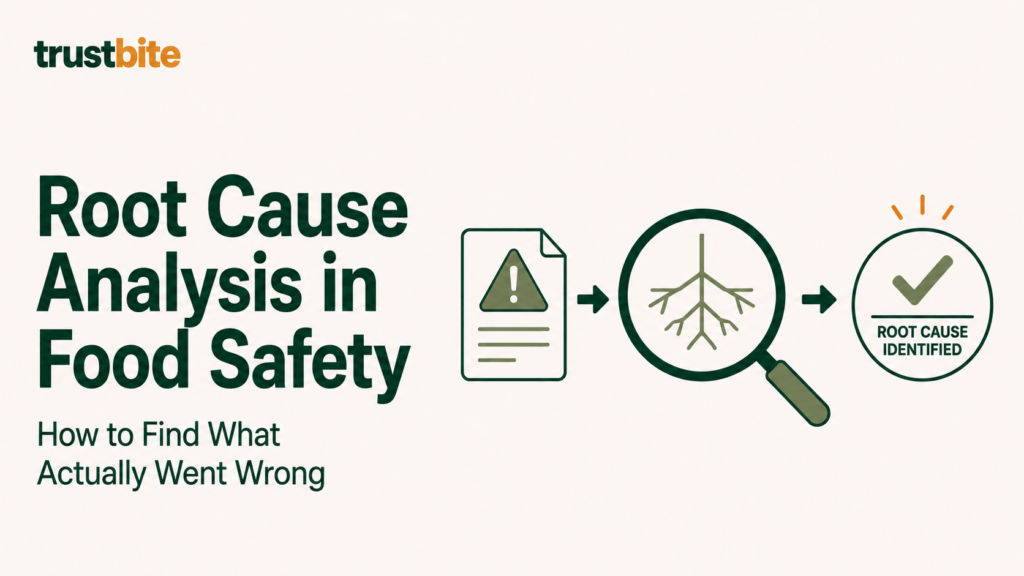
Root cause analysis in food safety is the structured process of identifying the underlying reason why a food safety failure, near miss, or non-conformance occurred, in enough depth that a genuinely effective corrective action can be designed and implemented. It is the analytical step between identifying that something went wrong and understanding what needs to change to prevent it from going wrong again.
Without root cause analysis, corrective actions address symptoms. A refrigerator found above temperature gets adjusted. Staff observed skipping handwashing get retrained. A CCP monitoring record found incomplete gets signed retrospectively. None of these responses address the underlying conditions that produced the failure, and without addressing those conditions, the same failure recurs, often in the next audit cycle.
What Is Root Cause Analysis in Food Safety?
Root cause analysis is a systematic investigation method used to identify the fundamental cause or causes of a food safety problem. The root cause is not the immediate failure observed, it is the condition or conditions that made the failure possible and likely in the first place.
In food safety management, root cause analysis is applied following food safety incidents such as a contamination event or a product recall, following significant non-conformances identified in food safety audits or regulatory inspections, following CCP monitoring failures where a critical limit was breached, and following near misses where a failure was caught before it produced a food safety outcome.
The output of root cause analysis is a documented understanding of why the failure occurred, which then drives the design of corrective actions targeted at preventing recurrence rather than only addressing the specific instance observed.
Why Root Cause Analysis Matters in Food Safety
Root cause analysis matters in food safety because most food safety failures are systemic rather than random. They occur not because of isolated bad luck but because conditions within the food safety management system, the production environment, the training program, or the organizational culture made the failure predictable.
A pathogen found in a finished product is not a random event. It is the outcome of a sequence of conditions that allowed the pathogen to be introduced, to survive, and to reach the finished product without being detected. Root cause analysis traces that sequence backward from the observed outcome to the point at which an intervention could have broken the chain.
Similarly, a recurring audit non-conformance in the same area across successive audits is not a random coincidence. It is evidence that previous corrective actions addressed a symptom while the root cause continued to operate. Root cause analysis applied thoroughly after the first occurrence should have prevented it from recurring.
Certification standards recognize this logic. ISO 22000, BRCGS, and most other food safety management standards require that corrective actions be based on root cause analysis. A corrective action plan submitted without documented root cause analysis is likely to be assessed as inadequate regardless of the actions proposed.
The 5 Whys Method
The 5 Whys is the most widely used root cause analysis method in food safety contexts, largely because it is simple enough to apply without specialist training and effective enough for the majority of food safety non-conformances.
The method involves asking “why” about each successive answer until the root cause is reached. Starting with the observed finding, each answer to “why” reveals a deeper contributing factor, and the process continues until reaching a cause that can be directly addressed by a corrective action.
An example applied to a CCP monitoring gap:
Finding: CCP monitoring records for the cooking step are incomplete for three production days in the past month.
Why were the records incomplete? The person responsible for monitoring was absent on those days.
Why was there no monitoring when that person was absent? There was no designated backup to perform monitoring during absences.
Why was there no backup designated? The HACCP plan does not specify backup monitoring responsibilities.
Why does the HACCP plan not specify backup responsibilities? The plan was written when the team was larger and this was assumed to be covered informally.
Why was this assumption not reviewed? There is no scheduled review process for the HACCP plan that would have identified this gap.
Root cause: The HACCP plan lacks a formal backup monitoring responsibility designation, and there is no scheduled plan review process that would identify such gaps.
Corrective action: Update the HACCP plan to designate backup monitoring responsibilities for each CCP. Implement a scheduled HACCP plan review process at defined intervals.
The corrective action at this root cause level prevents the recurrence far more reliably than retraining the absent employee, which would have been the symptom-level response.
Fishbone Diagram Analysis
A fishbone diagram, also called an Ishikawa or cause-and-effect diagram, is a structured visual tool for exploring all possible causes of a food safety problem before narrowing down to the root cause. It is particularly useful for complex findings where multiple contributing factors may be involved.
The diagram is structured with the problem statement at the head of a fish and the main branches representing categories of potential causes: People, Procedures, Equipment, Environment, Materials, and Measurement. For each category, the team brainstorms possible causes of the observed problem and records them as branches.
Once potential causes are mapped, the team investigates which causes are actually present and contributing to the problem, systematically ruling out those that are not and investigating those that are. The result is a narrowing of focus to the actual root cause or causes.
The fishbone method is more structured and time-intensive than the 5 Whys, making it more appropriate for serious incidents such as contamination events, product recalls, or major non-conformances where the stakes of getting the root cause wrong are high.
Fault Tree Analysis
Fault tree analysis is a deductive root cause analysis method that begins with an undesired outcome and works backward through the logical conditions that could produce it. It is represented as a branching tree diagram where each branch represents a contributing condition and the branches are connected by logical operators indicating whether conditions must occur together or independently to produce the outcome.
Fault tree analysis is used in higher-complexity food safety investigations, particularly in manufacturing environments where multiple simultaneous system elements must align to produce a food safety failure. It is more commonly used in quality engineering contexts than in everyday food safety non-conformance management, but understanding its logic helps food safety teams think more rigorously about the conditions that produce serious failures.
Common Root Cause Categories in Food Safety
While every food safety failure has its specific context, the root causes identified through thorough investigation tend to cluster into a relatively consistent set of categories.
People-related root causes include inadequate training, unclear responsibilities, insufficient supervision, production pressure that normalizes shortcuts, and a reporting culture that discourages staff from raising concerns. These root causes appear frequently behind findings that initially look like individual behavioral failures.
Procedure-related root causes include outdated procedures that no longer reflect current operations, procedures that are too vague to be followed consistently, procedures that are not accessible to the staff who need to follow them, and the absence of a procedure where one is required. The recurring finding of staff not following a procedure often has a root cause in the procedure itself rather than in the staff.
Equipment-related root causes include inadequate maintenance schedules, equipment that is not fit for purpose in the food safety role it is being asked to play, calibration that has lapsed, and monitoring equipment that cannot detect the parameter it is supposed to measure within the required accuracy. Continuous monitoring equipment from providers such as Adria Food Tech eliminates certain equipment-related root causes by removing the gap between manual monitoring intervals during which a deviation can occur and go undetected.
Management system root causes include an absence of internal audit processes that would identify gaps before they become significant findings, a management review process that does not use food safety performance data effectively, and a corrective action process that closes findings administratively without confirming effective implementation.
Cultural root causes include a food safety culture where compliance is performed rather than genuinely valued, where near misses are not reported because staff fear blame, and where management signals through behavior that production targets take precedence over food safety controls.
Training programs that build genuine understanding of why food safety matters, rather than only delivering procedural knowledge, address cultural root causes alongside the immediate knowledge gaps that food safety training is more commonly designed to resolve. Providers such as Confi Food develop food safety training designed specifically to build the understanding and cultural foundation that prevents the people-related and cultural root causes that appear most frequently in food safety failure investigations.
Documenting Root Cause Analysis
Root cause analysis should be documented as part of the corrective action plan so that the certification body or regulatory authority reviewing the plan can assess whether the analysis was thorough and whether the proposed corrective actions address the identified root cause rather than the symptom.
The documentation should record the method used, the investigation activities undertaken, the contributing factors identified, and the root cause conclusion. Where a finding has multiple contributing root causes, each should be documented and addressed by a specific corrective action.
Documentation of root cause analysis also serves an internal purpose. A food safety incident or significant non-conformance that has been thoroughly investigated and whose root cause has been documented becomes a learning resource. The investigation findings can inform training content, HACCP plan reviews, and prerequisite program improvements in ways that strengthen the overall food safety management system beyond the specific finding that triggered the investigation.
Conclusion
Root cause analysis in food safety is the discipline that separates food safety management systems that improve from those that cycle through the same failures. Identifying and addressing root causes rather than symptoms produces corrective actions that prevent recurrence. Documenting root cause analysis provides auditors with evidence of genuine analytical capability and gives internal management the information needed to make systematic improvements. The food safety failures that result in serious incidents and product recalls almost always have traceable root causes that thorough investigation would have identified, and that a food safety management system with a functioning corrective action and root cause process could have addressed before the failure reached its most serious consequence.
Frequently Asked Questions
What is root cause analysis in food safety?
Root cause analysis in food safety is the structured process of identifying the underlying reason why a food safety failure, non-conformance, or near miss occurred, in enough depth that a corrective action can be designed that prevents recurrence rather than only addressing the immediate symptom.
Why is root cause analysis required in food safety management?
Root cause analysis is required because corrective actions that address symptoms rather than root causes allow the same failures to recur. Most food safety certification standards including ISO 22000 and BRCGS require that corrective actions be based on root cause analysis.
What is the 5 Whys method?
The 5 Whys method involves repeatedly asking “why” about each successive answer to a food safety problem until the underlying root cause is reached. Starting with the observed finding, each answer reveals a deeper contributing factor until reaching a cause that can be directly addressed by a corrective action.
What is a fishbone diagram?
A fishbone or Ishikawa diagram is a structured visual tool for exploring all possible causes of a food safety problem across categories including people, procedures, equipment, environment, materials, and measurement. It is used before narrowing down to the actual root cause, particularly for complex incidents with multiple potential contributing factors.
What is the difference between the observed finding and the root cause?
The observed finding is the symptom: the incomplete record, the refrigerator above temperature, the staff member observed not washing hands. The root cause is the underlying condition that made the failure possible and predictable: the absence of a backup monitoring procedure, the lapsed equipment calibration schedule, the training program that did not build understanding of why handwashing matters.
What are the most common root cause categories in food safety failures?
Common root cause categories include people-related causes such as inadequate training and unclear responsibilities, procedure-related causes such as outdated or vague procedures, equipment-related causes such as inadequate maintenance or lapsed calibration, management system causes such as absent internal audit processes, and cultural causes such as a reporting environment where staff fear blame for raising concerns.
How should root cause analysis be documented?
Root cause analysis documentation should record the method used, the investigation activities undertaken, the contributing factors identified, the root cause conclusion, and the corrective actions designed to address each root cause. Documentation allows certification bodies to assess whether the analysis was thorough and whether corrective actions address root causes rather than symptoms.
What happens if root cause analysis is not included in a corrective action plan?
A corrective action plan submitted without documented root cause analysis is likely to be assessed as inadequate by the certification body, which may reject the plan and require resubmission. At the next audit, recurring findings in the same area are a strong indicator that root cause analysis was not conducted or was superficial.
How deep should root cause analysis go?
The depth of root cause analysis should be proportionate to the severity of the finding. A minor documentation gap may have a straightforward root cause quickly identified through the 5 Whys. A major non-conformance involving a CCP monitoring failure warrants a more thorough investigation, potentially using a fishbone diagram, before a corrective action plan is submitted.
Can a food safety failure have more than one root cause?
Yes. Complex food safety failures often have multiple contributing root causes across different categories. A thorough investigation identifies all significant contributing causes, and the corrective action plan addresses each one rather than selecting only the most obvious.
What is the difference between a corrective action and a preventive action?
A corrective action addresses the root cause of a specific failure that has already occurred. A preventive action identifies and addresses a potential root cause before a failure occurs, based on risk assessment or the identification of a trend that has not yet produced a significant finding.
What role does food safety culture play in root cause analysis?
A food safety culture where near misses are reported and investigated, where staff raise concerns without fear of blame, and where management takes corrective action seriously generates the information that root cause analysis depends on. A culture that suppresses reporting produces an environment where root causes go unidentified until they produce a serious failure.
How is root cause analysis used after a food recall?
Following a food recall, root cause analysis traces the contamination event backward from its detection to its origin, identifying every point in the production and supply chain where the failure could have been prevented. The findings drive both immediate corrective actions to the specific failure point and systemic improvements to the food safety management system designed to prevent similar events.
What is fault tree analysis?
Fault tree analysis is a deductive root cause analysis method that begins with an undesired outcome and works backward through the logical conditions that could produce it, represented as a branching tree diagram with logical operators. It is used in higher-complexity food safety investigations in manufacturing environments.
Related from the Knowledge Center
Why Food Safety Systems Fail: Common Causes and Practical Prevention
Root cause analysis consistently reveals patterns in why food safety systems fail. This article examines the most common failure causes and how they can be systematically prevented.
Corrective Action Plans: How to Respond to Food Safety Audit Findings
Root cause analysis is the analytical foundation of every credible corrective action plan. This article explains what a corrective action plan must include and how findings should be addressed.
Anatomy of a Food Recall: How Contamination Reaches Consumers
Food recalls are the most visible consequence of food safety failures. Root cause analysis following a recall identifies exactly where the failure originated and what systemic changes are required to prevent recurrence.