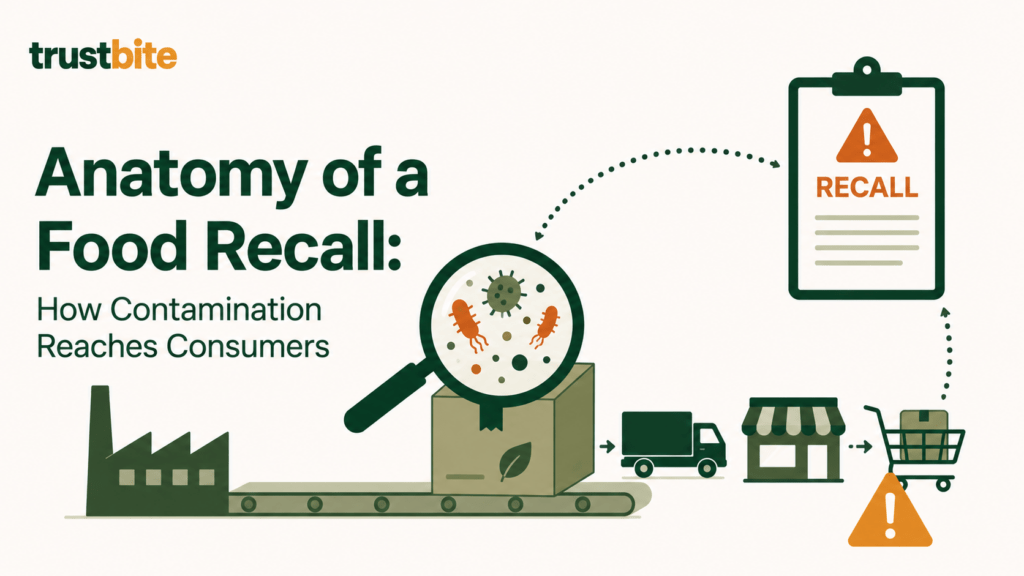
A food recall is the process of removing a food product from the market because it poses or may pose a risk to consumer health. Food recalls happen when a contaminated or potentially unsafe product has entered distribution or reached consumers before the hazard was detected and controlled at the production level.
Understanding how a food recall unfolds, what causes products to reach the market in a compromised state, and what the recall process requires from a food business is important for two related reasons. It helps businesses understand what their traceability and recall readiness systems need to be capable of. And it illustrates what food safety system failures look like when they reach their most visible and costly consequence.
What Is a Food Recall?
A food recall is the removal of a food product from sale, distribution, and where possible, consumer possession because the product has been found or is reasonably suspected to be unsafe. Recalls are initiated by the food business responsible for the product, sometimes voluntarily after an internal discovery, and sometimes following notification from a regulatory authority, a customer complaint investigation, or a positive result from external testing.
A food recall is distinct from a food withdrawal. A withdrawal removes a product from distribution before it reaches consumers, typically because the product does not meet quality or labelling standards rather than because it poses a health risk. A recall extends further, including product already in consumers’ hands, and typically involves public communication and regulatory reporting.
How Contamination Reaches the Point of Recall
A food recall occurs because a hazard that should have been controlled at some point in the production and distribution chain was not. Understanding where that control failure occurred is the starting point for both the immediate response and the longer-term prevention.
Contamination at raw material level is one pathway. If a pathogen, allergen, or chemical contaminant is present in an ingredient supplied to a food manufacturer, and that ingredient is not tested or the test is inadequate, the contamination enters the production process. Depending on what subsequent processing steps occur, the contamination may or may not be eliminated before the product is distributed.
Process failures during production are another pathway. A cooking step that fails to reach a minimum temperature, a cooling step that takes too long, a mixing error that introduces an undeclared allergen, or a sanitation failure that allows pathogen cross-contamination between production runs can all introduce hazards into otherwise acceptable product.
Packaging and labelling failures create a separate category of recall that does not always involve microbiological or chemical contamination. A product containing an allergen that is not declared on the label poses a genuine health risk to allergic consumers even if the product itself is microbiologically safe. Undeclared allergens are among the most frequent recall triggers in many food markets.
Environmental contamination occurs when pathogens present in the production environment, such as Listeria monocytogenes in a chilled food facility or Salmonella in a dry food environment, contaminate products during production. Environmental pathogens can persist in facilities for extended periods and affect multiple production batches before the source is identified.
Post-production contamination during distribution or retail can also trigger recalls, though responsibility in these cases often lies with the distributor or retailer rather than the original manufacturer.
How a Food Recall Is Detected
The pathway through which a recall becomes necessary differs from the pathway through which it is detected. Detection can occur at several points.
Internal detection happens when a food business identifies a problem through its own monitoring, testing, or quality management systems. Internal detection before a product reaches consumers allows the business to initiate a withdrawal rather than a full recall. This is the best-case outcome and the one that well-designed food safety management systems aim to produce.
Customer complaints can trigger a recall investigation when multiple complaints point to a specific product, batch, or time period. A cluster of similar illness complaints following consumption of a specific product is a significant signal that requires immediate investigation.
Regulatory testing picks up contaminated products through routine market surveillance activities. Many regulatory authorities operate testing programs for specific pathogens or contaminants in high-risk food categories, and a positive result from market surveillance triggers a mandatory recall process.
Supplier or trade partner notification occurs when another party in the supply chain discovers a contamination issue that affects shared ingredients or products. A supplier discovering a contamination event affecting an ingredient they have distributed to multiple customers will notify those customers, who must then assess their own exposure.
Traceability systems determine how quickly a business can respond to any of these detection triggers. A business that can identify within hours which batches of product were made using a specific ingredient lot, and where those batches were distributed, is in a far better position to manage a recall than one that needs days to reconstruct that information. Food safety technology providers such as Adria Food Tech supply traceability and monitoring systems that support rapid trace-forward and trace-back exercises, which are critical to limiting the scope of a recall once a hazard is identified.
The Food Recall Process
The recall process involves several parallel activities that must happen quickly and in a coordinated way.
Product identification and scope determination establishes which products, batches, and date codes are affected by the recall, and where they have been distributed. The accuracy of this step determines whether the recall is appropriately targeted or either too broad, which is wasteful and damaging to unaffected products, or too narrow, which leaves unsafe product in circulation.
Regulatory notification is required in most jurisdictions once a decision to recall has been made. Food businesses must notify the relevant authority, provide information about the product, the hazard, and the distribution scope, and update the authority as the recall proceeds.
Trade notification informs distributors, retailers, and food service customers to remove the affected product from sale and return or destroy it according to the recall instructions. The speed and completeness of trade notification affects how much affected product remains available to consumers.
Consumer communication is required for Class 1 and Class 2 recalls, where the product poses a risk to health and is already in consumer hands. Consumer-level communication typically involves public announcements through the regulatory authority’s website, retailer point-of-sale notices, and in more serious cases, media communications. The goal is to reach consumers who may have purchased the product and inform them not to consume it.
Product recovery and disposal involves physically retrieving returned product, confirming destruction or disposal, and documenting the quantities recovered versus the quantities that were distributed.
Root cause investigation runs in parallel with the operational recall activities, identifying what went wrong, at which step in the process, and why the normal control measures did not prevent the contaminated product from reaching distribution.
What a Recall Costs a Food Business
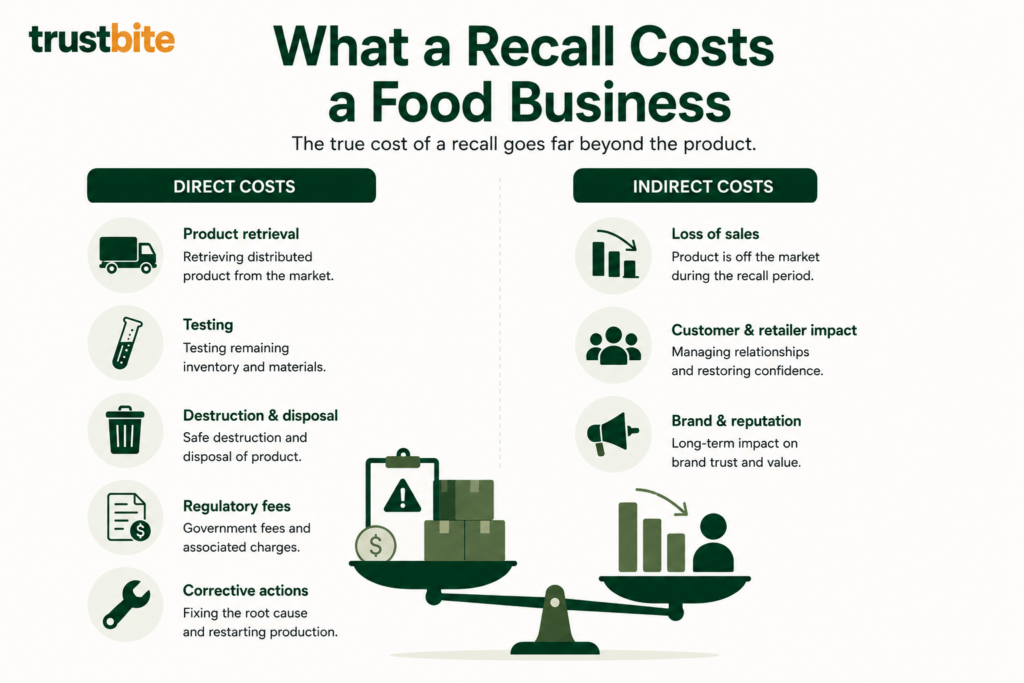
The financial cost of a food recall extends well beyond the immediate logistics of product retrieval and disposal. Direct costs include the cost of retrieving distributed product, testing remaining inventory, destruction and disposal costs, regulatory fees, and the cost of any corrective actions required to restart production.
Indirect costs include the commercial impact of product being off the market during the recall period, the cost of managing customer relationships and retailer relationships affected by the recall, and the longer-term reputational impact on the brand and its products.
The reputational dimension can be the largest element of total cost, particularly for consumer-facing brands where trust is a significant commercial asset. A recall that is handled transparently, quickly, and with clear communication about what happened and what has been done to prevent recurrence tends to preserve more commercial trust than a recall that is delayed, minimized, or poorly communicated.
Training, Traceability, and Recall Prevention
The single most effective way to reduce the probability and scope of a food recall is to operate a food safety management system that reliably controls hazards before products leave the facility. This requires a well-designed HACCP system, effective monitoring, validated prerequisite programs, and staff who understand and apply the controls relevant to their roles.
Providers such as Confi Food support food businesses in developing and maintaining food safety management systems designed to prevent the process failures that lead to recalls, alongside workforce training programs that build the operational knowledge required to apply those systems consistently.
Traceability systems must be tested regularly, not just documented. A traceability procedure that has never been exercised in a mock recall may fail under the time pressure of a real one.
Conclusion
A food recall is the visible end point of a food safety failure that began somewhere in the production, distribution, or supply chain process. The pathway from hazard introduction to consumer-level recall involves multiple points at which a functioning food safety system could have intervened. Understanding this anatomy helps food businesses identify where their systems need to be strongest, what their traceability capabilities must be able to do, and what the real cost of a system failure looks like when it runs its full course.
Frequently Asked Questions
What is a food recall?
A food recall is the removal of a food product from sale and distribution, and where possible from consumer possession, because the product has been found or reasonably suspected to pose a risk to consumer health.
What is the difference between a food recall and a food withdrawal?
A food withdrawal removes a product from distribution before it reaches consumers. A food recall extends to product already in consumers’ hands. Withdrawals are typically initiated for quality or labelling issues. Recalls are initiated when there is a genuine health risk.
What are the most common reasons for a food recall?
Common reasons include microbiological contamination such as Salmonella or Listeria, undeclared allergens due to labelling errors or allergen cross-contact, chemical contamination from ingredients or the production environment, and foreign body contamination such as metal or glass fragments.
How does a food business initiate a food recall?
A food recall is typically initiated when the business identifies a safety issue through internal monitoring, a customer complaint investigation, supplier notification, or notification from a regulatory authority. The business notifies the relevant regulatory authority, traces the affected product through its distribution chain, and begins retrieval.
What is traceability and why does it matter in a food recall?
Traceability is the ability to track a product and its ingredients through the supply chain. In a food recall, strong traceability allows a business to quickly identify which batches are affected and where they were distributed, limiting both the scope of the recall and the time unsafe product remains in circulation.
What are the classes of food recall?
Recall classifications vary by jurisdiction but commonly fall into three classes. Class 1 involves products that will cause serious adverse health effects or death. Class 2 involves products that may cause adverse health effects but are not likely to cause serious harm. Class 3 involves products unlikely to cause adverse health effects but which violate regulatory requirements.
What regulatory obligations does a food business have during a recall?
Obligations vary by jurisdiction but typically include notifying the relevant regulatory authority within a defined timeframe, providing information about the product and the hazard, implementing the recall and notifying trade partners, and reporting on recall progress and product recovery.
How does an undeclared allergen trigger a food recall?
A product containing an allergen not listed on its label poses a health risk to allergic consumers. Undeclared allergens trigger recalls even when the product is microbiologically safe because the consumer cannot make an informed safety decision without accurate labelling.
What is a root cause investigation in the context of a food recall?
A root cause investigation identifies the specific point in the process where the food safety failure occurred and the conditions that allowed it to happen. The findings drive the corrective actions required before production of the affected product can resume.
How long does a food recall take?
Recall timelines vary depending on the scope of distribution, the complexity of the traceability challenge, and the nature of the hazard. Simple recalls of locally distributed products may resolve in days. Recalls involving widely distributed products across multiple markets can take weeks or months to complete.
What is a mock recall?
A mock recall is a simulated exercise in which a food business tests its traceability and recall procedures without an actual product safety issue. Mock recalls are required by most food safety certification schemes and reveal weaknesses in traceability systems before they are needed in a real situation.
How does environmental contamination lead to a food recall?
Environmental pathogens such as Listeria monocytogenes can persist in food production facilities and contaminate products during production even when ingredients are clean. Environmental contamination may affect multiple production batches before it is detected, making recalls of this type particularly broad in scope.
What should consumers do when a food recall is announced?
Consumers should stop using the recalled product immediately, check whether any product they have purchased matches the description and date codes specified in the recall notice, and follow the disposal or return instructions provided. The product should not be consumed even if it appears normal.
Can a business prevent a food recall entirely?
No food safety system eliminates all recall risk, but well-designed and consistently operated food safety management systems substantially reduce the probability of a recall and its scope when one does occur. Strong traceability limits the spread of affected product and reduces the recovery challenge.
Related from the Knowledge Center
Why Food Safety Systems Fail: Common Causes and Practical Prevention
Recalls are the visible consequence of food safety system failures. This article examines the underlying causes of those failures and how businesses can prevent them.
Cross-Contamination in Food Safety: Causes, Examples, and How to Prevent It
Cross-contamination is one of the most common contamination pathways that leads to food recalls. This article covers how contamination transfers and how to prevent it.
What Is a Food Safety Audit? Types, Process, and What to Expect
Food safety audits are designed to catch the system weaknesses that lead to recalls before a real product safety event occurs. This article explains how audits work and what they assess.