Food businesses today often face several types of external validation. A restaurant may receive regulatory inspections from local authorities. A food manufacturer may be audited against a private food safety standard. A supplier may need food safety certification to enter a retail chain. Employees may hold training certificates. A business may also participate in a recognition program or use a food safety trust mark to communicate its commitment to responsible practices.
Because these terms are often used together, they can easily become confusing. Certification, recognition, inspection, accreditation, approval, registration, training, and trust marks do not all mean the same thing. In food safety, that distinction matters.
This article explains the difference between certification vs recognition, especially in the context of food safety compliance, transparency, professional credibility, and public trust. It also explains how food safety recognition programs such as TrustBite can complement formal certification without replacing certification schemes, regulatory inspections, HACCP, ISO 22000, BRCGS, FSSC 22000, IFS, SQF, or legal food safety obligations.
Why the Difference Matters
Understanding the difference between certification and recognition is important for everyone involved in the food safety ecosystem, including:
- Food business owners
- Food safety managers
- Consultants
- Auditors
- Certification professionals
- Training providers
- Hospitality operators
- Food manufacturers
- Retailers
- Consumers interested in food safety trust marks
When the difference is unclear, businesses may unintentionally create misleading communication. For example, a company may describe a voluntary recognition mark as if it were accredited certification. A consumer may assume that a food safety trust mark means a business has passed a government inspection. A business owner may think that recognition replaces food safety compliance or legal obligations.
None of these assumptions are correct.
Clear communication protects everyone involved. For food businesses, the distinction helps prevent unrealistic expectations and reputational risk. For consumers, it supports better understanding of what a mark, certificate, or public claim actually means. For consultants and auditors, it protects professional credibility. For certification bodies and standards owners, it protects the integrity of formal schemes. For recognition programs, it ensures that their role is honest, transparent, and responsible.
The simplest way to understand the difference is this:
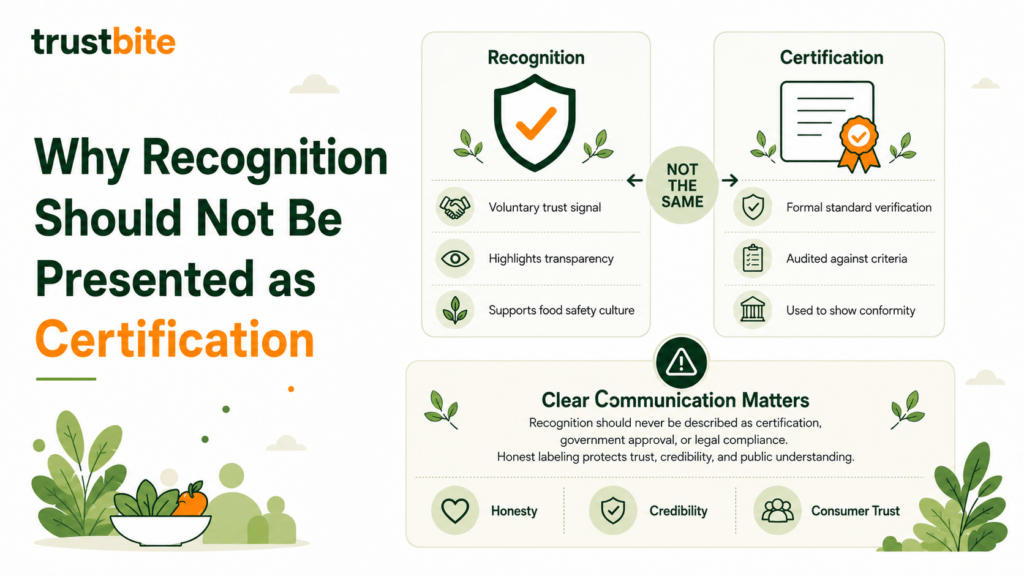
- Certification verifies conformity to a defined standard or scheme.
- Recognition acknowledges participation, commitment, transparency, or responsible practices within a defined framework.
Both can matter. Both can create value. But they do not serve the same purpose.
What Is Food Safety Certification?
Food safety certification is a formal process in which an independent certification body verifies that an organization, product, person, process, or management system conforms to defined requirements, standards, or schemes.
In the food industry, certification is often linked to a structured standard or certification scheme. These may include:
- HACCP-based certification programs
- ISO 22000
- FSSC 22000
- BRCGS
- IFS
- SQF
- Other food safety standards or private schemes
However, it is important to avoid oversimplification. Not all HACCP programs are equivalent. Not every certificate has the same scope. Not every food safety certificate is accredited. Not every certification scheme evaluates the same risks, processes, products, or management system requirements.
Certification usually involves defined requirements and a structured assessment process. A business is not certified simply because it claims to have good practices. It must demonstrate conformity against the relevant standard, scheme, or criteria.
Food safety certification usually involves:
- Defined standards or criteria
- Formal audits or assessments
- Documented evidence
- Competent auditors or assessors
- Certification decisions
- Surveillance, renewal, or recertification audits
- Rules for using certificates or certification marks
A certification body evaluates whether the business meets specific requirements. The certification decision is normally based on evidence collected during an audit or assessment. This evidence may include procedures, food safety plans, monitoring records, corrective actions, training records, internal audits, traceability exercises, management reviews, supplier controls, and operational practices.
For example, a food manufacturer certified to ISO 22000 has been assessed against the ISO 22000 food safety management system standard. A company certified to FSSC 22000, BRCGS, IFS, or SQF has been assessed against the requirements of that specific scheme. The certificate communicates conformity to that scheme within a defined scope and under defined audit conditions.
Certification is therefore technical, formal, and conformity-based.
What Does Certification Prove?
Certification can demonstrate that a business, product, process, person, or management system met defined requirements at a specific point in time and within a defined scope.
This is valuable because it gives customers, supply chain partners, retailers, authorities, and other stakeholders structured evidence that the business has been independently assessed. For many food manufacturers, exporters, distributors, and suppliers, food safety certification may be essential for commercial access.
Certification can help demonstrate that a business has implemented or maintained important food safety management elements, such as:
- Documented procedures
- Food safety plans
- HACCP-based controls
- Monitoring activities
- Corrective action processes
- Training systems
- Internal audits
- Verification activities
- Traceability systems
- Supplier approval processes
- Management review
- Continual improvement mechanisms
However, certification must be understood correctly.
Certification does not mean:
- The business is risk-free
- Food safety incidents are impossible
- The business will remain compliant forever without ongoing management
- Every certified business is automatically safer than every non-certified business
- Legal food safety duties no longer apply
- Government inspections are no longer needed
- Customer requirements are automatically covered outside the certificate scope
A certificate is not a permanent guarantee. It is evidence of conformity within a defined scope, against defined requirements, based on an assessment performed at a defined time.
Food safety still depends on daily management, competent people, effective procedures, monitoring, verification, corrective actions, leadership, and food safety culture.
Certification is powerful, but it is not a substitute for continuous responsibility.
What Is Food Safety Recognition?
Food safety recognition is a voluntary framework that acknowledges a food business, professional, training provider, consultant, digital platform, or related organization for meeting defined criteria connected to responsibility, transparency, trust-building, education, culture, or public communication.
Recognition is not the same as certification.
A recognition program may focus on visible commitment rather than formal conformity to a technical certification scheme. It may help businesses communicate that they take food safety seriously, invest in training, work with credible professionals, support transparency, and participate in a structured trust-building framework.
Food safety recognition programs may focus on:
- Visible commitment to food safety
- Responsible practices
- Staff training
- Transparency
- Public accountability
- Food safety culture
- Participation in a recognized framework
- Use of trusted support systems, consultants, or training providers
- Communication of responsible food safety behavior
- Openness toward continuous improvement
Recognition can be especially useful where a business wants to show that it takes food safety seriously but is not required to obtain formal certification. It can also help certified businesses communicate their commitment in a more public-facing and accessible way.
For example, a small restaurant may not need ISO 22000, BRCGS, FSSC 22000, IFS, or SQF certification. However, it may still want to show customers that it follows structured food safety practices, trains staff, takes allergen communication seriously, and participates in a voluntary recognition framework.
Recognition is therefore more communication-oriented, transparency-oriented, and trust-oriented than certification.
What Does Recognition Communicate?
Recognition communicates that a business or professional is participating in a defined trust-building framework. It can show commitment, transparency, accountability, education, and active effort to strengthen food safety culture.
A food safety recognition program can help stakeholders understand that a business is not treating food safety as a hidden internal issue. Instead, the business is willing to make its commitment more visible.
Recognition can support consumer trust in food businesses by making responsible practices easier to understand and communicate. It can also help food businesses differentiate themselves without claiming formal certification they do not have.
Recognition can communicate that a business is trying to demonstrate:
- Commitment to responsible food safety practices
- Participation in a voluntary recognition framework
- Attention to food safety culture
- Willingness to communicate transparently
- Investment in staff training or professional support
- Public-facing accountability
- Interest in strengthening consumer trust
However, recognition must be communicated carefully.
Recognition does not mean:
- The business is certified to ISO 22000
- The business is certified to BRCGS, FSSC 22000, IFS, or SQF
- The business has passed a government inspection
- The business is guaranteed safe
- The recognition body has replaced regulators
- The recognition body has replaced certification bodies
- The recognition body has replaced accreditation bodies
- Legal compliance is no longer required
- Food safety incidents are impossible
A food safety trust mark should never be presented as a legal approval, official inspection result, accredited certification, or guarantee of safety unless it truly has that status.
Recognition is valuable when it is honest, clear, and responsibly communicated.
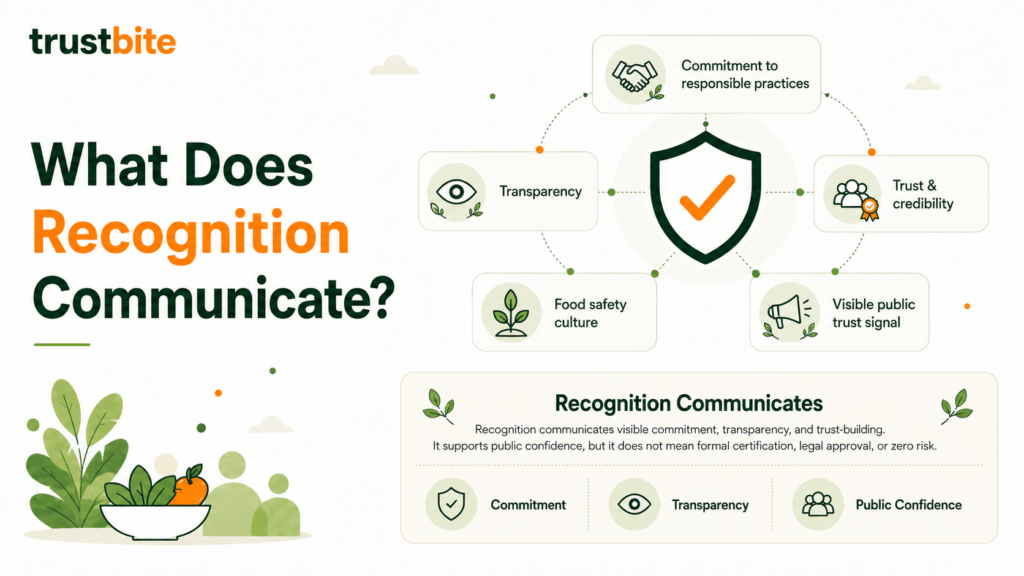
Certification vs Recognition: Side-by-Side Comparison
| Category | Certification | Recognition |
|---|---|---|
| Main purpose | To verify conformity to a defined standard, scheme, requirement, or set of criteria. | To acknowledge commitment, transparency, responsible practices, education, culture, or participation in a trust-building framework. |
| Legal status | May be required by customers, markets, contracts, or supply chains, but is not always legally required. | Usually voluntary and not a legal replacement for compliance, inspection, licensing, or certification. |
| Who provides it | Certification bodies, sometimes accredited depending on the scheme and context. | Recognition authorities, professional organizations, associations, platforms, or independent recognition programs. |
| Basis of evaluation | Defined technical standard, scheme, audit protocol, or certification requirements. | Defined recognition criteria connected to responsibility, transparency, training, culture, communication, or responsible participation. |
| Typical evidence reviewed | Procedures, records, HACCP plans, monitoring logs, corrective actions, internal audits, management review, site practices, traceability, supplier controls, training records, and other standard-specific evidence. | Training participation, transparency commitments, responsible practices, documentation support, professional involvement, culture-building activities, public communication, or participation in a recognition framework. |
| Level of formality | Usually high. Certification follows structured audit, decision, surveillance, and certificate-use processes. | Varies by program. Responsible recognition should still use clear criteria, rules, and communication boundaries. |
| Audit requirement | Often requires a formal audit or assessment. | May or may not involve an audit, depending on the recognition framework. Recognition should not be described as certification unless it follows certification rules. |
| Public communication role | Communicates conformity to a specific standard or scheme within a defined scope. | Communicates visible commitment, transparency, and participation in a trust-building framework. |
| Renewal or monitoring | Usually includes surveillance audits, recertification, or periodic reassessment. | May include renewal, monitoring, periodic review, or continued eligibility checks depending on the program. |
| Examples | HACCP-based certification programs, ISO 22000, FSSC 22000, BRCGS, IFS, SQF, personnel certification, product certification. | Food safety recognition, food safety trust mark, voluntary recognition framework, recognized training provider, recognized consultant, recognized digital support platform. |
| What it proves | Conformity to defined requirements at a defined point in time and within a defined scope. | Participation in a defined recognition framework and commitment to stated trust, transparency, responsibility, or culture criteria. |
| What it does not prove | That the business is risk-free, permanently compliant, incident-proof, or exempt from legal duties. | That the business is certified, government-approved, risk-free, or exempt from legal duties and inspections. |
| Best used for | Supply chain approval, export markets, customer requirements, technical conformity, manufacturing standards, retailer expectations, and international trade. | Public trust-building, transparency communication, visible commitment, food safety culture, responsible differentiation, and support for businesses not required to obtain formal certification. |
Where Regulation Fits In
Regulation is different from both certification and recognition.
Regulatory inspection is performed by competent authorities, official agencies, or legally authorized bodies. It is connected to food law, public health protection, official controls, licensing, enforcement, and legal compliance.
A government inspection may check whether a food business complies with applicable food safety laws. If serious non-compliance is found, authorities may issue corrective requirements, penalties, restrictions, or other enforcement actions depending on the legal system.
Certification and recognition do not replace regulation.
A business may be:
- Certified and still subject to legal obligations
- Recognized and still required to comply with food law
- Legally compliant but not certified
- Recognized but still subject to official inspection
- Certified but still required to maintain daily food safety controls
- Neither certified nor recognized but still legally responsible for food safety compliance
The relationship should be understood clearly:
- Regulation sets legal obligations.
- Certification verifies conformity to defined standards.
- Recognition communicates commitment, transparency, and participation in a trust-building framework.
Each has a different role.
Why Recognition Should Not Be Presented as Certification
Recognition should never be presented as certification unless it truly is certification.
This is not just a technical detail. It is a matter of honesty, consumer protection, professional credibility, and responsible communication.
A business should not describe a recognition mark as:
- Accredited certification
- Government approval
- Official inspection approval
- Legal authorization
- A license to operate
- ISO 22000 certification
- BRCGS certification
- FSSC 22000 certification
- IFS certification
- SQF certification
- HACCP certification, unless the program actually provides that certification under defined rules
Misleading communication can damage trust. It can confuse consumers. It can create unfair competition. It can also harm recognition programs by making them appear irresponsible.
Responsible recognition programs should clearly explain:
- What the recognition mark means
- What the recognition mark does not mean
- Who provides the recognition
- What criteria are used
- Whether review, monitoring, or renewal applies
- What claims recognized businesses may make
- What claims recognized businesses must avoid
A food safety trust mark is strongest when it is transparent.
How Certification and Recognition Can Work Together
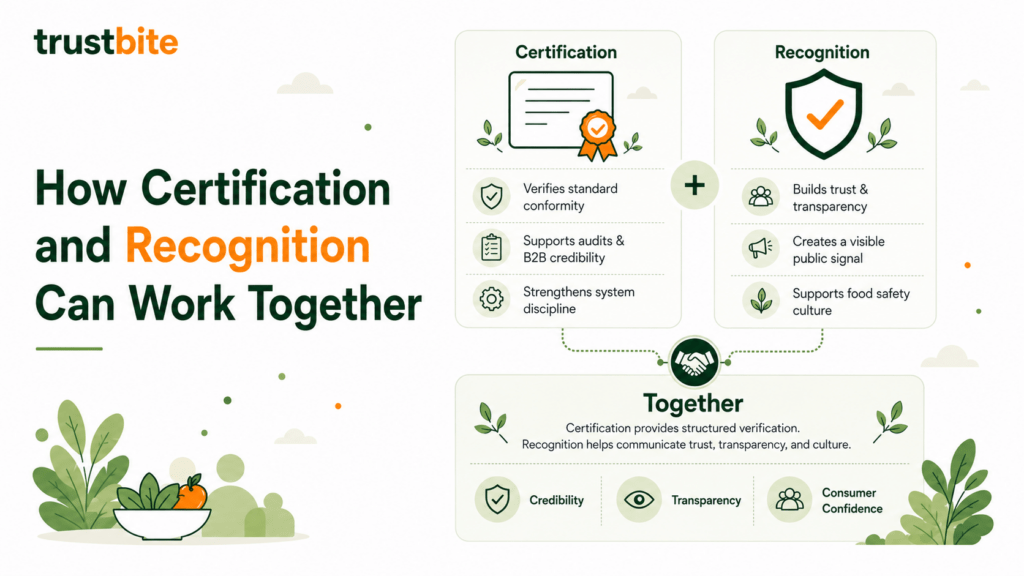
Certification and recognition do not need to compete. In many cases, they can support each other.
Certification verifies conformity to a standard. Recognition helps communicate transparency, culture, and trust.
A certified food manufacturer may already have strong technical systems in place. Recognition can help that manufacturer communicate its commitment to consumers, customers, employees, or the wider community in a more accessible way.
A recognized restaurant may not need ISO 22000 certification, but recognition can help it show visible commitment to staff training, responsible food handling, allergen awareness, transparency, and food safety culture.
A training provider may be recognized for supporting responsible food safety education. A consultant may be recognized for helping businesses improve systems honestly and professionally. A digital platform may be recognized for supporting documentation, monitoring, traceability, or transparency.
Certification and recognition can work together in several ways:
- Certification provides formal evidence of conformity.
- Recognition supports public communication of responsible practices.
- Certified businesses can use recognition to make their commitment more visible.
- Recognized businesses can use certification as a stronger technical foundation when needed.
- Recognition can help non-certified businesses communicate responsible efforts honestly.
- Certification and recognition can both support continuous improvement when used correctly.
The strongest approach is not to treat recognition as a shortcut around certification. Instead, recognition should sit beside certification as part of a wider food safety ecosystem.
Used honestly, both can support continuous improvement.
Examples in Practice
Example: Small Restaurant
A small restaurant may be legally compliant and regularly inspected by local authorities, but it may not need ISO 22000, BRCGS, FSSC 22000, IFS, or SQF certification.
However, the restaurant may still want to communicate that it:
- Trains staff in food safety
- Follows structured hygiene practices
- Takes allergen communication seriously
- Uses professional support when needed
- Participates in a voluntary recognition framework
- Wants to build consumer trust through transparency
In this case, food safety recognition can help the restaurant show visible commitment to food safety culture and consumer trust without pretending to be formally certified.
Example: Certified Food Manufacturer
A food manufacturer may already be certified to a recognized food safety standard such as ISO 22000, FSSC 22000, BRCGS, IFS, or SQF.
That certification may be important for customers, retailers, distributors, or export markets. However, technical certification is not always easily understood by consumers or non-specialist audiences.
Recognition can help the manufacturer communicate:
- Transparency
- Public accountability
- Responsible food safety practices
- Commitment to food safety culture
- Participation in a trust-building framework
- Willingness to make food safety more visible
In this case, recognition does not replace the manufacturer’s certification. It complements it by helping communicate trust in a more accessible way.
Example: Consultant or Training Provider
A food safety consultant or training provider may support businesses with HACCP, staff training, documentation, internal audits, food safety compliance, or food safety culture.
Recognition can acknowledge that the consultant or training provider participates in a responsible framework and supports credible food safety education.
This type of recognition may help communicate professional credibility, but it should not imply that the consultant or training provider is a certification body unless that is legally and technically true.
Recognition in this context may communicate:
- Commitment to responsible education
- Support for food safety improvement
- Participation in a professional framework
- Transparent communication
- Alignment with food safety culture and public trust
Example: Digital Food Safety Platform
A digital food safety platform may help businesses manage records, checklists, monitoring, corrective actions, training evidence, traceability, or transparency.
Recognition can position the platform as part of a wider ecosystem that supports better documentation, communication, and food safety management.
Recognition may be relevant where the platform supports:
- Easier recordkeeping
- Better documentation access
- Training evidence
- Corrective action tracking
- Food safety transparency
- Internal accountability
- Continuous improvement
Again, recognition should not imply that the platform certifies food businesses unless it is formally authorized and structured to do so.
Common Misunderstandings
“Recognition is just a weaker certification.”
Recognition is not simply a weaker certification. Recognition and certification have different purposes. Certification verifies conformity to a defined standard. Recognition communicates commitment, transparency, or participation in a trust-building framework.
Recognition should not be treated as a weaker version of certification. It is a different tool.
“Certification always means the business is safer than every non-certified business.”
Certification provides structured evidence of conformity to a standard, but it does not automatically mean every certified business is safer than every non-certified business.
Food safety depends on daily practices, including:
- Leadership
- Training
- Monitoring
- Verification
- Corrective actions
- Staff behavior
- Supplier control
- Cleaning and sanitation
- Allergen management
- Food safety culture
Some non-certified businesses may manage food safety responsibly, especially if formal certification is not required for their sector.
“Recognition replaces audits.”
Recognition does not replace audits. Some recognition frameworks may include review, eligibility checks, or monitoring, but that should not be confused with formal certification audits.
If a recognition program does not certify conformity to a standard, it should not be presented as certification.
“A trust mark means there is no risk.”
No food safety mark can honestly guarantee zero risk.
A food safety trust mark can communicate commitment and participation in a framework, but food safety risks still require active management. Every food business must continue to control hazards, train staff, monitor procedures, respond to issues, and comply with food law.
“Only large companies need certification or recognition.”
Large manufacturers may need certification because of supply chain, export, retailer, or customer requirements. Smaller food businesses may not need formal certification, but they may still benefit from recognition if they want to communicate transparency and responsible practices.
Certification and recognition can both be relevant to different types of organizations, including:
- Restaurants
- Cafes
- Hotels
- Catering businesses
- Food manufacturers
- Retailers
- Food service providers
- Consultants
- Training providers
- Digital food safety platforms
The right choice depends on the business model, risks, customer expectations, legal context, and communication goals.
“Recognition is only marketing.”
Recognition can support communication, but responsible recognition should be more than marketing.
A credible recognition program should be based on:
- Defined criteria
- Clear rules
- Honest claims
- Transparent limitations
- Responsible communication
- Commitment to food safety transparency and culture
Recognition becomes problematic only when it is vague, exaggerated, or presented as something it is not.
When Should a Business Seek Certification?
A business should consider food safety certification when certification is needed for technical, commercial, regulatory, or supply chain reasons.
Certification may be appropriate when:
- Required by customers
- Required by export markets
- Needed for supply chain approval
- Needed to demonstrate conformity to a recognized standard
- Expected by retailers or distributors
- Required for manufacturing contracts
- Useful for international trade
- Needed to satisfy buyer requirements
- Useful for structured food safety management system improvement
- Required for access to certain markets, tenders, or supplier lists
For example, a food manufacturer supplying large retailers may need certification to BRCGS, FSSC 22000, IFS, SQF, or another accepted scheme. An exporter may need ISO 22000 or another recognized certification depending on the market and customer expectations.
Certification is especially important when a buyer needs formal, auditable evidence of conformity.
When Should a Business Seek Recognition?
A business should consider food safety recognition when it wants to communicate trust, transparency, responsibility, and commitment in a structured way.
Recognition may be appropriate when:
- The business wants to communicate transparency
- The business wants to show commitment to food safety culture
- The business wants to build consumer trust
- The business wants public visibility for responsible practices
- The business wants to participate in a voluntary trust-building framework
- The business is not required to obtain formal certification but still wants structured recognition
- The business wants to make training or professional support more visible
- The business wants to show that food safety is part of its identity
Recognition may be especially useful for:
- Restaurants
- Hospitality operators
- Cafes
- Catering businesses
- Small food businesses
- Food service providers
- Consultants
- Training providers
- Digital food safety tools
- Certified businesses that want stronger public-facing communication
Recognition should be chosen for the right reason: to strengthen transparency and trust, not to imitate certification.
Key Takeaways
- Certification and recognition are different but complementary concepts.
- Food safety certification verifies conformity to a defined standard, scheme, or requirement.
- Food safety recognition acknowledges commitment, transparency, responsibility, education, culture, or participation in a trust-building framework.
- Certification does not guarantee that a business is risk-free or permanently compliant.
- Recognition does not replace certification, legal compliance, HACCP, ISO 22000, BRCGS, FSSC 22000, IFS, SQF, or government inspection.
- Regulation is separate from both certification and recognition and remains legally binding.
- Recognition marks should never be presented as accredited certification, official approval, or a legal license.
- Certification may be necessary for supply chain, export, retail, or customer requirements.
- Recognition may be useful for public trust, food safety transparency, and visible commitment.
- When used honestly, certification and recognition can both support food safety culture, professional credibility, and consumer trust in food businesses.
FAQ Section
Is recognition the same as certification?
No. Recognition is not the same as certification.
Certification verifies conformity to a defined standard or scheme through a formal process. Recognition acknowledges participation, commitment, transparency, responsible practices, or trust-building within a defined framework.
Does TrustBite provide food safety certification?
No. TrustBite does not provide food safety certification to ISO 22000, BRCGS, FSSC 22000, IFS, SQF, HACCP, or other certification standards.
TrustBite operates as an independent food safety recognition authority focused on transparency, responsible practices, education, and public trust.
Can a business have both certification and recognition?
Yes. A business can have both certification and recognition.
For example, a food manufacturer may be certified to a food safety standard and also participate in a recognition program to communicate transparency and commitment to food safety culture.
Does recognition replace government inspection?
No. Recognition does not replace government inspection.
Regulatory inspections are performed by competent authorities or official bodies and are connected to legal food safety requirements. Recognition is voluntary and does not remove legal obligations.
Is certification always legally required?
No. Certification is not always legally required.
In many cases, certification is required by customers, retailers, export markets, or supply chain partners rather than by law. However, every food business must still comply with applicable food safety regulations.
Can recognition improve consumer trust?
Yes, recognition can support consumer trust when it is communicated honestly and based on clear criteria.
A food safety recognition program can help businesses make their commitment to transparency, responsible practices, training, and food safety culture more visible. However, recognition should never be presented as a guarantee of safety.
Conclusion
Certification and recognition serve different but complementary purposes in the modern food safety ecosystem.
Certification focuses on conformity. It verifies that a business, person, product, process, or management system meets defined requirements within a specific scope and audit context. It is especially important for supply chains, manufacturing, export markets, retailers, and customers that require formal evidence of compliance with food safety standards.
Recognition focuses on visible commitment. It helps food businesses, professionals, training providers, consultants, and related organizations communicate transparency, responsibility, education, culture, and public trust.
One should not be confused with the other.
Food safety certification should not be reduced to a marketing badge. Food safety recognition should not be presented as accredited certification or government approval. Regulation, certification, and recognition each have their own place.
When communicated honestly and used responsibly, both certification and recognition can help strengthen food safety culture, improve transparency, and support consumer trust in food businesses.