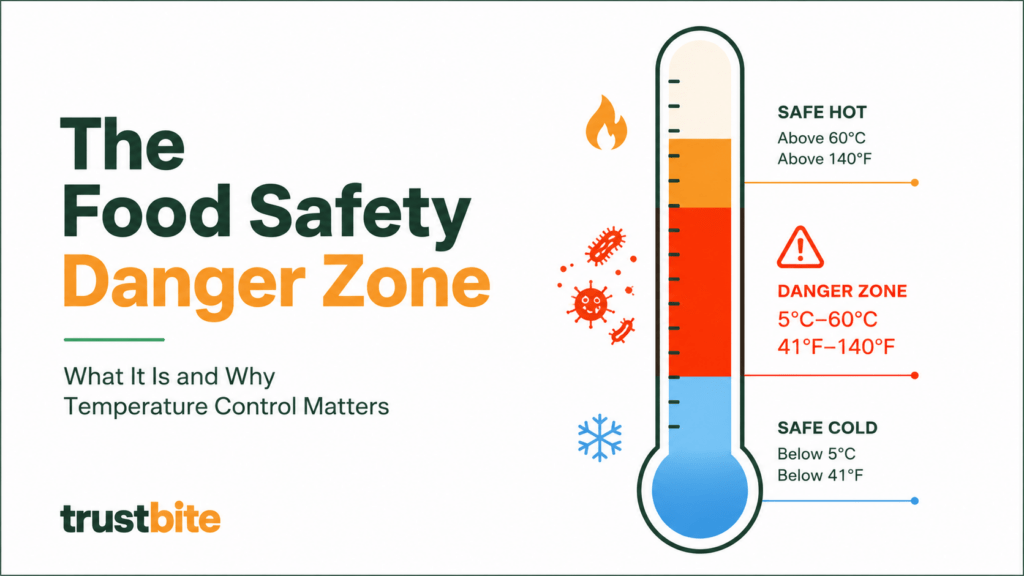
The food safety danger zone is the temperature range between 5°C and 63°C (41°F and 145°F) in which most foodborne bacteria multiply most rapidly. Food left within this range for extended periods gives pathogens the conditions they need to reach levels that cause illness, regardless of how the food looked or smelled when it was served.
Temperature control is one of the most fundamental and most commonly breached food safety controls. Understanding the food safety danger zone explains why refrigerators are set to 5°C or below, why cooked food must reach specific internal temperatures, why food left out at room temperature has a defined safe window, and why the cold chain from supplier to consumer must remain unbroken.
What Is the Food Safety Danger Zone?
The food safety danger zone is the temperature range in which most foodborne pathogens multiply rapidly. The range is 5°C to 63°C (41°F to 145°F). Within this range, bacteria such as Salmonella, Staphylococcus aureus, Clostridium perfringens, and Bacillus cereus can double in number every 20 minutes under ideal conditions.
Below 5°C, bacterial growth slows significantly, though it does not stop entirely. Pathogens such as Listeria monocytogenes can continue growing at refrigeration temperatures, which is why chilled storage reduces rather than eliminates risk. Above 63°C, most foodborne pathogens are killed over time, which is why cooking to a minimum safe internal temperature is an effective critical control point.
The danger zone concept is the temperature rationale behind most of the practical controls in food safety, from refrigerator settings to minimum cooking temperatures to the time limits placed on buffet food and food in transit.
Why Bacteria Multiply So Quickly in the Danger Zone
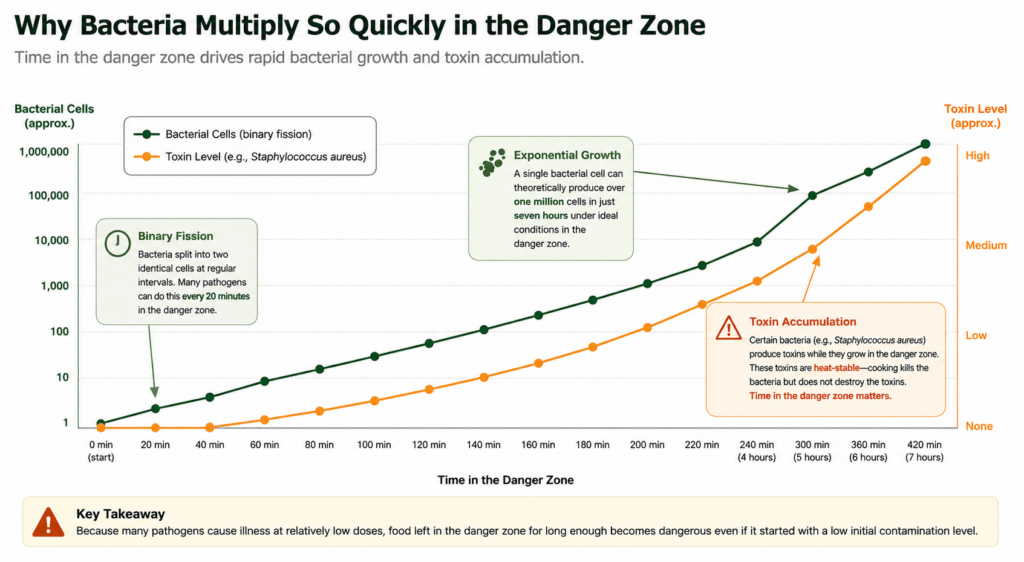
Foodborne bacteria multiply through binary fission, splitting into two identical cells at regular intervals. At optimal temperatures within the danger zone, this can happen every 20 minutes for many pathogens. A single bacterial cell can theoretically produce over one million cells in just seven hours under ideal conditions within the danger zone. Because many pathogens cause illness at relatively low doses, the practical consequence is that food left in the danger zone for long enough becomes dangerous even if it started with a low initial contamination level.
The danger zone also affects the rate at which toxins produced by certain bacteria accumulate. Staphylococcus aureus produces toxins in food while it grows within the danger zone. Those toxins are heat-stable, meaning that cooking the food after toxin formation will destroy the bacteria but not the toxins themselves. This is why time in the danger zone matters independently of whether food is subsequently cooked.
Common Situations Where the Danger Zone Becomes a Risk
Several everyday situations in food businesses create danger zone exposure that contributes to foodborne illness when they are not controlled.
Food held at room temperature for extended periods is one of the most frequent risk situations. Cooked food left out on a counter while other preparation continues, buffet food maintained without temperature control, and food transported without refrigeration all accumulate time in the danger zone.
Inadequate cooking is another common risk. Food that does not reach a sufficient internal temperature throughout its mass remains in the danger zone at its core even if the surface reaches a safe temperature. Poultry, minced meat, and stuffed products require particular attention because heat penetration to the centre takes longer than it does in thinner or less dense products.
Improper cooling is a risk that receives less attention than cooking and refrigeration but is equally important. Cooked food that is transferred to a refrigerator while still hot cools slowly through the danger zone, and a large quantity of hot food can raise the ambient temperature inside the refrigerator enough to bring other products into the danger zone while the cooling process continues.
Thawing at room temperature is a common shortcut that places the outer layers of frozen food in the danger zone while the centre is still frozen, creating a window of pathogen growth before the product is fully thawed.
Repeated reheating of food that has been allowed to cool inadequately, or that has spent too much time in the danger zone, can accumulate bacterial and toxin loads across multiple temperature cycles even when each reheating event reaches the correct temperature.
Safe Temperatures for Food Control
Refrigerated storage should be maintained at 5°C or below. Refrigerators should be monitored with calibrated thermometers and the temperature should be logged at regular intervals. Overloading a refrigerator with warm food reduces its ability to maintain safe temperatures.
Frozen storage should be maintained at minus 18°C or below. Freezing does not kill bacteria but prevents them from multiplying. Food that has thawed and been refrozen may have accumulated pathogen loads during the thawing period that remain present after refreezing.
Cooking temperatures vary by product type. The commonly applied minimum internal temperature for whole cuts of meat in many jurisdictions is 63°C, for poultry 74°C, and for minced or ground meat products 71°C. These temperatures must be achieved at the core of the product, not just at the surface.
Hot holding, where cooked food is kept warm for service rather than being cooked to order, must maintain a temperature of 63°C or above. Food that drops below this threshold has entered the danger zone and has a limited safe hold time.
Cooling cooked food for refrigerated storage should take food from 60°C to 21°C within two hours and from 21°C to 5°C within a further four hours, with total cooling not exceeding six hours. Dividing large quantities into smaller portions, using ice baths, or using blast chilling equipment accelerates this process.
Monitoring Temperature in Food Safety Systems
Temperature monitoring is one of the most common critical control point monitoring activities in food safety management systems. Cooking temperature CCPs require measurement at the core of the product at the time of cooking. Refrigerated and frozen storage temperature CCPs require ongoing ambient monitoring. Hot holding CCPs require temperature checks during service.
Manual temperature monitoring, where a food handler checks and records temperatures at defined intervals, has gaps between checks during which a temperature breach can occur and go undetected. Continuous electronic temperature monitoring eliminates this gap by generating a permanent, time-stamped record of every temperature reading across a monitoring period. Equipment providers such as Adria Food Tech supply temperature monitoring and cold chain management systems that automate this record-keeping, giving food businesses and auditors a complete evidence trail rather than a series of spot checks.
Training Staff on the Danger Zone
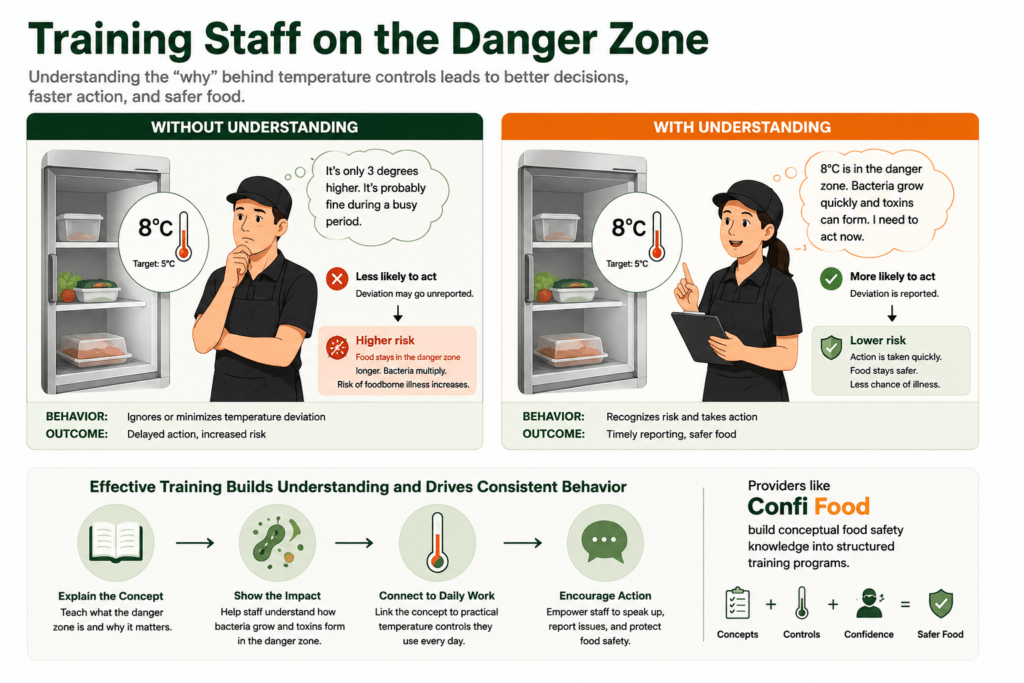
Temperature control procedures are only effective when the staff implementing them understand the reasoning behind them. A food handler who knows the temperature of a refrigerator is supposed to be 5°C but does not understand why may not appreciate the significance of a reading of 8°C during a peak service period. A food handler who understands what the danger zone means, and what happens to food left within it, is more likely to act on a temperature deviation and report it to a supervisor.
Food safety training programs that explain the danger zone as a concept, not just as a number to remember, tend to produce more consistent temperature control behavior from operational staff. Providers such as Confi Food build this kind of conceptual food safety knowledge into their structured training programs, covering the danger zone alongside the practical temperature controls food handlers are expected to apply in their daily work.
Conclusion
The food safety danger zone is the temperature range where bacterial growth creates the greatest risk for food products. Understanding it explains the rationale behind most practical temperature controls in food safety, from refrigerator settings and cooking temperatures to hot holding requirements and time limits on food at room temperature. Businesses that monitor temperatures consistently, act on deviations promptly, and train staff to understand why temperature control matters build more reliable systems than those that treat temperature requirements as arbitrary rules.
Frequently Asked Questions
What is the food safety danger zone?
The food safety danger zone is the temperature range between 5°C and 63°C (41°F and 145°F) in which most foodborne bacteria multiply most rapidly, creating the conditions for foodborne illness if food is left within this range for extended periods.
Why is it called the danger zone?
The range is called the danger zone because it represents the temperatures at which bacterial growth poses the greatest food safety risk. Within this range, pathogens can double in number every 20 minutes under optimal conditions.
What temperature should a refrigerator be set to?
Refrigerators used for food storage should be set to 5°C or below to keep food out of the danger zone and slow bacterial growth. Temperatures should be monitored and logged regularly.
What temperature kills foodborne bacteria?
Most foodborne pathogens are killed by heat above 63°C over time. Specific minimum cooking temperatures vary by product type, but 74°C at the core is a commonly applied standard for poultry, and 63°C for whole cuts of meat in many regulatory frameworks.
How long can food stay in the danger zone?
Most food safety guidelines treat two hours as the maximum cumulative time food should spend in the danger zone before it is either cooked, refrigerated, or discarded. Some frameworks apply a more conservative one-hour limit in higher-risk environments or during warmer ambient conditions.
What happens to food left in the danger zone too long?
Bacteria multiply to levels that may cause illness. Some bacteria also produce heat-stable toxins while growing within the danger zone. These toxins are not destroyed by subsequent cooking, meaning that food that has spent too long in the danger zone may still be dangerous even after reheating.
Can food be refrozen after thawing?
Food that has thawed at refrigerator temperatures can generally be refrozen safely if it has not entered the danger zone. Food thawed at room temperature should not be refrozen, as the outer layers will have been in the danger zone during thawing.
What is the safe temperature for hot holding food?
Food held hot for service should be maintained at 63°C or above. Food that drops below this temperature has entered the danger zone and should be treated according to the business’s corrective action procedure.
What is temperature abuse?
Temperature abuse occurs when food is held within the danger zone for longer than safe limits, whether through improper refrigeration, slow cooling, inadequate cooking, or extended time at room temperature.
Does freezing kill bacteria?
Freezing does not kill most bacteria. It stops or dramatically slows their multiplication. Bacteria that were present in food before freezing remain present after thawing and can begin multiplying again once the food returns to the danger zone.
What is the best way to cool cooked food quickly?
Dividing food into smaller shallow portions, placing containers in an ice bath, and using blast chilling equipment all accelerate the cooling process. The goal is to move food from 60°C to 21°C within two hours and then from 21°C to 5°C within a further four hours.
Why is monitoring temperature automatically better than manual checks?
Automatic temperature monitoring generates a continuous record of every temperature reading over time, revealing whether a temperature breach occurred between manual checks. Manual monitoring only captures the temperature at the moment of the check and cannot detect brief excursions that occur between monitoring intervals.
What foods are most at risk in the danger zone?
High-protein, high-moisture foods including cooked meat and poultry, cooked rice, cooked pasta, dairy products, eggs, and prepared salads containing protein are among the highest-risk foods in the danger zone because they support rapid bacterial growth.
How does the danger zone relate to HACCP?
Temperature control within the danger zone is the basis of many critical control points in HACCP systems. Cooking CCPs address the upper boundary of the danger zone by specifying minimum temperatures that pathogens cannot survive. Chilled storage CCPs address the lower boundary by maintaining temperatures below 5°C.
Related from the Knowledge Center
Cross-Contamination in Food Safety: Causes, Examples, and How to Prevent It
Temperature abuse and cross-contamination are two of the most common causes of foodborne illness. This article covers how contamination transfers between products and how businesses prevent it.
What Is HACCP? A Beginner’s Guide to Food Safety and Risk Prevention
Temperature control is addressed as a critical control point within HACCP. This article explains the broader system that temperature monitoring forms part of.
Food Safety Training: A Complete Guide for Employers
Staff who understand why the danger zone matters apply temperature controls more reliably. This article covers how to build a training program that produces that understanding.