Prerequisite programs are the foundational hygiene and operational controls that a food business must have in place before a HACCP system can function effectively. They address the general conditions and practices in a food handling environment that create the baseline level of control necessary for HACCP to focus specifically on product-related hazards rather than environmental and operational hazards that should already be under control.
A HACCP plan built without effective prerequisite programs in place is built on an unstable foundation. The hazard analysis may identify the right critical control points, but if the production environment itself is not under basic hygienic control, the HACCP system will be managing a much wider and less predictable range of hazards than it was designed to handle.
What Are Prerequisite Programs?
Prerequisite programs are a set of procedures and practices that control the general conditions in a food production, preparation, or handling environment. They are sometimes called Good Hygiene Practices, Good Manufacturing Practices, or simply PRPs. The Codex Alimentarius Commission defines them as practices and conditions needed prior to and during the implementation of HACCP that are essential for food safety.
Prerequisite programs are not the same as HACCP. HACCP focuses on product-specific hazards at specific process steps. Prerequisite programs address the broader environmental and operational conditions that affect the entire facility, including cleaning and sanitation, pest control, personal hygiene, water quality, and supplier management.
The relationship between prerequisite programs and HACCP is sequential and dependent. Prerequisite programs create the conditions in which HACCP can operate as a focused hazard control system. Without them, the number and complexity of hazards requiring HACCP controls would be unmanageable.
Why Prerequisite Programs Matter
Prerequisite programs matter because most food safety hazards in a food handling environment do not originate from a specific product-related process step. They originate from the environment, the people working in it, the equipment being used, and the incoming materials entering the facility.
If pests have access to a production facility, that is not a hazard that a cooking CCP will address. If cleaning is inadequate and pathogen residues persist on surfaces, a metal detection CCP cannot detect that hazard. If incoming water is contaminated, no downstream process step in a typical food operation is designed to remediate it.
Prerequisite programs are the controls that address these environmental and operational hazards before they become HACCP problems. A facility with strong prerequisite programs has a stable, controlled environment in which the HACCP system can focus on the specific product hazards it was designed to manage.
Core Areas Covered by Prerequisite Programs
While the specific content of prerequisite programs varies between food businesses depending on their size, risk level, and the nature of their operations, most frameworks group prerequisite programs into a consistent set of core areas.
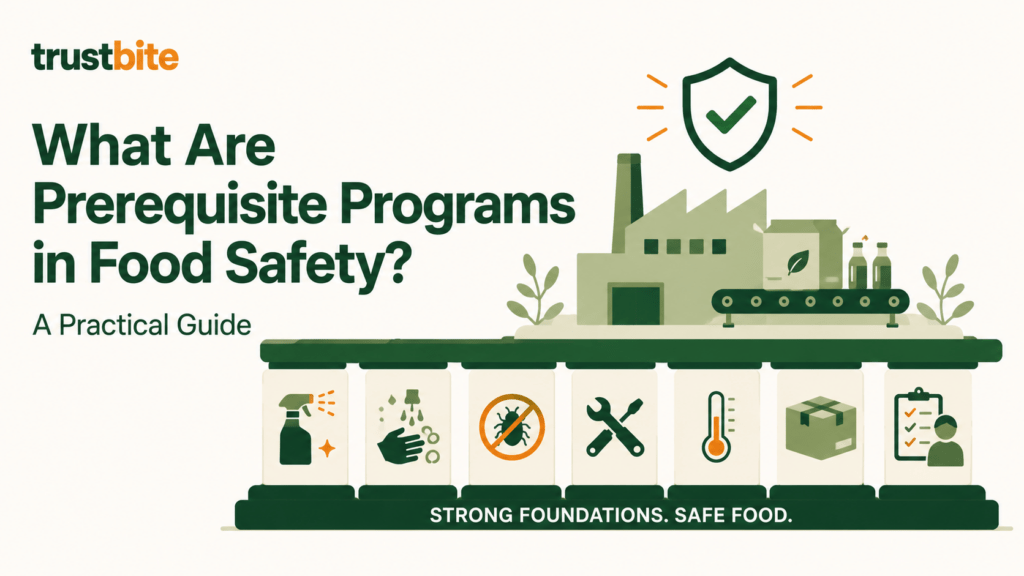
Cleaning and sanitation procedures cover how food contact surfaces, equipment, and the facility environment are cleaned and sanitized, at what frequency, using which products and concentrations, and how the effectiveness of cleaning is verified. Cleaning and sanitation is one of the most frequently audited prerequisite areas and one where gaps between documented procedure and actual practice are commonly found.
Pest control covers the measures in place to prevent pests from entering the facility, the monitoring systems used to detect pest activity, and the response procedures when pest activity is identified. Pest control is typically managed under a contract with an external pest control provider, but the food business remains responsible for maintaining the structural and operational conditions that make pest entry difficult.
Personal hygiene covers the requirements for staff working in food handling areas, including handwashing procedures, rules regarding jewellery, nail polish, and personal items, illness reporting requirements, and the use of protective clothing. Personal hygiene standards are a prerequisite area where training and behavioral compliance matter as much as documented procedure.
Water and ice quality covers the standard of water used in food production and preparation, including potable water requirements, the management of water supplies, and the use and storage of ice where relevant.
Supplier management covers the controls in place to ensure that incoming raw materials and ingredients meet defined food safety standards. This includes supplier approval processes, incoming goods inspection procedures, and the documentation required from suppliers to confirm the safety status of materials they deliver.
Maintenance and equipment calibration covers how food contact equipment is maintained in a condition that does not pose a contamination risk, and how monitoring equipment such as thermometers and temperature sensors is calibrated to ensure accurate readings. Calibrated equipment is particularly critical for monitoring CCPs accurately.
Temperature control as a prerequisite covers the management of refrigerated and frozen storage temperatures across the facility, separate from the specific cooking or chilling CCPs that may exist in the HACCP plan.
Traceability and recall procedures cover the systems in place to trace product and ingredients through the supply chain and to withdraw or recall product when a safety issue is identified.
Waste management covers how food waste and other waste materials are handled and removed from food production areas in a way that does not create contamination risks.
Staff training is itself a prerequisite program requirement. The people operating every other prerequisite program and the HACCP system itself must have the knowledge and understanding to do so correctly. Training records that confirm prerequisite-relevant knowledge has been delivered and assessed are part of the documented evidence for this area. Providers such as Confi Food develop food safety training programs that cover prerequisite program content for food handlers and managers, including hygiene, allergen awareness, temperature control, and cleaning procedures, building the knowledge base that prerequisite programs depend on for their day-to-day operation.
How Prerequisite Programs Are Documented and Monitored
Each prerequisite program should have a written procedure that describes what is done, how, by whom, at what frequency, and how compliance is monitored and recorded. The documented procedure becomes the standard against which performance is assessed during internal and external audits.
Monitoring prerequisite programs typically involves scheduled verification activities such as checking cleaning records, reviewing pest control reports, inspecting incoming goods, confirming refrigeration temperatures, and reviewing staff training completion. The monitoring frequency should reflect the risk associated with the specific prerequisite area.
Corrective actions must be defined for each prerequisite program, specifying what should happen when monitoring reveals that the prerequisite condition has not been met. A cleaning verification result that indicates inadequate sanitation requires an immediate response, both re-cleaning the affected area and investigating why the initial clean was insufficient.
Continuous environmental monitoring, including automated temperature logging in refrigerated and frozen storage, provides a more complete record of prerequisite program performance than periodic manual checks. Equipment providers such as Adria Food Tech supply temperature monitoring and environmental control systems that generate the automated records food businesses use to demonstrate ongoing prerequisite program compliance to auditors and certification bodies.
Prerequisite Programs in Certification Standards
Most major food safety certification standards explicitly require documented and functioning prerequisite programs as a condition of certification. BRCGS, ISO 22000, SQF, IFS, and FSSC 22000 all address prerequisite programs in their requirements, using slightly different terminology but covering the same fundamental areas.
ISO 22000 and FSSC 22000 use the term Infrastructure and Maintenance PRPs and Operational PRPs to distinguish between the general conditions PRPs and the more operational control PRPs that sit between general prerequisites and full HACCP CCPs. This structure reflects a risk-based approach to prerequisite management where not all prerequisite areas carry equal food safety significance.
During a certification audit, auditors assess prerequisite programs through documentation review, facility walkthroughs, staff interviews, and where relevant, verification testing. A gap in prerequisite programs is a common source of non-conformances in food safety audits, often because businesses invest heavily in their HACCP documentation but give less attention to the underpinning prerequisite controls.
The Relationship Between Prerequisite Programs and HACCP
The practical test of whether prerequisite programs are working is whether the HACCP system can operate as designed. A facility where pests are regularly sighted, where surface cleaning verification consistently fails, or where refrigeration temperatures drift above safe limits is a facility where the HACCP system is fighting a battle it was not designed to fight.
Conversely, a facility with robust prerequisite programs creates a stable environment where HACCP can focus on the product-specific hazards that require the precision and documentation of a formal CCP monitoring system. The cleaner and more controlled the environment, the more reliable the HACCP system operating within it.
Conclusion
Prerequisite programs are the operational foundation of every functional HACCP system. They control the environmental and general hygiene conditions that create the stable baseline HACCP depends on. Without them, a HACCP plan may look complete on paper while the facility it describes is operating in conditions that undermine every critical control point within it. Building, documenting, monitoring, and maintaining strong prerequisite programs is not a preliminary step to food safety management. It is food safety management at its most fundamental level.
Frequently Asked Questions
What are prerequisite programs in food safety?
Prerequisite programs are foundational hygiene and operational controls that address the general conditions in a food handling environment. They cover areas such as cleaning and sanitation, pest control, personal hygiene, water quality, supplier management, and staff training, and they must be in place before a HACCP system can function effectively.
What is the difference between prerequisite programs and HACCP?
HACCP focuses on product-specific hazards at specific process steps through a structured hazard analysis and critical control point system. Prerequisite programs address the broader environmental and operational conditions across the entire facility. Both are required for an effective food safety management system.
Why are prerequisite programs important?
Prerequisite programs control the general conditions in which food is handled. Without them, the production environment itself becomes a source of hazards that HACCP was not designed to manage, undermining the effectiveness of the entire food safety system.
What areas do prerequisite programs typically cover?
Core prerequisite program areas include cleaning and sanitation, pest control, personal hygiene, water and ice quality, supplier management, equipment maintenance and calibration, temperature control in storage, traceability and recall procedures, waste management, and staff training.
Are prerequisite programs required for HACCP certification?
Most food safety certification standards including BRCGS, ISO 22000, SQF, IFS, and FSSC 22000 require documented and functioning prerequisite programs as a condition of certification. Gaps in prerequisite programs are a common source of audit non-conformances.
How are prerequisite programs documented?
Each prerequisite program should have a written procedure describing what is done, how, by whom, at what frequency, and how compliance is monitored and recorded. Monitoring records and corrective action documentation are part of the prerequisite program documentation set.
How often should prerequisite programs be monitored?
Monitoring frequency should reflect the food safety risk associated with each prerequisite area. Higher-risk areas such as cleaning and sanitation in ready-to-eat food environments require more frequent verification than lower-risk areas. Each prerequisite program’s monitoring schedule should be defined in the written procedure.
What is an Operational PRP?
An Operational PRP is a term used in ISO 22000 and FSSC 22000 for prerequisite measures that are determined during the hazard analysis to be necessary to control specific identified hazards but where monitoring and management is less prescriptive than a full CCP. Operational PRPs sit between general prerequisite programs and HACCP CCPs in the food safety management system hierarchy.
Can a business have a HACCP system without prerequisite programs?
Technically a HACCP plan can exist without formally documented prerequisite programs, but the system will not function reliably. The hazards that prerequisite programs control will surface within the HACCP system and create an unmanageable number of CCPs or allow hazards to pass through uncontrolled.
What happens during an audit if prerequisite programs are inadequate?
Inadequate prerequisite programs are a significant audit finding. An auditor who observes pest activity, inadequate cleaning, or poor personal hygiene practices will raise these as non-conformances that must be addressed before certification can be awarded or maintained.
How does cleaning verification differ from cleaning itself?
Cleaning is the physical act of removing contamination from surfaces and equipment. Cleaning verification confirms that the cleaning was effective, using methods such as visual inspection, ATP swab testing, or microbiological swabbing. A cleaning procedure that has not been verified provides no objective evidence of its effectiveness.
What role does staff training play in prerequisite programs?
Staff training is itself a prerequisite program requirement. Every other prerequisite program depends on staff who understand what they are doing and why. Training records confirming that prerequisite-relevant knowledge has been delivered and assessed form part of the documentation auditors review.
How do prerequisite programs relate to traceability?
Traceability is one of the core prerequisite program areas. A food business must be able to trace product and ingredients through its supply chain and demonstrate the ability to withdraw or recall product when a food safety issue is identified. Traceability procedures are tested through mock recall exercises.
What is the most commonly failed prerequisite program area in food safety audits?
Cleaning and sanitation is among the most frequently cited prerequisite areas in audit non-conformances, typically because the gap between documented cleaning procedures and actual cleaning practice is wider than management realizes, and because cleaning verification is less consistently applied than the cleaning procedure itself.
Related from the Knowledge Center
What Is HACCP? A Beginner’s Guide to Food Safety and Risk Prevention
The foundational overview of the HACCP system and why prerequisite programs must be in place before HACCP principles can be applied effectively.
The 12 Steps of HACCP: A Practical Guide to Implementation
Prerequisite programs are established before Step 6 of HACCP implementation. This article explains the full 12-step sequence from team assembly through to documentation.
What Is a Food Safety Audit? Types, Process, and What to Expect
Prerequisite programs are a core area of review in food safety audits. This article explains how audits work, what auditors look for, and how businesses prepare.