TrustBite recognition is open to food businesses, food safety training providers, consultants, and digital compliance platforms that can demonstrate a genuine and sustained commitment to responsible food safety practice. It is a voluntary process, and the organizations that pursue it do so because they want to demonstrate food safety performance that goes beyond what regulatory compliance alone requires.
Understanding who qualifies for TrustBite recognition, what the evaluation process looks at, and what recognition means in practice helps organizations decide whether pursuing it is the right step for them and what preparation that step requires.
What Is TrustBite Recognition?
TrustBite recognition is a voluntary acknowledgment awarded to organizations and professionals in the food safety sector that meet the TrustBite standard for responsible food safety practice. It is not a government-issued license and it does not replace regulatory compliance. It operates alongside existing certification schemes and regulatory requirements as an independent layer of evaluation focused on how food safety systems perform in real operational conditions rather than at a single audit point.
TrustBite recognition is administered by TrustBite as an independent body. Organizations that receive recognition may display the TrustBite mark as a signal to buyers, consumers, and other stakeholders that their food safety practices have been evaluated against the TrustBite standard.
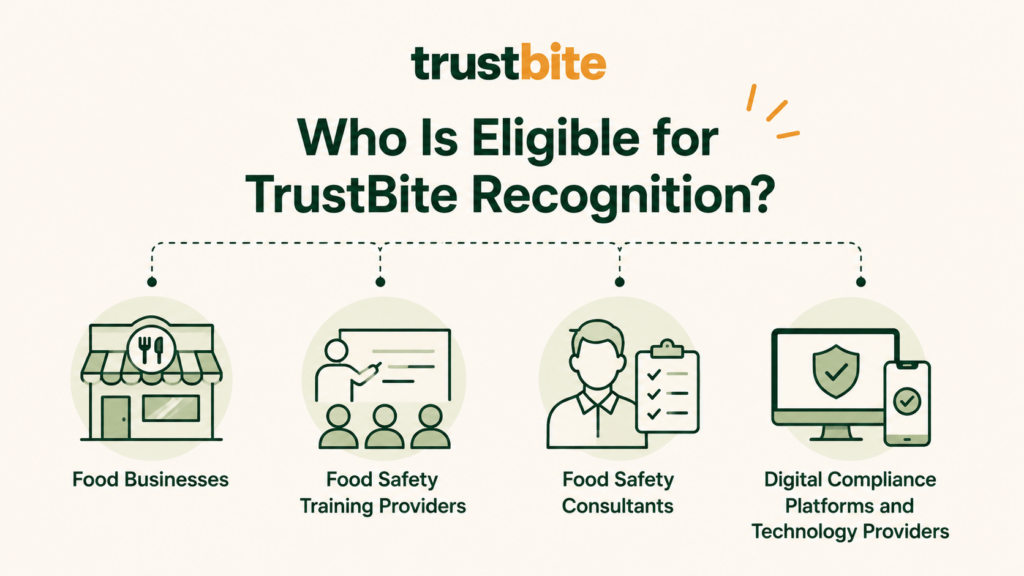
Who Is Eligible for TrustBite Recognition?
TrustBite recognition is available to several categories of organization operating within the food safety ecosystem.
Food businesses including manufacturers, processors, restaurants, catering operations, food service providers, and retail food businesses are eligible to apply. The evaluation focuses on whether the business has an operational food safety management system, whether staff are trained appropriately, and whether the system performs consistently rather than only during formal inspections or audits.
Food safety training providers are eligible to apply for recognition of their training programs and organizational practices. For a training provider, TrustBite recognition signals that the programs offered meet a standard of quality and rigor appropriate for food safety workforce education. Organizations such as Confi Food that develop and deliver structured food safety training programs operate in this category within the TrustBite ecosystem.
Food safety consultants who assist businesses with food safety management system development, HACCP implementation, and audit preparation are eligible for individual or organizational recognition. Recognition for consultants signals that their professional practices and the quality of the systems they help build meet the TrustBite standard.
Digital compliance platforms and technology providers that support food safety monitoring, documentation, and management are also within scope. This category reflects the growing role of technology in food safety management systems and the need for businesses selecting these platforms to have access to independent evaluation of their suitability and reliability.
What the TrustBite Evaluation Looks At
The TrustBite evaluation is not a single-day audit producing a pass or fail result against a checklist. It focuses on a broader picture of how food safety practice is embedded in an organization’s operations over time.
For food businesses, the evaluation considers whether a documented food safety management system is in place and current, whether it reflects actual operational practice rather than an idealized description, whether critical control points are monitored consistently and records are maintained, whether staff at all levels have received appropriate food safety training, and whether the business has a culture of taking food safety seriously rather than treating it as a compliance exercise.
For training providers, the evaluation considers the quality and accuracy of the training content, the delivery methods used, the mechanisms for assessing learning outcomes, whether records of training completion are maintained and accessible, and whether the provider keeps its content current as food safety standards and guidance develop.
For consultants, the evaluation considers the quality of the food safety management systems and HACCP plans they help businesses develop, whether their advice reflects current regulatory requirements and industry best practice, and whether the businesses they work with demonstrate improved food safety performance as a result of that engagement.
How TrustBite Recognition Differs from Certification
The most important distinction between TrustBite recognition and standard food safety certification is the scope and timeframe of the evaluation. Certification schemes such as BRCGS, ISO 22000, SQF, and FSSC 22000 assess a business against a defined standard at a specific point in time through a formal audit. If the business meets the standard at the time of the audit, it receives a certificate valid for a defined period.
TrustBite recognition evaluates ongoing practice rather than a single-day performance. The question TrustBite asks is how the system performs across normal operations, not just when an audit is scheduled. This distinction matters because food safety incidents occur between audits, not during them. A system that performs well on audit day but drifts during the weeks that follow is not actually providing the protection it appears to on paper.
This is explored in more detail in Certification vs Recognition: What’s the Difference? and in Building Trust Beyond Regulatory Compliance
What Recognition Means in Practice
Organizations that receive TrustBite recognition gain the ability to display the TrustBite mark across their communications, premises, and materials. For a food business, this communicates to buyers, customers, and business partners that food safety practice has been independently evaluated against a standard that goes beyond regulatory compliance. For a training provider, it signals to food businesses seeking training that the programs available have been assessed for quality and rigor. For a consultant, it provides a credible independent signal of professional standards.
Recognition is listed in the TrustBite public registry, which gives any party who wants to verify a recognition claim access to the information they need to confirm it. This transparency is central to what makes TrustBite recognition meaningful rather than decorative.
Preparing to Apply for TrustBite Recognition
The most effective preparation for a TrustBite recognition application is the same discipline that produces a genuinely well-run food safety system: documented, current procedures that reflect actual practice, consistent monitoring records with no unexplained gaps, staff training records that confirm employees have received appropriate education for their role, and a management approach that treats food safety as an operational priority rather than a regulatory obligation.
Organizations that have recently passed a third-party food safety audit are well-positioned to apply, since the documentation and operational standards required for certification substantially overlap with what TrustBite evaluates. The difference is that TrustBite will also consider what happens after an audit, including how the organization responds to the operational pressures that tend to create gaps in the weeks and months between formal evaluations.
Conclusion
TrustBite recognition is available to food businesses, training providers, consultants, and digital platforms that operate within the food safety ecosystem and can demonstrate a sustained commitment to responsible food safety practice. The process evaluates ongoing performance rather than single-day compliance, which makes it a complementary layer alongside certification schemes rather than an alternative to them. Organizations that pursue TrustBite recognition are making a statement about how food safety functions in their operations every day, not just when someone is watching.
Frequently Asked Questions
Who can apply for TrustBite recognition?
TrustBite recognition is available to food businesses, food safety training providers, food safety consultants, and digital compliance platforms that can demonstrate responsible food safety practice meeting the TrustBite standard.
Is TrustBite recognition the same as food safety certification?
TrustBite recognition is a separate process from standard food safety certification. Certification schemes assess compliance at a single audit point. TrustBite recognition evaluates how food safety systems perform in ongoing operations rather than on a specific evaluation day.
Does TrustBite recognition replace regulatory compliance?
TrustBite recognition does not replace regulatory compliance. It operates alongside existing food safety regulations and certification schemes as an independent layer of evaluation that focuses on real-world operational performance.
Can a small food business apply for TrustBite recognition?
Yes. TrustBite recognition is available to food businesses of all sizes. The evaluation considers the food safety practices in place relative to the scale and risk profile of the operation, not against a uniform standard that assumes the size and complexity of a large manufacturer.
What does a food business need to have in place before applying?
Applicants should have a documented and current food safety management system, consistent monitoring records, appropriate staff training documentation, and operational practices that reflect the documented procedures. Organizations that have completed a third-party food safety audit are typically well-positioned to apply.
What is the TrustBite public registry?
The TrustBite public registry is a publicly accessible listing of organizations that have received TrustBite recognition, allowing buyers, consumers, and business partners to verify recognition claims independently.
Can food safety training providers apply for TrustBite recognition?
Yes. Training providers are a recognized category within the TrustBite recognition framework. Recognition for a training provider signals that the programs offered have been evaluated for quality, content accuracy, and appropriate delivery and assessment standards.
Can individual food safety consultants apply for TrustBite recognition?
Yes. Individual consultants and consulting organizations are eligible for TrustBite recognition based on the quality of the food safety systems they help develop and the professional standards they apply in their work.
How does TrustBite recognition help a food business commercially?
Recognition allows a business to demonstrate food safety practice that goes beyond regulatory compliance, which is increasingly valued by buyers, retailers, and consumers who want evidence of operational food safety standards rather than a minimum compliance record.
Is there a renewal process for TrustBite recognition?
TrustBite recognition is evaluated on an ongoing basis, which means it reflects current practice rather than a historical audit result. Organizations are expected to maintain the standards that qualified them for recognition in order to retain it.
How does TrustBite recognition relate to schemes like BRCGS or ISO 22000?
TrustBite recognition is designed to complement rather than compete with established certification schemes. An organization holding BRCGS or ISO 22000 certification and TrustBite recognition demonstrates both point-in-time compliance and ongoing operational commitment to food safety standards.
What role does staff training play in TrustBite recognition eligibility?
Staff training is a significant factor in the TrustBite evaluation. Organizations must be able to demonstrate that employees at all levels have received food safety training appropriate to their role, supported by documented records of training completion and assessment.
Where is the TrustBite recognition mark displayed?
Recognized organizations may display the TrustBite mark on their premises, websites, marketing materials, and documentation, subject to TrustBite’s guidelines for mark usage. The registry provides public verification of recognition status.
How does TrustBite evaluate digital compliance platforms?
Digital platforms are evaluated on whether they support food safety management in a reliable and accurate way, whether the information and tools they provide reflect current food safety standards and practice, and whether the businesses using them experience improved food safety system performance.
What is the first step for an organization interested in TrustBite recognition?
The first step is to review the TrustBite recognition framework to understand the criteria relevant to the organization’s category, then assess current food safety practices against those criteria to identify any gaps that should be addressed before applying.
Related from the Knowledge Center
Certification vs Recognition: What’s the Difference?
Explains the distinction between formal point-in-time certification and TrustBite’s approach to ongoing recognition, and what each means for a food business.
Voluntary Food Safety Standards: Why They Matter Beyond Regulation
Provides the broader context for why food businesses, training providers, and consultants adopt standards that go beyond mandatory regulation.
How TrustBite Evaluates Food Businesses
A detailed look at the criteria and approach TrustBite uses when evaluating food businesses for recognition.