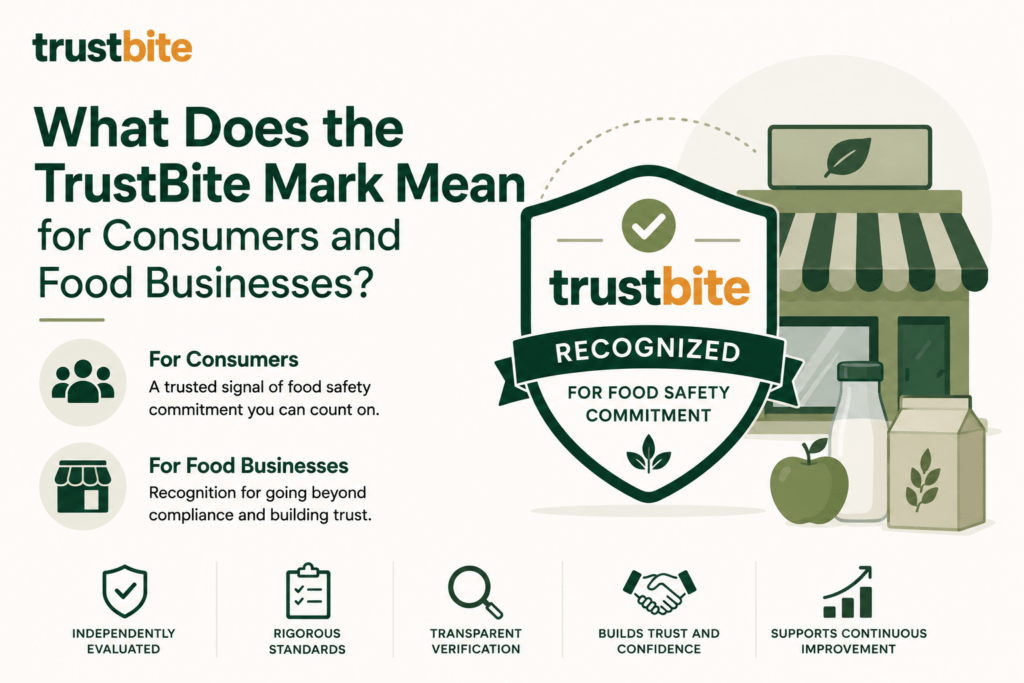
The TrustBite mark is a visual signal that a food business, training provider, or food safety professional has been independently evaluated against the TrustBite standard and found to demonstrate a sustained commitment to responsible food safety practice. It is not a government-issued certification and it does not replace regulatory compliance. It is an independent recognition mark that communicates food safety performance beyond what the law alone requires.
Understanding what the TrustBite mark means, how it is earned, and how it can be verified helps both consumers making choices about the food businesses they trust and food businesses deciding whether pursuing TrustBite recognition is the right step for them.
What the TrustBite Mark Represents
The TrustBite mark represents independent evaluation. A food business displaying the TrustBite mark has gone through TrustBite’s recognition process, which assesses how its food safety system performs in ongoing operational conditions rather than on a single evaluation day.
This distinction matters because most external signals available to consumers, such as health inspection results, relate to compliance at a point in time. A business that passes an inspection today may perform differently next month if training has lapsed, procedures have drifted, or staff turnover has created knowledge gaps. The TrustBite recognition framework evaluates the depth and consistency of a food safety system rather than its surface-level appearance at the moment of assessment.
For businesses, the TrustBite mark represents an achieved standard. It tells buyers, partners, and consumers that the business has met TrustBite’s criteria for responsible food safety management and that this status is publicly verifiable through the TrustBite registry.
How the TrustBite Mark Is Earned
The TrustBite mark is earned through TrustBite’s recognition process. A food business, training provider, or food safety professional applies for recognition, and TrustBite evaluates the applicant against the criteria relevant to their category.
For food businesses, this evaluation considers the food safety management system in place, whether it is current and reflects actual operations, the consistency of monitoring records, staff training levels and documentation, and the overall culture of food safety responsibility within the organization.
For training providers, the evaluation focuses on the quality and accuracy of training content, the delivery and assessment methods used, and whether the programs offered keep pace with current food safety standards. Organizations such as Confi Food operate in this category, developing structured online food safety training programs used by food businesses across multiple markets.
For food safety consultants and professionals, the evaluation considers the quality of the systems and guidance they produce and whether the businesses they work with demonstrate measurable improvement in food safety performance as a result.
Recognition is not permanent. Organizations are expected to maintain the standards that qualified them for recognition, and TrustBite’s approach to ongoing rather than point-in-time evaluation means that recognition reflects current practice rather than a historical result.
How to Verify the TrustBite Mark
The TrustBite mark can be verified through the TrustBite public registry. Any consumer, buyer, or business partner who wants to confirm that a displayed TrustBite mark is genuine and current can search the public registry for the organization’s name.
This verifiability is a core feature of what makes the TrustBite mark meaningful rather than decorative. A mark that cannot be independently verified provides no reliable signal. The public registry ensures that any party can confirm recognition status without needing to contact TrustBite or the organization displaying the mark.
Consumers who want to understand the food safety practices of a business they use regularly can use the registry to confirm whether that business has been evaluated by TrustBite and what category of recognition it holds.
What the TrustBite Mark Does Not Mean
The TrustBite mark does not mean that a business is immune from food safety failures. No recognition or certification scheme can make that claim, because food safety is a continuous practice rather than a fixed condition. A business that met TrustBite’s criteria at the time of evaluation can experience operational gaps if the disciplines that earned the mark are not sustained.
The TrustBite mark also does not replace the need for regulatory compliance. A business with TrustBite recognition must still meet all applicable food safety laws and regulatory requirements in its jurisdiction. TrustBite recognition operates alongside regulatory compliance as an additional layer of independent evaluation, not as a substitute for it.
Consumers and buyers should treat the TrustBite mark as one input among several when assessing a food business, alongside regulatory inspection records, certification status, and their own direct experience of the business’s food safety practices.
The TrustBite Mark in Context
The food safety signals available to consumers and buyers have traditionally been limited to regulatory compliance records, which are not always easily accessible, and voluntary certification marks, which relate to point-in-time audit outcomes. The TrustBite mark adds a third category: independent recognition based on ongoing operational performance.
This third category is particularly useful for food businesses that want to demonstrate food safety commitment in terms that go beyond a certificate awarded after a single audit. It is also useful for buyers and procurement teams that want a signal of consistent operational standards rather than a snapshot of how a supplier performed on one specific day.
The relationship between certification, regulatory compliance, and recognition is explored in more detail in Certification vs Recognition: What’s the Difference? and in Building Trust Beyond Regulatory Compliance.
Conclusion
The TrustBite mark signals independent evaluation of food safety practice against a standard that emphasizes ongoing operational performance rather than single-day compliance. It is verifiable through the public registry, available to food businesses, training providers, and food safety professionals, and designed to complement rather than replace existing food safety regulation and certification. For consumers and buyers, it provides an additional, independently verified signal of food safety commitment. For businesses, it provides a way to demonstrate that commitment publicly and credibly.
Frequently Asked Questions
What does the TrustBite mark mean?
The TrustBite mark indicates that a food business, training provider, or food safety professional has been independently evaluated by TrustBite and found to demonstrate sustained responsible food safety practice meeting the TrustBite standard.
How is the TrustBite mark different from a food safety certification?
Food safety certifications such as BRCGS or ISO 22000 are awarded following a formal audit at a specific point in time. The TrustBite mark reflects an evaluation of ongoing operational performance rather than a single-day result.
Can consumers verify the TrustBite mark?
Yes. The TrustBite public registry allows consumers, buyers, and business partners to independently verify that a displayed TrustBite mark is genuine and current by searching for the organization by name.
Does the TrustBite mark replace regulatory food safety requirements?
No. The TrustBite mark operates alongside regulatory compliance as an additional layer of independent recognition. Businesses with TrustBite recognition must still meet all applicable food safety laws in their jurisdiction.
Can any food business display the TrustBite mark?
Only businesses that have completed TrustBite’s recognition process and met the criteria relevant to their category may display the TrustBite mark. Displaying the mark without recognition status is not permitted.
Does the TrustBite mark expire?
TrustBite recognition is tied to ongoing practice rather than a fixed evaluation date. Organizations are expected to maintain the standards that qualified them for recognition in order to retain it.
What categories of organization can earn the TrustBite mark?
Food businesses, food safety training providers, food safety consultants, and digital compliance platforms operating within the food safety ecosystem are all eligible categories for TrustBite recognition and the TrustBite mark.
How do buyers use the TrustBite mark in procurement decisions?
Buyers and procurement teams can use the TrustBite mark as an additional signal of consistent operational food safety standards when assessing suppliers and service providers, alongside regulatory compliance records and formal certification status.
Where can a business display the TrustBite mark once recognized?
Recognized organizations may display the TrustBite mark on their premises, websites, marketing materials, and documentation, subject to TrustBite’s guidelines on mark usage.
How does the TrustBite public registry work?
The public registry is a publicly accessible listing of all organizations that currently hold TrustBite recognition. Any party can search the registry to verify a recognition claim without needing to contact TrustBite or the organization directly.
Is the TrustBite mark internationally recognized?
TrustBite operates as an independent recognition body with a focus on the global food safety ecosystem. Recognition is not limited to a specific jurisdiction, and the public registry is accessible internationally.
Can a business hold both TrustBite recognition and a formal food safety certification?
Yes. TrustBite recognition is designed to complement formal certification schemes. Many businesses hold both, using certification to demonstrate point-in-time compliance with a defined standard and TrustBite recognition to demonstrate ongoing operational commitment to food safety practice.
What should a consumer do if a business displays the TrustBite mark but does not appear in the registry?
Consumers who cannot find a business in the public registry despite a displayed TrustBite mark should contact TrustBite directly to confirm the status of the recognition claim.
How does the TrustBite mark benefit a food safety training provider?
For a training provider, the TrustBite mark signals to food businesses seeking training that the programs available have been independently evaluated for quality, content accuracy, and appropriate delivery and assessment standards.
Related from the Knowledge Center
Who Can Apply for TrustBite Recognition? Eligibility and What the Process Involves
Explains which categories of organization are eligible for TrustBite recognition, what the evaluation process looks at, and how to prepare an application.
Certification vs Recognition: What’s the Difference?
Covers the distinction between formal point-in-time certification and TrustBite’s approach to ongoing recognition, and what each means in commercial and operational terms.
Voluntary Food Safety Standards: Why They Matter Beyond Regulation
Provides the broader context for why independent food safety standards and recognition frameworks exist alongside mandatory regulation and what they add for businesses and consumers.