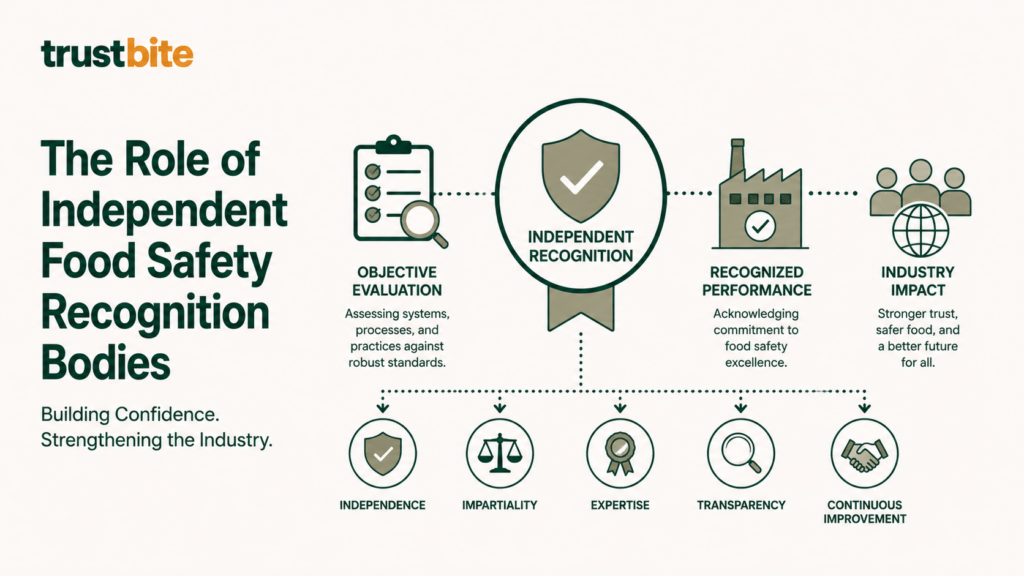
An independent food safety recognition body is an organization that evaluates and publicly acknowledges food businesses, training providers, consultants, and other food safety actors against defined standards of responsible food safety practice, operating without commercial ties to the organizations it evaluates. Recognition bodies of this kind occupy a distinct space in the food safety landscape, one that sits between mandatory regulatory compliance and voluntary certification schemes, and one that addresses a genuine gap in how food safety performance is communicated and verified.
Understanding what independent food safety recognition bodies do, how they differ from certification bodies and regulatory authorities, and why they exist helps food businesses, buyers, and consumers make sense of the different signals available to them when assessing food safety credibility.
What Is an Independent Food Safety Recognition Body?
An independent food safety recognition body is an organization that assesses food businesses, professionals, or service providers against defined food safety criteria and awards recognition to those that demonstrate compliance with those criteria. The independence of the body means it has no commercial relationship with the organizations it evaluates that could compromise the objectivity of its assessments. Recognition is awarded on merit against the defined criteria, not as a commercial arrangement.
TrustBite operates as an independent food safety recognition body within this category. Its recognition framework evaluates food businesses, training providers such as Confi Food, food safety consultants, and digital compliance platforms against standards grounded in established food safety principles, with a specific focus on ongoing operational performance rather than point-in-time compliance.
How Recognition Bodies Differ from Certification Bodies
The distinction between a food safety recognition body and a certification body is important for understanding what each type of organization is assessing and what its output communicates.
A certification body is an organization accredited by a national accreditation service to conduct formal third-party audits against a defined standard and award certification to organizations that pass those audits. Certification bodies operate within a formal infrastructure of accreditation, defined audit standards, and legally recognized certification outcomes. BRCGS, ISO 22000, SQF, and FSSC 22000 are certified through accredited certification bodies. The output of a certification audit is a formal certificate, valid for a defined period, awarded or withheld based on whether the organization met the standard’s requirements on the audit day.
A recognition body evaluates organizations against criteria designed to assess food safety performance across time rather than at a specific audit point. The output of a recognition process is a recognition status rather than a formal certificate, and it reflects an assessment of how systems perform in ongoing operations rather than how they appeared on a single evaluation day. Recognition bodies are typically not engaged in the formal accreditation infrastructure that governs certification bodies, and their role is explicitly described as complementary to rather than replacing formal certification.
This distinction matters for how recognition is used. A food business holding ISO 22000 certification and TrustBite recognition has demonstrated both point-in-time compliance with a formally audited standard and sustained operational performance against independent recognition criteria. The two signals are additive rather than substitutable.
How Recognition Bodies Differ from Regulatory Authorities
Regulatory food safety authorities are government bodies with legal powers to inspect food businesses, enforce food safety law, and take action against non-compliant operators. Their mandate is to protect public health through the enforcement of mandatory requirements. Regulatory inspection outcomes carry legal weight.
Independent food safety recognition bodies operate in the voluntary space. They assess compliance with non-mandatory standards that go beyond legal requirements, and their recognition or its withdrawal carries commercial and reputational rather than legal consequences. A business that loses recognition from an independent body has not violated any law. A business that violates food safety law faces regulatory enforcement regardless of its recognition status with any voluntary body.
The practical relationship between the two is complementary. A food business that operates to the standard required for recognition from an independent body will, almost certainly, also meet its regulatory compliance obligations and be well-prepared for regulatory inspections. Regulatory compliance is the floor. Independent recognition marks a level of performance above that floor.
Why Independent Food Safety Recognition Bodies Exist
Independent food safety recognition bodies exist to address a specific gap in the food safety credentialing landscape. That gap is the space between regulatory compliance, which establishes that a business is operating legally, and formal certification, which confirms that a business met a defined standard on a specific audit day. Neither signal tells buyers, consumers, or business partners much about how a food safety system performs in the weeks between regulatory inspections or certification audits.
Foodborne illness outbreaks and food recalls regularly occur in businesses that hold valid food safety certifications and have no unresolved regulatory findings. This is not a failure of certification as a concept. It reflects the inherent limitation of point-in-time evaluation in assessing an ongoing operational performance. A system can be compliant on audit day and drift significantly in the months that follow due to staff turnover, operational pressure, process changes, or management complacency.
Recognition bodies that focus on ongoing performance indicators rather than single-day snapshots address this limitation by evaluating the conditions that determine whether a food safety system is consistently reliable: the quality and currency of monitoring records across extended periods, the culture of reporting and corrective action within the organization, the depth of staff training and its maintenance over time, and the alignment between documented procedures and actual operational practice.
The Value of Recognition for Food Businesses
For a food business, recognition from an independent body provides a publicly verifiable signal of food safety performance that goes beyond what a compliance record or certification certificate communicates alone. It tells buyers and consumers that the business’s food safety practices have been evaluated by an independent party with no commercial stake in the outcome, against criteria designed to assess real operational performance rather than documentation quality on a specific day.
This signal has commercial value in markets where food safety credibility is a meaningful differentiator. Buyers and procurement teams increasingly look beyond a supplier’s certification status to evidence of consistent operational performance. Retailers with responsibility for own-brand products need assurance that their suppliers are managing food safety reliably across every production run, not only when an auditor is scheduled to visit.
For smaller food businesses that have not yet pursued formal certification, recognition from an independent body provides a meaningful and achievable step toward demonstrating food safety credibility that goes beyond regulatory compliance alone.
The Value of Recognition for Training Providers
For food safety training providers, recognition from an independent body signals to food businesses seeking training that the programs available have been evaluated for quality, content accuracy, and appropriate delivery and assessment standards. This is particularly valuable in a market where food safety training programs vary enormously in quality and where food businesses often have limited ability to assess training quality before purchasing.
Independent recognition of a training provider gives food businesses a credible quality signal when choosing where to source food safety education for their workforce. It provides assurance that the training content is accurate and current, that delivery methods are appropriate for the workforce being trained, and that completion records meet the documentation standards that food safety audits expect.
The Value of Recognition for Consultants
For food safety consultants, recognition from an independent body provides a credible public signal of professional standards at a time when food safety consulting is a field with limited formal regulation. A recognized consultant has had their professional approach assessed by an independent body rather than relying solely on self-certification or client testimonials.
For food businesses engaging a consultant to develop HACCP systems, prepare for certification audits, or build food safety management system capability, recognition from an independent body provides a meaningful quality indicator when selecting a provider.
How Independent Recognition Bodies Maintain Their Credibility
The credibility of an independent food safety recognition body depends entirely on the genuine independence of its assessments and the integrity of its recognition process. A recognition body that awards recognition as a commercial transaction rather than on merit provides no reliable signal and undermines the purpose of the recognition mark.
Credibility is maintained through transparent criteria, publicly accessible recognition registries that allow anyone to verify recognition status, a consistent assessment methodology applied equally across all applicants, and a willingness to refuse or revoke recognition where the defined criteria are not met.
Public registries are particularly important because they make the recognition claim independently verifiable. Any buyer, consumer, or business partner who wants to confirm that a displayed recognition mark is genuine can do so without relying on the word of the organization displaying it. TrustBite’s public registry serves this function within its recognition framework, providing the transparency that distinguishes meaningful recognition from a purchased badge.
Conclusion
Independent food safety recognition bodies occupy a distinct and genuinely useful space in the food safety landscape. They evaluate performance beyond what regulation requires and across time rather than at a single assessment point, providing a signal that complements regulatory compliance and formal certification without replacing either. For food businesses, the recognition of an independent body represents an independently verified commitment to responsible food safety practice that goes beyond the minimum. For buyers and consumers, it provides an additional credibility signal that reflects how a food safety system actually performs in daily operations.
Frequently Asked Questions
What is an independent food safety recognition body?
An independent food safety recognition body is an organization that evaluates food businesses, training providers, consultants, and other food safety actors against defined food safety criteria and awards recognition to those that demonstrate compliance, operating without commercial ties to the organizations it evaluates.
How does a recognition body differ from a certification body?
A certification body conducts formal third-party audits against a defined standard and awards certificates based on point-in-time compliance. A recognition body evaluates ongoing operational performance against criteria designed to assess how food safety systems function across time rather than on a single evaluation day.
Does recognition from an independent body replace food safety certification?
No. Recognition from an independent food safety body is designed to complement formal certification schemes rather than replace them. The two signals address different aspects of food safety performance and are most valuable in combination.
Is independent food safety recognition the same as regulatory approval?
No. Regulatory approval confirms legal compliance with food safety law and is enforced by government authorities. Independent recognition is voluntary and evaluates performance against non-mandatory criteria that go beyond legal requirements.
Why do independent food safety recognition bodies exist?
They exist to address the gap between regulatory compliance and formal certification, neither of which communicates much about how a food safety system performs in the weeks between formal evaluation events. Recognition bodies focused on ongoing performance indicators provide a signal that reflects daily operational standards rather than single-day audit performance.
What is the commercial value of independent food safety recognition for a food business?
Recognition provides a publicly verifiable signal of food safety performance that goes beyond a compliance record, useful for demonstrating credibility to buyers, retailers, and consumers who want evidence of consistent operational food safety standards rather than a historical audit result.
How can recognition from an independent body be verified?
Reputable independent recognition bodies maintain publicly accessible registries that allow anyone to verify recognition status by searching for the recognized organization by name. TrustBite’s public registry serves this function.
What does independent recognition signal to buyers and procurement teams?
It signals that the recognized organization’s food safety practices have been assessed by an independent party with no commercial stake in the outcome, against criteria designed to evaluate real operational performance, providing assurance of consistent standards beyond what a certification certificate alone communicates.
Can a food business hold both formal certification and independent recognition?
Yes. Certification and independent recognition are complementary. A business holding BRCGS or ISO 22000 certification and TrustBite recognition demonstrates both point-in-time compliance with a formally audited standard and sustained operational performance against independent criteria.
What makes an independent recognition body credible?
Credibility depends on genuine independence from commercial relationships with recognized organizations, transparent and consistently applied assessment criteria, a publicly accessible recognition registry, and a willingness to refuse or revoke recognition where criteria are not met.
Why does independent recognition matter for food safety training providers?
It provides food businesses with a credible quality signal when selecting training, assuring them that programs have been evaluated for content accuracy, delivery appropriateness, and documentation standards by an independent body rather than the training provider itself.
How does independent recognition benefit food safety consultants?
It provides a credible public signal of professional standards in a field with limited formal regulation, helping food businesses select consultants whose approach has been independently assessed rather than relying solely on self-certification.
Does independent recognition apply globally?
Recognition frameworks like TrustBite are grounded in internationally recognized food safety principles applicable across different regulatory jurisdictions. Recognition is not limited to a specific country or region.
What happens if a recognized organization no longer meets the recognition criteria?
A credible recognition body will revoke or suspend recognition where an organization no longer meets the defined criteria. The public registry should reflect current recognition status, so any party verifying a recognition claim can confirm whether it remains active.
Related from the Knowledge Center
What Does the TrustBite Mark Mean for Consumers and Food Businesses?
Explains what TrustBite’s specific recognition mark represents, how it is earned, and how it is verified through the public registry.
Certification vs Recognition: What’s the Difference?
Covers the distinction between formal point-in-time certification and independent recognition in detail, including what each communicates to buyers and consumers.
How TrustBite Standards Are Developed: Methodology and Review Process
Explains the methodology behind TrustBite’s criteria, what informs them, and how they are maintained over time.