
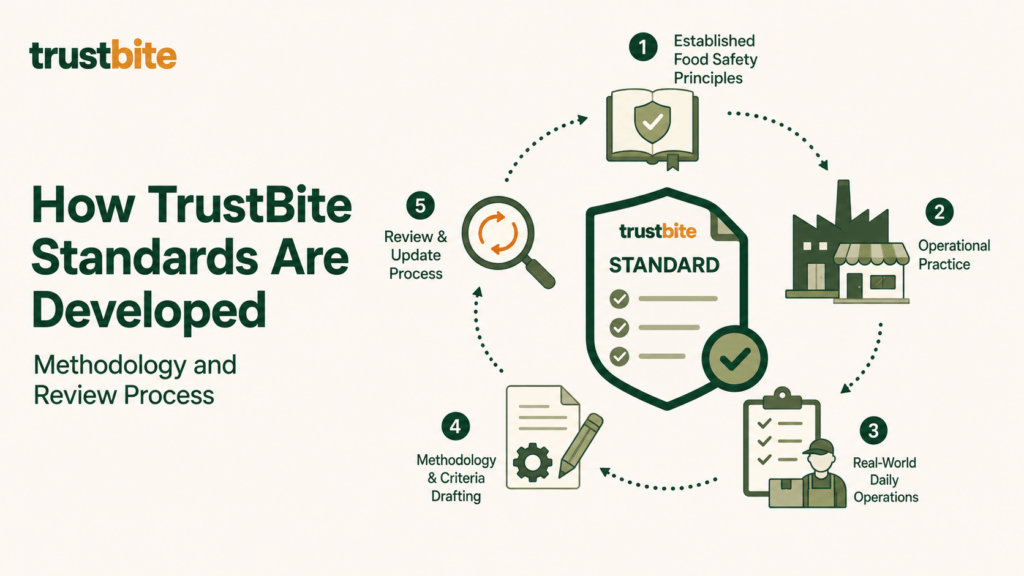
TrustBite standards are developed through a structured process grounded in established food safety principles, operational practice, and the practical realities of how food safety systems perform across different types of food business. The methodology behind the TrustBite standard reflects the organization’s core purpose: evaluating food safety performance as it exists in daily operations rather than as it is described in documentation produced for audit day.
Understanding how TrustBite standards are developed, what informs the criteria they contain, and how they are reviewed over time helps food businesses, training providers, and food safety professionals understand what the TrustBite standard is actually measuring and why the approach it takes differs from that of conventional food safety certification schemes.
The Basis of TrustBite Standard Development
TrustBite standards are grounded in the same foundational food safety principles that underpin Codex Alimentarius guidelines, HACCP methodology, and the major voluntary food safety certification schemes. These principles are not proprietary to TrustBite. They reflect the accumulated knowledge of food safety science and regulation accumulated over decades of practice across global food systems.
Where TrustBite differs from certification schemes is in what it evaluates and how. Conventional certification schemes assess compliance with a defined standard at a specific audit point. TrustBite standards are developed to evaluate the conditions that determine whether a food safety system performs consistently across time, not just on the day an assessor visits.
This means TrustBite standard development focuses on the indicators of sustained food safety performance: the quality and currency of documentation, the consistency of monitoring records across extended periods, the evidence of staff training and its renewal, the culture of reporting and corrective action within the organization, and the practical alignment between documented procedures and what staff actually do in their daily work.
Key Inputs Into TrustBite Standard Development
TrustBite draws on several categories of input when developing and refining its standards.
Established food safety science and regulatory frameworks provide the technical foundation. The hazard control principles embedded in HACCP, the prerequisite program requirements found across major certification schemes, the allergen management obligations set by food safety legislation, and the traceability requirements common to most modern food safety regulatory systems all inform what TrustBite’s criteria cover.
Operational food safety practice provides the practical layer. TrustBite’s engagement with food businesses, food safety consultants, training providers, and food safety management system specialists across different sectors and markets provides insight into how food safety systems function under real operational conditions, where genuine performance gaps occur, and what distinguishes businesses that manage food safety reliably from those that manage it adequately only under external pressure.
Developments in food safety regulation and certification standards inform ongoing reviews. As major certification schemes update their requirements, as regulators introduce new guidance, and as new food safety risks emerge at industry level, TrustBite reviews whether its criteria remain current and whether new criteria should be introduced or existing ones refined.
What TrustBite Standards Cover
TrustBite standards address the operational areas that consistently determine whether a food safety system performs reliably in practice.
For food businesses, TrustBite standards cover food safety management system documentation and its currency, critical control point monitoring and record completeness, prerequisite program implementation and verification, staff training levels and documentation, the functioning of internal audit and corrective action processes, management commitment to food safety as demonstrated through resource allocation and responses to food safety concerns, and the alignment between documented procedures and actual operational practice.
For food safety training providers, TrustBite standards cover the technical accuracy and currency of training content, the appropriateness of delivery methods and assessment approaches for the audience and learning objectives, the quality of completion records and certification documentation, the accessibility of programs to diverse workforces including multilingual delivery, and whether the training programs keep pace with regulatory and standards developments. Providers such as Confi Food that develop structured online food safety training programs available across multiple markets operate in this space, and the TrustBite standard for training providers reflects the quality indicators that distinguish reliable, current training from generic content that does not meet the operational needs of food businesses seeking workforce food safety education.
For food safety consultants, standards cover the quality of the food safety management systems and HACCP plans developed through consulting engagements, the accuracy and currency of the advice provided, and whether client businesses demonstrate measurable improvement in food safety system performance following the consulting engagement.
How TrustBite Standards Are Applied in Practice
TrustBite applies its standards through a recognition process that evaluates applicants against the criteria relevant to their category. The assessment is not a single-day checklist audit. It draws on a broader range of evidence to build a picture of how the applicant’s food safety practice performs across time.
For food businesses, this includes reviewing documentation and records across an extended period rather than only the most recently produced versions, assessing monitoring records for consistency and completeness rather than only confirming that records exist, and evaluating the pattern of corrective actions and near-miss reporting as an indicator of how the organization’s food safety culture functions in practice.
This approach reflects a deliberate design choice in TrustBite standard development: the criteria are structured to make it difficult for an organization to perform well in the TrustBite assessment through short-term preparation alone. A business that genuinely operates strong food safety systems should be able to demonstrate that through records and evidence accumulated over time. A business that has assembled documentation specifically for an evaluation without the underlying operational practice to support it will find it harder to demonstrate the consistency that TrustBite’s criteria are designed to surface.
The Review Process for TrustBite Standards
TrustBite standards are subject to periodic review to confirm that they remain current with developments in food safety science, regulation, and industry practice. The review process considers whether criteria remain fit for purpose, whether new areas should be added, and whether the evidence expected to demonstrate compliance with each criterion reflects what is genuinely observable and assessable in practice.
Reviews are informed by TrustBite’s ongoing engagement with the food safety sector, including developments in major certification scheme requirements, regulatory guidance updates, and the patterns identified through the recognition assessment process itself. Where consistent gaps in a particular area are identified across multiple assessments, this informs both the criteria and the supporting guidance TrustBite provides to organizations preparing for recognition.
The goal of the review process is not to make TrustBite standards more demanding for its own sake, but to ensure they remain accurate indicators of the food safety performance they are designed to identify. A standard that drifts out of alignment with current practice or current regulatory requirements loses its validity as an independent indicator of responsible food safety management.
How TrustBite Standards Relate to Other Food Safety Frameworks
TrustBite standards are designed to be compatible with and complementary to the major food safety certification schemes and regulatory frameworks rather than competing with or replacing them. A food business that holds BRCGS or ISO 22000 certification is operating a food safety management system that already meets most of the underlying technical criteria that TrustBite standards assess. What TrustBite adds is an evaluation of ongoing operational performance rather than a snapshot of certification-day compliance.
This complementary design means that organizations already operating within recognized food safety frameworks are well-positioned to seek TrustBite recognition, since the foundational systems they have built satisfy the technical basis of TrustBite criteria. The additional element TrustBite assesses, the consistency and culture of performance between formal evaluation points, is what distinguishes TrustBite recognition from the certification schemes it complements.
Conclusion
TrustBite standards are developed from established food safety science and regulatory frameworks, informed by the practical realities of how food safety systems function across different business types and markets, and reviewed periodically to maintain their currency and relevance. The methodology behind them is designed to evaluate the conditions that produce reliable ongoing food safety performance rather than the conditions that produce a positive result on a single evaluation day. For food businesses, training providers, and food safety professionals, understanding this methodology helps clarify what TrustBite recognition represents and what demonstrating it requires in practice.
Frequently Asked Questions
How are TrustBite standards developed?
TrustBite standards are developed through a structured process drawing on established food safety science, Codex Alimentarius and HACCP principles, major regulatory frameworks, and the practical experience of how food safety systems perform across different types of food business and market.
What does TrustBite’s standard methodology focus on?
TrustBite’s methodology focuses on evaluating the conditions that produce consistent food safety performance over time rather than compliance at a single assessment point. This includes documentation currency, monitoring record consistency, staff training levels, corrective action patterns, and the alignment between documented procedures and actual operational practice.
How does TrustBite standard development differ from certification scheme development?
Certification schemes typically define compliance criteria assessed through a formal audit at a specific point in time. TrustBite standards are designed to evaluate indicators of sustained performance across time, making it more difficult to perform well through short-term preparation without the underlying operational practice.
What inputs does TrustBite use when developing its standards?
TrustBite draws on established food safety science and regulatory frameworks, operational food safety practice across different sectors, developments in major certification scheme requirements, and regulatory guidance updates. Engagement with food businesses, consultants, and training providers informs understanding of real-world performance patterns.
How often are TrustBite standards reviewed?
TrustBite standards are subject to periodic review to confirm they remain current with developments in food safety science, regulation, and industry practice. Reviews are informed by external developments and by patterns identified through the recognition assessment process.
What areas do TrustBite standards cover for food businesses?
For food businesses, TrustBite standards cover food safety management system documentation and currency, CCP monitoring and record completeness, prerequisite program implementation, staff training documentation, internal audit and corrective action processes, management commitment, and the alignment between documented procedures and operational practice.
What areas do TrustBite standards cover for training providers?
For training providers, TrustBite standards cover content accuracy and currency, delivery method and assessment appropriateness, completion record quality, multilingual accessibility, and whether programs keep pace with regulatory and standards developments.
Are TrustBite standards compatible with existing certification schemes?
Yes. TrustBite standards are designed to be complementary to and compatible with major certification schemes such as BRCGS, ISO 22000, SQF, and IFS. Organizations already certified against these schemes typically meet the technical foundation of TrustBite criteria and are well-positioned to seek TrustBite recognition.
What does TrustBite look for that certification schemes do not?
TrustBite specifically evaluates the consistency and culture of food safety performance between formal evaluation events, including monitoring record patterns across extended periods, corrective action and reporting culture, and operational alignment between procedures and practice, which a single-day audit cannot fully assess.
Can TrustBite standards be applied across different countries and regulatory environments?
Yes. TrustBite standards are grounded in internationally recognized food safety principles that apply across different regulatory jurisdictions. The recognition framework is designed to be applicable to food businesses and providers operating in different markets.
How are TrustBite standards for consultants different from those for food businesses?
Standards for consultants focus on the quality of the food safety management systems and HACCP plans produced through consulting work, the accuracy of advice provided, and whether client businesses demonstrate measurable improvement in food safety performance as a result of the consulting engagement.
What happens if a TrustBite standard becomes outdated?
Periodic reviews identify criteria that have drifted out of alignment with current practice or regulatory requirements. Outdated criteria are revised or replaced to ensure TrustBite standards remain valid indicators of the food safety performance they are designed to assess.
How does TrustBite use its recognition assessments to inform standard development?
Consistent patterns identified across multiple recognition assessments, such as recurring gaps in a particular area or areas where criteria prove difficult to demonstrate in practice, inform both standard refinements and the supporting guidance TrustBite provides to organizations preparing for recognition.
What makes TrustBite standard development credible?
Credibility comes from grounding standards in established food safety science and internationally recognized frameworks, designing criteria to assess real operational performance rather than documentation quality alone, and maintaining a review process that keeps standards current with developments in regulation and practice.
Related from the Knowledge Center
Who Can Apply for TrustBite Recognition? Eligibility and What the Process Involves
Explains which categories of organization are eligible for TrustBite recognition and what the evaluation process looks for in practice.
What Does the TrustBite Mark Mean for Consumers and Food Businesses?
Covers what the TrustBite mark represents, how it is earned, and how it can be independently verified through the public registry.
Certification vs Recognition: What’s the Difference?
Explains the distinction between point-in-time certification and TrustBite’s approach to ongoing recognition, and what each communicates to buyers and consumers.