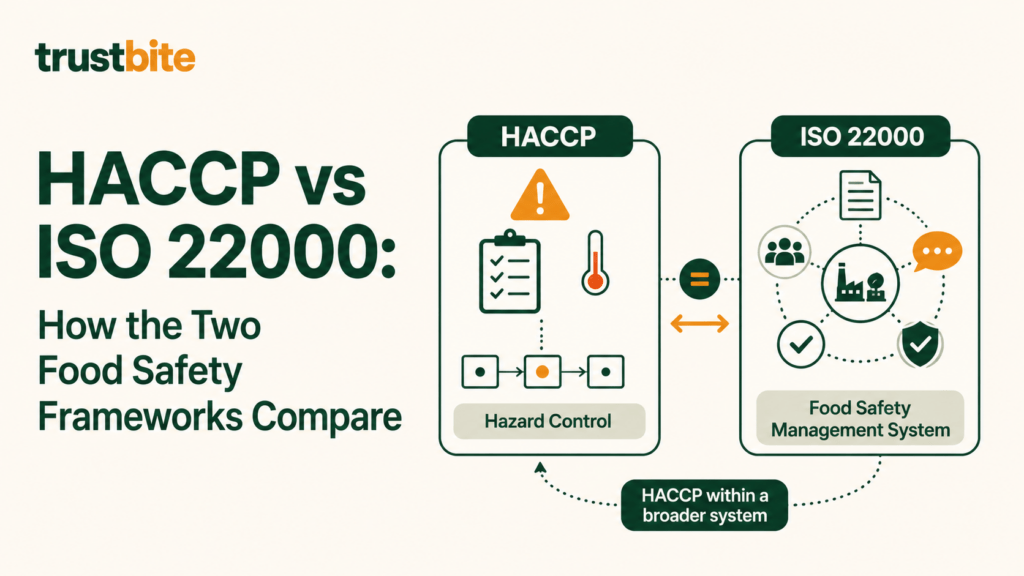
HACCP vs ISO 22000. HACCP and ISO 22000 are both food safety frameworks built on hazard analysis and risk control principles, but they operate at different levels and serve different purposes within a food safety management system. HACCP is a hazard control methodology. ISO 22000 is a comprehensive food safety management system standard that incorporates HACCP as one of its core technical components alongside requirements covering communication, management systems, and organizational governance.
A food business implementing HACCP has a structured approach to identifying and controlling food safety hazards. A food business certified to ISO 22000 has all of that plus a formally governed management system around it. Understanding the difference between HACCP and ISO 22000, how they relate to each other, and which is appropriate for a given business helps food businesses make informed decisions about their food safety system development.
What Is HACCP?
HACCP, which stands for Hazard Analysis and Critical Control Points, is a science-based preventive approach to food safety that identifies potential biological, chemical, and physical hazards in a food production or preparation process, determines which steps in that process require specific controls to manage those hazards, and establishes monitoring, corrective action, verification, and documentation systems to confirm those controls are working.
HACCP is built on seven principles defined by Codex Alimentarius: conduct a hazard analysis, identify critical control points, establish critical limits, establish monitoring procedures, establish corrective actions, establish verification procedures, and establish documentation and record-keeping. These seven principles are implemented through a 12-step process that begins with team assembly and product description before the principles are applied.
HACCP is required by law in most food safety regulatory frameworks. EU Regulation (EC) 852/2004 requires food business operators to implement and maintain a permanent procedure based on HACCP principles. Equivalent requirements exist in the US Food Safety Modernization Act and in most other national food safety regulatory systems.
What Is ISO 22000?
ISO 22000 is an international standard for food safety management systems published by the International Organization for Standardization. The current version is ISO 22000:2018. The standard specifies requirements for a food safety management system applicable to any organization in the food chain, from primary production through processing, distribution, retail, and food service.
ISO 22000 incorporates HACCP principles as its hazard analysis and control methodology but places them within a broader management system framework structured according to ISO’s High Level Structure, which is also used by ISO 9001 for quality management and ISO 14001 for environmental management. This means an organization certified to ISO 22000 has integrated its food safety management into a formally governed system covering leadership, planning, support, operation, performance evaluation, and continual improvement.
ISO 22000 certification is voluntary. It is pursued by food businesses that want to demonstrate food safety management system quality to international buyers, enter markets that expect a recognized food safety standard, or integrate their food safety management with other ISO management systems they operate.
The Key Differences Between HACCP and ISO 22000
The most fundamental difference between HACCP vs ISO 22000 is scope. HACCP addresses the technical hazard control methodology for identifying and managing food safety hazards within a specific process. ISO 22000 addresses the entire food safety management system including the organizational governance, communication processes, and continual improvement framework within which HACCP operates.
A business implementing HACCP has a hazard analysis, a HACCP plan, monitoring records, corrective action procedures, verification activities, and documentation. This is a solid technical food safety system.
A business certified to ISO 22000 has all of that plus a formally structured management system that governs how food safety is managed at the organizational level. This includes defined roles and responsibilities for food safety, management review processes that assess system performance, internal communication processes for food safety information, external communication procedures for supply chain partners, and a formal approach to continual improvement that goes beyond individual corrective actions.
A second significant difference is in how prerequisite programs are addressed. HACCP assumes that prerequisite programs are in place but does not specify their content in detail. ISO 22000 explicitly requires prerequisite programs as part of the standard and specifies categories that must be addressed, distinguishing between general infrastructure PRPs and operational PRPs that sit between general prerequisites and full HACCP CCPs.
A third difference is in how the standards are verified. HACCP can be implemented and assessed internally or through a range of third-party audit processes with varying rigor. ISO 22000 certification is awarded exclusively through formal third-party certification audits conducted by accredited certification bodies, with defined surveillance and renewal audit cycles.
HACCP Within ISO 22000
One of the most important things to understand about the HACCP vs ISO 22000 comparison is that the two are not alternatives to each other. ISO 22000 requires HACCP. A business certified to ISO 22000 must have a functioning HACCP system. The certification encompasses the HACCP system and the management framework around it.
Within ISO 22000, the hazard analysis and control methodology incorporates both Operational PRPs and HACCP CCPs as distinct categories of control measure. Operational PRPs are measures determined during the hazard analysis to be necessary for controlling a specific hazard but where the management approach is less prescriptive than a full CCP with defined critical limits and continuous monitoring. This three-tier structure of general PRPs, Operational PRPs, and CCPs provides a more nuanced framework for hazard control than the binary CCP or not-CCP classification used in basic HACCP implementation.
Which Framework Is Right for a Given Business?
The choice between implementing HACCP alone and pursuing ISO 22000 certification depends on the business’s size, commercial context, and food safety goals.
HACCP implementation without ISO 22000 certification is appropriate for food businesses that are meeting their legal obligations, preparing for regulatory compliance, or building a foundation for their food safety management system. Many smaller food businesses, restaurants, catering operations, and food retailers operate effective food safety management systems based on HACCP principles without pursuing ISO 22000 certification.
ISO 22000 certification is most appropriate for food manufacturers, processors, and distributors operating in markets where buyers or importers expect a recognized international food safety management system standard, or for businesses that want to integrate food safety management with other ISO management systems such as ISO 9001.
For businesses considering ISO 22000 certification, a strong, well-implemented HACCP system is the best starting point. The technical food safety content of ISO 22000 builds directly on HACCP, and a business that has already developed a rigorous HACCP plan with functioning monitoring, corrective action, and verification systems has completed the most technically demanding element of ISO 22000 implementation. The additional work required for certification covers the management system framework rather than repeating the hazard analysis from scratch.
Food safety management system consultants and training providers support businesses at both stages. Providers such as Confi Food work with food businesses on HACCP system development and food safety management system consulting that covers both HACCP implementation and preparation for ISO 22000 and other certification standards, helping businesses build food safety systems that are both operationally strong and ready for formal certification when that step is appropriate.
FSSC 22000: ISO 22000 With Additional Sector Requirements
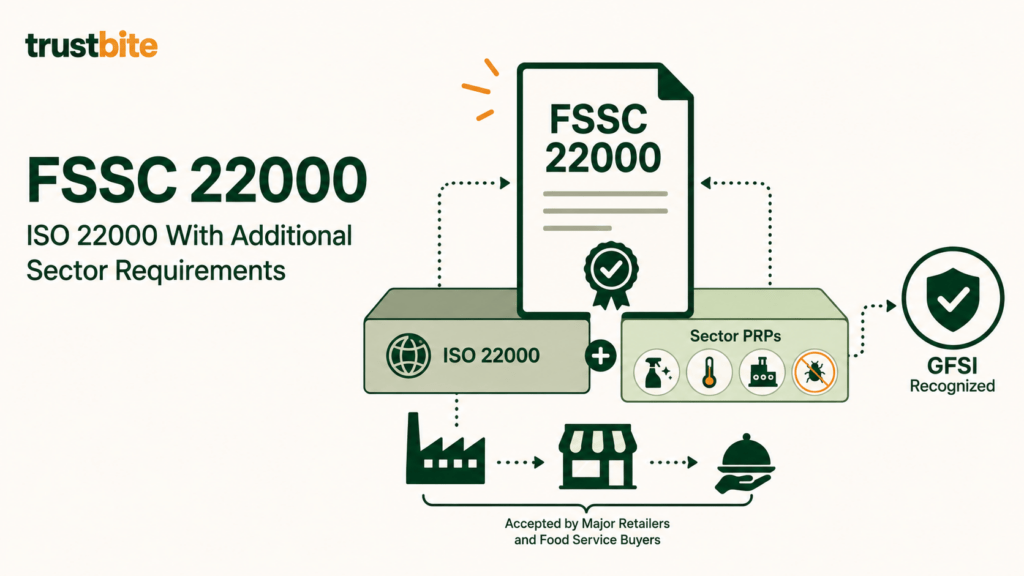
FSSC 22000 is a certification scheme built on ISO 22000, adding sector-specific prerequisite program requirements from internationally recognized technical specifications such as ISO 22002-1 for food manufacturing. FSSC 22000 is a GFSI-recognized scheme, meaning it is accepted by major retailers and food service companies that require GFSI-benchmarked certification from their suppliers.
For food manufacturers seeking a GFSI-recognized certification that is compatible with ISO 22000, FSSC 22000 is a common choice. The additional requirements it adds to ISO 22000 cover the sector-specific PRP content that ISO 22000 itself leaves open for organizations to define, providing a more prescriptive and therefore more consistently auditable framework.
Monitoring Requirements Under HACCP and ISO 22000
Both HACCP and ISO 22000 require monitoring of critical control points and verification that the food safety management system is functioning as intended. The specific monitoring approach, including whether automated or manual monitoring is used, is not prescribed by either framework, but the record-keeping requirements make continuous automated monitoring substantially more defensible in both regulatory and certification audit contexts.
Automated temperature monitoring, foreign body detection systems, and ATP swab testing for surface sanitation generate the kind of objective, time-stamped evidence that both HACCP and ISO 22000 auditors look for when assessing whether CCPs and PRPs are genuinely under control. Food safety monitoring equipment providers such as Adria Food Tech supply these monitoring and verification systems, supporting food businesses in generating the records their food safety management systems require under both HACCP-only and ISO 22000 frameworks.
Conclusion
HACCP and ISO 22000 are not competing frameworks. HACCP is the hazard control methodology at the technical heart of most food safety management systems. ISO 22000 is the comprehensive management system standard that places HACCP within a formally governed organizational framework covering leadership, communication, and continual improvement. A business implementing HACCP is building the technical foundation that ISO 22000 builds upon. A business certified to ISO 22000 has that HACCP foundation plus the governance and system structure that formal international certification requires.
Frequently Asked Questions
What is the difference between HACCP and ISO 22000?
HACCP is a hazard control methodology focused on identifying and managing food safety hazards at specific process steps. ISO 22000 is a comprehensive food safety management system standard that incorporates HACCP as its technical hazard control component within a broader organizational management framework.
Does ISO 22000 include HACCP?
Yes. ISO 22000 requires a functioning HACCP-based hazard analysis and control system as a core component. Businesses certified to ISO 22000 must have an implemented HACCP system within their broader food safety management system.
Is HACCP certification the same as ISO 22000 certification?
No. HACCP can be assessed through a range of processes with varying formality. ISO 22000 certification is awarded exclusively through formal third-party certification audits conducted by accredited certification bodies and covers the full management system framework rather than only the hazard control methodology.
Which is harder to implement, HACCP or ISO 22000?
ISO 22000 is more demanding to implement than HACCP alone because it requires a formally governed management system framework in addition to the technical HACCP content. However, a business with a well-implemented HACCP system has completed the most technically demanding element of ISO 22000 and needs to build the management system layer rather than starting from scratch.
Is ISO 22000 recognized internationally?
Yes. ISO 22000 is an internationally recognized standard published by the International Organization for Standardization and accepted by buyers, regulators, and certification bodies across global markets.
What is FSSC 22000 and how does it relate to ISO 22000?
FSSC 22000 is a certification scheme built on ISO 22000, adding sector-specific prerequisite program requirements from technical specifications such as ISO 22002-1. It is a GFSI-recognized scheme, making it accepted by major retailers and food service companies that require GFSI-benchmarked certification from suppliers.
What are Operational PRPs in ISO 22000?
Operational PRPs are control measures identified during the ISO 22000 hazard analysis that are necessary for managing a specific hazard but do not require the prescriptive monitoring and critical limit management of a full CCP. They sit between general prerequisite programs and HACCP CCPs in the ISO 22000 hazard control hierarchy.
Do small food businesses need ISO 22000?
ISO 22000 is most appropriate for manufacturers, processors, and distributors in markets where buyers expect an international management system standard. Most small food businesses, restaurants, and caterers meet their food safety obligations through HACCP-based systems without requiring ISO 22000 certification.
Can a business hold both HACCP certification and ISO 22000 certification?
A business certified to ISO 22000 is already operating a HACCP-based system. Some businesses also hold standalone HACCP certificates from certification bodies that offer them. ISO 22000 certification encompasses and supersedes a standalone HACCP certificate in terms of scope and rigor.
What is the High Level Structure in ISO 22000?
The High Level Structure is the organizational framework used across multiple ISO management system standards including ISO 22000, ISO 9001, and ISO 14001. It structures the management system into common sections covering context, leadership, planning, support, operation, performance evaluation, and improvement, allowing organizations to integrate multiple management systems more easily.
How does ISO 22000 address prerequisite programs differently from HACCP?
HACCP assumes that prerequisite programs are in place but does not specify their content in detail. ISO 22000 explicitly requires prerequisite programs and distinguishes between general infrastructure PRPs and Operational PRPs, providing a more structured framework for how different levels of food safety control are managed and documented.
What records does ISO 22000 require beyond standard HACCP documentation?
ISO 22000 requires documentation covering management reviews, internal communication processes for food safety information, external communication procedures, competence records for all personnel whose work affects food safety, and the full governance structure of the food safety management system, in addition to the HACCP plan and associated monitoring, corrective action, and verification records.
How does a business transition from HACCP to ISO 22000 certification?
Transition involves building the management system framework around the existing HACCP content, including formalizing roles and responsibilities, establishing management review processes, developing communication procedures, and implementing a functioning internal audit program. A gap analysis against ISO 22000 requirements is the recommended starting point to identify what is already in place and what needs to be developed.
What is the role of continual improvement in ISO 22000?
ISO 22000 requires a formal approach to continual improvement of the food safety management system, going beyond individual corrective actions to a systematic process of identifying opportunities to improve system performance over time. This is assessed during certification audits through management review records and improvement activity documentation.
Related from the Knowledge Center
What Is HACCP? A Beginner’s Guide to Food Safety and Risk Prevention
The foundational overview of the HACCP system, its seven principles, and why it is the technical core of most food safety management systems including ISO 22000.
What Are Prerequisite Programs in Food Safety? A Practical Guide
Prerequisite programs are required by both HACCP and ISO 22000. This article explains what they cover and why they must be in place before HACCP principles can function effectively.
HACCP Certification: What It Is and How Food Businesses Get Certified
Covers the certification process for HACCP-based standards including ISO 22000, what preparation is required, and how audits assess both the technical HACCP content and the wider management system.