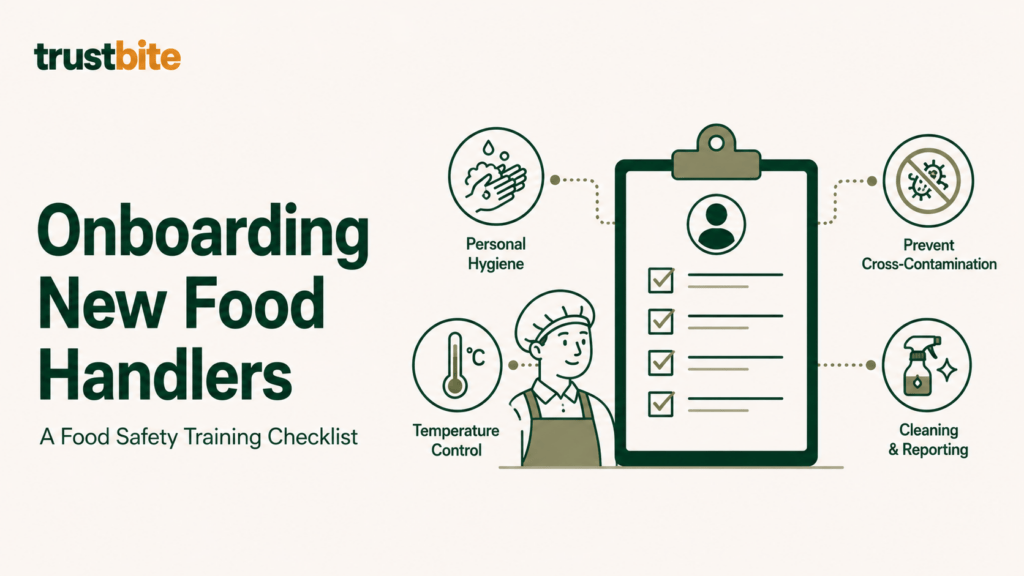
Onboarding new food handlers with structured food safety training from day one is one of the most effective risk reduction measures available to a food business. New employees are statistically the most likely source of food safety procedural failures in the weeks following their start. They do not yet know the specific controls in place, they have not developed the habits that experienced staff apply automatically, and without structured induction they often absorb whatever informal practices happen to be demonstrated by whoever they work alongside first.
A well-designed food handler onboarding process closes this gap by ensuring that every new employee receives the same foundational food safety knowledge and site-specific procedural training before they begin working independently. This article explains what that onboarding process should cover, how to structure it, and what records it should produce.
Why Food Safety Onboarding Training Matters
Food handler onboarding training matters for operational and compliance reasons that reinforce each other. From an operational standpoint, a new employee who begins work without understanding personal hygiene requirements, temperature control procedures, or allergen management practices is a food safety risk from their first shift. Contamination incidents linked to new employees are more common than management usually expects, because the assumption that common sense fills the gap between induction and training is consistently wrong.
From a compliance standpoint, food safety regulations in most jurisdictions require that food handlers receive instruction and training in food hygiene appropriate to their role before they work independently. An employee who has been on site for two weeks with no documented food safety training is a regulatory finding regardless of how experienced they are from a previous job, since the specific controls, procedures, and hazards in the current operation are new to them.
Auditors from certification bodies and regulatory authorities review training records as a standard part of food safety audits. A training record that shows a new employee started work but has no documented food safety induction for the first several weeks of employment is a gap that raises questions about the overall rigor of the training program.
What Food Handler Onboarding Training Should Cover
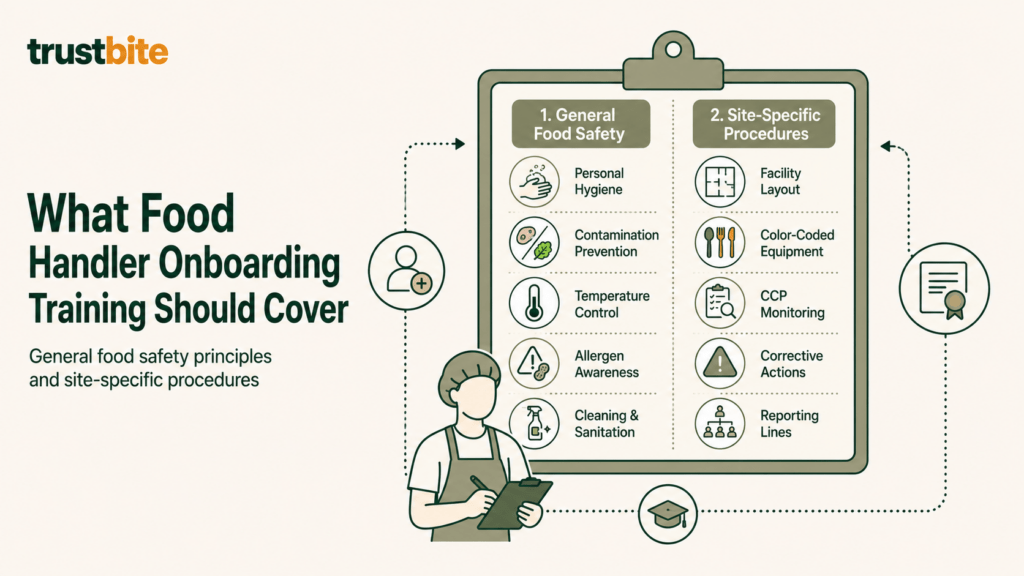
Food handler induction training covers two categories of content that should both be delivered during the onboarding period: general food safety principles applicable to all food handling environments, and site-specific procedures applicable to the specific operation the employee is joining.
General food safety content for food handlers covers personal hygiene requirements including handwashing procedure and frequency, illness reporting obligations, clothing and jewelry rules, and the behavior standards required in food handling areas. It covers contamination prevention including the difference between raw and ready to eat products, how cross-contamination occurs, and why the physical controls in place to prevent it exist. It covers temperature control including the food safety danger zone, why food cannot be left at room temperature without time control, and what the correct storage temperatures are for different product categories. It covers allergen awareness including the major regulated allergens, how allergen cross-contact occurs, why cooking does not eliminate allergen risk, and what to do when a consumer asks about allergens. And it covers cleaning and sanitation procedures relevant to the employee’s role.
Site-specific content covers the actual procedures and controls in the specific operation. This includes the layout of the facility and the designated areas for different activities, the specific color-coded equipment system in use, the CCP monitoring responsibilities the employee will have if any, the corrective action procedures they should follow when they identify a problem, and the reporting lines for food safety concerns. Site-specific content must be accurate for the current operation and cannot be substituted with generic training content alone.
Structuring the Onboarding Training Sequence
The most effective food handler onboarding training is delivered in a structured sequence rather than as a single event on day one followed by independent work from day two.
Day one training should cover the personal hygiene requirements and the basic facility layout and rules that the employee must understand before entering a food handling area. This is the minimum required before a new employee can work in the operation safely, even under supervision.
Within the first week, training should extend to cover allergen management, temperature control, cross-contamination prevention, and the cleaning procedures relevant to the employee’s role. These topics should be covered in enough depth that the employee understands the reasoning behind the practices, not just the practices themselves.
Within the first month, the employee should have completed all components of the site-specific food safety induction and have their competence assessed through a short practical or written assessment that confirms understanding rather than only attendance.
Supervised work during the induction period, where a new employee works alongside a more experienced colleague who has been briefed on their role in supporting the induction, reinforces formal training content with practical application in real working conditions.
The Role of Online Training in Food Handler Onboarding
Online food safety training has become a standard component of food handler onboarding in many food businesses because it allows consistent delivery of foundational food safety content regardless of when a new employee starts, what shift pattern they work, or what language they prefer to learn in.
A new employee who starts on a Saturday evening when no trainer is available can complete online food safety training before their first shift on Monday. A multilingual team can receive the same foundational content in each person’s preferred language without requiring the business to run separate training sessions. Digital completion records are generated automatically and are immediately available for audit purposes without requiring manual filing.
Providers such as Confi Food develop accredited online food safety training programs available in almost any language, designed to cover both foundational food handler content and the documentation requirements that certification standards and regulatory inspections expect from a structured induction program. Online delivery of general food safety content sits alongside site-specific practical induction for new staff, making the combination more efficient and more consistent than either approach alone.
What Records Onboarding Training Should Produce
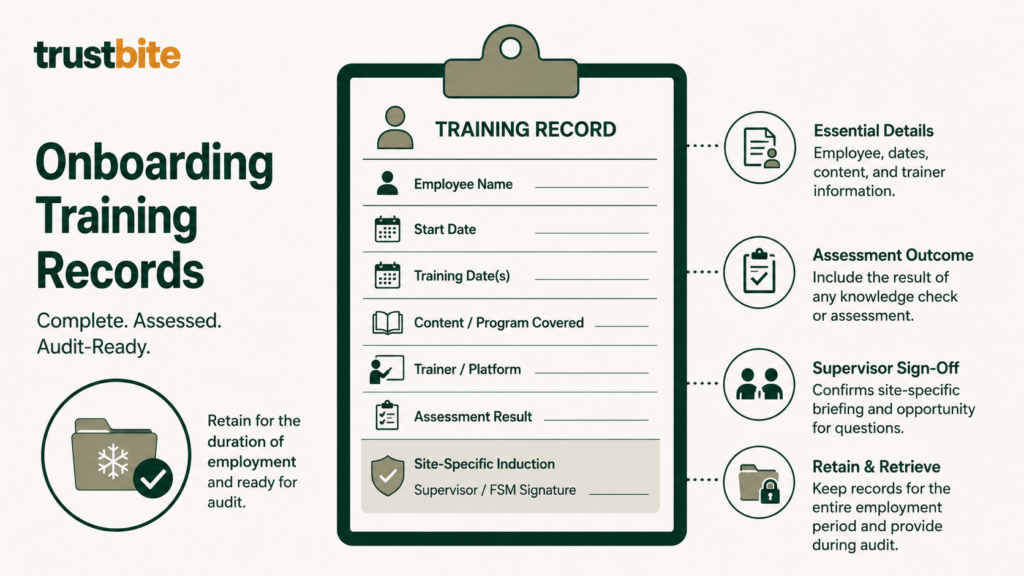
Food handler onboarding training should produce a documented record that can be retrieved and reviewed during an audit. The record should contain the employee’s name, their start date, the date or dates on which training was completed, the specific content or program covered, the name of the trainer or delivery platform, and the result of any assessment conducted.
A training record that only confirms attendance, without any assessment outcome, provides weaker evidence of competence than one that includes the result of a brief knowledge check. Most certification schemes expect evidence that training has been assessed rather than only delivered.
Site-specific induction records should be countersigned by a supervisor or food safety manager to confirm that the employee has been briefed on the site-specific procedures relevant to their role and has had the opportunity to ask questions.
Induction records should be retained for the duration of the employee’s time at the business and made available during audit without significant delay.
Common Gaps in Food Handler Onboarding Training
Several gaps appear consistently in food handler onboarding programs when they are reviewed during audits or following food safety incidents.
Informal induction where new employees shadow experienced colleagues without any structured training content is common in smaller businesses and produces highly variable food safety knowledge depending on who the new employee happens to work alongside.
Delaying training until a busy period passes is a pattern in seasonal and high-turnover operations where there always seems to be a better time to run training than right now. This leaves new employees working independently without the knowledge they need.
Covering only general food safety content without site-specific procedural training produces employees who understand principles but do not know the specific controls in place in the operation they are working in.
Failing to assess or record the outcome of training produces evidence gaps that appear as non-conformances during audits regardless of how thorough the actual training was.
Conclusion
Food handler onboarding training is the first and most time-sensitive food safety investment a food business makes in each new employee. The habits, knowledge, and understanding built during induction shape how each person applies food safety practices across their entire time with the business. A structured, documented, assessed induction program that covers both general food safety principles and site-specific procedures produces food handlers who are safer from day one and more reliable over time than those who learn by informal absorption.
Frequently Asked Questions
What should food handler onboarding training cover?
Food handler onboarding training should cover personal hygiene requirements, contamination prevention including cross-contamination, temperature control and the danger zone, allergen awareness, cleaning and sanitation procedures relevant to the role, and site-specific procedures including facility layout, color-coded equipment systems, CCP monitoring responsibilities, and reporting procedures.
When should food safety training begin for new food handlers?
Food safety training should begin on day one, covering at minimum the personal hygiene requirements and facility rules that must be understood before the employee enters a food handling area. The full induction program should be completed within the first month of employment.
Is food safety induction training a legal requirement?
Yes. Food safety regulations in most jurisdictions require that food handlers receive food hygiene training appropriate to their role. An employee working without documented food safety induction training represents a compliance gap regardless of their prior experience.
What is the difference between general food safety training and site-specific induction?
General food safety training covers the principles applicable to all food handling environments. Site-specific induction covers the actual procedures, controls, equipment systems, and reporting processes in the specific operation the employee is joining. Both are required during onboarding.
Can online food safety training be used for new employee onboarding?
Yes. Online food safety training is widely used and accepted for delivering foundational food safety content during onboarding. It allows consistent delivery across different start dates, shift patterns, and languages. Site-specific induction content must still be delivered in a way that reflects the specific operation.
What records should food handler onboarding training produce?
Records should capture the employee’s name, start date, training dates, content or program covered, trainer or platform name, and the result of any knowledge assessment. Records should be countersigned by a supervisor for site-specific induction components.
How should food safety onboarding training be assessed?
A short knowledge check covering the core content of the induction program confirms understanding rather than only attendance. Assessment results should be recorded alongside completion records. Employees who do not demonstrate adequate understanding should receive additional training before working independently.
What happens if a new employee starts without food safety induction training?
The employee represents a food safety risk from their first shift and a compliance gap if they work independently without documented training. In the event of a food safety incident or an audit, the absence of onboarding training records is a significant non-conformance.
How does supervised work support food safety onboarding?
Supervised work during the induction period allows new employees to apply the principles covered in formal training under practical conditions, reinforced by an experienced colleague who models correct procedures. It bridges the gap between knowledge delivered in training and consistent behavior in real working conditions.
How long should food handler onboarding training take?
The full onboarding program typically takes between a few hours and a full week to complete, depending on the complexity of the operation and the range of content to cover. Day one training covering minimum hygiene and facility rules should be completed before the employee enters a food handling area.
What should a business do if a new employee has prior food safety training from another employer?
Prior training reduces the time needed for general food safety content but does not replace site-specific induction. The controls, procedures, allergen profile, and CCP monitoring responsibilities in the current operation are specific to that business and must be covered regardless of prior experience.
Can food safety onboarding training be delivered in multiple languages?
Yes. Online food safety training platforms support multilingual delivery, which is particularly important in food businesses with diverse workforces where language barriers can affect how consistently training is understood and applied.
What role does allergen training play in food handler onboarding?
Allergen training is a core component of food handler onboarding, not an optional add-on. New employees must understand the allergens handled in the operation, how cross-contact occurs, why it cannot be eliminated by cooking, and what to do when a consumer raises an allergen concern before they work independently.
How often should food handler onboarding training content be reviewed?
Onboarding training content should be reviewed whenever procedures change, new products or allergens are introduced, or regulatory requirements are updated. The content should always reflect current operational practice rather than how the business operated when the training material was last written.
Related from the Knowledge Center
Food Safety Training: A Complete Guide for Employers
The foundational guide to what food safety training covers across all roles, how programs are structured, and what records they should produce.
How Often Should Food Safety Training Be Renewed? A Practical Guide
Onboarding training is the starting point. This article explains the renewal intervals and operational triggers that keep food safety knowledge current beyond the induction period.
Building a Food Safety Culture: What It Means and How Training Creates It
The habits and values built during onboarding training shape how each employee applies food safety practices throughout their time at the business. This article explains how training builds the cultural foundation that makes food safety systems reliable.