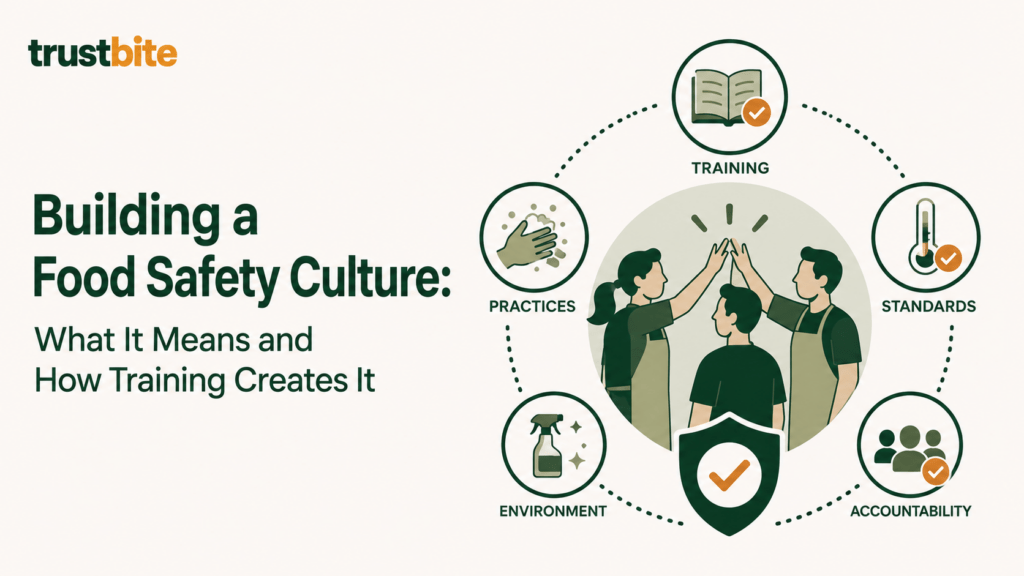
A food safety culture is the shared values, beliefs, and behaviors within a food business that determine how seriously food safety is taken in daily operations, particularly when no one in authority is observing. It is the difference between a team that washes hands because they understand why it matters and a team that washes hands only when a manager is present. It is the difference between a food safety system that functions reliably and one that exists only on paper.
The concept of food safety culture has moved from a theoretical ideal to a defined requirement. Major food safety certification standards including BRCGS, FSSC 22000, and SQF now include food safety culture as an explicit assessment area, reflecting the recognition that technical systems and documented procedures alone cannot produce reliable food safety outcomes without the behavioral foundation that culture provides.
What Is Food Safety Culture?
Food safety culture is the collection of attitudes, knowledge, and habits that shape how food safety is practiced within a business every day. A strong food safety culture means that staff at every level understand why food safety matters, know what their specific responsibilities are, and apply those responsibilities consistently regardless of whether anyone is checking.
A weak food safety culture means food safety is treated as an external imposition, something done to satisfy inspectors and auditors rather than something the team genuinely values. In a weak food safety culture, procedures are followed when monitored and cut when not. Shortcuts accumulate. Hazards that a strong culture would surface and report instead go unaddressed.
Food safety culture is not a separate program sitting alongside other food safety management activities. It is the environment in which every other food safety control either works reliably or fails silently.
Why Food Safety Culture Matters
The most technically sophisticated HACCP plan in the industry will underperform in an organization where staff do not understand or care about the controls they are supposed to operate. A temperature check that is completed on paper but not actually performed, a corrective action that is documented but not implemented, a cleaning procedure followed to the letter when a supervisor is present and skipped when they are not: these are food safety culture failures, and they occur in organizations with excellent documentation.
Food safety incidents frequently occur not because a business lacked the correct procedure but because the procedure was not followed in the way it was intended. Root cause investigations into food safety failures consistently surface cultural factors alongside technical ones: pressure to maintain production speed, inadequate emphasis on food safety from management, staff who did not feel confident reporting a problem, or a normalization of minor deviations that eventually accumulated into a significant failure.
Regulators and certification bodies have recognized this pattern. The inclusion of food safety culture in audit criteria reflects the understanding that assessing a business’s culture, and not just its documentation, provides a more accurate picture of its real food safety performance.
The Role of Training in Building Food Safety Culture
Training is the primary mechanism through which food safety culture is built in a food business. This goes beyond delivering factual content about temperature limits or handwashing technique. Training that builds food safety culture teaches the why behind every what, connects procedures to consequences, gives staff the confidence to raise concerns, and creates a shared frame of reference for what responsible food handling means.
Training that presents food safety as a list of rules produces compliance. Training that explains what happens when a critical limit is breached, what foodborne illness does to a consumer, and why a specific control was designed in the way it was produces understanding. Understanding produces behavior that holds up under operational pressure, not just when a trainer or manager is watching.
The delivery approach matters as much as the content. Training that is interactive, presented in a language staff are fully comfortable with, and delivered in a way that treats participants as capable adults rather than rule-followers to be managed tends to produce stronger engagement and better retention. Providers such as Confi Food develop food safety training programs available in almost any language, designed to build genuine understanding of food safety principles alongside the practical knowledge food handlers and managers need for their daily roles.
Management Commitment as a Cultural Foundation
Training builds food safety culture from the bottom up, but management behavior determines whether that culture is sustained. In every organization, staff observe what management actually prioritizes, not what it says it prioritizes. If management consistently accepts shortcuts to meet production targets, treats food safety concerns as inconveniences, or demonstrates through their own behavior that food safety is negotiable, no amount of training will produce a strong food safety culture.
Management commitment to food safety culture means allocating adequate time for training, following up on food safety concerns raised by staff, taking corrective actions seriously, and modeling the food safety behaviors they expect from their teams. It also means creating the conditions in which staff feel safe raising concerns, since a culture where problems are reported and addressed is fundamentally safer than one where staff hide problems to avoid blame.
BRCGS and other certification standards assess management commitment as part of food safety culture evaluation, asking auditors to look beyond documentation to how management actually behaves and what signals it sends to the wider team.
Measuring Food Safety Culture
Food safety culture is more difficult to measure than temperature logs or training completion rates, but it is not impossible to assess. Several indicators provide useful signals about the state of food safety culture in a business.
Voluntary reporting of near misses and minor deviations is one of the strongest positive indicators. In a strong food safety culture, staff report problems they observe because they understand why reporting matters and trust that their report will be taken seriously. A business where near misses are never reported is not necessarily a business where nothing is going wrong.
Staff responses to auditor interview questions reveal a great deal about food safety culture. Employees who can explain the reasoning behind a control, describe what they would do if a CCP was out of control, and speak with genuine ownership of their food safety responsibilities are demonstrating a strong cultural foundation. Employees who can only confirm that a procedure is required, or who wait to see what the manager says before answering, suggest a culture where food safety is performed rather than understood.
The frequency and nature of corrective actions provides another signal. A business with an active corrective action system that records and resolves deviations is demonstrating that its culture supports identifying and fixing problems. A business with very few corrective action records in an environment where deviations are realistically inevitable is more likely masking problems than preventing them.
Building Food Safety Culture in High-Turnover Environments
Many food businesses operate with high rates of staff turnover, seasonal workforce fluctuations, or large proportions of temporary and agency staff. Building a strong food safety culture in these conditions requires deliberate design rather than relying on informal cultural transmission that works in stable, long-tenured teams.
Structured induction training that begins building food safety culture from day one is essential. New staff need to understand not just the procedures but the values behind them, and they need to receive this message clearly and early rather than picking up habits informally from whoever they happen to work alongside first.
Online food safety training supports this consistency in high-turnover environments by delivering a standardized cultural message alongside technical content, regardless of when a new employee joins or what shift pattern they work. This makes the initial cultural message independent of which supervisor or team member happens to be on duty during induction week.
Conclusion
A food safety culture is the operating environment in which every other food safety control either performs reliably or fails quietly. Building it requires training that goes beyond rules to explanation and understanding, management that models the behaviors it expects from staff, and systems that reward honesty and reporting rather than penalizing them. Businesses that invest in food safety culture produce outcomes that trained-but-disengaged workforces cannot match, because the controls work even when nobody is watching.
Frequently Asked Questions
What is food safety culture?
Food safety culture is the collection of attitudes, knowledge, and behaviors within a food business that determine how food safety is practiced in daily operations, particularly when no one in authority is observing. A strong food safety culture means staff apply food safety controls consistently because they understand why they matter, not only because they are required.
Why is food safety culture included in certification standards?
Major food safety certification standards including BRCGS, FSSC 22000, and SQF include food safety culture as an explicit assessment area because technical systems and documentation alone cannot produce reliable food safety outcomes without the behavioral foundation that a strong culture provides.
How does training build food safety culture?
Training builds food safety culture by explaining the reasons behind procedures rather than just presenting rules. Staff who understand why a control exists are more likely to apply it consistently under operational pressure than staff who treat it as an arbitrary requirement.
What is the difference between food safety compliance and food safety culture?
Compliance means following required procedures. Culture means genuinely valuing the reasons behind those procedures. Compliance can be achieved through monitoring and enforcement. Culture produces consistent behavior regardless of whether anyone is checking.
What role does management play in food safety culture?
Management behavior sets the cultural tone for the entire organization. If management consistently prioritizes production speed over food safety procedures, or treats food safety concerns as inconveniences, staff absorb that signal regardless of what training they have received. Management commitment to food safety is assessed explicitly in most food safety culture evaluations.
How can a business measure its food safety culture?
Indicators include the voluntary reporting rate of near misses and deviations, the quality of staff responses during auditor interviews, the frequency and resolution of corrective actions, and management behavior toward food safety concerns and reporting.
Why is near-miss reporting a positive food safety culture indicator?
Voluntary near-miss reporting indicates that staff feel confident raising concerns and trust that their reports will be taken seriously. A business where near misses are regularly reported and addressed is catching problems before they become incidents. A business with no near-miss reports in an environment where minor deviations are inevitable may be suppressing information rather than preventing problems.
How does food safety culture affect audit performance?
Auditors assess food safety culture through staff interviews, observation of staff behavior during the facility walkthrough, and discussions with management about how food safety concerns are handled. A strong food safety culture produces staff who speak about food safety with genuine ownership, which is a positive audit indicator.
Can food safety culture be built in a high-turnover workforce?
Yes, but it requires deliberate design. Structured induction training that conveys both the procedures and the values behind them from day one, delivered consistently regardless of when a new employee joins, is the most effective approach in high-turnover environments.
What are the signs of a weak food safety culture?
Signs include procedures that are followed only when a manager is present, a low rate of near-miss and deviation reporting, staff who cannot explain the reasoning behind controls they operate, management responses to food safety concerns that prioritize production over safety, and a corrective action system that records very few deviations despite operational complexity.
How does food safety culture relate to food safety training?
Training is the primary mechanism for building food safety culture. The content, delivery approach, and language of training shape whether staff develop genuine understanding of food safety principles or simply absorb a list of rules. Culture is the outcome of effective training sustained over time.
Is food safety culture the same in all types of food business?
The specific content of food safety culture varies by business type, product risk, and workforce composition, but the underlying principle is consistent: staff at every level should understand why food safety matters in their specific role and apply that understanding consistently in their daily work.
How does allergen management relate to food safety culture?
Allergen incidents frequently reflect cultural as well as procedural failures. A team that understands the severity of allergen reactions and takes allergen queries from customers seriously has a stronger allergen management culture than one that treats allergen controls as bureaucratic requirements. Training that explains what allergen reactions look like and why they occur builds this cultural understanding.
Can a business have a strong food safety culture without formal certification?
Yes. Food safety culture is a behavioral and attitudinal quality that exists independently of whether a business holds a formal certification. However, businesses pursuing certification are required to demonstrate food safety culture, and the process of building toward certification requirements tends to strengthen cultural foundations alongside technical systems.
Related from the Knowledge Center
Food Safety Training: A Complete Guide for Employers
The foundational guide to what food safety training covers, who needs it, and how employers build programs that produce genuine understanding rather than surface-level compliance.
Why Food Safety Systems Fail: Common Causes and Practical Prevention
Many food safety system failures have cultural roots alongside technical ones. This article examines the full pattern of failure causes including the human and behavioral factors.
What Is a Food Safety Audit? Types, Process, and What to Expect
Food safety culture is now assessed during certification audits. This article explains how audits work and what auditors observe beyond documentation during a facility walkthrough.