
Food safety training should be renewed at regular intervals determined by the role of the employee, the requirements of any applicable certification scheme, and a set of operational triggers that make early renewal necessary regardless of when the last training took place. There is no single universal renewal interval that applies across all food businesses and all roles, but several clear principles guide how renewal schedules should be set and maintained.
Training that was completed once and never revisited represents a known weakness in food safety audits and regulatory inspections. Knowledge fades, procedures change, staff develop habits that drift from what they were taught, and the food safety landscape itself evolves. A renewal schedule built around these realities produces a workforce that applies food safety practices reliably, not just in the weeks following induction training.
Why Food Safety Training Renewal Matters
Food safety training renewal matters for three distinct reasons that operate independently of each other, meaning a training program needs to address all three rather than treating them as alternatives.
Knowledge retention declines over time. Research across learning disciplines consistently shows that retention of learned information drops significantly in the weeks and months following training without reinforcement or application. In a food handling environment, the knowledge that fades first is often the knowledge that matters most: why a specific control exists, what happens when it is not followed, and how to respond when something goes wrong. Regular renewal counteracts this natural decline.
Procedures and standards change. Food safety regulations are updated, new hazards are identified, standards are revised, and a business’s own processes evolve. Training that was accurate when delivered becomes partially inaccurate when the procedures it covers change. Renewal provides the mechanism for bringing training content into alignment with current requirements.
Auditors expect renewal records. A business that cannot demonstrate that its staff have received training refreshes at appropriate intervals has a gap in its training documentation that will be identified during a food safety audit or regulatory inspection. Renewal records are part of the evidence auditors use to assess whether a food safety system is being maintained rather than left to coast on historic activity.
General Renewal Intervals by Role
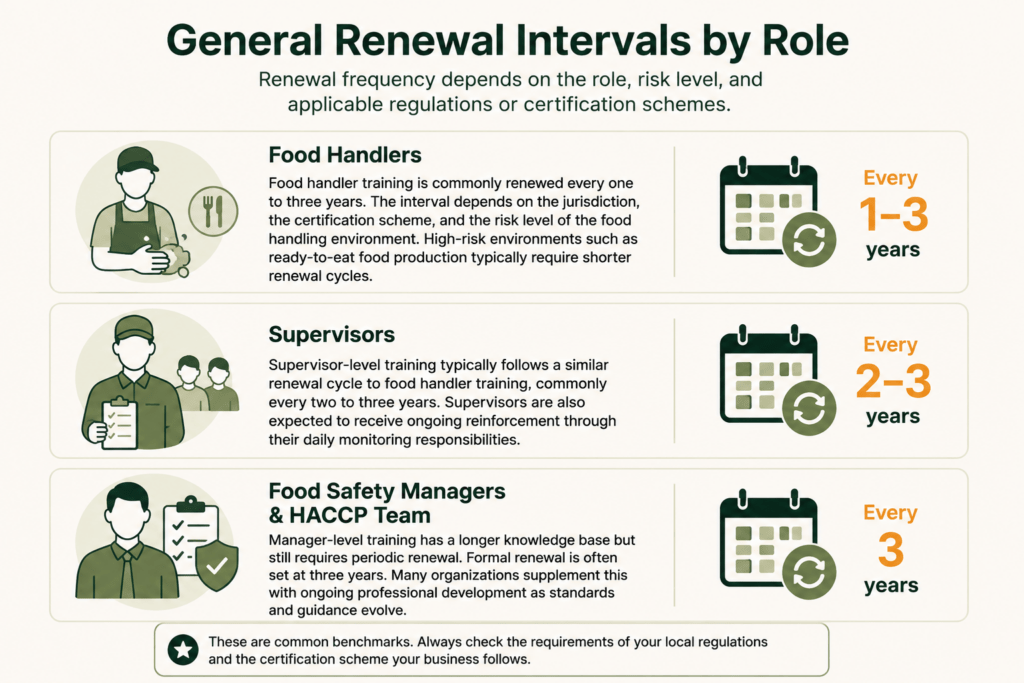
Food handler training is commonly renewed every one to three years in most regulatory frameworks and certification schemes. The exact interval depends on the jurisdiction, the scheme being followed, and the risk level of the food handling environment. High-risk environments such as ready-to-eat food production typically operate on shorter renewal cycles than lower-risk environments.
Supervisor-level training, which covers both food handling knowledge and the ability to monitor and manage compliance among a team, typically follows a similar renewal cycle to food handler training, commonly every two to three years, with the expectation that supervisors are also receiving ongoing reinforcement through their daily monitoring responsibilities.
Food safety manager and HACCP team training operates on a longer initial knowledge base but still requires periodic renewal. Formal renewal for manager-level training is often set at three years, though many organizations choose to supplement formal renewal with ongoing professional development in the intervening period as food safety standards and guidance evolve.
Triggers for Early Renewal
Several operational events should trigger food safety training renewal ahead of the scheduled interval, regardless of when training was last completed.
A change to products, ingredients, or allergens handled in the operation requires targeted refresher training for the staff affected by the change. Introducing a new allergen to the menu or production line, for example, demands immediate training for any staff handling that ingredient before the change takes effect.
A change to production processes or procedures requires training to reflect the new procedures. A business that updates its HACCP plan following a process change but does not retrain the staff operating the changed process has a documented control that is not matched by operational knowledge.
A food safety incident, near miss, or significant non-conformance finding from an audit often points to a gap in knowledge or understanding among the staff involved. Targeted retraining following the incident or finding is both a corrective action and a demonstration to auditors that the root cause has been addressed.
Staff returning from extended absences may have missed procedure updates or have allowed knowledge to fade during the absence. A renewal or targeted refresher on return is good practice in higher-risk environments.
New equipment or technology introduced into the food handling environment typically requires operational training that includes the food safety implications of the new equipment, such as how a new cooking unit’s temperature characteristics affect the monitoring procedure at a cooking CCP.
How to Structure a Food Safety Training Renewal Program
An effective renewal program defines renewal intervals for each role category, establishes a calendar or tracking system for monitoring when renewal falls due, and assigns clear responsibility for ensuring renewal happens on schedule.
Training records must capture renewal activity in the same way they capture initial training: the name of the employee, the date of training, the content covered, and the outcome of any assessment. A training record that shows initial training but no subsequent renewal is a flag for auditors regardless of how much time has passed.
Online food safety training platforms simplify renewal management significantly for businesses with multiple staff members or multiple sites, since they allow automated tracking of completion dates, renewal reminders, and digital records that can be accessed during audits without manual filing. Providers such as Confi Food offer structured online food safety training programs available in almost any language, with digital completion records that satisfy the documentation requirements of both regulatory inspections and certification audits, making renewal scheduling and record maintenance substantially less burdensome for food business operators.
Renewal Requirements in Specific Certification Schemes
Most major voluntary food safety certification schemes include explicit or implicit training renewal requirements. BRCGS requires that food safety training is provided, records maintained, and the training program reviewed at least annually. ISO 22000 requires that the organization ensures competence of personnel whose work affects food safety performance, which implies an ongoing maintenance of that competence rather than a one-time training event. SQF requires documented training programs with training records and specifies that training effectiveness must be evaluated.
The common thread across schemes is that training is not treated as a historical event but as an ongoing organizational practice. Renewal is the mechanism through which ongoing practice is maintained and demonstrated.
Assessing Whether Food Safety Training Renewal Is Working
A training renewal program that is completing on schedule but not producing maintained knowledge or improved behavior has fulfilled the administrative requirement without achieving the food safety purpose. Effectiveness indicators worth monitoring alongside renewal schedules include audit findings related to staff knowledge and practice, the frequency of monitoring deviations and corrective actions, results from environmental testing and verification activities, and the quality of responses from staff during auditor interviews.
Staff who have completed regular food safety training renewal and understand the reasoning behind the controls they apply will answer auditor questions confidently. Staff who can only confirm that a procedure exists without explaining why it matters are an indicator that renewal is happening as a box-ticking exercise rather than as genuine knowledge maintenance.
Conclusion
Food safety training renewal should be treated as a continuous operational discipline rather than a periodic administrative task. The intervals for renewal vary by role and scheme, but the principle is consistent: food safety knowledge must be maintained, updated when procedures change, and reinforced when incidents or system changes create gaps between what staff know and what the current operation requires. Businesses that manage renewal proactively, with clear schedules, trigger-based early renewal procedures, and robust records, consistently outperform those that treat initial training as sufficient.
Frequently Asked Questions
How often should food safety training be renewed?
Food safety training renewal intervals depend on the role, jurisdiction, and applicable certification scheme. Food handler training is commonly renewed every one to three years. Manager-level training is typically renewed every three years. Certain operational triggers require early renewal regardless of the scheduled interval.
Is food safety training renewal a legal requirement?
In most jurisdictions, food safety regulations require that employees receive food safety training and instruction appropriate to their role. While specific renewal intervals are not always legislated, the requirement for maintained competence implies ongoing training rather than a one-time event.
What triggers early food safety training renewal?
Early renewal is triggered by changes to products, ingredients, or allergens handled; changes to production processes or procedures; food safety incidents, near misses, or significant audit non-conformances; staff returning from extended absences; and the introduction of new equipment or technology.
What records should be kept for food safety training renewal?
Records should capture the name of the employee, the date of renewal training, the content or program covered, and the outcome of any assessment. Records must be retained and made available during food safety audits and regulatory inspections.
Do certification schemes specify food safety training renewal intervals?
Most major certification schemes including BRCGS, ISO 22000, and SQF include requirements for ongoing training and competence maintenance that imply regular renewal. Some schemes specify minimum review or renewal frequencies explicitly.
How does a business track food safety training renewal for multiple staff?
Online training platforms simplify tracking by recording completion dates, generating renewal reminders, and maintaining digital records accessible during audits. Manual systems using spreadsheets or training logs are also used but require more active management to stay current.
What happens during a food safety audit if training renewal records are missing?
Missing or outdated training renewal records are typically cited as a non-conformance during a food safety audit. Auditors assess whether the training program is being maintained, and gaps in renewal records indicate that it is not.
Should all staff receive the same food safety training renewal content?
Renewal content should be appropriate to each role. Food handlers receive renewal covering hygiene, contamination prevention, allergen awareness, and temperature control. Supervisors receive renewal covering those topics plus monitoring and response responsibilities. Managers and HACCP team members receive renewal covering system-level food safety management.
How long does food safety training renewal take?
Renewal duration depends on the program and the role. Food handler renewal training commonly takes two to four hours for a focused refresher. Manager-level renewal programs may take longer, particularly when covering updates to standards or new regulatory requirements.
Can food safety training renewal be delivered online?
Yes. Online delivery is widely used and accepted for renewal training across most regulatory and certification frameworks, provided the content meets the required standard and digital completion records are maintained.
What is the consequence of not renewing food safety training?
Beyond the audit and compliance risk, unreneved training means staff are applying knowledge that may be outdated, incomplete, or misaligned with current procedures. This increases the probability of food safety incidents driven by gaps in understanding rather than gaps in system design.
Does food safety training renewal need to be conducted by an external provider?
Renewal can be conducted internally by a qualified food safety manager or externally by a training provider. Internal renewal is acceptable provided the content is accurate, current, and the trainer is competent to deliver it. External providers offer consistent quality and independently verifiable records.
What should a business do if a staff member misses a scheduled renewal?
The renewal should be rescheduled as soon as possible and completed before the gap becomes significant. The delay should be noted in the training record. In higher-risk environments, a supervisor may need to provide closer oversight of the employee’s food safety practices until renewal is completed.
How does allergen training fit into food safety training renewal?
Allergen awareness is a core component of food safety training for food handlers and should be covered in every renewal cycle. Where the allergen profile of the business changes, targeted allergen training should be delivered immediately rather than waiting for the scheduled renewal date.
Related from the Knowledge Center
Food Safety Training: A Complete Guide for Employers
The foundational guide to what food safety training covers, who needs it, and how to build a training program that holds up in practice and in audits.
What Is a Food Safety Audit? Types, Process, and What to Expect
Training renewal records are reviewed as a standard part of food safety audits. This article explains what auditors look for and how businesses prepare.
Why Food Safety Systems Fail: Common Causes and Practical Prevention
Outdated or incomplete training is one of the recurring contributors to food safety system failure. This article examines the full range of failure patterns and how to address them.