Food safety training is the process through which food businesses ensure that every person handling food understands how to do so safely. It covers what employees need to know, what managers need to understand at a deeper level, and how those two layers of knowledge work together to keep a food safety system functioning in daily operations.
For employers, food safety training is both a legal requirement and an operational necessity. Regulations in most jurisdictions require food businesses to ensure their staff have food safety knowledge appropriate to their role. Beyond the legal requirement, untrained staff are among the most frequently cited contributors to food safety failures, and the investment in structured food safety training consistently delivers measurable returns in audit performance, incident reduction, and operational consistency.
This guide explains what food safety training covers, who needs it, what the difference is between food handler training and manager-level training, and how employers build a training program that holds up in practice.
What Is Food Safety Training?
Food safety training is a structured program of education that teaches food handlers and food safety managers the knowledge and skills required to handle, prepare, and manage food safely. Effective food safety training explains not just what to do but why specific practices matter, since staff who understand the reasoning behind a control are more likely to apply it consistently.
Food safety training is not a single event. It covers induction training for new employees, ongoing training as procedures change, role-specific training for supervisors and managers, and periodic refresher training to maintain knowledge over time.
Who Needs Food Safety Training?
Every person working in a food handling environment needs food safety training at a level appropriate to their role. The scope includes food handlers, supervisors, food safety managers, and in smaller businesses, business owners who may perform all of these roles.
Food handlers are employees who directly touch food, surfaces that come into contact with food, or equipment used in food preparation. Their training covers personal hygiene, temperature control, cross-contamination prevention, cleaning procedures, and allergen awareness.
Supervisors need the food handler knowledge base plus an understanding of how to monitor that procedures are being followed by their teams and how to respond when something goes wrong.
Food safety managers and HACCP team members need a more technical level of food safety training covering hazard analysis, critical control point identification, monitoring systems, corrective actions, and verification. This is the level of knowledge required to develop, review, and maintain a food safety management system.
What Food Safety Training Covers
At the food handler level, food safety training typically covers personal hygiene standards including handwashing, illness reporting, and appropriate protective equipment. It covers temperature control and the conditions under which pathogens multiply. It covers cross-contamination, including the difference between direct contamination from raw to ready to eat products and indirect contamination through surfaces, equipment, and hands. It covers allergen awareness and the consequences of allergen cross-contact. And it covers cleaning and sanitation procedures, including why a visually clean surface is not necessarily microbiologically safe.
At the manager and HACCP team level, food safety training builds on that foundation to cover the seven HACCP principles, how to conduct a hazard analysis, how to identify and document critical control points, how to establish monitoring procedures, and how to verify that a food safety management system is functioning as intended.
Legal Requirements for Food Safety Training
Food safety training requirements are set by national and regional food safety legislation. In the European Union, Regulation (EC) 852/2004 requires that food business operators ensure food handlers are supervised, instructed, and trained in food hygiene matters commensurate with their work activity. In the UK, the Food Safety and Hygiene Regulations require equivalent standards. In the United States, the FDA Food Safety Modernization Act includes training requirements for preventive controls qualified individuals.
The specific requirements vary by jurisdiction, but the common principle is that employees must receive training appropriate to the food safety risks associated with their role, and that this training must be demonstrable through records.
Types of Food Safety Training Delivery
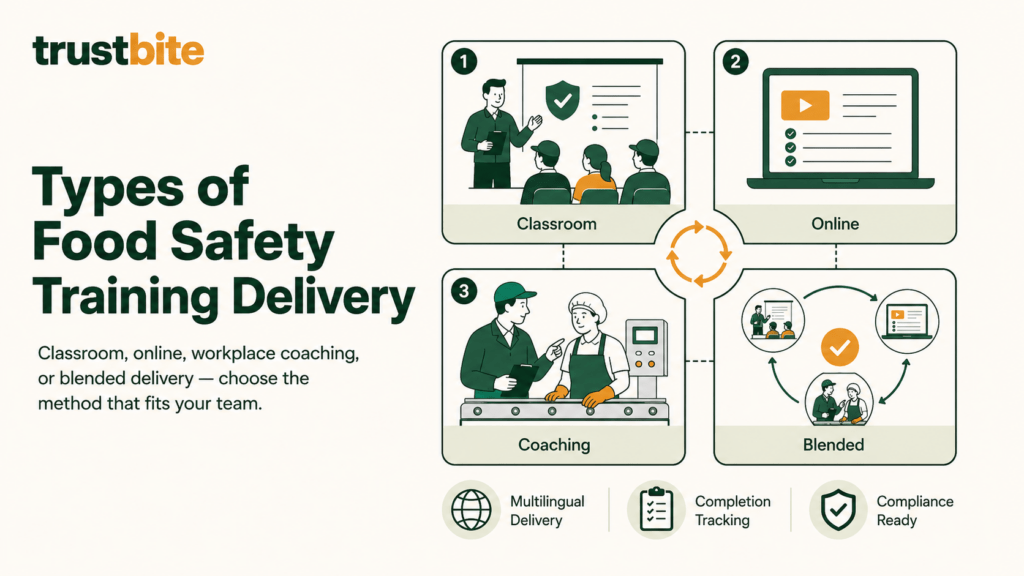
Food safety training can be delivered through classroom instruction, online learning platforms, workplace coaching, or a combination of these approaches. The right delivery method depends on the business, the workforce, and the specific knowledge being taught.
Classroom and instructor-led training works well for practical skills, group discussions, and situations where direct interaction between trainer and trainee accelerates understanding. It is typically more resource-intensive in terms of time and cost.
Online food safety training has grown significantly in adoption across the industry because it allows businesses to train staff at scale, maintain consistent content across multiple sites, track completion and assessment results digitally, and deliver training in almost any language to multilingual workforces. Providers such as Confi Food develop accredited online food safety training programs designed to cover both food handler and manager-level content, with digital records of completion and assessment that satisfy audit and regulatory requirements.
Building a Food Safety Training Program
An effective food safety training program has four components: content appropriate to each role, a delivery system that reaches all staff reliably, a record-keeping system that documents who was trained on what and when, and a schedule for refresher training and updates when procedures change.
Content should be built around the specific hazards and controls relevant to the business. Generic food safety training content covers the principles adequately for most food handler roles, but manager-level training and HACCP team training should reflect the specific products, processes, and risks of the business.
Records are not optional. Training records are reviewed during food safety audits and regulatory inspections. A business that trained its staff thoroughly but kept no documentation of that training cannot demonstrate compliance. Records should capture the name of the trainee, the date of training, the content covered, and where applicable, the outcome of any assessment.
Refresher training should be scheduled at regular intervals and triggered by specific events including changes to procedures, introduction of new products, responses to incidents or near misses, and the arrival of new staff.
How to Measure Whether Food Safety Training Is Working
The effectiveness of food safety training is ultimately measured by whether staff apply what they have learned in their daily work. The most direct indicators are audit findings related to staff knowledge and practice, the frequency of monitoring deviations and corrective actions, and the results of verification activities such as environmental swab testing and temperature log reviews.
Staff interviews during food safety audits are a direct test of training effectiveness. An auditor who asks an employee why a specific practice is required expects an answer that demonstrates understanding, not just compliance. Employees who can explain the reasoning behind a control, not just confirm that they follow it, are a reliable indicator of well-delivered food safety training.
Conclusion
Food safety training is the mechanism through which a food safety system designed on paper becomes a food safety system that operates in practice. The HACCP plan, the monitoring procedures, the corrective actions, the cleaning schedules, and every other documented element of a food safety system depends on staff who understand them and apply them reliably. Employers who invest in structured, role-appropriate, well-documented food safety training consistently build more resilient operations than those who treat training as a box-ticking exercise.
Frequently Asked Questions
What is food safety training?
Food safety training is a structured program that teaches employees and managers the knowledge and skills required to handle, prepare, and manage food safely, covering personal hygiene, temperature control, contamination prevention, allergen awareness, and food safety management principles.
Is food safety training a legal requirement?
Yes, in most jurisdictions. Food safety regulations in the European Union, UK, United States, and many other countries require food businesses to ensure staff have food safety knowledge and training appropriate to their role and the risks associated with it.
Who needs food safety training in a food business?
Every person working in a food handling environment needs food safety training at a level appropriate to their role. Food handlers need hygiene and contamination prevention training. Supervisors need additional monitoring and response knowledge. Food safety managers and HACCP team members need technical training covering hazard analysis and system management.
What is the difference between food handler training and food safety manager training?
Food handler training covers the practical hygiene and contamination prevention knowledge required for day to day food handling tasks. Food safety manager training covers the technical principles behind HACCP, hazard analysis, critical control point management, and food safety management system operation.
How often should food safety training be refreshed?
Training should be refreshed at regular intervals, commonly every one to three years depending on the role and the scheme, and whenever procedures change, new products are introduced, incidents occur, or new staff join the business.
What should food safety training records contain?
Training records should contain the name of the trainee, the date of training, the content or program covered, and the outcome of any assessment. Records must be retained and made available during food safety audits and regulatory inspections.
Can food safety training be delivered online?
Yes. Online food safety training is widely used and accepted by most regulatory and certification schemes as a valid delivery method, provided the content meets the required standard and the provider maintains digital records of completion and assessment outcomes.
What languages can food safety training be delivered in?
Reputable food safety training providers can deliver programs in almost any language, which is particularly important for businesses with multilingual workforces where language barriers can affect how consistently training is understood and applied.
How does food safety training relate to HACCP?
HACCP systems depend on trained staff to operate correctly. The people performing monitoring at critical control points, applying corrective actions, and completing records must understand what they are doing and why. Training is the mechanism through which HACCP knowledge reaches the operational level.
What happens during a food safety audit regarding training?
Auditors review training records to confirm that staff have received appropriate training, and they interview employees to assess whether that training has produced genuine understanding. Staff who cannot explain why a control exists, only that it is required, are a negative audit finding.
How can an employer measure whether food safety training has worked?
Indicators include audit findings related to staff knowledge and practice, the frequency and nature of monitoring deviations, the results of verification activities such as swab testing and temperature log reviews, and the ability of staff to answer auditor questions about their responsibilities.
What is allergen training in food safety?
Allergen training covers the 14 major allergens regulated in most food safety frameworks, how allergen cross-contact occurs, labelling obligations, and the procedures required to prevent allergen contamination in food preparation environments.
Can food safety training be self-administered?
Some elements of food safety knowledge can be taught through written materials or self-directed study. However, structured programs with assessment components and verifiable completion records provide stronger evidence of training and better assurance of learning outcomes than informal self-study.
Does online food safety training satisfy regulatory requirements?
In most jurisdictions, yes, provided the training program covers the required content and the provider maintains verifiable records of completion and assessment. Businesses should confirm the specific requirements of their jurisdiction and any applicable certification scheme.
Related from the Knowledge Center
Why Food Safety Systems Fail: Common Causes and Practical Prevention
Inadequate training is one of the most consistently cited contributors to food safety system failure. This article examines the patterns in detail.
The 12 Steps of HACCP: A Practical Guide to Implementation
Food safety training at the manager level covers the same content as HACCP implementation. This article explains what that process requires in practice.
What Is a Food Safety Audit? Types, Process, and What to Expect
Staff interviews during food safety audits are a direct test of training effectiveness. This article explains what auditors look for and how businesses prepare.