Cold chain management is the practice of maintaining perishable food products within safe temperature ranges from the point of production or harvest through storage, transportation, distribution, and retail until the point of consumption. A functioning cold chain keeps food cold enough throughout its entire journey to prevent the bacterial growth that causes foodborne illness. A broken cold chain, even briefly, can allow pathogens to multiply to dangerous levels before the food reaches the consumer.
Cold chain management is one of the most operationally demanding areas of food safety because it requires consistent performance across multiple handover points, different organizations, and different types of equipment. A food manufacturer may have excellent refrigerated storage but have no visibility of what happens to their product in a distributor’s vehicle. A retailer may control their cold storage well but have no way to know how many times a chilled product was removed from a refrigerator during a delivery run before it reached their loading bay.
What Is the Cold Chain?
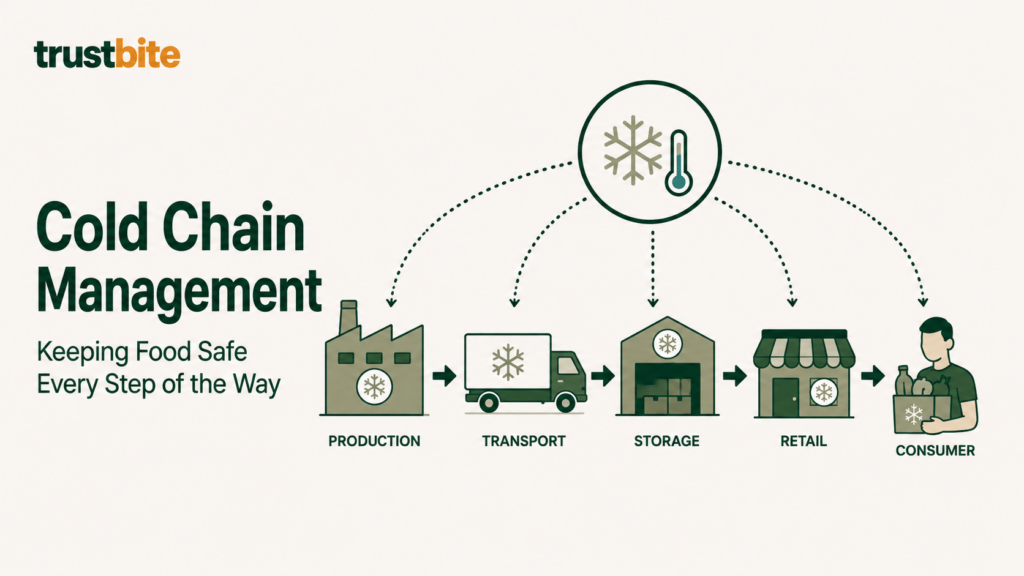
The cold chain is the continuous temperature-controlled supply chain through which perishable food products pass from their origin to the consumer. It typically involves refrigerated storage at the point of production, refrigerated transport between production facility and distribution center, refrigerated storage at the distribution center, refrigerated transport to the retail or food service point, refrigerated display or storage at the retail or food service point, and appropriate refrigerated storage after purchase by the consumer.
Each link in this chain must maintain the product within its required temperature range. The product’s safety depends on the weakest link. A product that was handled perfectly at every stage except one, where it spent two hours in an unrefrigerated vehicle on a warm day, may have accumulated a pathogen load that makes it unsafe even if all other aspects of the cold chain functioned correctly.
Why Cold Chain Management Matters for Food Safety
Temperature control is one of the most effective tools available for preventing bacterial growth in perishable food. Keeping food below 5°C does not kill bacteria, but it slows their multiplication to a rate slow enough that, across a product’s intended shelf life, pathogen levels do not reach a point where consumption causes illness.
When the cold chain breaks down, even temporarily, bacteria in the food resume multiplying at the faster rates characteristic of warmer temperatures. The time a product spends above 5°C accumulates across its history. A product that experienced three separate cold chain breaches of 30 minutes each has accumulated 90 minutes of temperature abuse, which may be well within safe limits or may represent a significant risk depending on the product’s initial contamination level and the temperatures reached during each breach.
Cold chain failures are directly linked to foodborne illness outbreaks involving chilled and refrigerated products, including ready to eat foods, dairy products, cooked meat and poultry, fresh produce, and chilled seafood. These are among the highest-risk food categories precisely because they depend on cold chain integrity rather than a cooking step to keep them safe at the point of consumption.
Key Stages of Cold Chain Management
Refrigerated storage at the production facility is the starting point. Product that has been produced, processed, or prepared under appropriate temperature controls must be moved into refrigerated storage promptly. Cooked food should be cooled to below 5°C within safe cooling time limits before being transferred to cold storage. Raw materials should be stored at appropriate refrigerated or frozen temperatures from the moment of receipt.
Refrigerated transport requires vehicles equipped with functioning refrigeration units capable of maintaining the required temperature range across the entire load and the entire journey. Load temperature at departure should be confirmed and recorded. Delivery routes and journey times should be planned to minimize the duration of transport, and vehicles should not be overloaded in ways that compromise temperature distribution within the load.
At handover points between organizations, such as when a product moves from a manufacturer’s vehicle to a distributor’s facility, temperature checks should be conducted and recorded. Receiving businesses should check the temperature of incoming chilled and frozen deliveries as a standard element of their goods-in procedure. A product arriving above its safe temperature range should not be accepted or should be placed in quarantine pending an assessment of whether it remains safe.
Retail and food service cold storage must maintain products at appropriate temperatures consistently throughout the trading period, including during periods of high customer traffic when refrigerator doors are opened frequently. Display equipment should be monitored and temperature records maintained.
Monitoring the Cold Chain
Cold chain monitoring is the practice of tracking temperature across one or more stages of the cold chain to confirm that safe temperatures have been maintained. Effective cold chain monitoring generates a continuous record rather than relying on periodic checks that may miss excursions occurring between manual readings.
Data loggers are devices placed within a food product shipment that record temperature at defined intervals throughout a transport or storage period, generating a time-stamped record that can be reviewed at delivery to confirm cold chain integrity. A data logger that shows a temperature spike during transport identifies a cold chain breach even if the product arrived at the correct temperature, since the product will have cooled again by the time it reached the delivery point.
Wireless temperature monitoring systems installed in refrigerated storage and transport equipment generate continuous records accessible remotely and in real time, allowing facility managers to receive alerts when temperatures exceed defined limits and respond before a significant breach develops. Food safety monitoring equipment providers such as Adria Food Tech supply cold chain monitoring systems including data loggers, wireless temperature sensors for refrigerated storage, and alert management tools that give food businesses the continuous temperature evidence their food safety management systems and auditors require.
Cold Chain Management in HACCP Systems
Cold chain control is addressed within a HACCP system through critical control points covering refrigerated storage, frozen storage, and in some operations, transport temperature control. Each of these CCPs has defined critical limits, typically a maximum storage temperature, monitoring procedures specifying how temperature is measured and how often, and corrective actions for when the temperature exceeds the critical limit.
For food businesses that also manage transport, the transport vehicle temperature may be an additional CCP. For businesses that purchase from external suppliers and distributors, the incoming goods temperature check is typically addressed through prerequisite programs rather than CCPs, covering the goods receiving procedure and its documentation requirements.
Cold chain monitoring records form part of the HACCP documentation set reviewed by auditors during certification and regulatory audits. Complete, continuous temperature records provide stronger audit evidence than periodic manual logs, since they demonstrate that the CCP was under control throughout the monitoring period rather than only at the moments of manual checking.
What Happens When the Cold Chain Breaks
When a cold chain failure is identified, the response depends on the severity of the breach, the product involved, and the time elapsed. A brief temperature excursion in a low-risk product may be assessable as safe to continue selling or serving. A significant breach in a high-risk ready to eat product may require the product to be discarded.
The assessment should be documented, with the breach recorded, the decision made about the product recorded, and the action taken confirmed. An undocumented cold chain breach that is discovered during an audit or an investigation following a foodborne illness complaint is a significant compliance and liability issue.
The cause of the breach should be investigated and addressed. A refrigerator that exceeded its critical limit on a single occasion may have experienced a transient operational issue. A refrigerator that regularly approaches or exceeds its critical limit has a performance problem that requires maintenance or replacement.
Staff Knowledge and Cold Chain Management
Cold chain management requires staff who understand why temperature control matters and what their specific responsibilities are at each stage they work within. A delivery driver who understands the consequences of leaving the vehicle doors open for extended periods during deliveries, or the importance of completing deliveries in the right sequence to minimize product time outside the vehicle, applies these considerations as judgment calls rather than waiting to be told what to do in each specific situation.
Food safety training programs that cover cold chain management as part of their temperature control content build this understanding at the operational level. Providers such as Confi Food include temperature control and cold chain management within their food safety training programs for food handlers and managers, covering why cold chain integrity matters alongside the practical procedures staff are expected to apply in their specific roles.
Conclusion
Cold chain management is the continuous discipline of keeping perishable food within safe temperatures across every stage from production to consumption. Its effectiveness depends on reliable equipment at every link in the chain, monitoring systems that generate complete temperature records, clear procedures at every handover point, and staff who understand what they are controlling and why. A cold chain that is strong at most links but weak at one creates food safety risk that a consumer has no way of detecting before consumption.
Frequently Asked Questions
What is cold chain management?
Cold chain management is the practice of maintaining perishable food products within safe temperature ranges throughout the entire supply chain, from production or harvest through storage, transport, distribution, retail, and until the point of consumption.
Why is cold chain management important for food safety?
Cold chain management prevents the bacterial growth that causes foodborne illness by keeping food below the temperature at which pathogens multiply rapidly. A break in the cold chain allows bacteria to multiply to dangerous levels before the food reaches the consumer.
What temperature should the cold chain maintain for chilled food?
Chilled food should be maintained at 5°C or below throughout the cold chain. Frozen food should be maintained at minus 18°C or below.
What happens when the cold chain breaks?
When cold chain integrity fails and food enters the danger zone above 5°C, bacteria begin multiplying at faster rates. The time accumulated above safe temperatures across a product’s history determines the level of risk. Significant or repeated cold chain breaches may make a product unsafe for consumption even if it has returned to a safe temperature by the time it reaches the consumer.
What is a data logger in cold chain management?
A data logger is a device placed within a food shipment that records temperature at defined intervals throughout a transport or storage period, generating a time-stamped record that confirms cold chain integrity or identifies breaches that occurred during transit.
What should a food business do when an incoming delivery arrives above its required temperature?
The business should refuse the delivery or quarantine the product pending an assessment of whether it remains safe, record the incoming temperature, document the decision and action taken, and notify the supplier of the cold chain failure.
How does cold chain management relate to HACCP?
Cold chain control is addressed within a HACCP system through critical control points covering refrigerated and frozen storage, and in some operations, transport temperature. Each CCP has defined critical limits, monitoring procedures, and corrective actions.
What is the difference between a refrigerator CCP and a cold chain prerequisite program?
Refrigerated storage within a food business is typically managed as a CCP within the HACCP system. The incoming goods temperature check for products arriving from external suppliers is typically managed as a prerequisite program procedure. Both contribute to overall cold chain management.
What monitoring equipment is used in cold chain management?
Cold chain monitoring equipment includes calibrated thermometers for manual temperature checks, data loggers placed within shipments for transport monitoring, wireless temperature sensors for refrigerated storage, and alert systems that notify managers when temperatures exceed defined limits.
Can a product be safe to consume after a brief cold chain breach?
It depends on the severity and duration of the breach, the product type, and its initial contamination level. Brief breaches in low-risk products may be assessable as safe. Any breach assessment should be documented and the outcome recorded. When in doubt, the product should be discarded.
How does cold chain management affect shelf life?
Products that have experienced cold chain breaches may have a shorter effective shelf life than their labelled date indicates, since pathogen growth during the breach has consumed some of the safety margin built into the shelf life calculation. Maintaining consistent cold chain temperatures is essential for shelf life validity.
What is the cold chain’s role in preventing Listeria contamination?
Listeria monocytogenes is unusual among foodborne pathogens in being capable of slow growth at refrigerator temperatures. Consistent cold storage temperatures below 5°C slow Listeria growth to rates that, for most ready to eat products with standard shelf lives, do not allow dangerous levels to develop before consumption. Temperature abuse above 5°C allows Listeria to multiply much faster, creating a food safety risk that is particularly serious for vulnerable consumers.
How are cold chain records used in food safety audits?
Auditors review cold chain records including refrigerated storage temperature logs, incoming goods temperature check records, and any corrective action documentation for temperature breaches. Continuous monitoring records that cover the full production period provide stronger evidence than periodic manual logs.
What is the role of delivery staff in cold chain management?
Delivery staff directly control cold chain integrity during transport. Their understanding of why temperature control matters, how to handle product during delivery, and what to do when a vehicle refrigeration system fails or a journey takes longer than planned is a critical factor in cold chain reliability.
Related from the Knowledge Center
The Food Safety Danger Zone: What It Is and Why Temperature Control Matters
The danger zone is the temperature range that cold chain management is designed to keep food out of. This article explains why the range is dangerous and what happens to food within it.
Temperature Abuse in Food Safety: What It Is and Why It Causes Illness
Cold chain failures are a form of temperature abuse. This article covers the broader topic of how temperature abuse occurs across food businesses and how to prevent it.
Allergen Management in Food Businesses: A Practical Guide
Temperature control and allergen management are the two most operationally demanding foundational food safety controls. This article covers allergen management with the same practical depth.