Temperature abuse occurs when food is held, stored, or transported at temperatures within the range where bacteria multiply most rapidly, and for long enough that pathogen levels reach a point where consumption causes illness. It is one of the most consistently cited contributing factors in foodborne illness outbreaks, and it happens across every type of food business, from large manufacturing operations to small restaurants to catering providers.
Unlike contamination events that introduce hazards through a specific failure point, temperature abuse is often a slow accumulation of small failures. Food left on a counter for slightly too long. A refrigerator running two or three degrees above its target. Cooked food cooled in a large container rather than split into smaller portions. Each of these alone may not produce a sufficient pathogen load to cause illness. Combined across a service period or production run, they create conditions in which pathogens can multiply to dangerous levels in food that looks, smells, and tastes perfectly normal.
What Is Temperature Abuse?
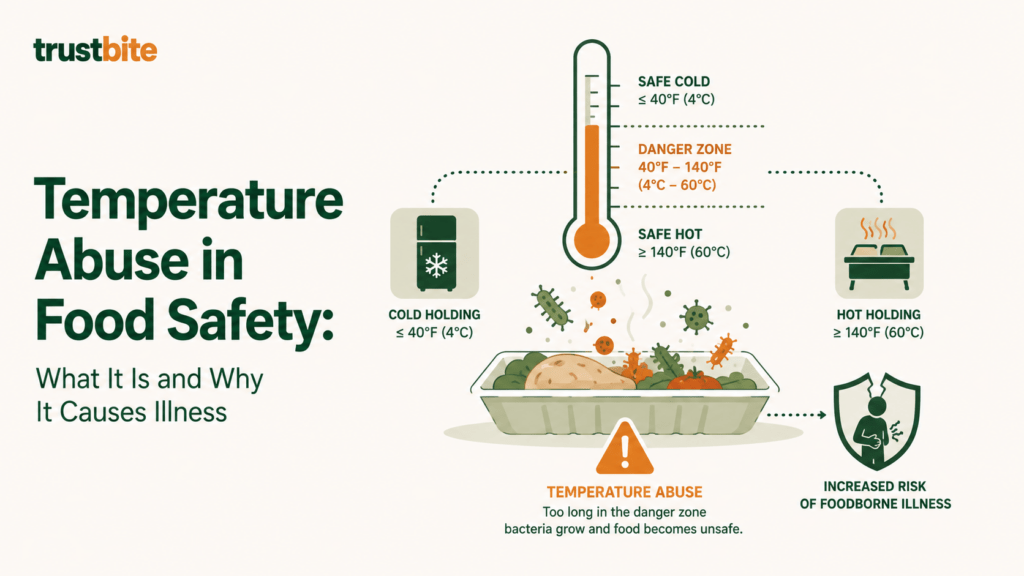
Temperature abuse is the failure to maintain food at safe temperatures during storage, preparation, holding, or transport. Safe temperatures keep food either cold enough to slow bacterial growth to an acceptable rate, or hot enough that pathogens cannot survive. The temperature range in which most foodborne bacteria multiply rapidly, between 5°C and 63°C, is known as the danger zone. Temperature abuse occurs when food spends more time in the danger zone than safe limits allow.
Temperature abuse can happen at any stage of the food chain, from a supplier’s delivery vehicle to a restaurant’s serving counter to a consumer’s home kitchen. In a food business, temperature abuse is primarily a failure of control systems and the people operating them.
How Temperature Abuse Leads to Illness
The connection between temperature abuse and foodborne illness runs through bacterial growth. Most foodborne pathogens are present on food in very low numbers that do not cause illness at the point of contamination. The problem develops when those pathogens are given time and temperature conditions that allow them to multiply.
Within the danger zone, common pathogens such as Salmonella, Staphylococcus aureus, Clostridium perfringens, and Bacillus cereus can double in number every 20 minutes under optimal conditions. A food product with a low initial contamination level can develop a dangerous pathogen load within a few hours if held within the danger zone without interruption.
Some pathogens add a further complication by producing heat-stable toxins during their growth phase. Staphylococcus aureus and Bacillus cereus both produce toxins that remain active even after the bacteria producing them are killed by cooking. Food that has undergone significant temperature abuse and then been reheated may have its bacterial load reduced by the heat treatment but still contain toxins at levels sufficient to cause illness.
Common Causes of Temperature Abuse in Food Businesses
Temperature abuse in food businesses most commonly results from a combination of inadequate equipment, operational pressures, and gaps in staff knowledge or procedure compliance.
Inadequate refrigeration capacity or poorly maintained refrigeration equipment is a frequent physical cause. A refrigerator that is overloaded with warm food, set to too high a temperature, or failing to maintain its set point will hold food in the danger zone without any obvious visual signal to staff that something is wrong. Refrigeration equipment that is not regularly checked and maintained accumulates small performance degradations that eventually result in a temperature abuse failure.
Slow cooling of cooked food is one of the most significant operational causes. Placing a large pot of hot soup or stew directly in a refrigerator creates a situation where the core of the food cools through the danger zone very slowly while the refrigerator itself works hard against the heat load. The outer layers may reach a safe temperature while the interior remains warm for several hours. Portioning food into shallower containers, using ice baths, or using blast chilling equipment are controls that address this problem. Many businesses know this intellectually but do not apply it consistently under the operational pressure of a busy service period.
Hot holding failures occur when food that should be kept hot for service drops below 63°C, often because serving equipment is not preheated adequately before food is placed in it, or because the volume of food in service equipment drops below the level at which the equipment maintains its temperature effectively.
Thawing at room temperature rather than under refrigeration or in cold running water places the outer layers of frozen food in the danger zone while the centre is still frozen, creating a window of uncontrolled bacterial growth before the food is fully thawed.
Extended preparation times in warm kitchen environments allow ingredients that should remain chilled to spend time at ambient temperatures that are within the danger zone, accumulating exposure that is rarely tracked or documented.
Delivery vehicles and transport that cannot maintain adequate temperature control create temperature abuse risks in the supply chain before food even reaches the food business. Businesses that do not check the temperature of incoming deliveries cannot know whether the cold chain has been maintained from the supplier’s facility to their door.
How Temperature Abuse Is Prevented
Preventing temperature abuse in a food business requires three things working together: equipment that is capable of maintaining safe temperatures, monitoring systems that detect deviations in time to act on them, and staff who understand what temperature controls are required and why they matter.
Equipment calibration and maintenance must be scheduled and documented. Refrigeration units should be checked regularly to confirm they are maintaining target temperatures. Temperature measurement devices used to check food temperatures must be calibrated to confirm their accuracy.
Monitoring systems that provide continuous temperature records eliminate the gap in evidence that periodic manual checks create. A temperature sensor logging refrigerator conditions every few minutes generates a complete record of whether the temperature has remained within safe limits across an entire shift or storage period, revealing excursions that would never appear in a twice-daily manual log. Food safety monitoring equipment providers such as Adria Food Tech supply automated temperature monitoring systems for refrigerated storage, hot holding equipment, and cold chain management that generate the time-stamped audit trails food businesses and certification auditors need to confirm that temperature controls are functioning as required.
Incoming goods temperature checks at delivery confirm that the cold chain from supplier to food business has been maintained. Recording the temperature of chilled and frozen deliveries as a standard part of the goods-in procedure provides evidence of control and flags supply chain temperature abuse events before affected product enters storage.
Cooling procedures should be documented and followed consistently. The procedure should specify the maximum container depth for cooling food, the cooling method to be used, and the time-temperature targets that must be met. Where a business uses blast chilling equipment, monitoring the chiller’s performance against these targets is part of the CCP monitoring system.
Staff knowledge and consistent application of temperature controls is the behavioral layer that makes all other controls function. A monitoring system that generates alerts when a refrigerator temperature rises above 8°C is only effective if the person receiving the alert understands what action to take and takes it promptly. Training programs from providers such as Confi Food build this understanding alongside the practical procedures staff need to apply in their specific roles, including why temperature control matters, what the consequences of temperature abuse are, and what to do when a deviation is identified.
Temperature Abuse as a HACCP Failure
Temperature abuse is addressed within a HACCP system through critical control points covering cooking, cooling, hot holding, and refrigerated storage. Each CCP has defined critical limits, monitoring procedures, and corrective actions for when limits are breached.
The most common HACCP failure related to temperature abuse is not a missing CCP but a monitoring failure. CCPs that exist on paper but are not monitored consistently, or whose monitoring records do not reflect what is actually happening, create a situation where temperature abuse can occur without triggering the corrective actions the HACCP plan requires.
Root cause investigations following temperature abuse incidents frequently find that monitoring was being performed less frequently than specified, that temperature readings outside the critical limit were being recorded without triggering corrective actions, or that monitoring equipment was out of calibration and had been generating inaccurate readings without anyone noticing.
Conclusion
Temperature abuse is a consistently present risk in food businesses that operates through the accumulation of small failures rather than a single dramatic event. Preventing it requires capable equipment, reliable monitoring systems, documented procedures that are actually followed, and staff who understand why temperature control matters well enough to act correctly when something goes wrong. The combination of continuous monitoring technology and well-trained staff produces substantially more reliable temperature control than either element alone.
Frequently Asked Questions
What is temperature abuse in food safety?
Temperature abuse is the failure to maintain food at safe temperatures during storage, preparation, holding, or transport, resulting in food spending too long in the danger zone where bacteria multiply rapidly.
What temperatures constitute the danger zone?
The food safety danger zone is the temperature range between 5°C and 63°C, within which most foodborne bacteria can multiply to dangerous levels given sufficient time.
How long can food safely remain in the danger zone?
Most food safety guidelines treat two hours as the maximum cumulative time food should spend in the danger zone before it is cooked to a safe temperature, refrigerated, or discarded. Some frameworks apply more conservative limits in higher-risk environments.
What are the most common causes of temperature abuse in food businesses?
Common causes include inadequate or poorly maintained refrigeration equipment, slow cooling of cooked food in large containers, hot holding equipment that fails to maintain 63°C, thawing at room temperature, extended preparation times in warm environments, and delivery vehicles that cannot maintain adequate cold chain temperatures.
What pathogens are most commonly associated with temperature abuse?
Pathogens commonly associated with temperature abuse include Salmonella, Clostridium perfringens, Staphylococcus aureus, Bacillus cereus, and Listeria monocytogenes, each of which has specific growth characteristics within the danger zone that determine how quickly dangerous levels develop.
Why is cooling cooked food correctly so important?
Incorrect cooling keeps food in the danger zone for extended periods while it moves slowly from cooking temperature to refrigeration temperature. A large volume of food cooling in a single container can remain in the danger zone at its core for several hours, allowing significant pathogen multiplication before the food reaches a safe temperature.
What is a heat-stable toxin and why is it dangerous?
Heat-stable toxins are produced by some bacteria, including Staphylococcus aureus and Bacillus cereus, while growing within the danger zone. These toxins are not destroyed by subsequent cooking. Food that has undergone temperature abuse and been reheated may still cause illness because the toxins produced during the abuse period remain active.
How should food be cooled after cooking?
Food should be divided into shallow portions to increase surface area, placed in an ice bath or transferred to a blast chiller, and cooled from 60°C to 21°C within two hours and from 21°C to 5°C within a further four hours.
What is the correct temperature for hot holding food?
Food held hot for service must be maintained at 63°C or above. Food that drops below this temperature has entered the danger zone and should be treated according to the business’s corrective action procedure for the relevant CCP.
How does continuous temperature monitoring differ from manual temperature checks?
Continuous monitoring generates a time-stamped record of every temperature reading across the monitoring period, revealing deviations that occur between manual checks. Manual monitoring only records the temperature at the moment of the check and misses any excursion that resolves before the next check.
What should a food business do if a refrigerator is found operating above its critical limit?
The business should apply its pre-defined corrective action, which should include removing and assessing any product held in the unit during the temperature excursion, repairing or replacing the refrigeration equipment, documenting the event and its resolution, and investigating why the deviation occurred.
How does incoming goods temperature checking prevent temperature abuse?
Checking the temperature of incoming chilled and frozen deliveries confirms whether the cold chain from the supplier has been maintained. Recording delivery temperatures as a standard procedure provides evidence of control and identifies supply chain temperature failures before affected product enters storage.
What is the relationship between temperature abuse and HACCP?
Temperature abuse is addressed within a HACCP system through critical control points covering cooking, cooling, hot holding, and refrigerated storage. Temperature abuse incidents typically reflect monitoring or corrective action failures within the HACCP system rather than missing CCPs.
Can temperature abuse occur in food that has been cooked?
Yes. Temperature abuse can affect food at any stage, including after cooking. Cooked food that is not cooled rapidly, held hot correctly, or refrigerated promptly can develop dangerous pathogen levels even though it was cooked to a safe temperature.
Related from the Knowledge Center
The Food Safety Danger Zone: What It Is and Why Temperature Control Matters
Explains the temperature range at the core of temperature abuse risk, why bacteria multiply so rapidly within it, and the safe temperature targets food businesses must maintain.
Cross-Contamination in Food Safety: Causes, Examples, and How to Prevent It
Temperature abuse and cross-contamination are two of the most common contributors to foodborne illness outbreaks. This article covers the contamination transfer pathways that operate alongside temperature failures.
Anatomy of a Food Recall: How Contamination Reaches Consumers
Temperature abuse is among the most frequent contributing factors in contamination events that reach the recall stage. This article explains how those events unfold from the point of failure to consumer-level impact.