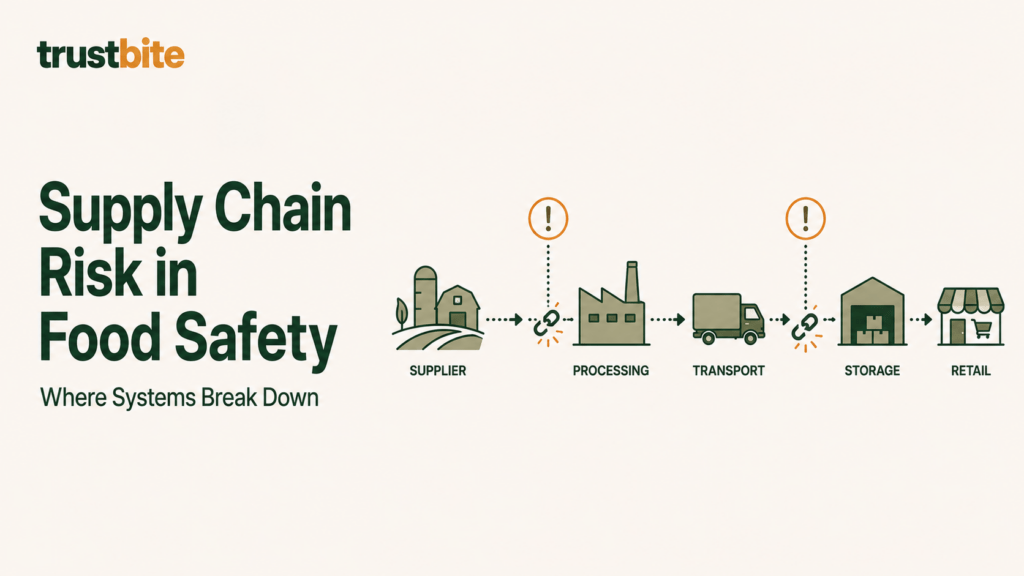
Supply chain risk in food safety refers to the hazards that enter a food business through its raw materials, ingredients, packaging, and services rather than through its own operational processes. A food business can operate an excellent internal food safety management system and still experience a food safety failure because a supplier delivered contaminated ingredients, an allergen formulation changed without notification, or a service provider’s practices introduced contamination into the operation.
Supply chain failures account for a significant proportion of food recalls and foodborne illness outbreaks, and they are structurally different from internal operational failures because they originate outside the control of the food business receiving the material. Understanding where supply chain food safety risks arise, how businesses manage them, and what happens when supply chain controls fail is essential for any food business that buys ingredients or materials from external sources, which in practice means every food business.
What Is Supply Chain Risk in Food Safety?
Supply chain risk in food safety is the probability that a hazard originates in the supply chain and reaches consumers through a food business that was not itself the source of the contamination or failure. The hazard may be biological, such as a pathogen present in a raw material. It may be chemical, such as a pesticide residue above regulatory limits in an ingredient. It may be physical, such as a foreign body present in an ingredient or packaging material. Or it may be an allergen hazard, such as an undeclared allergen in an ingredient that the food business is using in a product labelled as allergen-free.
Supply chain risk exists at every stage of the food supply chain. A manufacturer buying ingredients from a supplier faces supply chain risk. A restaurant buying prepared sauces or pre-processed ingredients faces the same category of risk, often with less visibility of what those ingredients contain and where they came from.
Where Supply Chain Food Safety Failures Commonly Occur
Ingredient contamination at the supplier level is one of the most direct supply chain failure pathways. A raw material that is contaminated with a pathogen, chemical, or foreign body before it reaches the food business will carry that hazard into any product it is used in, and if the food business’s process does not include a step that eliminates the hazard, the contaminated product will reach consumers.
Allergen undisclosed or changed in an ingredient is one of the most consistently recurring supply chain allergen risks. A supplier reformulates an ingredient, introducing a new allergen or removing the allergen-free status that a food business relied on for a specific product, and does not communicate this change. The food business continues producing and labelling the product as before, unaware that the allergen profile has changed.
Cold chain failure during transport from supplier to food business allows temperature abuse to occur before ingredients arrive. A food business that does not check the temperature of incoming chilled deliveries has no way of knowing whether a received ingredient has been held above safe temperatures during transit.
Cross-contamination at the supplier’s facility can introduce allergens or pathogens into ingredients that are not supposed to contain them, either through shared equipment, inadequate cleaning between production runs, or poor segregation practices in the supplier’s own operation.
Fraudulent or adulterated ingredients represent a supply chain food safety risk that periodic sampling and testing programs are designed to identify. Food fraud, where an ingredient is adulterated or substituted with a cheaper alternative, can introduce unlabelled substances including allergens and chemical residues into a food business’s products without the business’s knowledge.
Packaging that is itself contaminated or that leaches chemical substances into food it contains is a less common but real supply chain food safety hazard, particularly in operations using packaging materials from suppliers with less rigorous quality control.
How Food Businesses Manage Supply Chain Risk
Managing supply chain food safety risk requires a formal supplier management program that applies controls proportionate to the risk level of the materials and services being procured.
Supplier approval is the starting point. A food business should not purchase ingredients or materials from a supplier that has not been assessed and approved against defined food safety criteria. Supplier approval processes vary in rigor from requiring a supplier questionnaire and food safety certification evidence to conducting supplier audits at the supplier’s facility. The level of scrutiny applied should reflect the risk associated with the material being supplied. A supplier of high-risk ready to eat ingredients warrants more rigorous approval than a supplier of single-use catering supplies.
Supplier certification provides a useful baseline of assurance. A supplier holding BRCGS, SQF, or ISO 22000 certification has demonstrated to an independent assessor that their food safety management system meets defined standards. This is not a guarantee that every batch they supply is safe, but it is meaningful evidence of a systematic approach to food safety management that reduces, though does not eliminate, supply chain risk.
Incoming goods inspection and temperature checking confirms that materials arriving at the food business meet defined acceptance criteria at the point of receipt. Temperature checks for chilled and frozen deliveries, visual inspection of packaging integrity, and verification of labelling accuracy are standard components of an incoming goods procedure. Incoming goods that do not meet acceptance criteria should be rejected or quarantined pending assessment.
Ingredient specifications define the food safety requirements that each ingredient must meet, including microbiological limits, allergen status, maximum residue levels for contaminants, and packaging integrity requirements. Specifications provide the documented basis against which incoming materials are assessed and give a business the commercial mechanism to reject non-conforming deliveries.
Periodic testing of incoming materials provides an additional verification layer beyond supplier certification and visual inspection. Microbiological testing of high-risk ingredients, allergen testing where allergen cross-contact is a concern, and contaminant testing where chemical residue risk is elevated all generate objective evidence of ingredient safety that supplier documentation alone cannot provide.
Supplier performance monitoring tracks how suppliers are performing over time, including delivery quality records, non-conformance history, complaint and recall history, and any changes to their certification status. A supplier whose performance has deteriorated or who has lost certification should trigger a supplier review.
Food safety monitoring equipment supports incoming goods inspection at the receiving stage. Temperature measurement of incoming deliveries and ATP swab testing of incoming packaging integrity form part of many businesses’ goods-in procedures. Equipment providers such as Adria Food Tech supply temperature monitoring and testing equipment that food businesses use at the goods receiving stage to generate the objective records that confirm incoming material acceptance decisions.
Allergen Supply Chain Risk: A Specific Priority
Allergen supply chain risk deserves specific attention because it is one of the most frequently realized supply chain failures in food businesses and because its consequences for consumers can be severe. The allergen profile of a finished product depends entirely on the allergen status of every ingredient in it, and that status can change without warning if a supplier reformulates.
Managing allergen supply chain risk requires allergen declarations from all suppliers confirming the allergen status of each ingredient and whether it is produced in an environment where allergens are handled. These declarations must be reviewed when an ingredient specification changes, when a supplier changes their formulation, or when the supplier changes their manufacturing site or process. A supplier allergen communication process that relies only on the supplier notifying the food business when changes occur is insufficient. Active verification at defined intervals is required.
Training staff in allergen management at the goods receiving stage, so that incoming ingredient labels are checked for allergen declarations as part of the goods-in procedure, provides an additional verification layer against supplier communication failures. Providers such as Confi Food include allergen management as a core training topic, building the knowledge that allows staff to identify potential allergen supply chain issues rather than processing incoming materials without checking their allergen status.
Supply Chain Risk in HACCP Systems
Supply chain risk is addressed within a HACCP system primarily through the hazard analysis, where biological, chemical, and physical hazards associated with raw materials and ingredients are identified and assessed. Where a hazard is present in an incoming material and must be controlled at a subsequent process step, that step may become a CCP. Where a hazard must be controlled by the supplier, supplier management controls form part of the prerequisite program rather than a CCP.
Traceability, which is a prerequisite program requirement in most HACCP frameworks, is the mechanism through which a supply chain food safety failure can be investigated and its scope determined. A business that can trace which batches of product used a specific ingredient lot can rapidly identify the scope of a supply chain recall event rather than needing to treat all recent production as potentially affected.
Conclusion
Supply chain risk in food safety is an inherent feature of any food business that purchases materials from external sources. Managing it requires formal supplier approval processes, clear ingredient specifications, incoming goods inspection and testing, ongoing supplier performance monitoring, and alert systems that identify changes in supplier certification or formulation. A food safety management system that is excellent internally but has weak supplier management controls is operating with a significant uncontrolled risk at its most fundamental input point.
Frequently Asked Questions
What is supply chain risk in food safety?
Supply chain risk in food safety is the probability that a hazard originates in the supply chain through raw materials, ingredients, packaging, or services and reaches consumers through a food business that was not itself the original source of the contamination or failure.
Where do supply chain food safety failures most commonly occur?
Common supply chain failure points include ingredient contamination at the supplier level, allergen changes in supplier formulations that are not communicated, cold chain failures during transport, cross-contamination at the supplier’s own facility, food fraud and ingredient adulteration, and packaging contamination.
What is supplier approval in food safety?
Supplier approval is the process of assessing and formally approving suppliers against defined food safety criteria before purchasing materials from them. The rigor of the approval process should reflect the risk associated with the material being procured.
How does supplier certification help manage supply chain risk?
A supplier holding a recognized food safety certification such as BRCGS or ISO 22000 has demonstrated a systematic approach to food safety management assessed by an independent third party. Certification reduces but does not eliminate supply chain risk, and should be used alongside other controls such as ingredient specifications and incoming goods inspection.
What is an ingredient specification?
An ingredient specification is a document defining the food safety requirements that an ingredient must meet, including microbiological limits, allergen status, maximum contaminant levels, and packaging requirements. It provides the documented basis for accepting or rejecting incoming materials.
Why is allergen supply chain risk particularly significant?
Allergen supply chain risk is significant because ingredient allergen profiles can change when suppliers reformulate without notifying their customers. A food business relying on an ingredient being allergen-free that changes without notice may continue producing and labelling a product incorrectly, posing a serious risk to allergic consumers.
What should a food business do when a supplier changes their formulation?
The business should request updated allergen declarations and ingredient specifications, assess the impact of the change on product formulations and labelling, update product specifications and labels if the allergen profile has changed, and review whether the change affects any HACCP hazard analysis or prerequisite program controls.
How is incoming goods inspection conducted?
Incoming goods inspection typically includes temperature checking of chilled and frozen deliveries, visual inspection of packaging integrity, verification of labelling accuracy including allergen declarations, and comparison of the delivered material against the ingredient specification and order details.
What is traceability and why is it important for managing supply chain risk?
Traceability is the ability to track a product and its ingredients through the supply chain. It is critical for supply chain risk management because it allows a business to identify the scope of a supply chain contamination event quickly, limiting the spread of affected product when a recall is necessary.
What is food fraud and how does it create supply chain risk?
Food fraud occurs when an ingredient is adulterated, substituted, or mislabelled for commercial gain. It creates food safety risk when undeclared substances including allergens, contaminants, or unauthorized additives enter a food business’s products through fraudulently labelled ingredients.
How does incoming goods testing supplement supplier certification?
Periodic testing of incoming materials provides objective evidence of ingredient safety that supplier documentation cannot provide alone. Testing can identify batches that do not meet specification despite coming from an approved supplier and can detect contamination events that the supplier’s own controls failed to prevent.
What role does supplier performance monitoring play in supply chain risk management?
Supplier performance monitoring tracks quality and compliance over time, identifying suppliers whose performance has deteriorated. A supplier with increasing non-conformance rates, a food safety incident at their facility, or a loss of certification should trigger a formal review of the supplier approval.
What happens to supply chain risk if a supplier changes their manufacturing site?
A change of manufacturing site is a significant event that should trigger a review of the supplier approval, since the food safety management system, equipment, and controls at the new site may differ from those at the original site. A new allergen declaration should be obtained for all ingredients produced at the new site.
How does supply chain risk management relate to food recalls?
Strong supply chain risk management, combined with effective traceability, limits both the probability of a supply chain-sourced food safety failure and the scope of the recall if one occurs. A business that can quickly identify which production batches were made using a specific ingredient lot can target a recall precisely rather than recalling all recent production.
Related from the Knowledge Center
Anatomy of a Food Recall: How Contamination Reaches Consumers
Supply chain failures are among the most common originating causes of food recalls. This article explains how contamination travels from its source through to consumer-level recall.
Allergen Management in Food Businesses: A Practical Guide
Allergen supply chain risk is one of the most frequently realized supply chain failures. This article covers the full scope of allergen management including supplier controls.
What Is a Food Safety Audit? Types, Process, and What to Expect
Supplier management documentation and incoming goods records are reviewed during food safety audits. This article explains what auditors assess and how businesses prepare.