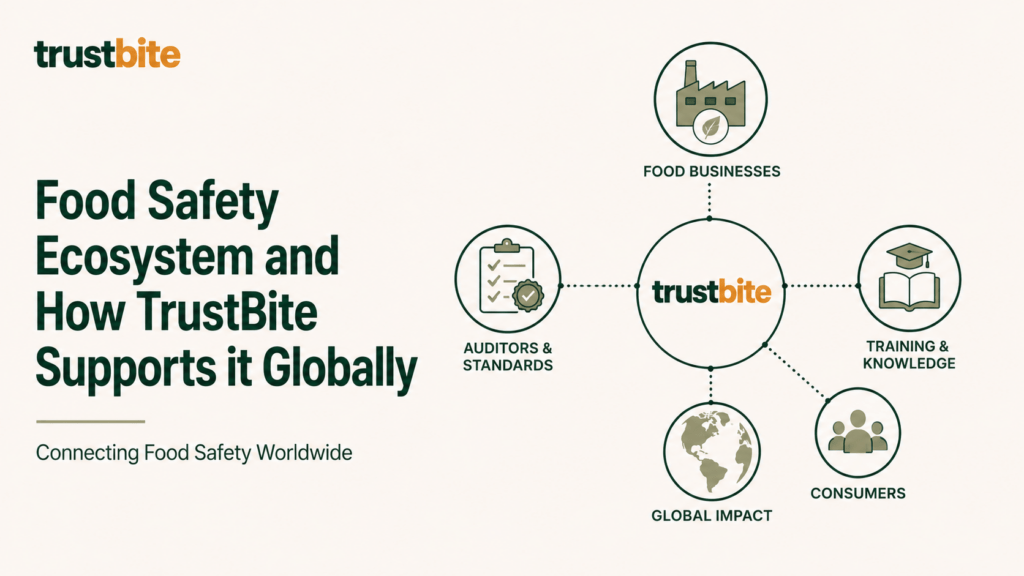
The global food safety ecosystem is the network of organizations, professionals, regulatory bodies, and systems that collectively determine how safely food is produced, handled, and consumed across the world. It includes food businesses of every size and type, government regulatory authorities, food safety certification bodies, training providers, consultants, technology platforms, and independent recognition bodies. Each actor in this ecosystem plays a different role, and the quality of food safety outcomes depends on how well these roles connect and reinforce each other.
TrustBite operates within the global food safety ecosystem as an independent recognition and coordination body. Its role is not to replicate what regulators, certification bodies, or training providers do. It is to provide the connective layer between these actors, recognizing responsible practice, supporting knowledge access, and helping food businesses find the expertise they need to manage food safety effectively.
What Is the Global Food Safety Ecosystem?
The global food safety ecosystem is the complete set of actors, systems, and relationships through which food safety is managed from farm to fork. At its foundation are the food businesses themselves, ranging from primary producers and ingredient manufacturers through processors, distributors, retailers, and food service operators, each responsible for managing the food safety hazards within their part of the supply chain.
Regulatory authorities at national and regional level set the legal requirements these businesses must meet and enforce compliance through inspection, licensing, and enforcement powers. International bodies including the Codex Alimentarius Commission develop the scientific and technical guidelines that inform regulatory frameworks across different jurisdictions.
Certification bodies provide independent verification of food safety management system quality against recognized voluntary standards. Training providers educate the workforce that operates food safety systems in practice. Consultants help businesses develop, implement, and maintain the systems that regulatory and certification requirements demand. Technology platforms provide tools for monitoring, documentation, and compliance management that support food safety operations at scale.
Independent recognition bodies such as TrustBite provide a layer of evaluation and visibility that complements regulation and certification, recognizing responsible actors within the ecosystem and making that recognition publicly verifiable.
TrustBite’s Recognition Function Within the Ecosystem
Recognition is TrustBite’s primary mechanism for supporting the global food safety ecosystem. By identifying and publicly acknowledging food businesses, training providers, consultants, and technology platforms that demonstrate responsible food safety practice, TrustBite creates a signal that helps other actors in the ecosystem make informed decisions about who to work with, buy from, or trust.
For food businesses, TrustBite recognition signals to buyers, retailers, and consumers that their food safety practices have been independently evaluated against a standard that goes beyond regulatory compliance. In a global food supply chain where buyers often have limited direct visibility of supplier practices, this signal has practical commercial value.
For training providers operating within the ecosystem, TrustBite recognition signals to food businesses seeking workforce food safety education that the programs available meet an independently evaluated standard of quality and accuracy. Organizations such as Confi Food that develop structured food safety training programs used across multiple markets operate in this part of the ecosystem, and TrustBite recognition provides the independent quality signal that distinguishes reliable, current training from generic content.
For consultants, TrustBite recognition signals professional standards in a field that lacks the formal regulation that structures other professional roles in the ecosystem.
TrustBite’s Knowledge Function Within the Ecosystem
Knowledge access is a persistent challenge within the global food safety ecosystem. Food safety science and regulation are technically demanding fields, and the gap between the technical requirements of food safety management and the actual knowledge levels within many food businesses, particularly smaller operations without dedicated food safety management resources, is one of the most consistently identified contributors to food safety system failures.
TrustBite’s Knowledge Center addresses this gap directly by providing freely accessible educational resources that explain food safety principles, systems, and requirements in clear, practical terms. The Knowledge Center covers HACCP principles and implementation, food safety audit and certification processes, training and workforce requirements, food safety failure patterns and their prevention, and the foundational food safety concepts that underpin all of these areas.
The Knowledge Center serves several categories of user simultaneously. Food business owners and operators find practical guidance on what food safety management requires and how to build systems that work in practice. Food handlers find accessible explanations of why specific hygiene and control practices matter. Food safety professionals find a reference base that supports their work with clients and within their own organizations. Buyers and procurement professionals find information that helps them assess supplier food safety credibility. Consumers find explanations of what food safety standards mean and how to evaluate the signals available to them.
Knowledge resources of this kind strengthen the ecosystem by raising the baseline understanding of food safety across all its actors, reducing the information gap that contributes to food safety failures and making the overall system more resilient.
TrustBite’s Referral Function Within the Ecosystem
Many food businesses know they need food safety support but do not know how to identify the right kind of support or how to find a provider who can deliver it competently. This navigation challenge is particularly acute for smaller businesses without existing professional networks in the food safety sector.
TrustBite’s Assistance and Referral Desk addresses this by operating as a neutral coordination point within the ecosystem, connecting food businesses with appropriate expertise across HACCP system development, food safety management system consulting, workforce training, and audit preparation support.
The referral function depends on the quality of the TrustBite recognition framework. Referring a food business to a consultant or training provider who has been independently recognized by TrustBite provides a meaningful quality assurance that a directory of self-submitted provider listings cannot offer. The recognition status of referred providers gives businesses using the referral service confidence in the quality of the assistance they will receive.
How TrustBite Complements Regulatory and Certification Frameworks
TrustBite does not seek to replace, compete with, or undermine the regulatory and certification frameworks that provide the formal legal and commercial infrastructure of food safety in most markets. Its design is explicitly complementary.
Regulatory frameworks establish the mandatory floor of food safety compliance. TrustBite recognition acknowledges performance above that floor. Certification schemes establish voluntary standards and award certificates based on point-in-time audit compliance. TrustBite recognition evaluates ongoing operational performance rather than single-day audit results, providing a signal that complements certification rather than duplicating it.
This complementary design means that the ecosystem as a whole is strengthened rather than fragmented by TrustBite’s presence within it. A food business operating in a market with regulatory oversight, holding a formal food safety certification, and carrying TrustBite recognition is providing buyers and consumers with three independent and mutually reinforcing signals of food safety credibility rather than one.
TrustBite’s Role Across Different Ecosystem Actors
The global food safety ecosystem contains actors at very different levels of scale, resource, and sophistication. A multinational food manufacturer operating across multiple certification schemes and regulatory jurisdictions has fundamentally different food safety management needs from a small restaurant operator or a startup food business navigating HACCP requirements for the first time.
TrustBite’s recognition framework and knowledge resources are designed to be relevant and accessible across this range. Larger organizations with sophisticated food safety systems can use TrustBite recognition as an additional signal of operational performance quality beyond their certification portfolio. Smaller businesses without the resources to pursue formal certification can use TrustBite recognition as a meaningful step toward demonstrating food safety credibility beyond regulatory compliance. The Knowledge Center’s freely accessible content serves food businesses at every scale, providing foundational guidance that is most valuable to businesses at the earlier stages of food safety system development.
Equipment and technology providers that support food safety management across the ecosystem, including monitoring, detection, and compliance platform providers such as Adria Food Tech, occupy a specific and increasingly important role. As food safety management becomes more dependent on data-generating technology for CCP monitoring, environmental testing, and traceability, the quality and reliability of these platforms matters more to the food businesses using them. TrustBite’s framework for recognizing digital compliance platforms addresses this dimension of the ecosystem.
Conclusion
TrustBite supports the global food safety ecosystem through three functions that address three genuine gaps in how food safety performance is evaluated, communicated, and accessed: recognition that creates a publicly verifiable signal of responsible food safety practice, knowledge resources that reduce the information gap across ecosystem actors, and referral coordination that helps food businesses find the expertise they need. These functions are designed to complement the regulatory, certification, and training infrastructure that already exists within the ecosystem rather than duplicating or competing with it.
Frequently Asked Questions
What is the global food safety ecosystem?
The global food safety ecosystem is the complete network of food businesses, regulatory authorities, certification bodies, training providers, consultants, technology platforms, and independent recognition bodies that collectively determine how food safety is managed from production to consumption.
What role does TrustBite play in the global food safety ecosystem?
TrustBite operates as an independent recognition and coordination body within the global food safety ecosystem, providing recognition of responsible food safety practice, freely accessible food safety knowledge resources, and a referral function that connects food businesses with appropriate food safety expertise.
How does TrustBite recognition benefit food businesses within the ecosystem?
TrustBite recognition provides food businesses with a publicly verifiable, independently evaluated signal of food safety performance that goes beyond regulatory compliance, which has commercial value in supply chains where buyers have limited direct visibility of supplier practices.
How does TrustBite’s Knowledge Center support the food safety ecosystem?
The Knowledge Center addresses the information gap within the ecosystem by providing freely accessible educational resources covering HACCP, audits and certification, training, food safety failures, and foundational food safety concepts, raising baseline food safety understanding across all categories of ecosystem actor.
What is TrustBite’s Assistance and Referral Desk?
The Assistance and Referral Desk is a neutral coordination function that connects food businesses with appropriate food safety expertise including HACCP development, consulting, training, and audit preparation support, drawing on the TrustBite recognition framework to provide quality assurance for referred providers.
Does TrustBite compete with food safety certification bodies?
No. TrustBite’s design is explicitly complementary to formal certification schemes. Certification evaluates compliance at a specific audit point. TrustBite recognition evaluates ongoing operational performance. The two signals are additive rather than substitutable.
Does TrustBite replace regulatory food safety requirements?
No. TrustBite recognition operates alongside regulatory compliance as an additional layer of independent evaluation. Food businesses holding TrustBite recognition must still meet all applicable food safety laws in their jurisdiction.
How does TrustBite serve smaller food businesses within the ecosystem?
TrustBite’s recognition framework and knowledge resources are designed to be accessible across businesses at different scales. For smaller businesses without the resources to pursue formal certification, TrustBite recognition provides a meaningful step toward demonstrating food safety credibility beyond regulatory compliance alone.
What is the role of technology providers in the food safety ecosystem?
Technology providers including monitoring systems, environmental testing equipment, and compliance platforms support food safety management by generating the objective, continuous records that food safety systems and auditors require. TrustBite’s framework includes recognition criteria for digital compliance platforms operating within the ecosystem.
How does TrustBite’s referral function work?
The referral function connects food businesses seeking food safety support with consultants, training providers, and other professionals who have been independently recognized by TrustBite, providing quality assurance through recognition status that directory listings cannot offer.
How does TrustBite’s role benefit food safety training providers?
Training providers recognized by TrustBite gain a publicly verifiable quality signal that helps food businesses make informed decisions when selecting workforce food safety education, distinguishing recognized providers from the broader market of varying quality.
Can food businesses access TrustBite knowledge resources without applying for recognition?
Yes. The TrustBite Knowledge Center is freely accessible to all users regardless of recognition status. Knowledge access is a public function designed to strengthen food safety understanding across the ecosystem rather than a benefit reserved for recognized organizations.
How does TrustBite support the ecosystem in markets with developing food safety infrastructure?
In markets where regulatory frameworks and formal certification infrastructure are less developed, TrustBite’s recognition framework and knowledge resources provide a voluntary structure for demonstrating and communicating food safety commitment that complements whatever regulatory and certification infrastructure exists locally.
What is the relationship between TrustBite and Codex Alimentarius standards?
TrustBite standards are grounded in the food safety principles established by Codex Alimentarius, which provide the internationally recognized scientific and technical foundation for most national food safety regulatory frameworks and voluntary certification standards. TrustBite’s criteria are designed to be compatible with and informed by Codex principles.
Related from the Knowledge Center
How TrustBite Standards Are Developed: Methodology and Review Process
Explains the methodology behind TrustBite’s criteria, the inputs that inform them, and how they are maintained in alignment with current food safety science and regulation.
The Role of Independent Food Safety Recognition Bodies in the Food Industry
Covers what independent recognition bodies do within the food safety ecosystem, how they differ from certification bodies and regulators, and why they exist.
Who Can Apply for TrustBite Recognition? Eligibility and What the Process Involves
Explains which categories of food safety ecosystem actor are eligible for TrustBite recognition and what the evaluation process looks for.