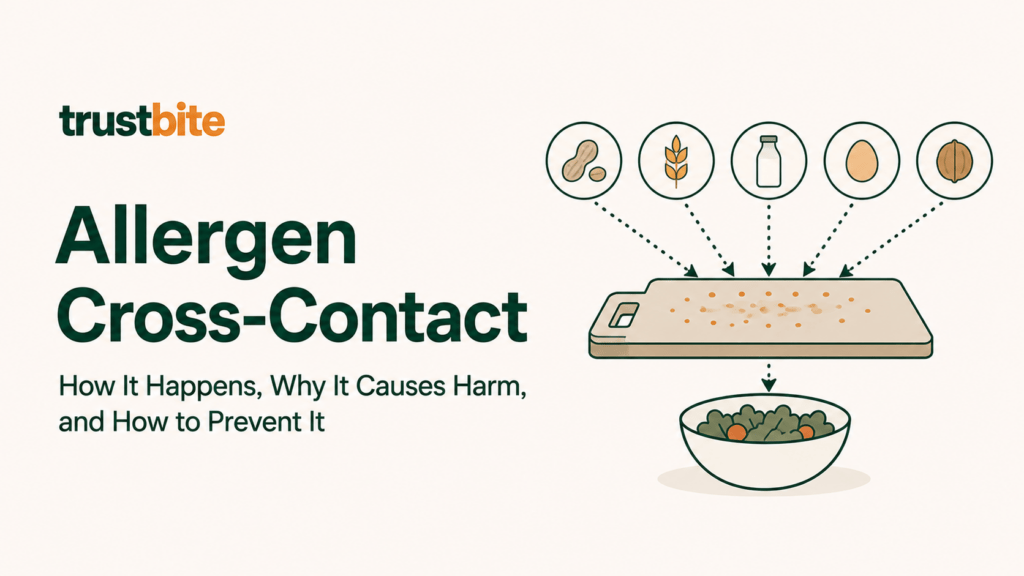
Allergen cross-contact is the unintentional transfer of an allergenic substance from one food or surface to another, resulting in a food that did not intentionally contain the allergen becoming a risk to consumers with allergies or intolerances to that allergen. It is one of the most serious and most preventable food safety failures in the food industry, responsible for a significant proportion of food recalls, food service incident investigations, and in the most serious cases, consumer deaths.
The defining characteristic of allergen cross-contact that makes it uniquely dangerous is that it cannot be reversed by subsequent processing. A product contaminated with an allergen during preparation or production cannot be made safe by cooking, chilling, pasteurisation, or any other standard food treatment. The allergenic proteins that cause immune reactions in sensitised individuals are not denatured by the temperatures and processes used in normal food production and preparation. A consumer with a severe peanut allergy who eats food that has been cross-contaminated with peanut residue during preparation is at the same risk as one who eats food intentionally containing peanut, regardless of what happened to that food after the cross-contact occurred.
What Allergen Cross-Contact Is and How It Differs From Microbial Cross-Contamination
Allergen cross-contact and microbial cross-contamination are both forms of contamination transfer, but they differ fundamentally in their mechanisms, consequences, and control requirements.
Microbial cross-contamination transfers pathogens from one food or surface to another. The food safety risk can often be controlled by a subsequent cooking step that eliminates the transferred pathogen. A cooking CCP with an appropriate critical limit can render a microbiologically cross-contaminated product safe.
Allergen cross-contact transfers allergenic proteins that retain their allergenicity through cooking. There is no CCP that eliminates allergen cross-contact. Once an allergen has been introduced into a product through cross-contact, no subsequent processing step makes that product safe for consumers who are allergic to the transferred allergen. This is why allergen management, and specifically allergen cross-contact prevention, is addressed through prerequisite programs and production controls that prevent the cross-contact from occurring rather than through CCPs that control it after the fact.
How Allergen Cross-Contact Occurs
Allergen cross-contact can occur through several distinct pathways, each of which requires different prevention measures.
Shared equipment is one of the most common pathways. When a piece of equipment, such as a mixing bowl, a blender, a slicing machine, or a baking tray, is used to process a product containing an allergen and then used without adequate cleaning to process an allergen-free product, allergen residue from the first product is transferred to the second. The transfer may involve quantities too small to see or taste, but sufficient to trigger an allergic reaction in a sensitised consumer.
Shared production surfaces follow the same logic. A preparation surface used for products containing nuts, gluten, or any other allergen and then used for allergen-free preparation without validated cleaning in between transfers allergen residue to the allergen-free product.
Hand transfer is a direct and frequently overlooked pathway. A food handler who has handled an allergen-containing ingredient without washing their hands, or whose gloves carry allergen residue, transfers that allergen to every subsequent food they touch. In food service environments, hand transfer is responsible for a significant proportion of allergen incidents because the pace of service creates pressure on handwashing frequency and thoroughness.
Airborne transfer is a less immediately obvious pathway but a real one in certain production environments. Flour dust in a bakery, powdered allergen ingredients in a production facility, and spray or misting processes involving allergen-containing liquids can deposit allergen particles on surfaces and into open food products at a distance from the source.
Rework incorporating allergen-containing product into allergen-free product is a manufacturing-specific pathway where the production efficiency practice of reintroducing off-specification or excess product into the production stream introduces allergen risk when the rework material is not the same allergen profile as the product it is being incorporated into.
Storage proximity can cause allergen cross-contact where allergen-containing and allergen-free products are stored in conditions that allow direct contact, drip contamination, or shared air space leading to dust or particle transfer.
The Scale of Allergen Cross-Contact as a Food Safety Failure
Allergen cross-contact is among the leading causes of food recalls in most markets with robust food safety regulatory systems. The UK Food Standards Agency, the US FDA, and the European Food Safety Authority all consistently identify undeclared allergens, frequently resulting from allergen cross-contact during production or preparation, as one of the primary triggers for product recall actions.
Beyond recalls, allergen cross-contact causes consumer harm that ranges from mild reactions requiring antihistamine treatment through moderate reactions requiring medical attention, to anaphylaxis requiring emergency intervention and in some cases resulting in death. Fatalities from allergic reactions linked to food prepared outside the home are almost always traceable to allergen cross-contact or undeclared allergen rather than intentional inclusion of the allergen in the product.
The human cost of allergen cross-contact is the reason its prevention is treated with the same seriousness as other life-threatening food safety hazards.
Why Cleaning Alone Does Not Always Prevent Allergen Cross-Contact
Standard cleaning and sanitation procedures designed to remove microbial contamination are not necessarily effective at removing allergen proteins to levels low enough to protect severely allergic consumers. This is one of the most important and least understood aspects of allergen cross-contact management.
A surface that has been cleaned to a standard that passes an ATP swab test for microbial hygiene may still carry allergen protein residue at levels sufficient to cause a reaction in a sensitised individual. The protein structures that cause allergic reactions are not organisms that can be killed or their numbers reduced. They are chemical substances that must be physically removed from the surface.
Allergen cleaning validation is the process of confirming that a cleaning procedure actually removes the allergen of concern to a level below the threshold relevant to allergic consumers, using allergen-specific testing rather than general hygiene testing. Until a cleaning procedure has been validated for allergen removal, it cannot be relied upon to prevent allergen cross-contact between production runs.
This validation requirement is why allergen management in food manufacturing goes beyond following general cleaning and sanitation guidelines. A BRCGS or SQF auditor reviewing allergen management will look for evidence that cleaning procedures used between allergen and allergen-free production runs have been validated specifically for the relevant allergens, using test methods appropriate to those allergens.
Preventing Allergen Cross-Contact in Food Production
Preventing allergen cross-contact in food production requires a system of controls across production scheduling, physical separation, equipment management, cleaning and validation, and staff training.
Production scheduling that sequences allergen-free production runs before allergen-containing runs, or that consolidates allergen runs together to minimize changeovers, reduces the frequency of allergen cross-contact risk events. A production schedule that runs allergen-free products first, then allergen-containing products, then conducts a validated allergen clean before returning to allergen-free production, is substantially safer than one that alternates allergen and allergen-free production repeatedly throughout a shift.
Physical separation of allergen-containing and allergen-free production areas, where the scale and layout of the facility permit, eliminates the cross-contact risks associated with shared air space, shared personnel movement, and surface contamination in mixed-use areas. Where separate areas are not achievable, robust temporal separation combined with validated cleaning provides the next level of control.
Dedicated equipment for allergen-free production, clearly identified and stored separately from equipment used in allergen-containing production, eliminates the equipment-sharing pathway for cross-contact where it is implemented. Colour coding of dedicated equipment provides a visual management system that reduces the risk of equipment being used in the wrong context.
Allergen cleaning validation must be conducted for every cleaning procedure used to manage allergen cross-contact, using test methods specific to each allergen being managed. Equipment providers such as Adria Food Tech supply allergen testing and validation equipment including allergen-specific test kits that produce rapid results at the production floor level, allowing cleaning validation to be conducted as part of the changeover process rather than requiring laboratory testing with extended turnaround times.
Preventing Allergen Cross-Contact in Food Service
In food service, allergen cross-contact prevention operates primarily through staff knowledge, kitchen organisation, and communication systems rather than the production scheduling and equipment validation approaches used in manufacturing.
Staff knowledge is the primary control in food service because the pace and unpredictability of service means that controls cannot always be enforced through physical systems alone. A chef who understands that allergen cross-contact cannot be reversed by cooking, knows which dishes contain which allergens, understands how contact transfer through hands and utensils works, and is motivated to take allergen queries seriously will apply appropriate controls during normal service as a matter of professional practice.
Kitchen organisation that designates specific preparation surfaces, utensils, and cooking equipment for allergen-free preparation where this is operationally feasible provides physical controls that support staff knowledge rather than relying on it exclusively. Where a business offers dishes that can be made allergen-free on request, having a clear protocol for how those dishes are prepared, on which surface, with which equipment, by which staff member, using which ingredients, creates a system that is more reliable than ad hoc allergen management decisions made under service pressure.
Communication between front-of-house and kitchen staff about allergen requirements is a critical link in the prevention chain. A consumer who informs a server of a nut allergy, and whose information is accurately communicated to the kitchen, and whose dish is prepared with appropriate care, is protected. A consumer whose allergen information is lost or minimized between the point of disclosure and the point of preparation is not. Training systems for front-of-house staff must specifically address how to take allergen information seriously, communicate it accurately to kitchen staff, and confirm that the kitchen has understood and will manage the allergen requirement. Providers such as Confi Food build allergen management training for both food handlers and front-of-house staff into their food safety programs, covering the communication chain as an explicit training topic alongside the technical content.
Labelling as the Final Allergen Cross-Contact Control
For packaged food products, labelling is the control that allows consumers to make informed decisions even when allergen cross-contact cannot be entirely eliminated. A “may contain” advisory statement communicates to allergic consumers that a product was produced in an environment where the stated allergen is present and that despite control measures, cross-contact cannot be guaranteed to be absent.
The decision to apply a “may contain” statement requires honesty about the actual allergen cross-contact risk in the production environment based on the specific control measures in place. A business that applies “may contain nut” statements to every product regardless of whether nuts are handled in the facility is using precautionary labelling as a substitute for allergen management rather than as a communication tool for residual risk that genuine control measures cannot eliminate. This practice reduces the utility of precautionary labelling for consumers who rely on it to navigate an already complex allergen information landscape.
Conclusion
Allergen cross-contact is a food safety failure that cannot be corrected after it occurs. Once an allergen has transferred to a food that should not contain it, no subsequent processing removes the risk to allergic consumers. Prevention is the only effective control, operating through production scheduling, physical separation, dedicated equipment, validated cleaning, and trained staff who understand both the mechanism and the irreversibility of allergen cross-contact. For food businesses of all types, the investment in robust allergen cross-contact prevention is an investment in the safety of their most vulnerable consumers.
Frequently Asked Questions
What is allergen cross-contact?
Allergen cross-contact is the unintentional transfer of an allergenic substance from one food or surface to another, resulting in a food that did not intentionally contain the allergen posing a risk to consumers who are allergic or intolerant to that allergen.
Why can allergen cross-contact not be reversed by cooking?
Allergenic proteins are not denatured by standard cooking temperatures in a way that removes their ability to trigger allergic reactions. A product contaminated with an allergen remains a risk to allergic consumers regardless of how it is subsequently cooked, chilled, or processed.
How does allergen cross-contact differ from microbial cross-contamination?
Microbial cross-contamination transfers pathogens that can often be eliminated by a subsequent cooking step. Allergen cross-contact transfers proteins that retain their allergenicity through cooking. There is no CCP equivalent for allergen control: prevention is the only available strategy.
What are the most common pathways through which allergen cross-contact occurs?
The most common pathways are shared equipment used without validated allergen cleaning between runs, shared preparation surfaces, hand transfer by food handlers who have handled allergen-containing ingredients, airborne transfer of allergen dusts or particles, rework incorporation in manufacturing, and storage proximity between allergen-containing and allergen-free products.
Why is allergen cleaning validation separate from standard hygiene cleaning verification?
Standard hygiene cleaning is designed to remove microbial contamination and is verified using ATP swab testing. ATP testing does not detect allergen proteins. Allergen cleaning validation requires allergen-specific testing methods to confirm that allergen residues have been reduced to levels below relevant thresholds.
How is allergen cross-contact prevented in food production?
Through production scheduling that sequences allergen-free before allergen-containing runs, physical separation of allergen and allergen-free production where possible, dedicated allergen-free equipment, validated allergen cleaning procedures between changeovers, and staff training covering allergen cross-contact pathways and prevention measures.
How is allergen cross-contact prevented in food service?
Through staff knowledge of which dishes contain which allergens, kitchen organisation that designates allergen-free preparation equipment and surfaces, clear communication protocols between front-of-house and kitchen staff for allergen information, and training that establishes allergen queries as serious food safety events rather than routine service requests.
What is a “may contain” advisory statement?
A “may contain” advisory statement on a food label communicates to allergic consumers that the product was produced in an environment where the stated allergen is handled and that allergen cross-contact cannot be guaranteed absent despite control measures. It should reflect genuine residual risk after real controls are in place, not substitute for managing allergen cross-contact.
What are the most frequent causes of allergen cross-contact incidents in food service?
The most frequent causes are inadequate handwashing after handling allergen-containing ingredients, use of shared utensils or surfaces without cleaning between allergen and allergen-free preparation, and communication failures between front-of-house and kitchen staff that result in allergen requirements not being acted on in the kitchen.
Is allergen cross-contact a common cause of food recalls?
Yes. Undeclared allergens resulting from allergen cross-contact or labelling failures are consistently among the most frequent recall triggers across most food regulatory markets with active recall monitoring systems.
Can a “may contain” statement replace allergen management controls?
No. Precautionary labelling communicates residual risk that genuine control measures cannot eliminate. Using “may contain” statements as a substitute for allergen management allows preventable cross-contact to occur and limits the utility of precautionary labelling for consumers who need it to navigate genuine residual risk.
What testing is used to verify allergen cleaning between production runs?
Allergen-specific test kits, including lateral flow devices and enzyme-linked immunosorbent assay methods, detect residual allergen protein on surfaces at the relevant sensitivity level. These tests are specific to particular allergens and must be selected to match the allergen being managed.
How should a food business respond when an allergen cross-contact incident is suspected?
The potentially affected product should be isolated immediately. The scope of the cross-contact should be assessed to determine which batches or dishes may be affected. If product has already been distributed or served, the business must assess whether a recall or notification is required. The root cause should be investigated and corrective actions implemented before production or service continues.
What training do staff need specifically about allergen cross-contact?
Staff must understand what allergen cross-contact is, the specific pathways through which it occurs in their working environment, why it cannot be corrected by cooking, the cleaning and segregation controls that prevent it, and the escalation procedure to follow when they believe an allergen cross-contact event may have occurred.
Related from the Knowledge Center
Allergen Management in Food Businesses: A Practical Guide
The complete guide to allergen management covering the full system of controls from ingredient specification through storage, production, cleaning validation, labelling, and consumer communication.
Cross-Contamination in Food Safety: Causes, Examples, and How to Prevent It
Allergen cross-contact is a specific category of cross-contamination with unique prevention requirements. This article covers the broader contamination transfer pathways including microbial cross-contamination.
Allergen Training for Food Handlers: What It Must Cover and Why It Matters
Staff knowledge is the primary prevention control in food service allergen management. This article explains what allergen training for food handlers must cover and how to deliver it effectively.