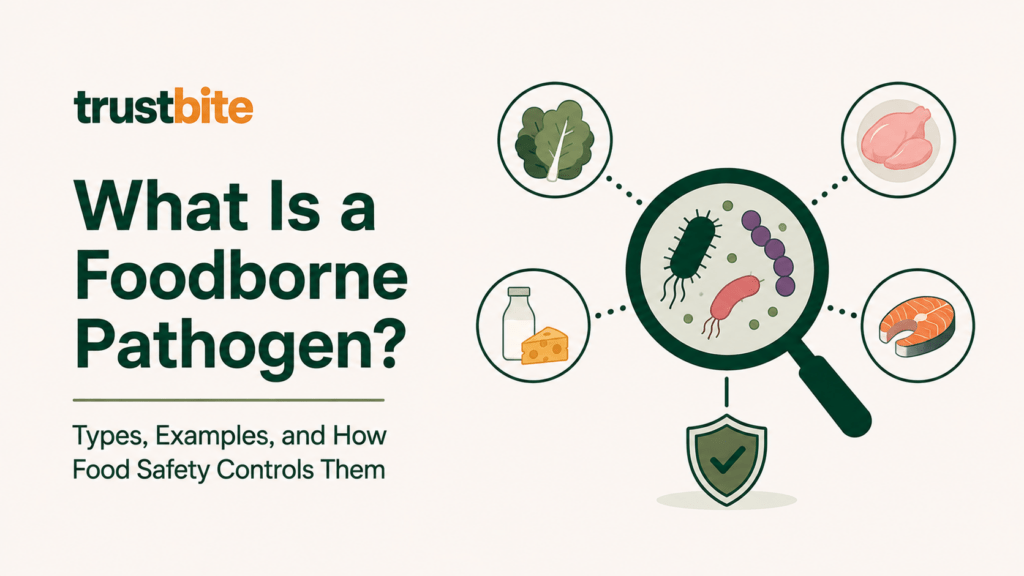
A foodborne pathogen is a biological agent, typically a bacterium, virus, or parasite, that is present in food and causes illness in humans when the food containing it is consumed. Foodborne pathogens are the primary biological hazard that most food safety controls are designed to prevent, reduce, or eliminate, and understanding what they are, how they behave, and what conditions allow them to cause harm is foundational knowledge for anyone working in food safety.
The term pathogen distinguishes organisms that cause illness from the much larger category of microorganisms that are simply present in food without causing harm, or that cause food spoilage without causing human illness. A food that smells bad or has visibly deteriorated may have been affected by spoilage organisms rather than pathogens. A food that looks, smells, and tastes normal may carry a foodborne pathogen load sufficient to cause serious illness. This disconnect between apparent food quality and food safety is why temperature control, cooking, and hygiene controls are structured as preventive systems rather than relying on sensory inspection to identify unsafe food.
How Foodborne Pathogens Cause Illness
Foodborne pathogens cause illness through two distinct mechanisms that have different implications for food safety control.
Infection occurs when a living pathogen is consumed and colonises the human gastrointestinal tract, multiplying and causing illness through the direct effects of the pathogen on the gut lining or through the immune response it triggers. Foodborne infections typically have an incubation period of hours to days between consumption of the contaminated food and the onset of symptoms, which means the food responsible for the illness has often been fully consumed and disposed of before the affected person makes the connection between their symptoms and a specific meal.
Intoxication occurs when a pathogen has produced toxins in food during growth, and those toxins are consumed along with or independently of the organisms that produced them. Some toxins are heat-stable, meaning that the toxin remains dangerous even if the food is subsequently cooked to a temperature that kills the bacteria that produced it. Staphylococcus aureus and Bacillus cereus are examples of organisms that produce heat-stable toxins, which is why temperature abuse allowing these organisms to grow in food creates a risk that cannot be eliminated by reheating.
Toxin-mediated infection is a hybrid mechanism where a pathogen is consumed, colonises the gut, and then produces toxins within the body. Clostridium perfringens operates primarily through this mechanism.
The Major Foodborne Pathogen Categories
Foodborne pathogens fall into three broad biological categories, each with distinct characteristics that affect how they are controlled.
Bacterial foodborne pathogens are the largest and most diverse category and include the organisms responsible for the majority of foodborne illness cases globally. They share the characteristic of being capable of multiplying in food given appropriate temperature, moisture, and nutrient conditions, which is why temperature control is such a central food safety control.
Viral foodborne pathogens do not multiply in food but can be present at infectious levels following contamination from an infected person or contaminated water. They are characterised by very low infectious doses, meaning that very small quantities of viral particles can cause illness, making personal hygiene and handwashing the primary control rather than temperature management.
Parasitic foodborne pathogens are less common than bacteria and viruses in most high-income markets but remain significant in certain food categories and geographic contexts. They typically require an intermediate host or specific environmental conditions for their lifecycle and are controlled primarily through cooking temperatures, source control, and in some cases freezing.
Key Bacterial Foodborne Pathogens and Their Food Safety Implications
Several bacterial foodborne pathogens appear with high frequency across food safety investigations, regulatory guidance, and HACCP hazard analyses, and understanding their specific characteristics helps explain why the food safety controls targeting them are designed as they are.
Salmonella is one of the most widely recognised bacterial foodborne pathogens, responsible for a substantial proportion of reported foodborne illness cases globally. It is associated primarily with raw poultry, eggs, raw meat, and in some cases fresh produce. Salmonella is controlled by adequate cooking, prevention of cross-contamination from raw to ready to eat food, and personal hygiene. It does not form spores and is killed at standard cooking temperatures, making the cooking CCP an effective control when correctly implemented.
Campylobacter is the most frequently reported bacterial foodborne pathogen in the UK and several other European markets. It is strongly associated with raw and undercooked poultry and is extremely sensitive to the environmental stresses that food safety controls apply. It is controlled by cooking poultry to the minimum safe internal temperature and preventing cross-contamination from raw poultry during preparation.
Listeria monocytogenes has characteristics that make it particularly difficult to control through standard temperature management alone. It is one of the very few foodborne pathogens capable of slow but continuous growth at refrigeration temperatures, meaning that products held under correct cold chain conditions can still accumulate Listeria loads over extended storage periods. It is found in ready to eat products including cold deli meats, soft cheeses, smoked fish, and pre-packaged salads. It is particularly dangerous for pregnant women, elderly people, and immunocompromised individuals, in whom it can cause severe illness and death. Food safety controls for Listeria in ready to eat product categories extend beyond cooking to environmental monitoring programs that detect Listeria in the production environment, cold chain controls that maintain temperatures that minimise growth rate, and shelf life management that prevents extended storage from allowing significant Listeria multiplication.
E. coli O157:H7 and other Shiga toxin-producing E. coli are associated with undercooked ground or minced beef, raw milk, and contaminated fresh produce. They are notable for their very low infectious dose: small numbers of organisms are sufficient to cause illness, including the serious complication of haemolytic uraemic syndrome in young children, which can cause kidney failure. They are controlled by adequate cooking of minced meat products and by preventing cross-contamination in food preparation environments.
Clostridium perfringens is associated with large-batch cooked foods, particularly meat and poultry dishes, that are held at inadequate temperatures after cooking. It forms heat-resistant spores that survive cooking, then germinate and multiply rapidly if cooked food is allowed to cool slowly or is held at temperatures within the danger zone. Temperature control of cooked food, including rapid cooling and adequate hot holding temperatures, is the primary control.
Staphylococcus aureus produces the heat-stable enterotoxins responsible for a common form of food poisoning characterised by rapid-onset vomiting. It is associated with foods handled extensively after cooking, including prepared salads, sandwiches, and cold meat dishes, where contamination from food handlers provides the initial inoculum and inadequate refrigeration allows multiplication and toxin production. Personal hygiene and temperature control of ready to eat products after preparation are the primary controls.
Bacillus cereus is found in soil and is commonly associated with rice, cereals, and starchy foods. It forms heat-resistant spores that survive cooking. If cooked rice or other starchy foods are stored at room temperature or inadequately chilled, spore germination and toxin production can occur rapidly. The emetic form of B. cereus illness is caused by a heat-stable toxin and rapid-onset symptoms are often attributed to other causes rather than correctly identified. Temperature control of cooked starchy foods is the primary preventive control.
Key Viral Foodborne Pathogens
Norovirus is the most common cause of foodborne illness outbreaks in many markets, responsible for a significant proportion of gastroenteritis outbreaks in food service settings. It is characterised by a very low infectious dose, high environmental stability, and transmission through contaminated food, water, and person-to-person contact. Unlike bacterial pathogens, Norovirus does not multiply in food. The control is primarily personal hygiene, particularly handwashing by food handlers, exclusion of symptomatic food handlers from food handling work, and effective cleaning and disinfection of contaminated surfaces with appropriate products. Standard ATP swab testing does not detect Norovirus.
Hepatitis A virus is transmitted through contaminated water and food handled by infected persons before symptoms develop. It is associated with raw shellfish harvested from contaminated waters and with food contaminated during preparation by infected handlers. Control measures include sourcing shellfish from approved, monitored harvesting areas and rigorous personal hygiene including effective handwashing.
Key Parasitic Foodborne Pathogens
Trichinella spiralis is a parasitic roundworm historically associated with undercooked pork and game meat. Adequate cooking to the minimum safe internal temperature is effective in killing Trichinella. Modern intensive pork production has substantially reduced Trichinella prevalence in commercially produced pork in most markets, but the parasite remains relevant for wild game consumption and in some geographic regions.
Cryptosporidium and Giardia are waterborne parasites that can contaminate fresh produce irrigated with contaminated water or washed in contaminated water supplies. They are associated with produce-linked outbreaks and are controlled through produce washing protocols using potable water and through the source water quality management programs of produce suppliers.
How Food Safety Systems Control Foodborne Pathogens
The food safety controls that HACCP systems identify and manage are designed to address the specific characteristics of the foodborne pathogens relevant to the products and processes being assessed.
Cooking CCPs address bacterial pathogens that are present in raw ingredients and must be killed before the product is safe for consumption. The minimum cooking temperature critical limit is set at the level scientifically demonstrated to kill the relevant pathogen load in the specific product.
Temperature control through cold chain management and hot holding addresses pathogens that multiply in food at temperatures within the danger zone. Keeping food below 5°C or above 63°C limits multiplication to rates that do not produce dangerous loads within the intended storage or holding period.
Personal hygiene controls address pathogen transfer from food handlers, which is particularly relevant for viruses like Norovirus that can be present in the gastrointestinal tract of an infected but asymptomatic food handler and transferred to food through hand contact.
Environmental monitoring programs in ready to eat food production environments detect the presence of Listeria and other environmental pathogens that can contaminate products after cooking and before packaging, where no further kill step is available.
Training staff to understand which foodborne pathogens are relevant to their specific working environment, how those pathogens behave, and what the controls preventing them are designed to achieve produces food handlers who apply controls with genuine understanding rather than procedural compliance alone. Providers such as Confi Food build foodborne pathogen awareness into their food safety training programs at a level appropriate for food handlers and supervisors, explaining what pathogens do and why the controls targeting them are structured as they are.
Monitoring equipment that maintains continuous objective records of temperature, which is the condition most directly linked to pathogen growth rates across most categories of foodborne bacteria, provides the verifiable evidence that temperature controls are functioning as intended across the full operational period. Equipment providers such as Adria Food Tech supply the temperature monitoring and cold chain management systems that generate this continuous evidence, supporting both the HACCP monitoring function and the verification activities that confirm the food safety system is controlling pathogen risks effectively.
Conclusion
A foodborne pathogen is a biological agent present in food that causes illness through infection, intoxication, or toxin-mediated infection when consumed. The major foodborne pathogens include bacteria such as Salmonella, Campylobacter, Listeria, and E. coli, viruses such as Norovirus, and in some contexts parasites. Each has specific characteristics that determine how it is best controlled, and understanding these characteristics is the foundation for designing food safety controls that address the actual pathogens present in specific products and processes rather than applying generic measures without understanding what they are controlling or why.
Frequently Asked Questions
What is a foodborne pathogen?
A foodborne pathogen is a biological agent, typically a bacterium, virus, or parasite, that is present in food and causes illness in humans when the contaminated food is consumed.
How does a foodborne pathogen differ from a food spoilage organism?
A food spoilage organism causes visible or sensory deterioration in food without necessarily causing human illness. A foodborne pathogen may be present in food at dangerous levels without producing any visible, olfactory, or taste changes, making sensory inspection an unreliable safety control.
What are the two main mechanisms through which foodborne pathogens cause illness?
Infection occurs when a living pathogen is consumed and causes illness by colonising the gastrointestinal tract. Intoxication occurs when toxins produced by a pathogen in food are consumed and cause illness, even if the pathogen itself is no longer viable. Some pathogens cause illness through a combination of both mechanisms.
Why are heat-stable toxins particularly dangerous?
Heat-stable toxins remain dangerous even after the food has been cooked to temperatures that kill the bacteria that produced them. This means temperature abuse that allowed toxin production cannot be corrected by subsequent reheating.
What foodborne pathogens are most associated with raw poultry?
Campylobacter and Salmonella are the primary pathogen concerns in raw poultry. Adequate cooking to the minimum safe internal temperature and prevention of cross-contamination from raw poultry during preparation are the primary controls.
Why is Listeria monocytogenes particularly challenging to control?
Listeria can grow slowly but continuously at refrigeration temperatures, meaning that adequate cold chain management slows rather than stops its growth in susceptible products. It is particularly dangerous for pregnant women, elderly people, and immunocompromised individuals. Control in ready to eat products extends to environmental monitoring and shelf life management alongside temperature control.
What is the infectious dose of a foodborne pathogen?
The infectious dose is the minimum quantity of a pathogen required to cause illness in a susceptible individual. Some pathogens such as E. coli O157:H7 and Norovirus have very low infectious doses, meaning that small quantities can cause illness. Others require higher levels to cause illness in most individuals.
Why does Norovirus require different controls than bacterial foodborne pathogens?
Norovirus does not multiply in food, so temperature control does not reduce the risk in the same way it does for bacterial pathogens. Control relies primarily on personal hygiene, exclusion of symptomatic food handlers, and effective environmental disinfection with products active against Norovirus.
What is a heat-resistant spore in food safety terms?
Certain bacteria including Clostridium and Bacillus species can form dormant spore structures that survive cooking temperatures that kill vegetative bacterial cells. After cooking, these spores can germinate and the bacteria can multiply if food is held at inappropriate temperatures. Temperature control of cooked food is the primary control for spore-forming pathogens.
How does HACCP identify and address foodborne pathogens?
In the hazard analysis stage of HACCP, biological hazards including relevant foodborne pathogens are identified at each process step and assessed for significance. Where a pathogen represents a significant hazard at a specific step, that step may be designated a CCP with a critical limit, monitoring procedure, and corrective action designed to control the pathogen risk.
Can foodborne pathogens be detected in food by smell or appearance?
Most foodborne pathogens cannot be reliably detected by sensory inspection. Food carrying dangerous pathogen loads typically looks, smells, and tastes normal. This is why temperature control, cooking, and hygiene controls are structured as preventive systems rather than relying on sensory assessment to identify unsafe food.
What is environmental monitoring and which pathogens is it used for?
Environmental monitoring is a verification program that regularly tests food production environments, particularly ready to eat food manufacturing facilities, for the presence of specific pathogens that can contaminate products from the production environment. Listeria monocytogenes is the pathogen most commonly targeted by environmental monitoring programs in chilled ready to eat food facilities.
What personal hygiene practices prevent foodborne pathogen transfer?
Thorough handwashing with soap and water at all required occasions is the most important personal hygiene control for preventing foodborne pathogen transfer from food handlers to food. Illness reporting and exclusion of symptomatic staff from food handling is equally critical, particularly for viral pathogens like Norovirus that can be shed in high quantities before symptoms are fully apparent.
How do training programs address foodborne pathogen awareness?
Effective food safety training for food handlers explains which pathogens are relevant to the products and processes they work with, how those pathogens behave, what conditions allow them to multiply or survive, and why the specific controls in place, cooking temperatures, refrigeration, handwashing, are designed to address the pathogen risks they work with.
Related from the Knowledge Center
The Food Safety Danger Zone: What It Is and Why Temperature Control Matters
The danger zone is the temperature range in which most bacterial foodborne pathogens multiply most rapidly. This article explains why temperature control is one of the most fundamental tools for managing pathogen growth in food.
Cross-Contamination in Food Safety: Causes, Examples, and How to Prevent It
Foodborne pathogen transfer through cross-contamination between raw and ready to eat products is one of the most common food safety failure modes. This article explains how it occurs and how food businesses prevent it.
What Is HACCP? A Beginner’s Guide to Food Safety and Risk Prevention
HACCP is the system designed specifically to identify and control foodborne pathogen risks at the points in a food process where control is most critical. This article explains how the system works and why it is the basis of modern food safety management.