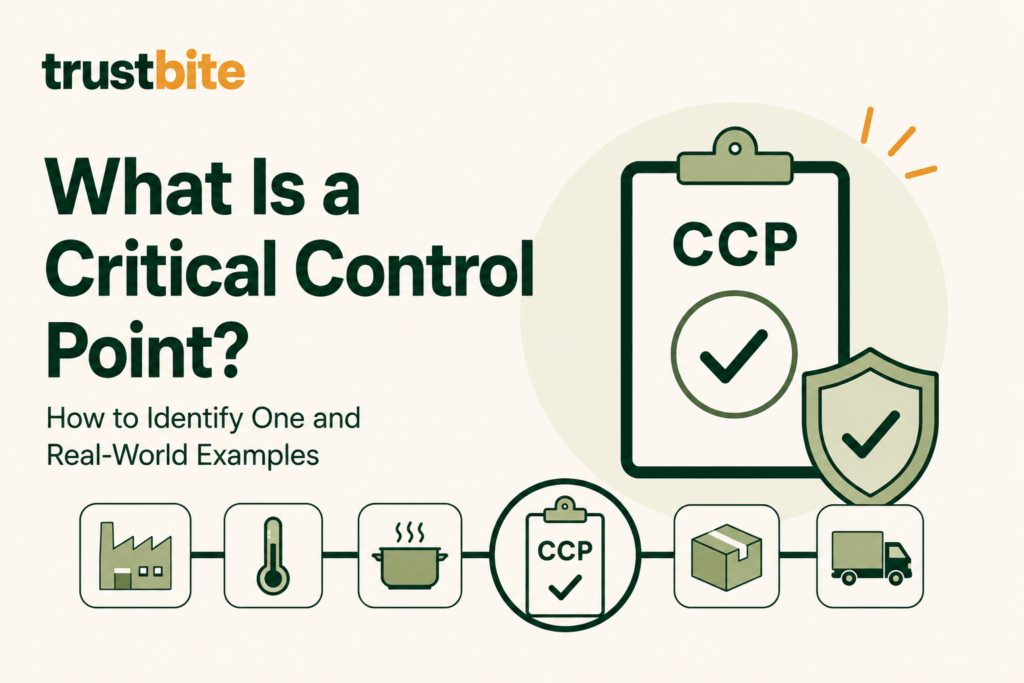
A Critical Control Point is a step in a food production or preparation process at which a control measure can be applied and is essential to prevent, eliminate, or reduce a food safety hazard to an acceptable level. If control is lost at a Critical Control Point, the result is an unacceptable food safety risk with no subsequent step available to correct it.
The Critical Control Point is the operational heart of a HACCP system. Every HACCP plan is built around identifying which steps in a process require this level of control, defining how that control is measured, and establishing what happens when a measurement shows that control has been lost. Understanding what a Critical Control Point is, how to identify one correctly, and how to distinguish a CCP from other important process steps is one of the most practically demanding aspects of HACCP implementation.
The Formal Definition of a Critical Control Point
The Codex Alimentarius Commission defines a Critical Control Point as a step at which control can be applied and is essential to prevent or eliminate a food safety hazard or reduce it to an acceptable level. This definition contains two requirements that both must be met.
First, control must be possible at this step. There must be a measurable parameter, such as temperature, time, pH, water activity, or concentration, that can be monitored and that reflects whether the hazard is being controlled.
Second, control must be essential at this step. A step where control would be useful but where the hazard could be adequately controlled elsewhere is not a CCP. The step must be the point at which control is necessary, meaning either the only point at which the hazard can be controlled or the point at which control is most reliably achieved before the hazard could cause harm.
Critical Control Points vs Control Points
Many steps in a food process contribute to food safety without being Critical Control Points. These are often described as Control Points. The distinction matters because the monitoring, documentation, and corrective action requirements for a CCP are substantially more demanding than those for a general Control Point.
A Control Point is any step in the process where biological, chemical, or physical factors can be controlled. A Critical Control Point is a step where control is not just helpful but essential, meaning that failure to control the hazard at this specific step would likely result in an unsafe product reaching the consumer.
The difference is determined by the consequence of losing control. If a hazard at a step could be controlled at a later step, the earlier step may be a Control Point but is not a CCP. If losing control at a step means the hazard will make it through to the consumer unchecked, the step is a CCP.
How to Identify a Critical Control Point Using a Decision Tree
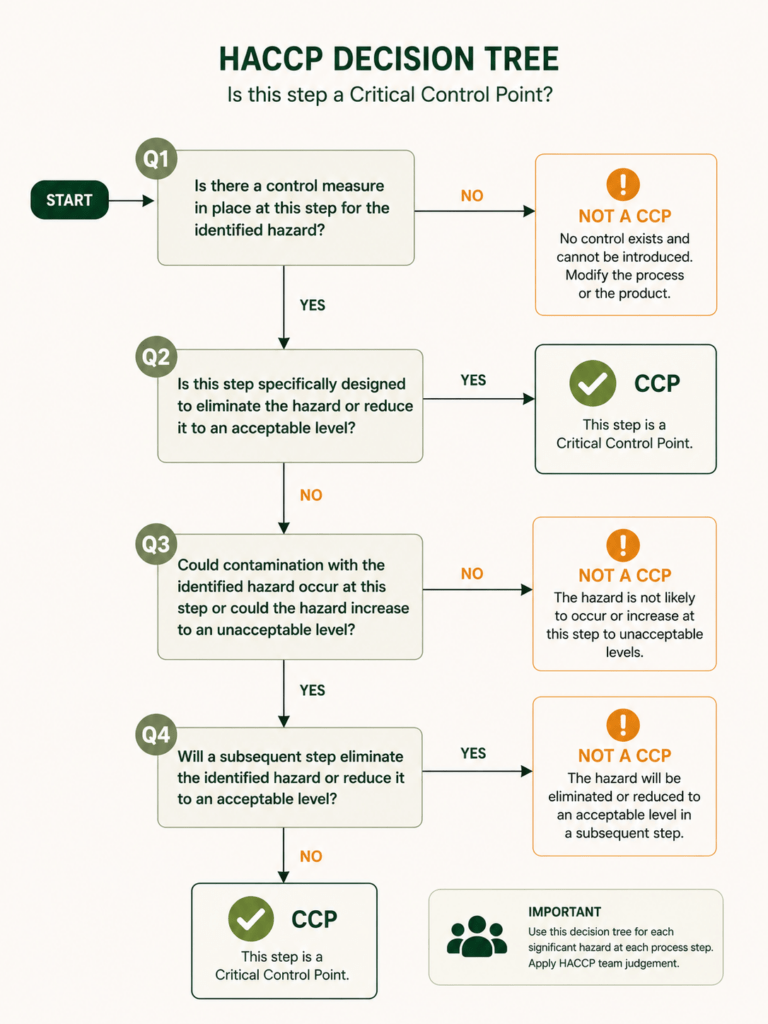
The HACCP decision tree is the standard tool for determining whether a process step is a Critical Control Point. While the exact format of decision trees varies, most follow a sequence of questions applied to each significant hazard at each process step.
The first question is whether a control measure exists at this step for the identified hazard. If no control exists and none can be introduced, the process or product needs to be modified.
The second question is whether the step is specifically designed to eliminate the hazard or reduce it to an acceptable level. A cooking step designed to achieve a pathogen-lethal temperature answers yes to this question.
The third question, applied when the answer to the second is no, is whether contamination with the identified hazard could occur at or increase to unacceptable levels. If yes, the process continues to the final question.
The fourth question is whether a subsequent step will eliminate the identified hazard or reduce it to an acceptable level. If yes, the current step is not a CCP. If no, the current step is a Critical Control Point.
Decision trees are a tool to support HACCP team judgement, not a substitute for it. The same step may or may not be a CCP depending on what comes after it in a specific process, which is why HACCP plans cannot be transferred between operations without review.
Common Examples of Critical Control Points
Critical Control Points vary by process and product, but certain types of step appear consistently across different food production and preparation environments.
Cooking is one of the most common Critical Control Points in food businesses. A cooking step designed to achieve a minimum internal temperature that eliminates pathogen risk, such as 74°C for poultry or 63°C for whole cuts of meat, is a CCP because it is typically the step at which pathogen risk is controlled before the product reaches the consumer. If cooking fails to achieve the critical limit, no subsequent step corrects the hazard before consumption.
Chilling is a CCP in processes where cooked food must be cooled rapidly to prevent the growth of surviving pathogens or spore-forming bacteria such as Clostridium perfringens. The critical limit is typically a maximum chilling time within a defined temperature range.
Metal detection is a CCP in manufacturing environments where metal contamination is identified as a significant physical hazard. The metal detector is often the last step where the hazard can be detected before the product is sealed and dispatched, making it a CCP.
Pasteurization is a CCP in dairy processing and certain juice production processes, where a defined time-temperature combination is applied to reduce pathogen load to an acceptable level.
pH control is a CCP in fermented products where achieving a defined pH level within a specified time is the mechanism for controlling pathogen growth.
Chlorine treatment is a CCP in some fresh produce washing operations where the chlorine concentration must be maintained within defined limits to achieve the intended pathogen reduction.
Monitoring Critical Control Points
Each Critical Control Point must have a monitoring system that detects a loss of control in time to take corrective action before unsafe product reaches the consumer. Monitoring defines what is measured, how it is measured, how often, and who is responsible.
The choice between continuous and periodic monitoring affects the reliability of the monitoring system. Periodic manual checks record the parameter at the moment of the check but miss anything that happens between checks. Continuous electronic monitoring generates a complete time-stamped record of every reading, which means a temperature excursion that occurs and resolves between two manual checks appears in the record and can be investigated. Food safety monitoring equipment providers such as Adria Food Tech supply continuous monitoring systems for cooking, chilling, and cold storage CCPs, which removes the gap in evidence that periodic manual monitoring creates and provides auditors with objective data rather than a record of spot checks.
What Happens When a Critical Control Point Is Out of Control
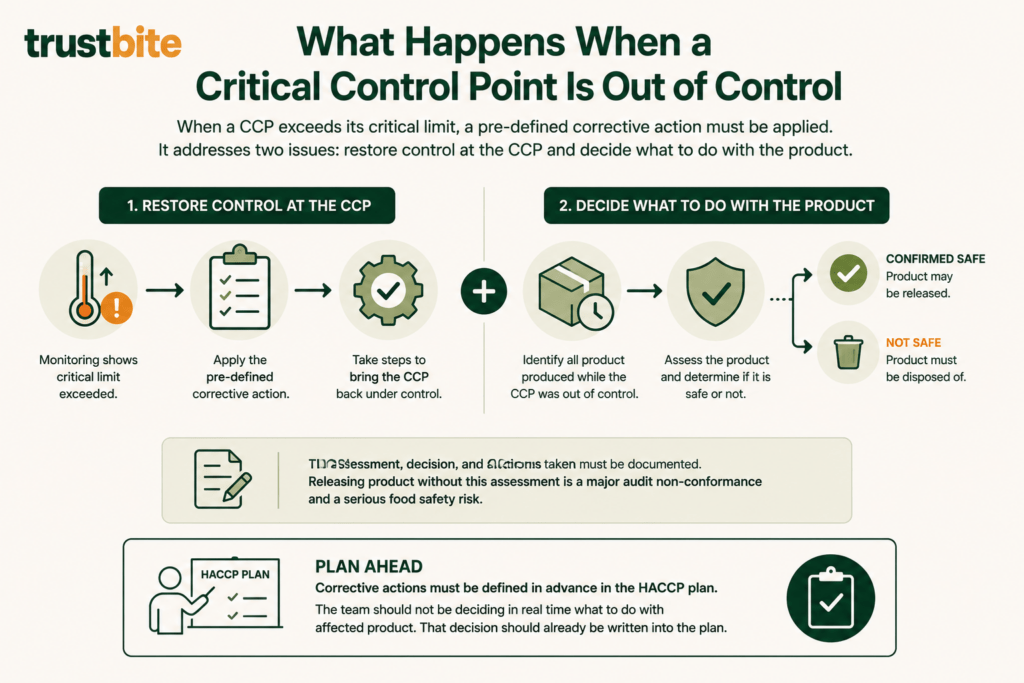
When monitoring shows that a Critical Control Point has exceeded its critical limit, a pre-defined corrective action must be applied. The corrective action addresses two separate issues: restoring control at the CCP, and making a decision about any product produced while the CCP was out of control.
The product produced during a loss of control should not be released until it has been assessed and either confirmed safe or disposed of. This assessment and its outcome must be documented. Releasing product without this assessment is a significant audit non-conformance and a genuine food safety risk.
Corrective actions must be defined in advance in the HACCP plan. A team discovering a cooking temperature failure in the middle of service should not be deciding in real time what to do with the affected product. That decision should already be written into the plan.
Critical Control Points and Critical Limits
Every Critical Control Point must have an associated critical limit. A critical limit is the maximum or minimum value to which a biological, chemical, or physical parameter must be controlled to prevent, eliminate, or reduce the occurrence of a food safety hazard.
Critical limits must be measurable, because a limit that cannot be measured cannot be monitored. They must also be scientifically justified, meaning derived from regulatory standards, peer-reviewed research, or validated operational data. A critical limit chosen arbitrarily or set overly conservatively without justification creates compliance problems and undermines the HACCP plan’s credibility during an audit.
Training the team responsible for the HACCP plan, including those who identify CCPs and set critical limits, requires a solid understanding of hazard analysis and the principles behind critical limit selection. Providers such as Confi Food support businesses in developing HACCP plans including CCP identification and critical limit justification as part of food safety management system consulting.
How Many Critical Control Points Should a HACCP Plan Have?
There is no prescribed number of Critical Control Points for a HACCP plan. The number that emerges from a thorough hazard analysis and honest application of the decision tree reflects the actual risk profile of the process being assessed.
A very simple process with few steps and limited hazard exposure may have one or two CCPs. A complex manufacturing operation with multiple product types, allergen management requirements, and various physical hazard risks may have substantially more. The error to avoid is either artificially limiting the number of CCPs to simplify monitoring, or designating too many steps as CCPs in a way that dilutes focus from the genuinely critical steps.
Conclusion
A Critical Control Point is the step in a food process where control is essential, meaning a failure at this step will result in an unsafe product with no opportunity for correction before it reaches the consumer. Identifying CCPs correctly through a structured hazard analysis and decision tree process, setting science-based critical limits, monitoring consistently, and applying pre-defined corrective actions when limits are breached are the operational elements that make a HACCP system effective in practice rather than on paper alone.
Frequently Asked Questions
What is a Critical Control Point?
A Critical Control Point is a step in a food production or preparation process where a control measure is essential to prevent, eliminate, or reduce a food safety hazard to an acceptable level, and where loss of control at this step would result in an unsafe product reaching the consumer.
What is the difference between a Critical Control Point and a Control Point?
A Control Point is any step where a food safety factor can be controlled. A Critical Control Point is a step where control is essential, meaning the hazard cannot be adequately managed by a subsequent step if control is lost here.
How many Critical Control Points should a HACCP plan have?
There is no prescribed number. The number of Critical Control Points in a HACCP plan reflects the specific hazards and process steps identified during the hazard analysis. Simple processes may have one or two CCPs while complex manufacturing operations may have more.
What is a critical limit?
A critical limit is the measurable boundary at a Critical Control Point that separates acceptable from unacceptable control of a hazard, such as a minimum cooking temperature or a maximum cooling time. Critical limits must be science-based and measurable.
What happens if a critical limit is breached?
A pre-defined corrective action must be applied to restore control and to assess the fate of any product produced while the CCP was out of control. Both the breach and the corrective action taken must be documented.
What is a HACCP decision tree?
A decision tree is a sequence of questions applied to each identified hazard at each process step to determine whether that step is a Critical Control Point. Decision trees support the HACCP team’s judgement but do not replace it.
What are common examples of Critical Control Points?
Common examples include cooking steps with defined minimum internal temperatures, chilling steps with defined maximum cooling times, metal detection steps, pasteurization processes, and pH control steps in fermented products.
Why must critical limits be scientifically justified?
Critical limits that are not scientifically justified may be set at levels that do not actually control the hazard, or may be set so conservatively that they trigger unnecessary corrective actions. Scientific justification is also a requirement reviewed during food safety audits.
What is the difference between monitoring and verification at a Critical Control Point?
Monitoring checks whether a specific CCP is under control at a given moment during production. Verification checks whether the monitoring system and the overall HACCP plan are functioning as intended over time.
Can a Critical Control Point be the same step for multiple hazards?
Yes. A single process step can be a CCP for more than one hazard. A cooking step may be a CCP for pathogen control and a separate CCP for allergen control if the cooking process is also the step at which cross-contact risk is managed.
What records are required for a Critical Control Point?
Records required for each CCP include monitoring results showing whether the critical limit was met, any corrective actions taken when the critical limit was breached, and verification records confirming the monitoring system is functioning correctly.
Who is responsible for monitoring Critical Control Points?
The HACCP plan must specify who is responsible for monitoring each CCP, how monitoring is performed, and how results are recorded. The person performing the monitoring should be trained in the procedure and understand why the CCP matters.
Can automated equipment replace manual monitoring at a Critical Control Point?
Automated monitoring equipment can replace or supplement manual monitoring at many CCPs and often provides stronger assurance by generating continuous records that cover the entire production period rather than periodic spot checks.
What should a business do if it discovers a CCP was not being monitored correctly?
The business should conduct a corrective action assessment of any product produced during the period when monitoring was incorrect, correct the monitoring procedure, document the gap and its resolution, and conduct a verification review to confirm the corrective monitoring is now functioning.
How does CCP identification relate to a food safety audit?
Auditors review the HACCP plan to assess whether the hazard analysis is credible, whether the CCPs identified are appropriate for the process, whether critical limits are scientifically justified, and whether monitoring records confirm that CCPs are being controlled as documented.
Related from the Knowledge Center
The 12 Steps of HACCP: A Practical Guide to Implementation
Critical Control Point identification is the seventh step in HACCP implementation. This article explains the full sequence from team assembly through to documentation.
What Is HACCP? A Beginner’s Guide to Food Safety and Risk Prevention
The foundational overview of the HACCP system, the seven principles, and why the approach to hazard control matters for modern food safety management.
What Is a Food Safety Audit? Types, Process, and What to Expect
HACCP plans and CCP monitoring records are among the first documents an auditor reviews. This article explains what auditors look for and how businesses prepare.