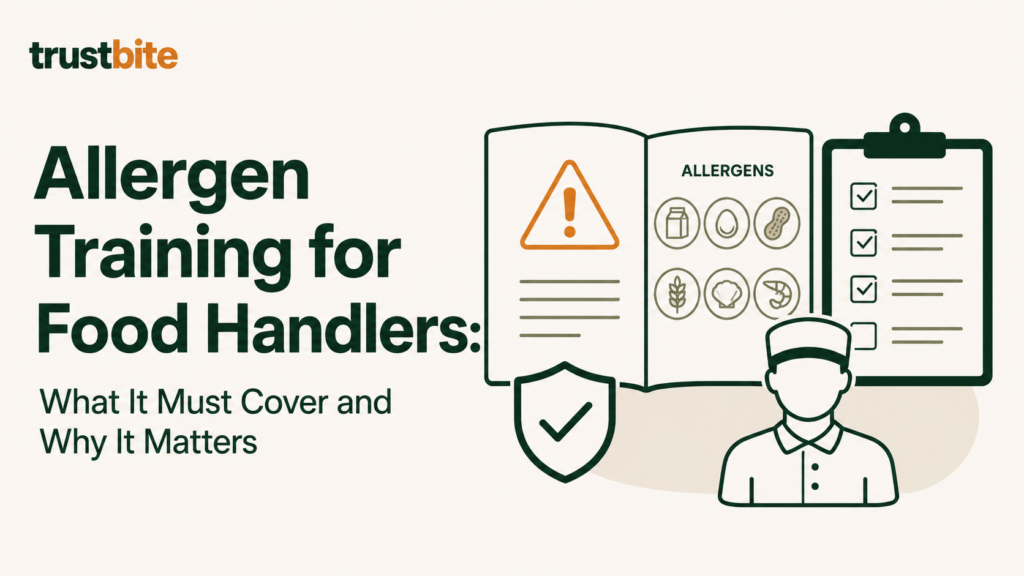
Allergen training for food handlers is the structured education that teaches staff who handle or prepare food how to manage allergens safely, prevent allergen cross-contact, and communicate allergen information accurately to consumers. It is one of the most consequential areas of food safety training because the failure modes it addresses can cause severe harm to allergic consumers, including anaphylaxis, in circumstances that are entirely preventable with correct knowledge and procedure application.
Allergen training for food handlers is a legal requirement in most food safety regulatory frameworks and an explicit assessment area in food safety audits and inspections. Yet allergen-related incidents continue to account for a significant proportion of food recalls and consumer harm events across the food industry, driven by allergen cross-contact, labelling errors, and communication failures that structured allergen training is specifically designed to prevent.
Why Allergen Training for Food Handlers Is Legally Required
Allergen training for food handlers is required because the food safety risks associated with allergen mismanagement are serious and the knowledge required to prevent them is not intuitive. The major allergens regulated in most markets are not obvious to someone without specific training, the mechanisms through which allergen cross-contact occurs are not always visible, and the severity of allergic reactions is not proportional to the amount of allergen consumed, meaning even trace quantities can trigger life-threatening responses in sensitized individuals.
Food safety regulations in the EU and UK, under Regulation (EU) 1169/2011 and the UK Food Information Regulations, impose allergen information and labelling obligations on food businesses that require trained staff to implement correctly. In the US, the Food Allergen Labeling and Consumer Protection Act and its amendments impose labelling requirements with equivalent implications for food handler knowledge.
Beyond regulatory compliance, allergen training for food handlers is required by most major food safety certification standards. BRCGS, SQF, ISO 22000, and FSSC 22000 all include requirements for allergen management that depend on trained staff to implement effectively. Certification auditors assess allergen training specifically during documentation review and staff interviews.
What Allergen Training for Food Handlers Must Cover
Allergen training for food handlers must address five core areas to be effective as a food safety control rather than a compliance exercise.
The regulated allergens applicable to the market in which the food business operates form the essential knowledge base. In the EU and UK, these are the 14 major allergens: cereals containing gluten, crustaceans, eggs, fish, peanuts, soybeans, milk, nuts, celery, mustard, sesame, sulphur dioxide and sulphites above defined thresholds, lupin, and molluscs. In the US, the nine major allergens are milk, eggs, fish, shellfish, tree nuts, peanuts, wheat, soybeans, and sesame. Food handlers must be able to identify which allergens are relevant to the products and ingredients they handle, not just recite the list in abstract.
How allergen cross-contact occurs is the mechanistic knowledge that allows food handlers to recognize and prevent the specific actions that create allergen risk in their working environment. Cross-contact occurs when an allergen-containing food touches an allergen-free food directly, when equipment or surfaces used with allergen-containing products are used with allergen-free products without adequate cleaning in between, when hands carry allergen residue from one food to another, and when airborne allergen particles settle on unprotected food during production or preparation of nearby allergen-containing products. Each of these pathways requires a different prevention measure, and allergen training for food handlers must cover all of them with examples specific to the working environment.
Why cooking does not eliminate allergen risk is a critical conceptual point that allergen training for food handlers must address directly, because the assumption that heat treatment eliminates food safety risks extends in many food handlers’ minds to allergens as well as pathogens. Allergenic proteins are not denatured by standard cooking temperatures in a way that removes their allergenicity. A product contaminated with an allergen during preparation remains a risk to an allergic consumer after cooking, serving, or any other heat treatment. This is not intuitive, and allergen training for food handlers must state it clearly and explain why.
What to do when a consumer asks about allergens is practical communication training that applies specifically to food service environments where food handlers interact directly with customers. Staff must understand which dishes contain which allergens, what cross-contact risks exist in the preparation environment, and how to communicate both of these things accurately without offering false reassurance. A food handler who tells a customer with a nut allergy that a dish “should be fine” without checking the ingredients or confirming the preparation conditions with a supervisor is creating a serious risk regardless of their good intentions. Allergen training for food handlers must equip staff with the knowledge and the organizational process to respond to allergen queries accurately.
What to do when an allergen control may have failed is the corrective action element of allergen training for food handlers. Staff must know when to raise an allergen concern, who to report it to, and what action should be taken before any potentially affected product reaches a consumer. A culture where staff feel confident raising allergen concerns without fear of blame or dismissal is a direct product of allergen training that establishes reporting as the right and expected response to an allergen incident or near miss.
Who Needs Allergen Training for Food Handlers
Allergen training for food handlers applies to every person whose role involves direct contact with food or food contact surfaces, but the depth and focus of the training should reflect the specific allergen management responsibilities of each role.
Front-of-house and customer-facing staff in food service environments need allergen training that covers the allergens in every menu item, how to respond to customer allergen queries, and the escalation process when a customer has a specific allergen requirement that needs to be confirmed with the kitchen. These staff members are the first point of contact for consumers making allergen-related decisions and must be able to provide accurate information without guessing.
Kitchen staff who prepare food need allergen training covering cross-contact prevention, equipment and surface cleaning requirements between allergen and non-allergen preparation, the specific allergen profile of every dish on the menu, and the correct response when an allergen risk is identified during preparation.
Production staff in manufacturing environments need allergen training covering the allergen segregation procedures in their facility, equipment cleaning requirements between allergen production runs, the importance of following production schedules that sequence allergen and allergen-free runs correctly, and the allergen testing and validation requirements that apply to their role.
Supervisors and managers need allergen training at a deeper level that covers allergen management system design, labelling obligations, supplier allergen communication requirements, and the corrective action process for allergen incidents. They are also responsible for modeling the allergen management behaviors they expect from their teams and for creating the culture in which allergen concerns are raised and addressed.
Delivering Allergen Training for Food Handlers Effectively
Allergen training for food handlers is most effective when it is delivered in the food handler’s preferred working language, covers examples specific to the products and preparation environment of the business they work in, and includes an assessment that confirms understanding rather than only attendance.
Generic allergen training that lists the regulated allergens and states the general principle of preventing cross-contact without connecting these to the specific allergens, products, and working conditions the food handler encounters daily produces weaker food safety outcomes than training tailored to the actual working context.
Online food safety training platforms that deliver allergen training for food handlers in almost any language make it possible to provide consistent, high-quality allergen training across multilingual workforces without requiring separate trainer-led sessions for each language group. Providers such as Confi Food develop accredited food safety training programs that cover allergen training for food handlers as a substantive component alongside the broader food safety content, available in almost any language, with built-in assessment and digital completion records that satisfy the documentation requirements of food safety audits and regulatory inspections.
Allergen Training for Food Handlers and the Audit Process
Food safety auditors assess allergen training for food handlers through two parallel activities: documentation review and staff interviews. Documentation review confirms that training records show allergen training has been completed by all relevant staff and that the training content was appropriate for their roles. Staff interviews assess whether the training has produced genuine understanding by asking directly about the allergens handled in the operation, how cross-contact is prevented, and what the food handler would do if an allergen concern arose during their shift.
A food handler who can answer these questions confidently and accurately is demonstrating that allergen training for food handlers in that business is producing the intended food safety outcome. A food handler who is uncertain about the allergens in products they regularly handle, or who is unsure of the reporting procedure for an allergen concern, is indicating a gap in allergen training effectiveness that will generate an audit finding.
Conclusion
Allergen training for food handlers is one of the most consequential areas of food safety training because the failures it addresses can cause serious harm to allergic consumers and because the knowledge required to prevent those failures is specific enough that it cannot be assumed without structured education. Effective allergen training for food handlers covers the regulated allergens, how cross-contact occurs, why cooking does not eliminate allergen risk, how to respond to consumer allergen queries, and what to do when an allergen control may have failed. Delivered in the food handler’s working language, connected to the specific working environment, and assessed for understanding rather than only attendance, allergen training for food handlers is one of the most direct investments a food business can make in preventing serious consumer harm.
Frequently Asked Questions
What is allergen training for food handlers?
Allergen training for food handlers is structured education that teaches staff how to manage allergens safely, prevent allergen cross-contact, communicate allergen information accurately to consumers, and respond correctly when an allergen control may have failed.
Is allergen training for food handlers legally required?
Yes. Food safety regulations in the EU, UK, and US require that food businesses ensure staff have the knowledge and training necessary to manage allergen information and prevent allergen cross-contact. Allergen training is also required by most major food safety certification standards.
What allergens does allergen training for food handlers need to cover?
In the EU and UK, training must cover the 14 regulated allergens. In the US, training must cover the 9 major allergens. Training should connect these allergens to the specific products and ingredients handled in the food business rather than presenting them as an abstract list.
Why can cooking not be relied on to eliminate allergen risk?
Allergenic proteins are not denatured by standard cooking temperatures in a way that removes their allergenicity. A food contaminated with an allergen during preparation remains a risk to an allergic consumer after cooking. Allergen training for food handlers must address this directly because the assumption that heat eliminates food safety risks often extends, incorrectly, to allergens.
Who needs allergen training for food handlers?
Every person whose role involves direct contact with food or food contact surfaces needs allergen training at a depth appropriate to their role. Front-of-house staff, kitchen and production staff, and supervisors all need allergen training, with the focus and depth of content reflecting their specific responsibilities.
What should allergen training for food handlers cover about cross-contact?
Allergen training must cover every pathway through which cross-contact can occur: direct food-to-food contact, transfer through shared equipment or surfaces without adequate cleaning, hand transfer between allergen-containing and allergen-free products, and airborne allergen settlement in open food environments.
How should food handlers respond to a customer allergen query?
Food handlers should know the allergen content of every product they serve, including potential cross-contact risks from the preparation environment. Where a customer has a specific allergen requirement, staff should check with a supervisor if there is any uncertainty rather than offering reassurance without confirming. Allergen training for food handlers must include a clear escalation process for allergen queries.
Does allergen training for food handlers need to be in multiple languages?
For businesses with multilingual workforces, allergen training should be delivered in each food handler’s preferred working language. Allergen training delivered in a language the food handler does not fully understand produces inconsistent knowledge and inconsistent behavior, creating the same allergen risk as no training at all.
How is allergen training for food handlers assessed during a food safety audit?
Auditors review training records confirming allergen training has been completed by all relevant staff, then conduct staff interviews to assess whether training has produced genuine understanding. Questions cover the allergens in handled products, how cross-contact is prevented, and the reporting procedure for allergen concerns.
How often should allergen training for food handlers be renewed?
Allergen training should be renewed at regular intervals consistent with the food business’s overall training renewal schedule, and should be refreshed immediately whenever the allergen profile of products changes, a new allergen is introduced to the operation, or an allergen-related incident or near miss occurs.
What records should allergen training for food handlers produce?
Records should capture the food handler’s name and role, the date of training, the allergen training content covered, the delivery method and provider, and the outcome of any knowledge assessment. Records must be retained and made available during food safety audits and regulatory inspections.
Can online platforms be used to deliver allergen training for food handlers?
Yes. Online delivery of allergen training is widely accepted by regulatory authorities and certification bodies. Online platforms allow consistent content delivery regardless of when a new employee starts, in almost any language, with automated digital records that satisfy audit documentation requirements.
What is the difference between allergen training and allergen management?
Allergen training is the education component that builds the knowledge food handlers need to implement allergen management correctly. Allergen management is the full system of controls covering ingredient specification, storage segregation, production scheduling, equipment cleaning and validation, labelling, and staff training that together prevent allergen cross-contact and labelling failures.
What should a food handler do if they think an allergen control has failed?
A food handler who believes an allergen control may have failed should immediately report the concern to their supervisor through the allergen incident reporting process established in the business’s allergen management procedures. Potentially affected product should not be served or released until the situation has been assessed. Allergen training for food handlers must establish this reporting expectation clearly.
Related from the Knowledge Center
Allergen Management in Food Businesses: A Practical Guide
Allergen training for food handlers is one component of a comprehensive allergen management system. This article covers the full scope of allergen controls from ingredient specification through to labelling and consumer communication.
Food Safety Training: A Complete Guide for Employers
The foundational guide to building a food safety training program that covers allergen training alongside all other core food safety training topics.
Cross-Contamination in Food Safety: Causes, Examples, and How to Prevent It
Allergen cross-contact is a specific form of cross-contamination with unique prevention requirements. This article covers the broader contamination transfer pathways that allergen training for food handlers must address alongside microbial cross-contamination.