Training is the most frequently cited response to human error in food safety. A temperature breach occurs and the corrective action plan says retrain the responsible operative. A handwashing failure is observed and the response is a refresher hygiene training session. A CCP monitoring record is found incomplete and the answer is training on record-keeping procedures. Training is important, and inadequate training does contribute to food safety failures. But training is not the only lever available for reducing human error, and treating it as though it were produces food safety systems that cycle through the same failures repeatedly despite a growing training history.
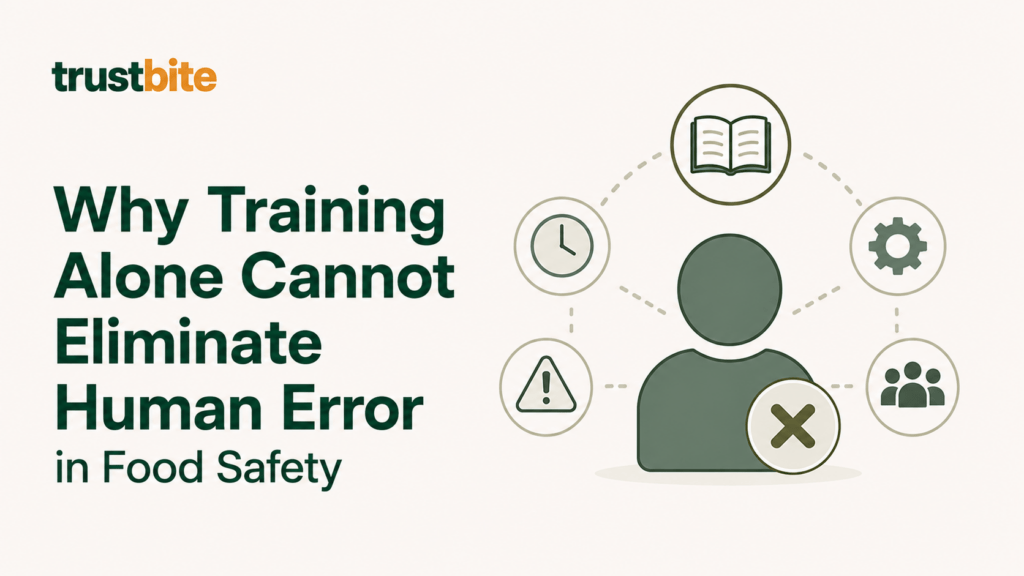
Human error in food safety is persistent because most of the conditions that produce it are not knowledge gaps. They are systemic conditions: time pressure, poor equipment design, ambiguous procedures, inadequate monitoring frequency, and organizational cultures that normalize small deviations. Training addresses knowledge. System design, environmental controls, and culture address the conditions that determine whether knowledge translates into consistent behavior.
What Is Human Error in Food Safety?
Human error in food safety is any unintended action, omission, or decision by a food handler or manager that creates or allows a food safety risk. It includes acts of commission, doing something incorrectly such as cross-contaminating a surface with raw product, and acts of omission, failing to do something required such as completing a monitoring record or washing hands at a required occasion.
Human error is not the same as deliberate non-compliance. A food handler who skips a handwashing step because they do not understand why it is required is making an error driven by a knowledge gap. A food handler who understands perfectly well why handwashing is required but skips it because they are under time pressure to complete a task is not making a knowledge error. They are responding rationally to a conflicting operational demand. Training addresses the first situation. System design must address the second.
Why Training Is Necessary But Insufficient
Training is a necessary component of human error reduction in food safety because knowledge gaps are a genuine contributor to certain categories of error. A food handler who does not know what the danger zone is cannot be expected to recognize when food is being held at an unsafe temperature. A CCP monitor who does not understand what their measurement is for cannot be expected to identify or respond appropriately to an out-of-range result.
Where knowledge gaps are the actual cause of an error, targeted training that builds the missing understanding is an appropriate and effective response. This is the category of human error that training is designed to address and can address effectively.
Where knowledge gaps are not the cause of the error, training does not help. Repeated retraining of staff who already know what they are supposed to do but are not doing it in practice is an expensive activity that does not reduce the error rate. The investment is misdirected because it is treating a symptom while leaving the actual cause untouched.
The question to ask before designing any human error response is: does this person lack the knowledge to perform the task correctly, or do they have the knowledge but face conditions that prevent them from applying it consistently? Root cause analysis determines which situation applies, and the answer determines whether training or system change is the appropriate intervention.
Systemic Conditions That Produce Human Error Despite Adequate Training
Several systemic conditions consistently produce human error in food safety environments even when training is thorough and well-understood.
Time pressure is the most pervasive. In busy food production and service environments, the pace of work creates situations where the time required to follow a procedure correctly conflicts with the pace required to meet production or service targets. Handwashing takes 40 seconds done correctly. Under pressure, a 10-second rinse becomes the habitual substitute. Training cannot resolve this if the operational pace leaves no time for correct execution. Adequate staffing levels, realistic production targets, and facility layouts that make correct procedures faster are the system-level responses.
Poor procedure design creates errors regardless of how thoroughly the procedure has been taught. A procedure that requires multiple steps performed in a specific sequence, with no visual prompts or decision aids to guide the sequence, relies entirely on memory for correct execution under operational pressure. A procedure redesigned to include visual checklists, color-coded equipment, or physical workspace layouts that make the correct sequence the easiest path reduces error without changing what the operator knows.
Equipment design influences error rates significantly. Monitoring equipment that is difficult to read, requires multiple calibration steps before each use, or generates results that must be manually transferred to a paper record introduces opportunities for error that automated equipment removes. A continuous temperature logging system that generates real-time alerts when a parameter exceeds a defined limit catches excursions without relying on an operative to notice, record, and respond to a temperature reading at the right moment. Equipment providers such as Adria Food Tech supply automated monitoring and detection systems that remove the human operator from certain error-prone steps in the monitoring chain, replacing manual judgment with objective automated records that cannot be omitted or misread.
Normalization of small deviations is a cultural condition that develops over time in food safety environments where minor non-compliances are not addressed consistently. When small deviations, such as a refrigerator temperature that regularly runs at 6°C rather than the 5°C target, go unaddressed, they establish a new informal standard that staff perceive as acceptable. Over time, the tolerance for deviation expands, and what began as a minor drift accumulates into a significant food safety gap. Addressing normalization requires consistent management response to small deviations, not retraining staff on a standard they already know.
Cognitive fatigue toward the end of long shifts increases error rates in repetitive monitoring tasks. A food handler who has completed the same temperature check 40 times during a shift is more likely to make an error in the 41st than in the first, regardless of how well they were trained. Task rotation, adequate break scheduling, and monitoring system design that alerts staff to deviations rather than relying entirely on their sustained attention reduce fatigue-related errors without requiring any change in knowledge levels.
What Actually Reduces Human Error in Food Safety
Human error reduction in food safety is most effective when it combines training with system-level interventions that address the conditions producing error rather than only the knowledge gaps.
Procedure redesign to make correct behavior the easiest behavior reduces error rates in environments where procedure complexity was a contributing factor. A procedure that can be followed correctly in the time available, with clear visual aids and decision points, produces better compliance than a complex procedure that relies on detailed recall under pressure.
Environmental design that removes the opportunity for certain errors, such as physical separation of allergen-containing and allergen-free ingredients that prevents accidental use, reduces error rates independently of training. When the correct action is the only physically available action, knowledge and attention become less critical variables.
Automated monitoring and detection removes reliance on human memory and judgment at CCP monitoring steps where the consequences of error are most significant. A metal detector that automatically rejects product above a defined threshold does not require a human operative to notice, record, and respond to a detection event. It performs the control action reliably every time without attention or memory requirements.
Feedback systems that alert staff immediately when a parameter exceeds a limit, rather than relying on scheduled monitoring checks, reduce the window between error occurrence and detection. An alert received in real time allows correction before affected product accumulates. An error detected at the end of a shift may have produced hours of non-conforming product before correction.
A food safety culture that treats error reporting as valuable information rather than a disciplinary trigger reduces the normalization of deviation by keeping small failures visible. When staff are comfortable reporting near misses and minor deviations, management can identify and address the systemic conditions producing them before they accumulate into significant failures. Training that builds this cultural understanding, explaining why reporting matters and what happens to reports when they are made, addresses a behavioral dimension that procedural training alone does not reach. Providers such as Confi Food develop food safety training programs designed to build both the procedural knowledge and the cultural understanding that translate into consistent, self-motivated food safety behavior rather than compliance maintained only by external monitoring.
The Appropriate Role of Training in Human Error Reduction
Training remains an essential component of human error reduction in food safety even though it is not sufficient on its own. The appropriate role of training is to ensure that every person in a food handling environment has the knowledge and understanding required to perform their food safety responsibilities correctly, and that they understand why those responsibilities matter.
Beyond this baseline, training contributes to error reduction by building the judgment required to navigate non-standard situations. A food handler who deeply understands why temperature control matters is better equipped to make the right decision when they encounter a situation not covered by a specific procedure than one who only knows the rules. This kind of judgment-level knowledge is the product of training that explains reasoning rather than only prescribing behavior.
Training also builds the cultural foundation for error reporting. Staff who understand that near-miss reporting improves the food safety system and is valued by management will report more consistently than those who have only been told that reporting is required. The cultural outcome of well-designed training is one of the most durable error-reduction mechanisms available.
Conclusion
Human error in food safety cannot be eliminated by training alone because most of the conditions that produce error are systemic rather than knowledge-based. Time pressure, poor procedure design, equipment that requires sustained human attention, and cultures that normalize deviation all produce error regardless of training quality. Reducing human error requires a combination of training that builds genuine understanding, system design that makes correct behavior easier than incorrect behavior, automated controls that remove human judgment from high-stakes monitoring steps, and cultures that value error reporting over error suppression. Training is where this combination starts, but it cannot be where it ends.
Frequently Asked Questions
Why can training alone not eliminate human error in food safety?
Training addresses knowledge gaps but most human errors in food safety are produced by systemic conditions: time pressure, poor procedure design, inadequate equipment, and cultural normalization of small deviations. These conditions produce error regardless of how well trained staff are, because the cause of the error is not a lack of knowledge.
What is the difference between a knowledge error and a performance error in food safety?
A knowledge error occurs when a person does not know what they are supposed to do. A performance error occurs when a person knows what they are supposed to do but fails to do it correctly due to systemic conditions such as time pressure, fatigue, or poor equipment design. Training addresses knowledge errors. System design must address performance errors.
What systemic conditions most commonly produce human error in food safety?
The most common systemic conditions producing human error in food safety include time pressure during busy operational periods, poor procedure design that relies on detailed recall, equipment that is difficult to use correctly, cognitive fatigue during long or repetitive shifts, and cultural normalization of minor deviations that establishes a drift in informal standards.
What is normalization of deviation and why is it dangerous?
Normalization of deviation occurs when minor non-compliances go unaddressed consistently, establishing a new informal standard that staff perceive as acceptable. Over time, the tolerance for deviation expands, and what began as a minor drift accumulates into a significant food safety gap.
How does automated monitoring reduce human error in food safety?
Automated monitoring removes reliance on human memory and judgment at monitoring steps by generating objective, real-time records of monitored parameters. It catches deviations that occur between manual monitoring intervals and provides immediate alerts that allow correction before significant amounts of non-conforming product accumulate.
What is the role of procedure design in reducing human error?
Procedure design that makes correct behavior the easiest available behavior reduces error rates independently of training. Visual aids, decision checklists, physical workspace layouts that enforce correct sequences, and procedures that can be followed correctly in the time operationally available all reduce error rates without changing what the operator knows.
When is retraining the appropriate response to a human error in food safety?
Retraining is appropriate when root cause analysis confirms that the error was caused by a genuine knowledge gap, meaning the person did not know what they were supposed to do or why. It is not appropriate as the primary or only response when the person already had the knowledge but faced systemic conditions that prevented correct execution.
What is the appropriate role of training in human error reduction?
Training’s appropriate role is to ensure every person has the knowledge and understanding to perform their food safety responsibilities correctly and to understand why those responsibilities matter. Beyond this baseline, training builds the judgment to navigate non-standard situations and the cultural motivation to report errors and near misses.
How does food safety culture reduce human error?
A food safety culture that values error reporting creates a feedback mechanism that keeps small failures visible and allows management to identify and address systemic conditions before they produce significant incidents. A culture that suppresses reporting allows systemic conditions to accumulate into serious failures while appearing compliant on the surface.
What is the relationship between cognitive fatigue and human error in food safety?
Cognitive fatigue toward the end of long shifts or during repetitive monitoring tasks increases error rates because sustained attention is a finite resource. Task rotation, break scheduling, and monitoring system design that alerts staff to deviations rather than relying on sustained attention reduce fatigue-related errors.
Can environmental design reduce human error without training?
Environmental design that makes incorrect behavior physically impossible or significantly more difficult than correct behavior reduces error rates independently of training. However, training remains necessary because environmental design cannot cover every situation, and staff who understand why controls exist will navigate non-standard situations more safely than those who rely entirely on environmental constraints.
What does research on human error suggest about food safety system design?
Human error research across high-reliability industries consistently shows that error rate reduction depends more on system design that removes error opportunities and catches errors quickly than on individual performance improvement through training alone. The most reliable systems are those designed so that correct performance is the easiest path and errors are detected and corrected before they produce consequences.
How does feedback affect human error rates in food safety monitoring?
Immediate feedback, such as a real-time alert when a monitored parameter exceeds a limit, produces faster correction than delayed feedback such as a supervisor review of the previous day’s monitoring records. Faster correction limits the scope of any non-conformance and provides immediate reinforcement of the desired monitoring behavior.
Why do some food businesses experience the same human error repeatedly despite repeated retraining?
Repeated errors despite repeated retraining indicate that the root cause of the error is systemic rather than knowledge-based. The training is addressing the wrong cause. Root cause analysis of the repeated error pattern will typically reveal a systemic condition, a procedure design issue, equipment limitation, or cultural factor, that the training is not capable of addressing.
Related from the Knowledge Center
Why Food Safety Systems Fail: Common Causes and Practical Prevention
Human error is one component of a broader pattern of food safety system failures. This article examines the full range of causes including the systemic and cultural factors that allow failures to persist.
Root Cause Analysis in Food Safety: How to Find What Actually Went Wrong
Root cause analysis is the tool that distinguishes knowledge errors from performance errors and determines whether training or system change is the appropriate intervention for a specific human error pattern.
Building a Food Safety Culture: What It Means and How Training Creates It
Food safety culture addresses the behavioral and attitudinal dimension of human error that procedural training alone cannot reach, including the conditions that make error reporting more or less likely.