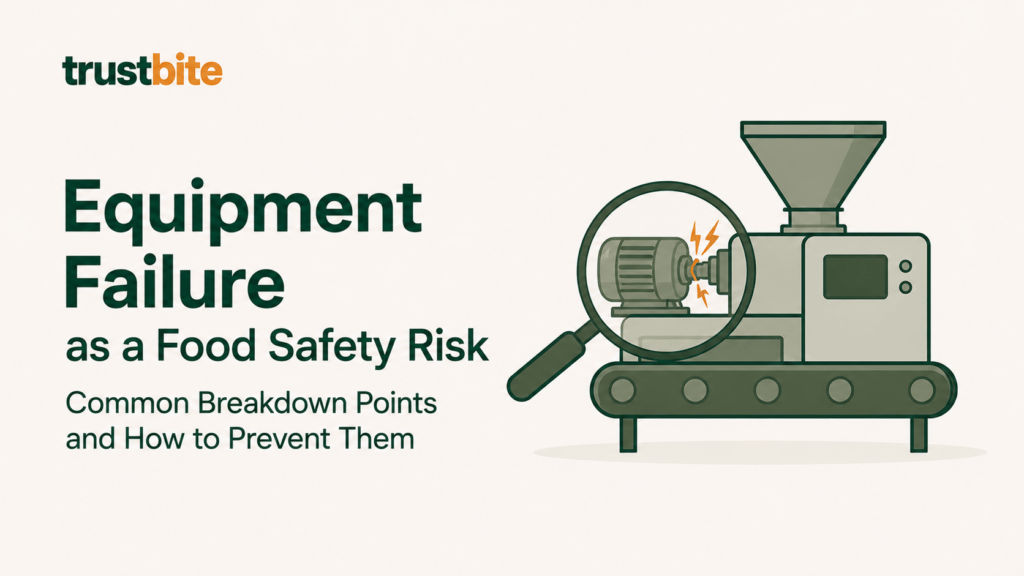
Equipment failure in food safety occurs when the physical systems that monitor, control, or detect food safety hazards stop functioning correctly, creating conditions in which hazards can reach consumers without being controlled or detected. Equipment failure food safety risks range from a refrigerator that drifts above its set point temperature to a metal detector that fails to reject contaminated product to a cooking oven whose temperature calibration has drifted from accuracy. In each case, the food safety system assumes the equipment is working as intended, and when it is not, the control it was supposed to provide is absent even when monitoring records appear normal.
Equipment failure food safety incidents are a recurring feature of food safety investigations and product recalls, often because equipment performance issues develop gradually rather than suddenly, making them difficult to detect through routine monitoring checks that pass while the equipment is still functioning within its limits and miss the point at which it crosses outside them.
Why Equipment Failure Is a Food Safety Risk
Equipment plays a critical role across every element of a food safety management system. Refrigeration equipment maintains cold chain temperatures that prevent bacterial growth. Cooking equipment achieves the minimum internal temperatures that eliminate pathogens at cooking CCPs. Metal detection equipment identifies foreign body contamination before product is sealed and dispatched. Temperature monitoring instruments generate the records that confirm CCPs are under control. Cleaning equipment delivers the chemical concentrations and mechanical action that remove contamination from food contact surfaces.
When any of this equipment fails, the food safety control it provides is lost. Depending on the nature of the failure and how quickly it is detected, equipment failure food safety consequences can range from a single batch of non-conforming product to a prolonged period of uncontrolled production that produces a significant recall.
Equipment failure food safety risks are distinct from operational errors because they can occur even when staff are doing everything correctly. A temperature sensor that has drifted from calibration without anyone’s knowledge will generate monitoring records that appear to confirm the CCP is under control while the actual temperature at the monitoring point is outside the critical limit. The food safety failure is invisible until calibration is checked, until a finished product is tested and found to be non-conforming, or until a consumer becomes ill.
Common Equipment Failure Food Safety Risks
Several categories of equipment generate the most significant and most frequently occurring equipment failure food safety risks across different types of food business.
Refrigeration equipment failure is among the most common and consequential equipment failure food safety events. Refrigerators and cold rooms can fail to maintain their set point temperature due to compressor faults, condenser blockage, door seal deterioration, overloading with warm product, or refrigerant loss. A refrigerator that is operating but not maintaining its target temperature may appear normal in all respects except the temperature records, and if temperature monitoring is conducted only periodically rather than continuously, the excursion may not be captured in the records at all.
Cooking equipment calibration drift is a significant equipment failure food safety risk in food service and food production environments where cooking is a CCP with a defined minimum temperature critical limit. Ovens, grills, and fryers can drift from their set temperatures due to element failure, thermostat wear, or incorrect calibration. A cooking temperature critical limit of 74°C for poultry that is set on equipment delivering actual temperatures of 68°C is a CCP failure that may not be detected without probe monitoring of actual product core temperatures rather than relying on equipment display temperatures.
Metal detection equipment failure creates a specific and serious equipment failure food safety risk in manufacturing environments where metal detection is the last CCP before product is sealed and dispatched. Metal detector sensitivity can be reduced by electrical interference, incorrect reject mechanism calibration, product effect changes that alter the baseline signal, and physical damage to the detector aperture. A metal detector that is operating but not detecting at its specified sensitivity level is not performing its food safety function, and this failure may not be visible without regular performance verification using test pieces of known size and material.
Temperature monitoring instrument calibration drift is an equipment failure food safety risk that affects the validity of all monitoring records generated using the affected instrument. A probe thermometer that reads 2°C above actual temperature will generate monitoring records showing CCPs within their critical limits when the actual temperature is 2°C outside them. Calibration of temperature monitoring instruments must be verified on a scheduled basis and documented to confirm that records are generated by instruments of known accuracy.
Cleaning equipment failure affects the effectiveness of cleaning and sanitation as a prerequisite program. Dishwashers that fail to reach temperature targets during the sanitation cycle, spray systems that do not deliver chemical at the correct concentration, and pressure washers that operate below their designed flow pressure all deliver inadequate cleaning performance that may not be apparent from visual inspection of the surfaces they clean.
Pest exclusion systems including door seals, screens, and automated closing mechanisms are physical equipment whose failure creates a pathway for pest entry that the pest control program assumes is blocked. Deteriorated door seals, broken screens, or malfunctioning automatic door closers create pest access opportunities that may not be detected until pest activity is observed inside the facility.
How Equipment Failure Food Safety Risks Are Managed
Managing equipment failure food safety risks requires a combination of preventive maintenance, calibration schedules, performance verification, and continuous monitoring that detects deviations before they produce significant non-conforming product.
Preventive maintenance programs schedule equipment service and inspection activities before failures are expected to occur rather than waiting for failures to develop into operational problems. A preventive maintenance schedule for food safety-critical equipment, including refrigeration units, cooking equipment, metal detectors, and temperature monitoring instruments, records the frequency and nature of scheduled maintenance for each item and documents completion of each maintenance activity.
Calibration schedules confirm at defined intervals that monitoring instruments are generating accurate readings. Temperature probes, thermometers, pH meters, and other measurement instruments should be calibrated against a traceable reference standard, with calibration records documenting the pre-calibration reading, the calibration adjustment made if any, and the post-calibration confirmation. Where a calibration check reveals that an instrument has been generating inaccurate readings, the scope of monitoring records affected by the inaccuracy must be assessed and a corrective action determination made about any product monitored during the affected period.
Performance verification for critical detection equipment, particularly metal detectors, requires regular testing using test pieces of defined size and material to confirm that the equipment is detecting at its specified sensitivity. Performance verification records document each test event, the test pieces used, the pass or fail result, and any adjustment required. Performance verification should occur at the start and end of each production run and at defined intervals during continuous production.
Continuous monitoring through automated sensors addresses the equipment failure food safety risk associated with equipment that operates normally between monitoring checks but experiences excursions during production periods not covered by manual checks. An automated temperature logging system that records refrigerator temperatures every few minutes generates a complete record of equipment performance across the entire monitoring period, revealing excursions that would be invisible in a twice-daily manual log.
Equipment providers such as Adria Food Tech supply continuous temperature monitoring systems, data logging equipment, and performance verification tools that generate the objective, time-stamped records food safety management systems require for equipment performance documentation. Automated monitoring removes the gap between manual check intervals that allows equipment failure food safety events to go undetected, providing both the operational response capability and the audit evidence that confirm critical equipment is performing within its required parameters.
Equipment Failure Food Safety Risks and HACCP
Equipment failure food safety risks are addressed within a HACCP system through verification activities that confirm monitoring equipment is functioning correctly and through corrective actions that address equipment failures when they are identified.
Equipment calibration is a verification activity that confirms the monitoring instruments used to assess CCP compliance are generating accurate data. Where calibration reveals that monitoring instruments have drifted from accuracy, the corrective action includes both recalibrating the instrument and assessing the validity of monitoring records generated while it was out of calibration.
Metal detector and critical equipment performance verification is a verification activity that confirms detection and control equipment is functioning at its specified performance level. Where performance verification reveals that equipment has been operating below its specification, the corrective action includes both restoring equipment performance and assessing the disposition of product produced while the equipment was not functioning correctly.
Preventive maintenance records form part of the prerequisite program documentation that confirms equipment used in food safety-critical roles is maintained in a condition that does not create contamination risks or monitoring inaccuracies.
Training staff to recognize early signs of equipment performance issues, such as a refrigerator that is running its compressor more frequently than usual or a metal detector whose reject rate has changed unexpectedly, creates an additional layer of equipment failure detection beyond scheduled verification and calibration checks. Providers such as Confi Food support food businesses in developing food safety management systems that include equipment maintenance, calibration, and verification procedures as integrated components of the HACCP system rather than as separate administrative activities.
Conclusion
Equipment failure food safety risk is a persistent and often underestimated source of food safety system vulnerability. Unlike operational errors that can be addressed through training and procedure improvement, equipment failures occur independently of human competence and can undermine food safety controls that appear to be functioning normally until the failure is directly detected. Managing equipment failure food safety risks requires preventive maintenance schedules, calibration programs, performance verification for critical detection and monitoring equipment, and continuous automated monitoring that fills the gaps between manual verification events. Together these controls produce food safety systems that detect and respond to equipment failure before it becomes an uncontrolled hazard rather than after it has produced non-conforming product.
Frequently Asked Questions
What is equipment failure in food safety?
Equipment failure food safety risk occurs when physical systems that monitor, control, or detect food safety hazards stop functioning correctly, creating conditions in which hazards can reach consumers without being controlled or detected, even when monitoring records appear normal.
What are the most common equipment failure food safety risks?
The most common equipment failure food safety risks are refrigeration equipment failing to maintain set point temperatures, cooking equipment calibration drift, metal detector sensitivity reduction, temperature monitoring instrument calibration drift, cleaning equipment performance failure, and pest exclusion equipment deterioration.
Why is equipment calibration drift a food safety risk?
When a monitoring instrument such as a thermometer drifts from accuracy, it generates monitoring records showing CCPs within their critical limits when the actual temperature may be outside them. The food safety failure is invisible in the records until the calibration drift is detected and verified.
How does metal detector failure create a food safety risk?
A metal detector whose sensitivity has been reduced by electrical interference, product effect changes, or physical damage may fail to detect metal contamination at its specified sensitivity level. Product that passes through a degraded metal detector without rejection may contain metal fragments that the detector was supposed to identify.
What is a preventive maintenance program in food safety?
A preventive maintenance program schedules equipment service and inspection activities before failures are expected to occur, rather than waiting for failures to develop into operational problems. For food safety-critical equipment, preventive maintenance records confirm that equipment is being maintained in a condition that supports its food safety function.
What is equipment calibration in the context of food safety?
Equipment calibration is the process of verifying that a monitoring instrument is generating accurate readings against a traceable reference standard, and adjusting the instrument if it has drifted from accuracy. Calibration records document the pre-calibration reading, any adjustment made, and the post-calibration confirmation.
How often should metal detectors be performance verified?
Metal detector performance should be verified using test pieces of defined size and material at the start and end of each production run and at defined intervals during continuous production. Performance verification records document each test event and any adjustment required.
What should a food business do if a calibration check reveals instrument drift?
The instrument should be recalibrated or replaced. The period during which the instrument was generating inaccurate readings should be identified, the monitoring records from that period should be assessed, and a corrective action determination should be made about the disposition of any product monitored during the affected period.
How does continuous monitoring reduce equipment failure food safety risk?
Continuous automated monitoring generates a complete record of equipment performance across the entire monitoring period rather than only at manual check intervals. Excursions that occur between manual checks are captured in the automated record and trigger alerts that allow rapid response before significant non-conforming product accumulates.
What is the difference between preventive maintenance and corrective maintenance in food safety equipment management?
Preventive maintenance schedules service and inspection activities to prevent failures from occurring. Corrective maintenance addresses failures after they have occurred. Food safety-critical equipment should have preventive maintenance schedules rather than relying on corrective maintenance after failure.
How does equipment failure relate to HACCP verification activities?
Equipment calibration, performance verification for detection equipment, and preventive maintenance records are verification activities that confirm the HACCP monitoring system is functioning as intended. Equipment failure identified through verification triggers a corrective action assessment of the affected monitoring records and the product produced during the failure period.
Can training help prevent equipment failure food safety risks?
Training staff to recognize early signs of equipment performance issues, such as unusual compressor cycling in a refrigerator or unexpected changes in metal detector reject rates, creates an additional layer of detection beyond scheduled verification. Training alone cannot prevent equipment failure, but informed staff can identify emerging issues before they become significant food safety events.
What records are required for food safety-critical equipment management?
Required records include preventive maintenance schedules and completion documentation, calibration records for monitoring instruments, performance verification records for detection equipment, and corrective action records for any equipment failure events including the scope of affected product and the disposition decision made.
How does equipment failure food safety risk relate to product recalls?
Equipment failure that goes undetected can produce sustained periods of non-conforming product that reaches distribution before the failure is identified. The scope of the resulting recall depends on how long the equipment was failing, how quickly the failure was detected, and how effectively traceability records can identify the affected batches.
Related from the Knowledge Center
Why Food Safety Systems Fail: Common Causes and Practical Prevention
Equipment failure is one component of a broader pattern of food safety system failures. This article examines the full range of causes including human, procedural, and systemic factors.
Temperature Abuse in Food Safety: What It Is and Why It Causes Illness
Refrigeration equipment failure is a leading cause of temperature abuse. This article covers the full range of temperature abuse causes and how food businesses prevent them.
What Is a Food Safety Audit? Types, Process, and What to Expect
Equipment calibration records and maintenance documentation are reviewed during food safety audits. This article explains what auditors assess and how the quality of equipment records affects audit outcomes.