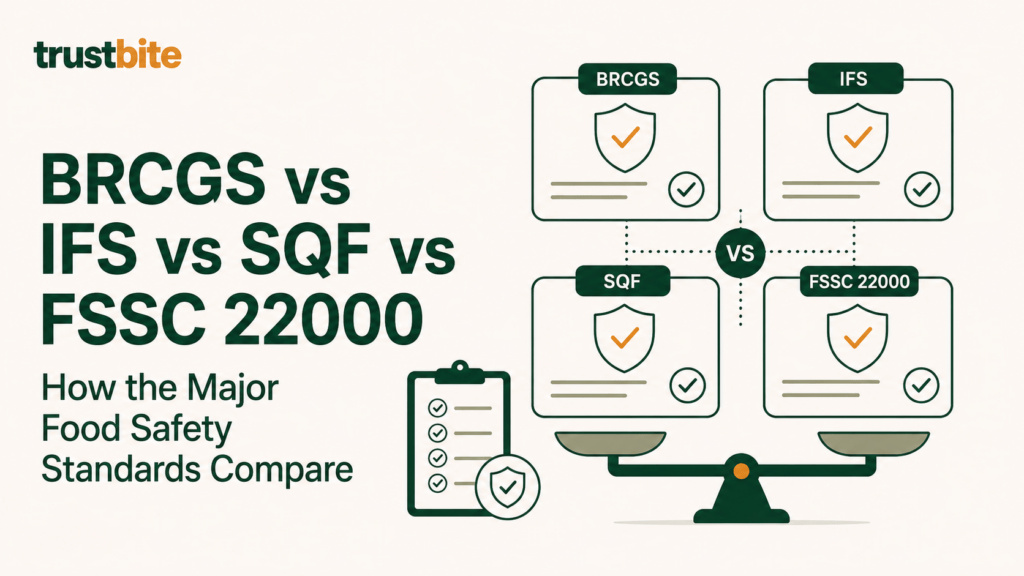
BRCGS, IFS, SQF, and FSSC 22000 are the four most widely recognized voluntary food safety certification standards in the global food industry. All four are recognized by the Global Food Safety Initiative as meeting its benchmarking requirements, meaning that certification against any of them is accepted by major retailers and food service companies that require GFSI-recognized certification from their suppliers.
Despite this common GFSI recognition, BRCGS, IFS, SQF, and FSSC 22000 are not interchangeable. They differ in their geographic reach, the sectors they serve, their audit approach, their structural requirements, and the buyer communities that prefer each one. Choosing the right standard for a specific business involves understanding these differences in terms of the commercial relationships the business operates within, the markets it sells into, and the operational realities of its food safety management system.
What Is GFSI and Why Does It Matter?
The Global Food Safety Initiative is a private sector organization that benchmarks food safety management standards against its defined requirements. Standards that achieve GFSI recognition are considered equivalent from a buyer perspective, meaning a supplier certified against any GFSI-recognized scheme satisfies the food safety certification requirements of buyers that accept GFSI-benchmarked certification.
GFSI recognition does not mean the standards are identical. It means they meet GFSI’s minimum requirements in terms of scope, technical content, and audit rigor. The differences between GFSI-recognized standards matter for operational and commercial reasons even when the GFSI recognition itself is the primary driver of a certification decision.
BRCGS: Global Standard for Food Safety
BRCGS, the Brand Reputation Compliance Global Standards organization, publishes the Global Standard for Food Safety, which has been updated across successive versions with the current version being Issue 9. BRCGS originated in the UK retail sector and was developed by major British retailers as a supplier assurance mechanism. It remains the dominant standard in UK and many European supply chains, and is widely recognized across global food retail and food service markets.
BRCGS Issue 9 is structured around five sections covering senior management commitment, the food safety plan, food safety and quality management systems, site standards, and product control. The standard places strong emphasis on senior management commitment to food safety culture as well as technical food safety system requirements.
BRCGS audits are unannounced in some elements of the scheme, with businesses required to accept an unannounced component or be graded accordingly. This unannounced element provides buyers with greater assurance that audit results reflect normal operational conditions rather than prepared-for compliance.
Certification grades range from AA through to D, with AA and A representing the highest compliance levels and D representing a conditional pass with significant non-conformances requiring resolution. Many retailers specify minimum grade requirements for their suppliers, with AA or A typically required for premium or own-brand supply relationships.
BRCGS is the most appropriate starting point for businesses supplying UK and European retailers, food service companies, or manufacturers who require BRCGS certification specifically. Providers such as Confi Food support food businesses in preparing for BRCGS certification through food safety management system development and gap analysis against BRCGS requirements.
IFS Food: International Featured Standards
IFS Food is a food safety standard developed by German and French retailer associations to provide a harmonized approach to supplier auditing across European retail supply chains. It is particularly dominant in German, French, Italian, and broader European Continental retail markets, making it the preferred or required standard for suppliers to those markets.
IFS Food is currently at Version 8 and covers food production and processing operations. Its structure includes management system requirements, quality management requirements, resource management, production process management, and food safety measurements and analysis.
IFS Food audits produce a percentage compliance score rather than a graded pass or fail outcome. A higher percentage score indicates a higher level of compliance across the standard’s requirements. Buyers may specify minimum score thresholds rather than minimum grade levels, and the scoring system allows comparison of supplier performance levels in a more granular way than a graded system.
IFS also publishes sector-specific standards including IFS Broker for food trading and brokerage operations and IFS Logistics for food transport and storage providers, making it a versatile framework across different parts of the food supply chain beyond manufacturing.
SQF: Safe Quality Food Program
SQF, the Safe Quality Food Program, is administered by the Safe Quality Food Institute and is particularly prevalent in North American food supply chains, making it the preferred standard for suppliers to major US and Canadian retailers and food service operators. SQF is structured in a two-code format covering both food safety and food quality, allowing businesses to certify at different levels depending on whether they are seeking food safety certification alone or combined food safety and quality certification.
SQF Level 2 covers food safety fundamentals and is the level most commonly required for food manufacturing and processing operations. SQF Level 3 adds quality management requirements for businesses whose buyers require quality assurance certification in addition to food safety certification.
SQF has a strong presence in primary production, food manufacturing, and food storage and distribution sectors in North America, and is recognized by major US retailers including Walmart and Costco as a preferred supplier certification standard. For businesses supplying North American markets, SQF certification is often the most commercially relevant choice.
FSSC 22000: Food Safety System Certification
FSSC 22000 is a certification scheme published by the Foundation for Food Safety Certification, built on ISO 22000 with additional sector-specific prerequisite program requirements drawn from technical specifications such as ISO 22002-1 for food manufacturing, ISO 22002-4 for food packaging manufacturers, and ISO 22002-6 for feed and animal food production.
FSSC 22000 is structured as a full food safety management system standard with the governance and continual improvement requirements of ISO 22000 alongside the sector-specific PRP content that makes the standard more prescriptive and consistently auditable than ISO 22000 alone. This structure makes FSSC 22000 the preferred choice for food businesses that want or need ISO-compatible certification, for multinational organizations that operate integrated ISO management systems, and for businesses in markets where ISO 22000 is a recognized baseline.
FSSC 22000 is the most globally distributed of the four standards, with a strong presence across Europe, North America, Asia, and emerging markets. Its ISO foundation makes it compatible with ISO 9001 quality management system certification, allowing businesses to integrate their food safety and quality management requirements under a common management system framework.
A Direct Comparison Across Key Dimensions
| BRCGS | IFS Food | SQF | FSSC 22000 | |
|---|---|---|---|---|
| Primary market | UK, global retail | Continental Europe | North America | Global, ISO-aligned |
| GFSI recognized | Yes | Yes | Yes | Yes |
| Audit outcome | Graded (AA to D) | Percentage score | Graded (Excellent to Fail) | Pass/Fail with non-conformances |
| Unannounced element | Yes, optional or required by grade | Yes, available | Yes, available | Yes, available |
| ISO 22000 based | No | No | No | Yes |
| Sector specificity | Broad food manufacturing | Broad food manufacturing | Multiple levels and sectors | Sector-specific PRPs |
| Frequency | Annual with unannounced option | Annual | Annual | Annual with surveillance |
How to Choose Between BRCGS, IFS, SQF, and FSSC 22000
The most practical approach to standard selection starts with the buyer. The right standard is usually the one that the business’s key customers or target customers require or prefer. A business supplying UK supermarkets will almost certainly need BRCGS. A business targeting German or French retailers will likely need IFS. A business supplying US retailers will often need SQF. A business operating in multiple markets may need to consider multiple certifications or select FSSC 22000 for its broader international reach.
Where buyer requirements do not specify a particular standard, the business’s existing food safety management system infrastructure is a relevant factor. A business that has already implemented ISO 22000 or has strong ISO management system infrastructure will typically find FSSC 22000 the most efficient progression. A business starting from a HACCP-based system without existing ISO infrastructure may find BRCGS or SQF more immediately achievable depending on their market.
Audit preparation for any of these standards benefits significantly from external support during the gap analysis and development phases. Consulting and food safety management system support from providers such as Confi Food helps businesses assess their current system against the specific requirements of their chosen standard, identify development priorities, and prepare for the certification audit in a way that produces a genuine system rather than documentation assembled for the audit occasion.
Monitoring equipment that generates objective, time-stamped records supports certification across all four standards by providing the audit-ready evidence of CCP control and prerequisite program performance that every scheme requires. Equipment providers such as Adria Food Tech supply temperature monitoring, environmental testing, and detection systems whose continuous records satisfy the verification evidence requirements of BRCGS, IFS, SQF, and FSSC 22000 auditors.
Can a Business Hold Multiple Certifications?
Yes, and many global food manufacturers do hold certification against more than one standard, typically because they supply into markets with different buyer requirements. Holding both BRCGS and IFS, for example, allows a business to supply UK retailers requiring BRCGS and Continental European retailers requiring IFS without needing separate food safety management systems for each.
Multiple certification is most efficiently managed when the food safety management system is built to satisfy the highest common denominator of requirements across the intended standards. A system built to BRCGS Issue 9 requirements will satisfy most of the requirements of IFS and SQF with relatively minor additional documentation, since the technical food safety content across GFSI-recognized schemes substantially overlaps. FSSC 22000’s ISO management system requirements add a governance layer that requires more deliberate development if it is added to a BRCGS or SQF-certified system.
Conclusion
BRCGS, IFS, SQF, and FSSC 22000 are all credible, rigorous, and globally recognized food safety certification standards. Choosing between them is primarily a commercial decision driven by buyer and market requirements rather than a technical judgment about which standard is inherently superior. All four require a functioning HACCP system, effective prerequisite programs, trained staff, complete monitoring records, and a documented management system. The investment in building a food safety management system that meets any one of them creates a foundation that can be extended to meet the others with proportionate additional work.
Frequently Asked Questions
What are BRCGS, IFS, SQF, and FSSC 22000?
BRCGS, IFS Food, SQF, and FSSC 22000 are the four most widely recognized voluntary food safety certification standards in the global food industry. All four are recognized by the Global Food Safety Initiative, meaning certification against any of them is accepted by buyers requiring GFSI-benchmarked food safety certification from their suppliers.
What is GFSI recognition?
GFSI recognition means that a food safety management standard has been benchmarked by the Global Food Safety Initiative and found to meet its defined requirements for scope, technical content, and audit rigor. GFSI-recognized standards are accepted as equivalent by buyers that require GFSI-benchmarked certification from their supply chains.
Which food safety standard is most widely used globally?
FSSC 22000 has the broadest global distribution due to its ISO foundation and recognition across multiple regions. BRCGS has the strongest presence in UK and European retail supply chains. IFS dominates Continental European supply chains particularly in Germany and France. SQF is the primary standard in North American food supply chains.
Which standard should a business choose?
The right standard is usually the one required or preferred by the business’s key customers or target markets. Where buyer requirements do not specify a standard, existing food safety management system infrastructure and the business’s geographic market focus are the most relevant factors.
Are BRCGS, IFS, SQF, and FSSC 22000 technically equivalent?
All four meet GFSI’s benchmarking requirements, making them broadly equivalent from a buyer acceptance perspective. They differ in their structural requirements, audit approaches, grading systems, sector specificity, and the degree to which they incorporate ISO 22000 management system requirements.
What is the difference between BRCGS and FSSC 22000?
BRCGS is a standalone food safety standard developed by the food retail sector with a graded audit outcome and strong emphasis on food safety culture. FSSC 22000 is built on ISO 22000 with sector-specific PRP requirements, producing a full food safety management system certification with an ISO management system framework.
Does FSSC 22000 include ISO 22000?
Yes. FSSC 22000 is built on ISO 22000 and requires full compliance with the ISO 22000 standard plus additional sector-specific PRP requirements from technical specifications such as ISO 22002-1. A business certified to FSSC 22000 is effectively certified to ISO 22000 within the FSSC 22000 framework.
What is SQF Level 2?
SQF Level 2 is the food safety certification level within the SQF program, covering HACCP-based food safety management system requirements. SQF Level 3 adds food quality management requirements. Level 2 is the most commonly required level for food manufacturing and processing operations in North American supply chains.
What does an unannounced audit element mean in practice?
An unannounced audit is conducted without advance notice to the business, assessing how the food safety system performs under normal unprepared operational conditions. BRCGS, IFS, and SQF all offer or require unannounced audit elements, with businesses receiving a more favorable grade or recognition for accepting unannounced visits.
Can a business hold BRCGS and IFS certification at the same time?
Yes. Many global food manufacturers hold multiple certifications to serve supply chains with different standard preferences. A food safety management system built to satisfy BRCGS requirements will satisfy most IFS requirements with relatively limited additional documentation since both are GFSI-benchmarked schemes with substantially overlapping technical content.
How long does it take to achieve certification against any of these standards?
Timelines vary significantly depending on the current state of the food safety management system, the complexity of the operation, and the standard chosen. A business with a well-implemented HACCP system and functioning prerequisite programs may achieve initial certification within three to six months. A business building its food safety management system from a lower baseline may require twelve months or more.
What is the IFS Food percentage scoring system?
IFS Food audits produce a percentage compliance score reflecting the overall level of compliance across the standard’s requirements. Higher percentages indicate higher compliance levels. Buyers may specify minimum percentage thresholds for suppliers, and the scoring system allows more granular comparison of supplier performance than a graded pass or fail outcome.
What sectors does SQF cover beyond food manufacturing?
SQF covers food manufacturing, primary production, food storage and distribution, retail, and food packaging. Sector-specific SQF codes are published for each of these categories, making SQF a versatile framework across the full food supply chain.
What additional requirements does FSSC 22000 add beyond ISO 22000?
FSSC 22000 adds sector-specific prerequisite program requirements from technical specifications such as ISO 22002-1 for food manufacturing, which provides more prescriptive PRP content than ISO 22000 itself specifies, making the combined standard more consistently auditable across different organizations and auditors.
Related from the Knowledge Center
What Is a Food Safety Audit? Types, Process, and What to Expect
All four major food safety standards are assessed through formal third-party audits. This article explains how food safety audits work, what auditors assess, and how businesses prepare.
HACCP Certification: What It Is and How Food Businesses Get Certified
BRCGS, IFS, SQF, and FSSC 22000 all require a functioning HACCP system as a core technical element. This article explains what HACCP certification involves and how the certification process works.
What Are Prerequisite Programs in Food Safety? A Practical Guide
Prerequisite programs are a core requirement across all four major food safety standards. This article explains what they cover and why they must be in place before any certification audit.