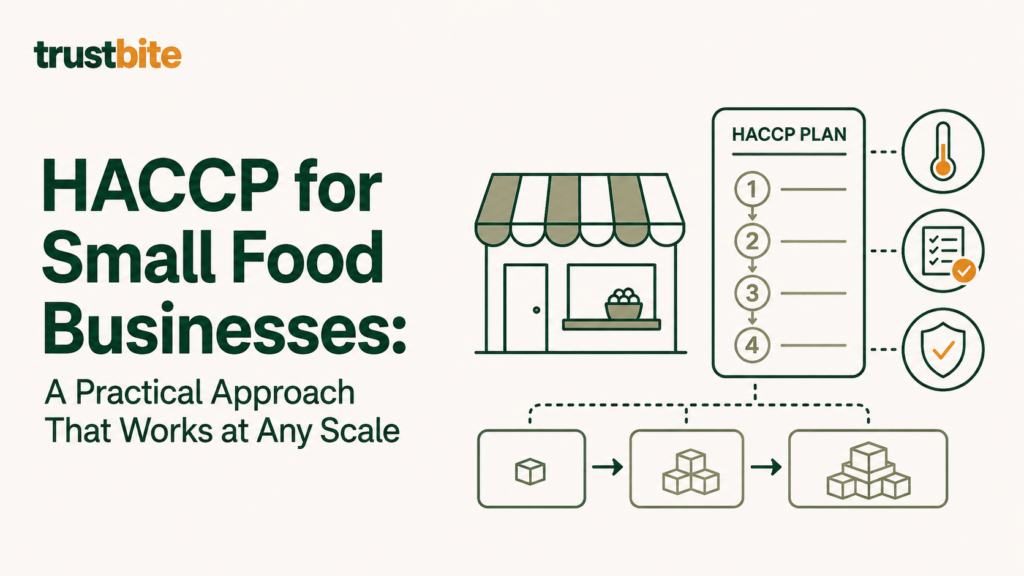
HACCP for small food businesses is a legal requirement in most jurisdictions and an operational necessity in all of them, regardless of whether the business is a single-location café, a market trader preparing food for retail, a small catering company, or a startup food producer. The Codex Alimentarius guidelines and the regulatory frameworks derived from them apply the same core principles across business sizes, but they also acknowledge that the depth and formality of documentation appropriate to a complex manufacturing facility is not the same as what is appropriate for a small, simple food operation.
HACCP for small food businesses does not mean a simplified version of HACCP that skips the principles or addresses fewer hazards. It means a proportionate application of the same principles, adapted in its complexity and documentation burden to reflect the actual scale and risk profile of the operation. A restaurant with three products on its menu does not need the same volume of HACCP documentation as a manufacturer producing forty product lines across multiple sites. But it needs the same quality of thinking about what hazards exist, where they can be controlled, and what happens when controls fail.
Why HACCP for Small Food Businesses Is Both Required and Achievable
The legal requirement for HACCP in most food regulatory frameworks does not differentiate by business size. EU Regulation (EC) 852/2004 requires that food business operators implement and maintain a permanent procedure based on HACCP principles. The equivalent requirements in UK food safety law, US FSMA regulations, and most other national frameworks are similarly broad in scope.
Where regulators do acknowledge scale is in the application of what is sometimes called “flexible HACCP” for small businesses. In guidance documents, regulatory authorities in the EU, UK, and elsewhere have confirmed that small food businesses may implement HACCP in a way that is proportionate to their operations, using simpler documentation formats, adapting generic templates to their specific processes, and focusing on the most significant hazards in their specific context rather than producing the elaborate multi-volume HACCP systems appropriate for large manufacturers.
This proportionality does not mean less rigorous hazard thinking. A small catering business that handles raw poultry must still identify and control the pathogen risk associated with raw poultry with the same rigor as a large manufacturer, because the risk to the consumer from undercooked or cross-contaminated chicken is the same regardless of the size of the business that prepared it.
Starting With the Right Foundation: Prerequisite Programs First
HACCP for small food businesses must be built on functioning prerequisite programs before a HACCP plan is developed. This is the same requirement that applies to any food business, but it is particularly important to state explicitly for small businesses where the temptation may be to start with the HACCP plan documentation and assume that basic hygiene is being handled separately without systematic documentation.
Prerequisite programs for a small food business cover personal hygiene standards for all staff who handle food, cleaning and sanitation procedures for food contact surfaces and equipment, pest control measures appropriate to the premises, food storage practices including temperature control and stock rotation, and supplier management for any ingredients purchased from external sources. Each of these must be in place and functioning before the HACCP hazard analysis begins, because the hazard analysis assumes these basic controls are operating and would be a different analysis if they were not.
For small food businesses that do not have a food safety manager or dedicated quality function, the prerequisite program documentation can be relatively simple: a one-page cleaning schedule, a written personal hygiene policy that staff have signed, a temperature monitoring log for the refrigerator, and a goods receiving record. The documentation needs to be sufficient to demonstrate that the control exists and is being followed, not impressive in its volume.
Conducting a Hazard Analysis for a Small Food Business
The hazard analysis is the most intellectually demanding element of HACCP for small food businesses, and it is where the quality of the HACCP system is primarily determined. A simple food business with a limited menu and straightforward processes has fewer hazards to assess than a complex manufacturer, but the assessment of each hazard must be equally rigorous.
The starting point is a process flow diagram for each product or product group, listing every step from ingredient receipt through preparation, cooking or processing, holding, and service or dispatch. For a café selling sandwiches, the flow might run from bread and filling receipt through storage, assembly, holding, and counter service. For a small caterer, it might run from raw ingredient receipt through storage, preparation, cooking, holding, transport, and service at an off-site event.
At each step, the HACCP team, which for a small business may be the business owner working with a food safety consultant, asks what biological, chemical, or physical hazards could occur at this step. Biological hazards for a café preparing sandwiches would include pathogens such as Salmonella from raw eggs or Listeria in ready to eat products, as well as the risk of pathogen cross-contamination from unwashed hands or contaminated surfaces. Chemical hazards would include allergens from ingredients and potential cleaning chemical residue if cleaning is not followed by adequate rinsing. Physical hazards would include foreign bodies from ingredient packaging or preparation equipment.
Each identified hazard is assessed for the likelihood of its occurrence and the severity of its potential health impact, and the significant hazards, those that require a control measure, are identified and the control measures recorded.
Identifying Critical Control Points in a Small Food Business
A small food business typically has fewer CCPs than a large manufacturer, because simpler processes mean fewer steps at which a hazard requires this level of specific control. Many small food businesses, particularly those in food service rather than food production, find that their HACCP plan has two or three CCPs rather than the larger numbers that might appear in a manufacturing HACCP plan.
Cooking is almost always a CCP for any food business that cooks high-risk products such as poultry, minced meat, or eggs. The critical limit is the minimum safe internal temperature for the product being cooked, measured at the product core. The monitoring procedure is a temperature probe check at the end of cooking. The corrective action is to continue cooking until the minimum temperature is reached or to discard product that cannot be brought to temperature.
Chilling of cooked food may be a CCP for food businesses that cook and chill product for later service rather than serving immediately after cooking. The critical limit is defined by the maximum time for the food to cool through the danger zone, and the monitoring procedure is temperature or time recording during the chilling process.
Hot holding may be a CCP for food service businesses that hold cooked food at temperature for service. The critical limit is the minimum holding temperature, typically 63°C, and the monitoring procedure is a regular temperature check of the held food.
Cold storage for high-risk ready to eat products may be a CCP for businesses where this is the primary control preventing pathogen growth in the period between preparation and service. The critical limit is the maximum storage temperature, and monitoring is the refrigerator temperature check.
For each identified CCP, the small food business HACCP plan must document the critical limit, the monitoring procedure, the corrective action for when the limit is breached, and the record that will be kept as evidence.
Documentation Requirements That Are Proportionate but Complete
HACCP for small food businesses does not require elaborate documentation systems, but it does require documentation that is sufficient to demonstrate that the HACCP plan exists, is being followed, and produces records that would allow a regulatory inspector or auditor to verify that CCPs are being monitored.
At minimum, the HACCP documentation for a small food business should include the product descriptions and flow diagrams, the hazard analysis with significance determinations, the HACCP plan showing each CCP, its critical limit, monitoring procedure, and corrective action, and the monitoring records generated by following the plan.
Many regulatory authorities provide template HACCP documentation for small food businesses that can be adapted to the specific operation. These templates are a useful starting point but must always be customized to reflect the actual products, processes, and hazards of the specific business. A generic template that has not been adapted to the real operation is one of the most common sources of HACCP non-conformances in small business inspections and audits.
External support in developing HACCP documentation is valuable for small food businesses that do not have internal food safety expertise. Providers such as Confi Food offer food safety management system consulting that includes HACCP plan development for small food businesses, producing documentation that is proportionate to the scale of the operation, accurately reflects the real processes and hazards, and meets the requirements that regulatory inspectors and certification auditors look for.
Monitoring in a Small Food Business Context
Monitoring for a small food business is typically simpler than in a manufacturing context, but it must be systematic and documented. A probe thermometer used to check cooking temperatures, a refrigerator thermometer with a log to record daily temperatures, and a written corrective action record for any deviations are sufficient monitoring documentation for most small food business CCPs.
The temptation in small businesses is to rely on experience and judgment rather than measurement. An experienced chef who knows by looking and feel that chicken is cooked is applying knowledge that is real but is not a documented CCP monitoring record. A temperature probe check that confirms the same judgment with a reading and a signed record is what a regulatory inspector or auditor needs to see.
For small businesses that want stronger monitoring evidence without significant infrastructure investment, basic continuous temperature logging for cold storage equipment is now available at relatively low cost. Equipment providers such as Adria Food Tech supply monitoring solutions across a range of scales, including simple data loggers for cold storage monitoring that generate continuous temperature records without requiring manual entries, providing a level of monitoring evidence that is substantially stronger than periodic manual checks at a cost accessible to small operations.
Training Staff in a Small Food Business HACCP Context
The same principle that applies to any food business applies to HACCP for small food businesses: the food safety system is only as effective as the knowledge and behavior of the people operating it. In a small business where the owner may be the only person with formal food safety knowledge, ensuring that all staff understand the CCPs relevant to their roles, the critical limits they are working to, and the corrective actions they should take is essential.
For small food businesses, food safety training does not need to be elaborate. Online food safety training programs available in almost any language, designed for food handlers at all levels, allow small businesses to provide structured, assessed, documented training to all staff without the cost of instructor-led programs. Providers such as Confi Food offer training programs that are appropriate for food handler and supervisor level in small business contexts, generating the digital completion records that satisfy both regulatory requirements and certification scheme documentation expectations.
Conclusion
HACCP for small food businesses is a proportionate application of the same principles that apply across the food industry, adapted in complexity and documentation volume to reflect the actual scale and risk profile of the operation. Small food businesses are not exempt from HACCP requirements, but they are not required to produce the same documentation burden as a large manufacturer. What they are required to produce is accurate, current, and demonstrably followed: a hazard analysis that reflects their real products and processes, a HACCP plan that identifies and monitors the steps where control is genuinely critical, and monitoring records that confirm those controls are working in daily operations.
Frequently Asked Questions
Is HACCP required for small food businesses?
Yes. Food safety regulations in most jurisdictions, including EU Regulation (EC) 852/2004 and equivalent UK and US frameworks, require all food businesses to implement procedures based on HACCP principles regardless of size.
Does HACCP for small food businesses need to be as detailed as for large manufacturers?
No. Regulatory guidance acknowledges that HACCP implementation should be proportionate to the scale and complexity of the operation. A small food business with a simple menu and straightforward processes implements HACCP with simpler documentation than a complex manufacturer, but the quality of the hazard thinking must be equally rigorous.
What is flexible HACCP for small businesses?
Flexible HACCP is the term used by some regulatory authorities to describe the proportionate application of HACCP principles to small food businesses, allowing simpler documentation formats and the use of adapted generic templates while maintaining the same core analytical rigor.
How many CCPs does a small food business typically have?
Small food businesses in food service typically have two to four CCPs, often including a cooking CCP, a cold storage CCP, and in some operations a hot holding or chilling CCP. The number reflects the actual process steps where hazard control is critical rather than any prescribed minimum or maximum.
Can a small food business use a generic HACCP template?
A generic template can be a useful starting point but must be customized to reflect the actual products, processes, and hazards of the specific business before it constitutes a valid HACCP plan. An unadapted generic template is not a functioning HACCP plan.
What monitoring records does a small food business need to keep?
Small food businesses need to keep records confirming that CCP monitoring is being conducted as specified in the HACCP plan. For most small businesses, this means cooking temperature logs, refrigerator temperature logs, and corrective action records for any deviations identified.
Who develops the HACCP plan for a small food business?
The HACCP plan should be developed by someone with knowledge of both the food safety principles involved and the specific products and processes of the business. For small businesses without internal expertise, external food safety consultants can develop the plan in collaboration with the business owner.
What training do staff in a small food business need for HACCP?
All staff must understand the food safety controls relevant to their role, including the CCPs they operate, the critical limits they work to, and the corrective actions they should take when a monitoring result falls outside the limit. This can be delivered through online training programs appropriate to food handler and supervisor levels.
Does a small food business need a food safety manager?
Not necessarily in the sense of a dedicated role, but someone in the business must have sufficient food safety knowledge to develop, implement, and review the HACCP plan and manage the food safety management system. In a very small business, this is often the owner or a senior member of staff who has completed manager-level food safety training.
What are the prerequisite programs a small food business must have in place?
Essential prerequisite programs for small food businesses include personal hygiene standards, cleaning and sanitation procedures, pest control measures, food storage practices including temperature control and FIFO stock rotation, and supplier management for externally sourced ingredients.
How should a small food business handle allergen management within HACCP?
Allergen management is typically addressed through prerequisite programs rather than CCPs in most HACCP frameworks. Small food businesses must identify the allergens in every product, store allergen-containing ingredients appropriately, clean equipment between allergen and non-allergen preparation, and communicate allergen information accurately to consumers.
Can online tools help small food businesses with HACCP?
Yes. Online HACCP tools, digital monitoring platforms, and simple data logging equipment can significantly reduce the documentation burden of HACCP for small food businesses while improving the quality and consistency of monitoring records compared to manual paper logs.
Related from the Knowledge Center
What Is HACCP? A Beginner’s Guide to Food Safety and Risk Prevention
The foundational overview of HACCP principles for anyone new to the system, explaining what HACCP is, where it came from, and why it is the basis of food safety management across the industry.
What Are Prerequisite Programs in Food Safety? A Practical Guide
Prerequisite programs are the foundation HACCP depends on. This article explains what they cover and why they must be in place before any HACCP hazard analysis is conducted.
HACCP Plan Template: What a Complete HACCP Plan Must Include
Covers every component a HACCP plan must contain, with explanation of what each element requires and why. Relevant for small food businesses adapting a proportionate HACCP plan to their specific operation.