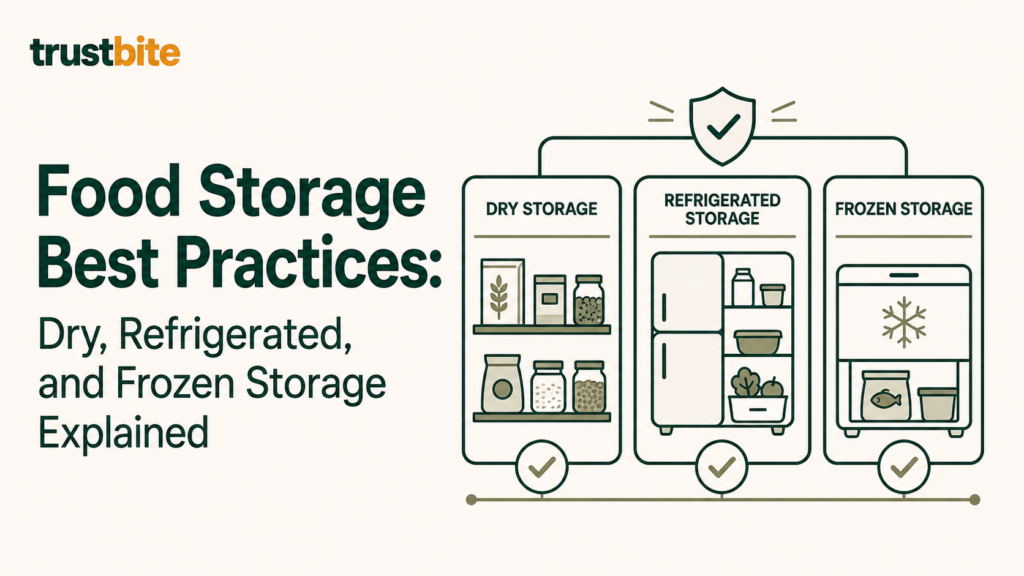
Food storage best practices are the procedures and conditions required to keep food safe from the point it enters a food business to the point it is used in preparation or service. They cover dry goods storage, refrigerated storage of perishable and chilled products, and frozen storage of products requiring sub-zero temperature maintenance. In each storage category, the goal is the same: prevent contamination, control microbial growth, maintain product integrity, and enable accurate traceability of what has been stored and when.
Poor food storage is one of the most consistently identified contributors to food safety failures across all types of food business. Temperature abuse in refrigerated storage, allergen cross-contact from improper ingredient segregation, pest access to dry goods, and FIFO failures that allow food to exceed its shelf life all originate in storage areas and create risks that subsequent preparation steps often cannot undo.
Why Food Storage Best Practices Matter
Food storage best practices matter because many of the hazards that produce foodborne illness, allergen reactions, and product recalls originate not in active food preparation but in the conditions under which food is held before preparation begins. A pathogen introduced into food through inadequate refrigerated storage cannot always be eliminated at a subsequent cooking step, particularly in ready to eat foods that receive no further heat treatment. An allergen cross-contact that occurs in dry goods storage because allergen-containing and allergen-free ingredients share a shelf creates a risk that may not be detected before product reaches a consumer.
Storage is also where traceability evidence is generated or lost. A business that can trace a contamination event to a specific batch of incoming ingredient depends on storage records and date labelling practices established when the ingredient was first put away. A storage system that does not record lot numbers, does not label products with use-by or use-first dates, or does not apply FIFO stock rotation consistently cannot generate the traceability evidence a recall investigation requires.
Dry Goods Storage Best Practices
Dry goods storage covers non-perishable ingredients, packaging materials, and cleaning products held at ambient temperature. The food safety risks in dry goods storage are primarily contamination rather than microbial growth, since most dry goods do not support rapid bacterial growth at ambient temperatures, though some do under certain humidity conditions.
Physical separation of food from non-food items is a fundamental dry storage requirement. Cleaning chemicals, pest control products, and other non-food materials must be stored separately from food ingredients and packaging, typically in a dedicated locked store. Chemical contamination from improper storage proximity is a food safety risk that has caused serious incidents where cleaning agents were mistakenly used in food preparation.
Allergen segregation in dry goods storage is critical for businesses handling multiple products with different allergen profiles. Allergen-containing ingredients must be stored separately from allergen-free ingredients in a way that prevents cross-contact through spillage, dusting, or shared containers. Labelled, sealed, dedicated storage areas for allergen-containing ingredients, positioned to prevent allergen-free ingredients being stored directly below them where spillage or dusting could cause cross-contact, are the physical control required.
All dry goods must be stored off the floor, typically on shelving at least 15 centimeters above floor level. Floor-level storage prevents cleaning of the floor area beneath products, creates pest harboring sites, and risks moisture ingress from floor cleaning activities.
FIFO, First In First Out, is the stock rotation principle that ensures the oldest stock of any ingredient is used before newer stock, preventing products from exceeding their shelf life in storage. FIFO requires clear date labelling of all stored items, including the date of receipt and the use-by or use-first date, and storage organization that places older stock at the front where it will be selected first.
Pest control for dry goods storage requires good housekeeping to remove food debris that attracts pests, regular inspection of stored goods and the storage area for pest activity, structural integrity of the storage area to exclude pest entry, and a documented pest control program that includes scheduled monitoring and treatment activities.
Refrigerated Storage Best Practices
Refrigerated storage is required for perishable food products that must be held below 5°C to prevent bacterial growth at rates that would make them unsafe within their intended shelf life. The food safety risks in refrigerated storage include temperature abuse if the refrigerator fails to maintain its set point, cross-contamination between raw and ready to eat products, and allergen cross-contact between products stored in proximity.
Temperature control is the primary refrigerated storage control. Refrigerators used for food storage must maintain a temperature of 5°C or below throughout the storage space, including in areas furthest from the cooling element. Temperature must be monitored at defined intervals and recorded. Continuous automated temperature logging provides stronger monitoring evidence than periodic manual checks, since it generates a complete record of every temperature reading across the monitoring period and reveals any excursion that occurs between manual checks. Food safety monitoring equipment providers such as Adria Food Tech supply refrigerated storage monitoring systems including wireless temperature sensors and data logging equipment that generate the continuous records food safety management systems and auditors require as verification of cold storage CCP performance.
Separation of raw and ready to eat products is essential in refrigerated storage. Raw meat, poultry, and fish must be stored separately from ready to eat products, and where separate refrigerators are not available, raw products must be stored on lower shelves to prevent drip contamination onto ready to eat products stored below. Dedicated refrigerators for raw and ready to eat products respectively provide stronger separation than shelf placement in a shared unit.
Allergen management in refrigerated storage follows the same principle as dry goods allergen segregation. Products containing allergens that are not present in other stored products must be stored in a way that prevents cross-contact, with particular attention to products stored immediately below allergen-containing items.
Date labelling in refrigerated storage must confirm the use-by date of each product and, for opened or decanted products, the date of opening or preparation. Unlabelled or incorrectly dated products in refrigerated storage are a common audit finding and a genuine food safety risk since staff cannot determine whether the product remains within a safe use period.
Refrigerator loading practices affect temperature maintenance. A refrigerator that is overloaded with warm food must work significantly harder to cool the contents, and may fail to maintain its set point during this cooling period. Large volumes of warm food should be cooled in smaller portions or using blast chilling equipment before being transferred to refrigerated storage.
Frozen Storage Best Practices
Frozen storage is required for products that must be maintained at minus 18°C or below to prevent microbial growth and maintain product quality across the intended storage period. The food safety risks specific to frozen storage are primarily associated with thawing events, both unintended partial thaws and planned thawing procedures.
Temperature monitoring for frozen storage follows the same principles as refrigerated storage monitoring, with the additional consideration that excursions above minus 18°C in frozen storage may not always be visible in the product appearance and may produce partial thawing that allows bacterial multiplication before refreezing. Continuous temperature monitoring that generates alerts when frozen storage temperatures rise above defined thresholds allows rapid response before a significant thaw event occurs.
FIFO stock rotation applies to frozen storage as to dry and refrigerated storage. The date of freezing and the use-by date of frozen products must be clearly marked on packaging, and older stock must be selected before newer stock.
Thawing procedures for frozen food must be documented and followed consistently. Thawing at room temperature places the outer layers of frozen food in the danger zone while the interior remains frozen, creating conditions for bacterial growth during the thawing period. Safe thawing methods include thawing under refrigeration, which keeps the product below 5°C throughout the thawing process, and thawing under cold running water, which is faster than refrigeration thawing but still keeps the product at a lower temperature than room-temperature thawing.
Products that have been thawed must not be refrozen unless they are cooked to a safe temperature first. Refreezing without cooking does not eliminate any bacterial growth that occurred during the thaw period and may mask the safety status of the product from staff who see a frozen product and assume it is in its original condition.
Cross-Cutting Food Storage Best Practices
Several food storage best practices apply across dry, refrigerated, and frozen storage categories.
Labelling of all stored items with product identity, date of receipt or preparation, and use-by date is required across all storage categories. Labels must be legible, durable for the storage conditions in use, and positioned where they can be read without moving the product.
Stock rotation following FIFO principles must be applied consistently across all storage areas. A FIFO system that is applied in refrigerated storage but not in dry goods storage leaves the dry goods area as a source of date-exceeded ingredients that may enter preparation without the date check that would have identified them.
Cleaning schedules covering all storage areas must specify the method, frequency, and verification of cleaning for each storage type. Refrigerators and freezers require periodic deep cleaning in addition to routine spillage cleaning, and the cleaning schedule must specify how food is handled during cleaning to prevent contamination during the process.
Staff training on food storage best practices covers the specific storage requirements applicable to the business, including the temperature targets for each storage category, the allergen segregation requirements, the date labelling and FIFO procedures, and the reporting procedure when a temperature excursion, pest sighting, or date labelling gap is identified. Providers such as Confi Food include food storage best practices as a component of food handler training programs, covering the reasoning behind storage requirements alongside the specific procedures staff are expected to apply in their roles.
Traceability Through Food Storage Records
Food storage practices generate the traceability records that allow a business to respond rapidly to a food safety event. When an ingredient is identified as a contamination risk, the ability to trace which products were made using that ingredient, and when those products were distributed, depends on storage intake records that captured the lot number of the incoming ingredient, date labelling records that link the ingredient lot to specific production dates, and stock rotation records that confirm when the ingredient was used.
A storage system that does not capture this information at the intake and storage stage cannot produce this traceability evidence when it is needed. Traceability exercises and mock recalls that test the food storage record system confirm whether the records generated are sufficient to support a real recall investigation.
Conclusion
Food storage best practices across dry, refrigerated, and frozen categories are foundational food safety controls that determine the condition of ingredients before preparation begins and the integrity of the traceability chain that allows swift response when food safety events occur. Temperature control in refrigerated and frozen storage, physical and allergen separation in all storage categories, consistent date labelling and FIFO stock rotation, effective cleaning programs, and staff who understand the food safety reasoning behind each requirement together produce a storage system that protects food safety from the moment ingredients arrive until the moment they are used.
Frequently Asked Questions
What are the most important food storage best practices?
The most important food storage best practices include maintaining correct temperatures in refrigerated and frozen storage, separating raw and ready to eat products to prevent cross-contamination, segregating allergen-containing ingredients from allergen-free ones, applying FIFO stock rotation, clearly labelling all stored items with use-by dates, storing food off the floor, and keeping non-food items separate from food ingredients.
What temperature should refrigerated food storage be maintained at?
Refrigerated food storage should be maintained at 5°C or below. Temperature should be monitored and recorded at defined intervals, with continuous automated monitoring providing stronger assurance than periodic manual checks.
What temperature should frozen food storage be maintained at?
Frozen food storage should be maintained at minus 18°C or below. Temperature monitoring is required, and continuous monitoring systems that alert when temperatures rise above defined thresholds allow rapid response to potential thaw events.
What is FIFO in food storage?
FIFO stands for First In First Out. It is the stock rotation principle that ensures the oldest stock of any product or ingredient is used before newer stock, preventing items from exceeding their shelf life while being held in storage. FIFO requires clear date labelling of all stored items and storage organization that places older stock at the front.
How should raw meat and ready to eat food be stored together in a shared refrigerator?
Where separate refrigerators for raw and ready to eat products are not available, raw meat, poultry, and fish must be stored on lower shelves to prevent drip contamination onto ready to eat products stored below them. Dedicated refrigerators for each category provide stronger protection.
Why must food be stored off the floor?
Storing food off the floor, typically on shelving at least 15 centimeters above floor level, prevents pest harboring sites under stored goods, allows cleaning of the floor area beneath storage, prevents moisture ingress from floor cleaning, and reduces the risk of contamination from floor-level sources.
How should allergen-containing ingredients be stored?
Allergen-containing ingredients must be stored in clearly labelled, sealed, dedicated storage areas separate from allergen-free ingredients. They should not be stored directly above allergen-free ingredients where spillage or dusting could cause cross-contact.
What are safe thawing methods for frozen food?
Safe thawing methods include thawing under refrigeration, which keeps the product below 5°C throughout the process, and thawing under cold running water. Thawing at room temperature places the outer layers of frozen food in the danger zone while the interior is still frozen and should not be used as a routine thawing method.
Can food be refrozen after it has been thawed?
Food that has been thawed at room temperature should not be refrozen. Food thawed under refrigeration that has not entered the danger zone may be refrozen, but this should be documented. Food that has been cooked after thawing can be refrozen after cooling to a safe temperature.
What should be included on labels for stored food?
Labels for stored food should include the product identity, the date of receipt or the date of opening or preparation for decanted products, the use-by or use-first date, and for allergen-containing products, the allergen content or a clear allergen designation.
How often should refrigerators and freezers be cleaned?
Cleaning frequency depends on the type of food stored and the level of contamination risk. Routine cleaning should occur whenever a spillage happens and at defined scheduled intervals. Deep cleaning of refrigerators and freezers should be scheduled periodically and recorded. Cleaning procedures must specify how food is handled during cleaning to prevent contamination.
What pest control measures apply to dry goods storage?
Dry goods storage pest control measures include maintaining good housekeeping to remove food debris, regular inspection of stored goods and the storage area for pest activity, structural integrity of the storage area to exclude pest entry, and a documented pest control program with scheduled monitoring and treatment activities.
How does food storage relate to traceability?
Food storage records including ingredient intake records capturing lot numbers, date labelling records linking ingredients to specific storage and use dates, and FIFO records confirming the order of ingredient use generate the traceability evidence that allows a business to rapidly identify which products were made using a specific ingredient lot when a food safety event requires investigation.
What training do staff need on food storage best practices?
Staff need training covering the temperature targets for each storage category and how to monitor and record them, allergen segregation requirements, date labelling and FIFO procedures, cleaning requirements for storage areas, and the procedure for reporting temperature excursions, pest sightings, or date labelling gaps.
Related from the Knowledge Center
The Food Safety Danger Zone: What It Is and Why Temperature Control Matters
The danger zone is the temperature range that refrigerated and frozen storage is designed to keep food out of. This article explains the danger zone concept and the microbial growth it enables.
Cold Chain Management: What It Is and Why It Matters for Food Safety
Food storage is one stage within the broader cold chain. This article covers how temperature control is maintained across the full supply chain from production to consumption.
Allergen Management in Food Businesses: A Practical Guide
Allergen segregation in storage is one component of a comprehensive allergen management system. This article covers the full scope of allergen management from ingredient specification through to labelling and consumer communication.