
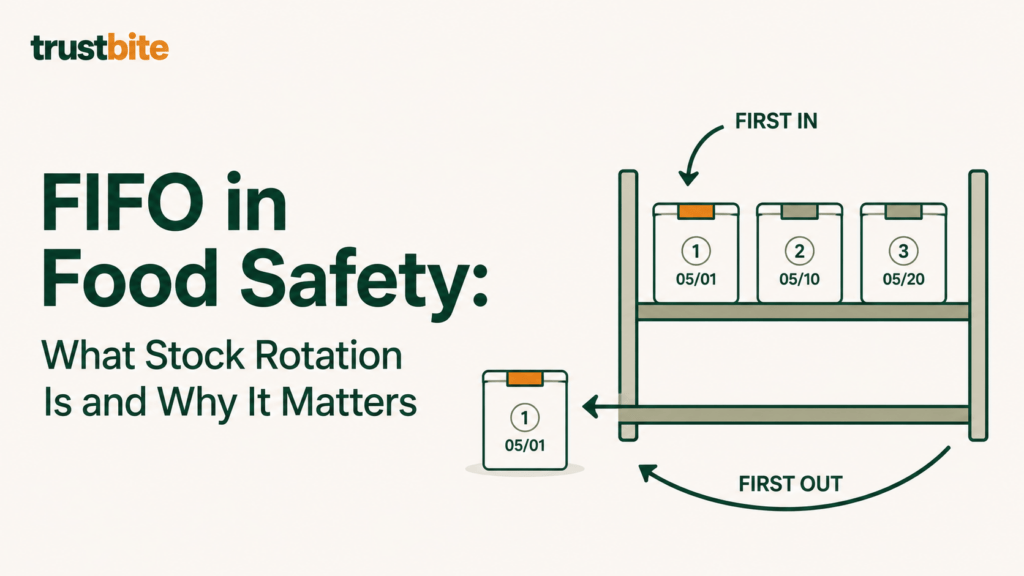
FIFO food safety practice is the stock rotation principle that ensures the oldest inventory of any food product or ingredient is used before newer stock of the same product. FIFO stands for First In, First Out, and it applies across every storage category in a food business: dry goods, refrigerated ingredients, frozen products, and finished goods awaiting distribution. FIFO food safety stock rotation prevents products from exceeding their shelf life while being held in storage and is one of the most straightforward yet most consistently mismanaged food safety controls in daily operations.
The food safety consequence of failing to apply FIFO food safety principles is predictable. An ingredient batch that has been superseded by newer deliveries but remains at the back of a shelf, pushed behind the fresh stock, accumulates time against its use-by date while appearing to be part of the normal inventory. When it is eventually reached, it may be beyond its safe use date, may have undergone quality deterioration that indicates food safety compromise, or may have been used in production without the date check that would have identified it as out of specification.
What Is FIFO in a Food Safety Context?
FIFO food safety stock rotation means organizing and managing food inventory so that items received or produced first are always used or sold before items received or produced more recently. The principle requires physical organization of storage areas so that older stock is positioned at the front or top where it will be selected first, newer stock is placed behind or beneath existing stock, and clear date labelling allows the order of use to be confirmed without relying on memory.
FIFO food safety practice applies wherever food is stored before use, including dry goods rooms holding ingredients and packaging materials, refrigerators and cold rooms holding chilled ingredients and finished products, freezers holding frozen ingredients and finished goods, and finished product warehouses holding sealed products before distribution.
FIFO food safety controls are assessed during food safety audits and regulatory inspections as part of the review of prerequisite programs and food safety management practices. An auditor who observes products with earlier use-by dates behind products with later ones, or who finds unlabelled products with no way to determine their age, has identified a FIFO food safety control failure regardless of whether any specific product has yet exceeded its use-by date.
Why FIFO Food Safety Stock Rotation Matters
FIFO food safety stock rotation matters because shelf life is a food safety control, not only a quality measure. The use-by date on a perishable food product is the point beyond which the manufacturer or producer cannot guarantee the product is safe for consumption based on the conditions of storage specified on the label. For pathogen control in chilled products, the shelf life is calculated with a safety margin that accounts for the possibility of low-level contamination that multiplies slowly under correct refrigeration. That safety margin is consumed by time in storage regardless of whether the product is used.
A FIFO food safety failure that allows a chilled product to remain in storage beyond its use-by date before it is used in preparation does not produce a product that looks, smells, or tastes different in most cases. Many foodborne pathogens produce no visible, olfactory, or taste indicators at the concentrations that cause illness. The product appears normal and may be served or used in production without any indication that its food safety status has been compromised by FIFO food safety failure.
FIFO food safety practice also matters for allergen management. Where an ingredient specification changes and the allergen status of a product in a specific lot is different from more recent deliveries, FIFO food safety stock rotation ensures that older, potentially differently specified stock is used and cleared before the newer stock is used. A FIFO failure in this context could result in an allergen-free production run using an ingredient lot that does not match the allergen specification the HACCP plan assumed.
FIFO food safety control is also the mechanism through which traceability is maintained in practice. A FIFO food safety system that documents the lot numbers of ingredients as they enter storage and records their use in production in the order they arrived creates the traceability chain that allows a specific lot to be traced through production to finished goods if a food safety event requires investigation. Without FIFO food safety discipline, ingredient lots become mixed, and the traceability evidence needed for a recall investigation may be impossible to reconstruct.
How FIFO Food Safety Stock Rotation Is Implemented
FIFO food safety stock rotation requires three things working together: physical storage organization that makes selecting older stock the easiest choice, date labelling that makes the age of each item visible, and staff training that establishes FIFO food safety practice as the automatic approach to stock selection rather than something that requires deliberate thought.
Physical storage organization for FIFO food safety practice means that shelving, racking, and refrigerated storage are arranged so that new deliveries are placed behind or beneath existing stock. Walk-in cold rooms may have designated entry points for new stock and designated exit points for stock being selected for use, creating a physical flow that enforces FIFO food safety practice without relying on staff to manually select older items.
In practice, correct FIFO food safety physical organization requires time to rearrange existing stock before placing new deliveries, which conflicts with the operational pace of goods receiving during busy periods. A goods receiving procedure that specifies the FIFO food safety steps required at the time of delivery, including the requirement to place new stock behind existing stock before the delivery is signed off, builds this discipline into the receiving process rather than leaving it to individual staff judgment.
Date labelling for FIFO food safety practice must confirm the use-by date of every item in storage clearly enough that it can be read without moving the item. Refrigerator storage where use-by dates are hidden behind the product packaging rather than visible on the front of the item creates a FIFO food safety labelling failure regardless of how well the physical storage organization is otherwise managed.
For opened, decanted, or prepared products that do not carry their original manufacturer’s date labelling, internal date labelling using colour-coded day dots or dated labels must confirm when the product was opened or prepared and by when it must be used or discarded. A consistent colour-coding system for day-of-week labelling, with staff trained to understand and apply it, is a practical FIFO food safety labelling approach for high-volume food service environments.
Prepared and produced goods must carry production date and use-by information that allows FIFO food safety stock rotation to be applied in exactly the same way as for purchased ingredients. A batch of cooked product prepared on Tuesday must be used before a batch prepared on Wednesday, and the labelling and storage organization must make this sequence clear and enforceable.
FIFO Food Safety Practice in Different Storage Categories
FIFO food safety stock rotation applies consistently across storage categories but requires category-specific implementation approaches.
In dry goods storage, FIFO food safety practice means bags, boxes, and containers of dry ingredients are stacked with the oldest delivery at the front or top and newer deliveries added behind or beneath. Large-volume dry goods stored in bins or hoppers require a full empty-before-refill discipline for true FIFO food safety compliance, since topping up a half-full bin with new stock without emptying the residual old stock first creates a FIFO food safety failure at the bottom of every bin.
In refrigerated storage, FIFO food safety rotation requires that new deliveries of chilled products are placed at the back of shelving with existing stock moved forward. The same principle applies to own-produced products such as cooked dishes, prepared ingredients, and portioned raw materials. Designated sections of refrigerated storage for specific product categories, with clear labelling of each section, support FIFO food safety compliance by preventing different products from being mixed in ways that obscure the date sequence.
In frozen storage, FIFO food safety rotation requires the same physical organization principles as refrigerated storage, with the additional consideration that frozen products may be harder to rearrange due to weight, packaging rigidity, and the impracticality of spending extended time in frozen storage for stock rotation activities. Designated frozen storage locations for each product with clear date labelling visible from outside the storage unit supports FIFO food safety rotation without requiring physical rearrangement with each new delivery.
Continuous electronic monitoring of refrigerated and frozen storage temperatures from providers such as Adria Food Tech supports FIFO food safety management by confirming that the cold storage conditions under which FIFO food safety rotation is occurring are maintained at correct temperatures throughout, providing the objective monitoring records that confirm cold chain integrity alongside the FIFO food safety stock rotation records that confirm date sequencing.
Training Staff on FIFO Food Safety Practice
FIFO food safety stock rotation is a control that depends almost entirely on staff behavior in daily operations. No physical system can enforce FIFO food safety compliance without staff who understand the principle, know the labelling requirements of the operation they work in, and apply stock rotation consistently as part of every goods receiving and stock selection activity.
Food safety training that explains why FIFO food safety stock rotation matters, not just what the correct procedure is, produces more consistent compliance than training that presents FIFO food safety practice as a procedural requirement without context. A food handler who understands that using a product past its use-by date creates a food safety risk that cannot be detected by appearance or smell is more motivated to apply FIFO food safety stock rotation correctly than one who has been told to check dates because it is required.
Training should cover the specific labelling system used in the operation, including colour-coding or date label formats for prepared products, the physical organization required in each storage area, and the reporting procedure when a product is found past its use-by date. Providers such as Confi Food include FIFO food safety stock rotation as a component of food handler training programs, covering the food safety reasoning alongside the practical procedures staff are expected to apply in their specific roles.
FIFO Food Safety Practice and Traceability
FIFO food safety practice generates the traceability chain that allows a food business to respond to a food safety event involving a specific ingredient lot. When a supplier notifies a food business that an ingredient lot they supplied is contaminated or has been recalled, the food business needs to determine whether that specific lot has been used, when it was used, and in which finished products it appeared.
A FIFO food safety system that records lot numbers at goods receipt, sequences ingredients through production in receipt order, and links production records to ingredient lot numbers through the FIFO food safety sequence generates this traceability information as a natural output of the stock rotation system. Without FIFO food safety discipline, ingredient lots can become mixed in storage in ways that make it impossible to determine which production batches were made from which ingredient lots.
Mock traceability exercises that test the FIFO food safety traceability chain by attempting to trace a hypothetical ingredient lot through production confirm whether the records generated by the FIFO food safety system are sufficient to support a real recall investigation. A traceability exercise that fails because stock rotation was not recorded, lot numbers were not captured at receipt, or production records do not link to ingredient lots reveals a FIFO food safety traceability gap that should be addressed before it is needed in a real event.
Conclusion
FIFO food safety stock rotation is one of the most fundamental and most practically important food safety controls in daily food business operations. It prevents ingredients and products from being used after their use-by date, maintains the allergen and specification integrity of production by ensuring ingredient lot sequences are known, and generates the traceability chain that supports rapid response to food safety events involving specific ingredient lots. Effective FIFO food safety practice requires physical storage organization that makes selecting older stock the default, date labelling that makes the age of every stored item visible, and trained staff who understand why the principle matters and apply it consistently in every goods receiving and stock selection activity.
Frequently Asked Questions
What is FIFO in food safety?
FIFO in food safety stands for First In, First Out. It is the stock rotation principle that ensures the oldest inventory of any food product or ingredient is used before newer stock, preventing products from exceeding their use-by date while in storage and maintaining the traceability chain that links production to specific ingredient lots.
Why is FIFO important for food safety?
FIFO food safety practice is important because shelf life is a food safety control, not only a quality measure. Using a product past its use-by date can create a food safety risk that is invisible in the product’s appearance, smell, or taste. FIFO food safety rotation prevents this by ensuring older stock is always used first.
How is FIFO food safety stock rotation implemented in practice?
FIFO food safety practice requires physical storage organization that places older stock at the front or top of storage where it is selected first, clear date labelling of all stored items, and staff training that establishes stock rotation as the automatic approach to every goods receiving and stock selection activity.
Does FIFO food safety apply to frozen storage?
Yes. FIFO food safety stock rotation applies to frozen storage as well as refrigerated and dry goods storage. Frozen products should be organized so that older stock is selected before newer stock, with clear date labelling visible from outside the storage unit.
What labelling is required to support FIFO food safety practice?
All stored food items must carry visible use-by or use-first date labelling. Opened, decanted, or prepared products must carry internal date labelling confirming when the product was opened or prepared and by when it must be used or discarded. The labelling must be legible and visible without moving the item.
What is the food safety consequence of a FIFO failure?
A FIFO food safety failure can result in products or ingredients being used after their use-by date, creating a food safety risk that is not detectable from the product’s appearance. It can also compromise allergen management by using ingredient lots whose specification differs from more recent deliveries, and disrupts the traceability chain needed to respond to food safety events.
Can FIFO food safety practice be audited?
Yes. FIFO food safety practice is assessed during food safety audits and regulatory inspections through observation of storage area organization, review of date labelling on stored products, and checking of goods receiving records for lot number capture and date sequencing. A storage area where products with earlier use-by dates are behind products with later dates has a visible FIFO failure.
How does FIFO food safety practice relate to traceability?
FIFO food safety practice generates the traceability chain by recording ingredient lot numbers at receipt and using ingredients in the order they arrived. This allows a specific lot to be traced through production to finished goods when a food safety event requires investigation.
What training do staff need for FIFO food safety practice?
Staff need training covering why FIFO food safety stock rotation matters, the specific labelling system used in the operation, the physical organization required in each storage area, and the reporting procedure when a product is found past its use-by date or when the FIFO sequence cannot be maintained.
Does FIFO food safety apply to own-produced products as well as purchased ingredients?
Yes. FIFO food safety stock rotation applies to all stored products, including batches of cooked food, prepared ingredients, and portioned raw materials produced within the food business. Production date and use-by information must be applied to own-produced products so that FIFO food safety rotation can be applied in exactly the same way as for purchased ingredients.
What is the relationship between FIFO food safety and dry goods storage?
In dry goods storage, FIFO food safety practice requires placing new deliveries behind existing stock and using residual stock before new deliveries. Large-volume dry goods in bins or hoppers require a full empty-before-refill practice because topping up without emptying creates a FIFO food safety failure at the bottom of every container.
How does FIFO food safety practice prevent allergen incidents?
FIFO food safety rotation ensures that ingredient lots are used in the order they were received. Where an ingredient specification changes between deliveries and the allergen status of different lots differs, FIFO food safety practice confirms which lot was used in any specific production run, maintaining the allergen traceability that underpins accurate product labelling.
What is a mock traceability exercise and how does it test FIFO food safety practice?
A mock traceability exercise tests the FIFO food safety traceability chain by attempting to trace a hypothetical ingredient lot through production to finished goods using the records generated by the stock rotation system. A successful exercise confirms that FIFO food safety records are sufficient to support a real recall investigation. A failed exercise reveals traceability gaps that should be addressed.
How does colour-coded day dot labelling support FIFO food safety in food service?
Colour-coded day dot labelling uses different colours assigned to different days of the week to label prepared products with their production date without requiring a written date on each item. Staff trained on the colour code can identify the production date and apply FIFO food safety rotation without reading individual date labels, which is practical in high-volume food service environments.
Related from the Knowledge Center
Food Storage Best Practices: Dry, Refrigerated, and Frozen Storage Explained
FIFO food safety stock rotation is the core stock management principle within a complete food storage best practice system. This article covers all aspects of safe food storage across dry, refrigerated, and frozen categories.
Cold Chain Management: What It Is and Why It Matters for Food Safety
FIFO food safety practice in chilled and frozen storage operates within the broader cold chain management system. This article explains how temperature control is maintained across the full supply chain from production to consumption.
Anatomy of a Food Recall: How Contamination Reaches Consumers
FIFO food safety traceability records are the mechanism through which a food business can rapidly identify and limit the scope of a recall affecting a specific ingredient lot. This article explains how food recalls unfold and what traceability systems must be able to do.