
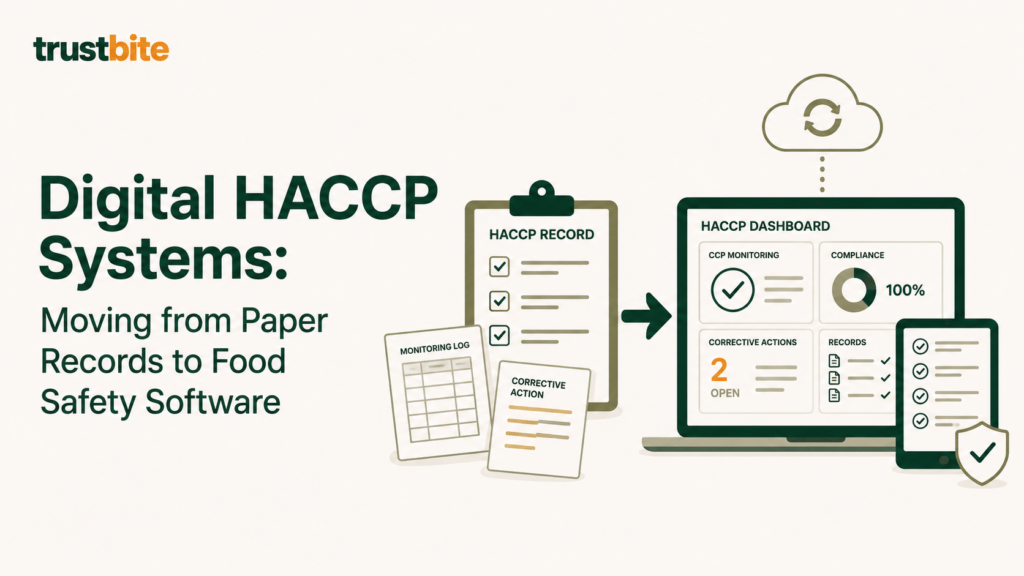
A digital HACCP system is a software-based approach to managing the documentation, monitoring, corrective action, and verification activities that a HACCP-based food safety management system requires. It replaces or supplements the paper-based records that traditional HACCP implementation has relied on, generating electronic records that are more consistent, more complete, and more immediately accessible than manual logs completed by hand during production.
The shift from paper to a digital HACCP system is underway across the food industry for practical operational reasons as much as technological ones. Paper records have gaps between monitoring events, require physical retrieval during audits, and depend entirely on the diligence and accuracy of the person completing them at the time. A digital HACCP system addresses all three of these limitations while generating the objective, time-stamped evidence that food safety auditors and regulatory inspectors increasingly expect.
What Is a Digital HACCP System?
A digital HACCP system is a software platform or integrated technology solution that manages the core documentation and data-recording functions of a HACCP-based food safety management system. At its most basic level, a digital HACCP system replaces paper monitoring logs with electronic forms completed on a tablet, smartphone, or dedicated device. At a more advanced level, a digital HACCP system integrates with automated monitoring equipment to capture temperature, process, and detection data directly without requiring manual data entry.
A digital HACCP system typically covers the documentation of the HACCP plan itself, including product descriptions, flow diagrams, hazard analyses, CCP identification, critical limit specifications, monitoring procedures, and corrective action definitions. It also covers the operational records generated when the plan is followed in practice: CCP monitoring logs, corrective action records, verification activity records, calibration logs, and training records.
The distinguishing feature of a digital HACCP system compared to paper records is the quality and reliability of the data it generates. Electronic records created in real time cannot be backdated, cannot have entries missed without the gap being visible in the record, and are immediately available for retrieval without physical filing or searching through paper logs.
Why Food Businesses Move to a Digital HACCP System
Food businesses move to a digital HACCP system for several overlapping reasons that reflect both operational and compliance motivations.
Audit performance is one of the most immediate drivers. Food safety auditors reviewing paper monitoring records regularly encounter illegible entries, missing signatures, gaps in the monitoring sequence, and patterns of entries that suggest retrospective completion rather than real-time recording. A digital HACCP system generates records that are legible by definition, automatically time-stamped, and impossible to complete retrospectively without the gap being visible in the data. Auditors recognize the difference, and businesses that transition to a digital HACCP system typically find that their documentation-related non-conformances reduce significantly at the next audit.
Operational visibility is another significant driver. A paper-based monitoring system requires a supervisor to physically collect and review monitoring logs to assess whether CCPs are being controlled consistently. A digital HACCP system makes this information available in real time on a management dashboard, allowing issues to be identified and addressed as they occur rather than discovered during the next shift’s record review.
Multi-site operations benefit particularly from a digital HACCP system because it allows food safety management performance to be monitored consistently across all locations from a single platform. Comparing CCP monitoring compliance rates, corrective action response times, and training completion status across multiple sites is straightforward in a digital system and extremely cumbersome with paper records.
The growing requirement among buyers, retailers, and certification bodies for objective monitoring evidence rather than manually completed logs is creating commercial pressure toward digital HACCP systems. Some major retailers now specifically ask about food safety management system digitization as part of supplier questionnaires.
Components of a Digital HACCP System
A digital HACCP system covers several functional areas that map to the core elements of a HACCP-based food safety management system.
HACCP documentation management stores the HACCP plan itself as a live document that can be updated when process changes require review, with version control that records every revision, who made it, and when. This addresses one of the most common audit findings: outdated HACCP plans that were accurate when written but have not been updated to reflect current operations.
CCP monitoring record capture replaces paper monitoring logs with electronic records completed on a device at the point of monitoring. Mandatory fields prevent records from being submitted incomplete. Time and date stamping is automatic. Where a monitoring result falls outside the critical limit, the system can prompt the operative to record the corrective action taken before the monitoring entry is closed.
Automated monitoring integration is the most powerful feature of advanced digital HACCP systems. Rather than relying on a person to measure and record a temperature, a continuous electronic sensor measures the parameter automatically and logs every reading to the system without human intervention. When a reading exceeds the critical limit, the system generates an immediate alert to the responsible person and records the excursion, its duration, and the corrective action taken. Food safety monitoring equipment providers such as Adria Food Tech supply the sensor hardware and data logging infrastructure that integrates with digital HACCP software platforms, providing the automated monitoring layer that removes human data entry from the most time-sensitive CCP monitoring activities.
Corrective action management within a digital HACCP system links each corrective action directly to the monitoring record that triggered it, with fields for recording the immediate action taken, the product disposition decision, the responsible person, and the date and time of resolution. This creates a complete, searchable corrective action history that can be retrieved during audits without manual filing.
Verification activity tracking records calibration events, internal audits, and product or environmental testing results within the same system that holds the monitoring records they verify, creating a single integrated record of food safety management system performance.
Training record integration within a digital HACCP system links training completion data for each employee to their monitoring responsibilities, allowing the system to flag where a person is assigned a monitoring role for which their training record shows no relevant completion.
Making the Transition from Paper to a Digital HACCP System
Transitioning from paper records to a digital HACCP system requires planning across three areas: the food safety management system content that will be migrated to the new platform, the operational change management required to embed digital processes into daily workflows, and the staff training needed to ensure the system is used correctly.
The food safety management system content review should happen before or alongside the digital transition, because migrating an outdated or inaccurate HACCP plan to a new platform creates a digital version of the same problem. The transition provides a natural opportunity to review and update the HACCP plan, verify the flow diagram against current operations, and confirm that critical limits and monitoring procedures are current before they are loaded into the new system.
Operational change management addresses the reality that a digital HACCP system changes how monitoring is performed, records are completed, and corrective actions are managed. Staff who have completed paper records for years need to understand not just how to use the new system but why the change is being made and how the digital system benefits them in their daily work. Change management that presents the digital transition as a support for food safety work rather than an additional burden on top of existing tasks produces better adoption rates.
Staff training for a digital HACCP system covers the operational use of the platform or devices being introduced, but should also reinforce the food safety principles that underpin the monitoring activities the system manages. A food handler who understands why CCP monitoring matters and what their monitoring data is used for is more likely to use a digital system carefully and correctly than one who sees it as a new way to complete the same administrative task. Providers such as Confi Food develop food safety training programs that build this foundational understanding, which supports the successful adoption of a digital HACCP system by giving staff the context they need to engage with digital monitoring tools as genuine food safety controls rather than compliance paperwork.
What a Digital HACCP System Cannot Do
A digital HACCP system improves the consistency and reliability of food safety record-keeping but does not replace the food safety management knowledge and judgment that the HACCP plan requires. A digital system that records inaccurate monitoring results, manages a poorly designed corrective action process, or operates against an outdated HACCP plan is a digital version of the same problems that exist in a paper-based system.
The quality of a digital HACCP system is ultimately determined by the quality of the HACCP plan it is built on. A thorough hazard analysis, correctly identified CCPs, science-based critical limits, and well-designed monitoring procedures are what make a digital HACCP system an effective food safety control. The technology makes these elements more consistently applied and more reliably recorded. It does not create them.
Digital HACCP Systems and Food Safety Audits
Auditors are increasingly familiar with digital HACCP systems and generally view them positively as evidence of a food safety management system that is actively managed rather than periodically updated. The quality of the records a digital HACCP system generates, including real-time monitoring entries, automated sensor data, and linked corrective action records, provides stronger audit evidence than the equivalent paper records.
The transition period between paper and digital records may require explanation during an audit, since monitoring records from before the transition will be in a different format from those generated afterward. A brief document in the HACCP file explaining the transition date and confirming the continuity of the monitoring program across both formats addresses this without ambiguity.
Conclusion
A digital HACCP system improves the consistency, completeness, and auditability of food safety management records by replacing or supplementing paper-based monitoring with electronic records generated in real time. The transition from paper to a digital HACCP system produces measurable improvements in audit performance, operational visibility, and monitoring reliability when it is built on a sound HACCP plan and supported by effective staff training. The technology amplifies the quality of the food safety management system it serves rather than substituting for it.
Frequently Asked Questions
What is a digital HACCP system?
A digital HACCP system is a software-based approach to managing the documentation, monitoring records, corrective actions, and verification activities of a HACCP-based food safety management system, replacing or supplementing paper records with electronic records generated in real time.
What are the main benefits of a digital HACCP system over paper records?
The main benefits are improved record completeness through mandatory digital fields, automatic time-stamping that eliminates retrospective completion, real-time operational visibility of CCP monitoring status, easier retrieval of records during audits, and integration capability with automated monitoring sensors that remove human data entry from critical monitoring steps.
Does a digital HACCP system replace the need for a HACCP plan?
No. A digital HACCP system manages the records generated by implementing a HACCP plan but does not create the plan itself. The quality of a digital HACCP system depends entirely on the quality of the underlying hazard analysis, CCP identification, and monitoring procedure design it is built on.
What monitoring equipment integrates with a digital HACCP system?
Temperature sensors, cold chain monitoring devices, metal detectors, flow meters, and other process monitoring instruments can integrate with digital HACCP platforms through wired or wireless data connections, automatically logging readings to the system without manual data entry.
How does a digital HACCP system help during food safety audits?
A digital HACCP system provides auditors with complete, legible, automatically time-stamped records that cannot be retrospectively completed. The system also allows rapid retrieval of specific records by date, location, or CCP without manual file searching, which significantly reduces the time required for documentation review during an audit.
What staff training is required to implement a digital HACCP system?
Staff need training on the operational use of the platform and devices being introduced, as well as a reinforcement of the food safety principles underlying the monitoring activities the system manages. Staff who understand why CCP monitoring matters are more likely to use a digital system correctly than those who see it as a new administrative process.
Can a digital HACCP system be used across multiple sites?
Yes. Cloud-based digital HACCP systems allow food safety management performance to be monitored consistently across multiple sites from a single platform, making multi-site operations substantially easier to manage than paper-based systems which require physical aggregation of records from different locations.
Is a digital HACCP system accepted by certification bodies?
Yes. BRCGS, ISO 22000, SQF, FSSC 22000, and other major certification bodies accept digital records as valid documentation of HACCP system implementation. Some schemes may have specific requirements about record retention and system validation that should be confirmed with the relevant certification body.
What happens to paper records during the transition to a digital HACCP system?
Paper records generated before the digital transition should be retained for the required retention period and remain available for audit alongside the digital records generated after the transition. A note in the HACCP documentation explaining the transition date and confirming monitoring continuity across both formats addresses any potential audit confusion.
Does a digital HACCP system eliminate the risk of human error in food safety monitoring?
A digital HACCP system significantly reduces certain categories of human error, particularly those related to record-keeping inconsistency and monitoring gaps between manual checks. It does not eliminate human error entirely, since humans are still involved in calibrating sensors, responding to alerts, and making corrective action decisions.
What is the difference between a digital HACCP system and automated monitoring equipment?
Automated monitoring equipment, such as temperature sensors and data loggers, generates the monitoring data. A digital HACCP system is the software platform that receives, stores, organizes, and makes accessible the data generated by monitoring equipment alongside the HACCP documentation and corrective action records.
How should a food business evaluate digital HACCP system providers?
Evaluation criteria should include whether the platform covers all required HACCP documentation components, whether it integrates with the monitoring equipment the business uses, whether records are exportable in formats auditors can review, how data is secured and backed up, and whether the provider offers support for implementation and staff training.
Can a digital HACCP system manage prerequisite program records as well as CCP records?
Yes. Most comprehensive digital HACCP system platforms manage prerequisite program records including cleaning schedules, pest control records, supplier approval documentation, and calibration records alongside CCP monitoring records, creating a single integrated food safety management system record base.
What is the regulatory status of digital records for food safety compliance?
Digital records are accepted as valid compliance documentation by food safety regulatory authorities in most jurisdictions. Specific requirements regarding electronic signature, record retention format, and system validation may apply in some regulated food sectors and should be confirmed against the applicable regulatory framework.
Related from the Knowledge Center
HACCP Plan Template: What a Complete HACCP Plan Must Include
A digital HACCP system is built on a complete and accurate HACCP plan. This article explains every component that plan must contain before it is loaded into a digital platform.
Common Mistakes in HACCP Implementation and How to Avoid Them
Transitioning to a digital HACCP system is an opportunity to address the common HACCP documentation and monitoring mistakes that generate the most frequent audit non-conformances.
What Is a Food Safety Audit? Types, Process, and What to Expect
Digital HACCP system records are reviewed during food safety audits. This article explains what auditors assess and how the quality of monitoring records affects audit outcomes.